Posts Tagged ‘education’
“The clearest way to see through a culture is to attend to its tools for conversation”*…
Matt Pearce revisits Neil Postman‘s 1992 Technopoly: The Surrender of Culture to Technology…
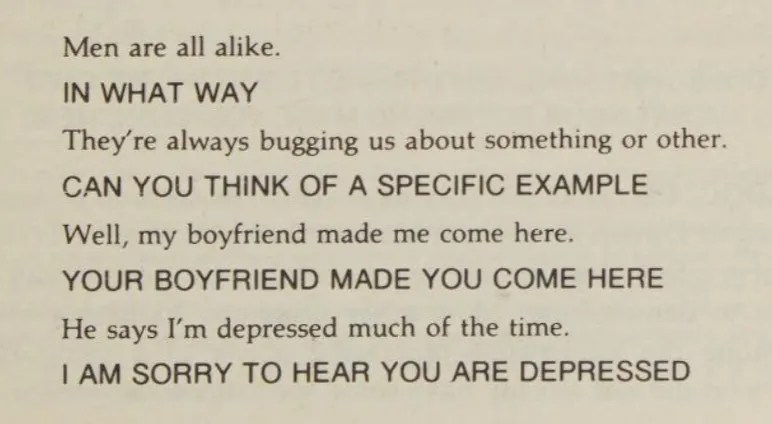
In the 1960s, a German-American computer scientist named Joseph Weizenbaum coded an early version of today’s AI chatbots. Weizenbaum called his program ELIZA, after the “My Fair Lady” character Eliza Doolittle who takes speech lessons (and gets better).
How people reacted to Weizenbaum’s crude creation tells us almost everything we need to know about AI hype more than half a century later.
ELIZA could hold basic “conversations,” including playing the role of a psychotherapist with real human users. [In the example above, ELIZA’s responses to one woman are shown in capital letters.]
Anybody with a cursory awareness of recent headlines about AI romances and AI psychosis already knows where this is going. ELIZA’s human interlocuters in the 1960s, despite talking to a clunky machine they knew had been programmed by Weizenbaum, refused to believe that they were talking to a mere machine. His secretary, having watched him build the contraption over several months, after just a few exchanges with ELIZA, asked Weizenbaum to leave the room so she could have some privacy.
Weizenbaum, exhibiting a bit of Freudian sangfroid about all this, was not surprised to see people form emotional attachments with inanimate objects. He’d already seen people get attached to their cars or guitars or computers. But “what I had not realized is that extremely short exposures to a relatively simple computer program could induce powerful delusional thinking in quite normal people,” Weizenbaum wrote in his 1976 book “Computer Power and Human Reason: From Judgment to Calculation.”…
… I learned about Weizenbaum’s ELIZA experiment from Neil Postman’s 1992 book “Technopoly: The Surrender of Culture to Technology,” a work of technoconservatism that, like Weizenbaum’s writings, was imbued with foresight about our struggles with today’s vastly more powerful technologies.
Consider this passage from Postman’s “Technopoly”:
In a technocracy, tools play a central role in the thought-world of the culture. Everything must give way, in some degree, to their development. The social and symbolic worlds become increasingly subject to the requirements of that development. Tools are not integrated into the culture; they attack the culture. They bid to become the culture. As a consequence, tradition, social mores, myth, politics, ritual, and religion have to fight for their lives.
Technology, attacking and taking over the culture? Bending society to its own imperative for advancement? In my United States of America? Postman (most famous for writing “Amusing Ourselves to Death”) thought the U.S. was the world’s first “Technopoly,” a society marked by “the submission of all forms of cultural life to the sovereignty of technique and technology,” where information itself has become a form of pollution.
To Postman, “the milieu in which Technopoly flourishes is one in which the tie between information and human purpose has been severed, i.e., information appears indiscriminately, directed at no one in particular, in enormous volume and at high speeds, and disconnected from theory, meaning or purpose.”
Neil Postman wrote “Technopoly” before the introduction of ChatGPT and Sora; TikTok and YouTube; Twitter and Facebook; Google Search and the Netscape browser. Postman wrote the book before Windows 95 existed. A philosophy of technology that mostly holds up through successive eras of technical revolution has already passed time’s first test, which is for the philosophy to outlive the philosopher. And Postman’s philosophy is ultimately conservative, motivated by the desire to preserve the traditions of humanism, social cohesion and a shareable sense of collective history.
Technoconservatism was old before it was new. Postman quotes Plato’s “Phaedrus,” where Thamus warns that whoever learns writing (one of our first dangerous technologies) “will cease to exercise their memory and become forgetful” and “will receive a quantity of information without proper instruction, and in consequence be thought very knowledgeable when they are for the most part quite ignorant.” And Postman, to his credit, is like — well, yeah! Writing really did that. A new technology is neither good nor bad, but ecological: it “does not add or subtract something. It changes everything. In the year 1500, fifty years after the printing press was invented, we did not have old Europe plus the printing press. We had a different Europe.”
In previous generations, societies dealt with information revolutions (which always produced information gluts) by creating institutions that prioritize “good” information and deprioritize the bad; think about schools with their organized curricula, courts with their standards of evidence, newspapers with their party lines or codes of journalistic ethics. But Postman notes that we got lucky after the Gutenberg revolution, when information technology’s development slowed down long enough for societies to catch up and be excellent:
From the early seventeenth century, when Western culture undertook to reorganize itself to accommodate the printing press, until the mid-nineteenth century [with the invention of the telegraph], no significant technologies were introduced that altered the form, volume, or speed of information. As a consequence, Western culture had more than two hundred years to accustom itself to the new information conditions created by the press. It developed new institutions, such as the school and representative government. It developed new conceptions of knowledge and intelligence, and a heightened respect for reason and privacy. It developed new forms of economic activity, such as mechanized production and corporate capitalism, and even gave articulate expression to the possibilities of a humane socialism. New forms of public discourse came into being through newspapers, pamphlets, broadsides, and books. It is no wonder that the eighteenth century gave us in the work of Goethe, Voltaire, Diderot, Kant, Hume, Adam Smith, Edmund Burke, Vico, Edward Gibbon, and, of course, Jefferson, Madison, Franklin, Adams, Hamilton, and Thomas Paine. I weight the list with America’s “Founding Fathers” because technocratic-typographic America was the first nation ever to be argued into existence in print.
Contrast the luxuriously slow social pace of the Gutenberg era with today’s information development timelines. Over the course of three decades, we’ve seen the rise and now-decline of the open web; the rise and now-decline of social media; the rise of short-form video and the rise of chatbots and synthetic information. All created enormous economic and philosophical disruptions whose fundamental impacts you can’t get a group of people in a room together to describe accurately. Among the disruptions: These increasingly efficient forms of sharing information keep encountering falling test scores; universities are trying to implement AI as their own students use it for cheating or boo the tech at their graduations; people are falling in love with their chatbots, which sometimes tell their users to kill themselves. A society that wants to understand itself probably wouldn’t act like this…
Read on for how we might — dare one suggest, should— act: “A society that wants to understand itself probably wouldn’t act like this,” from @mattdpearce.com.
Compare to/contrast with with Yuval Avnar‘s riff on Pascal’s musing on the implications of his invention, the “arithmetic machine” (an early, if not the first, modern mechanical calculator): “The Inventor of the Thinking Machine Didn’t Worry. Neither Should You.“
* Neil Postman, Amusing Ourselves to Death: Public Discourse in the Age of Show Business
###
As we introspect, we might send pointed birthday greetings to Ambrose Bierce; he was born on this date in 1842. His satirical lexicon The Devil’s Dictionary was named as one of “The 100 Greatest Masterpieces of American Literature” by the American Revolution Bicentennial Administration. His story “An Occurrence at Owl Creek Bridge” has been described as “one of the most famous and frequently anthologized stories in American literature”; and his book Tales of Soldiers and Civilians (also published as In the Midst of Life) was named by the Grolier Club as one of the 100 most influential American books printed before 1900.
A prolific and versatile writer, Bierce was regarded as one of the most influential journalists in the United States, and as a pioneering writer of realist fiction. For his horror writing, Michael Dirda ranked him alongside Edgar Allan Poe and H. P. Lovecraft. S. T. Joshi argues that he may well be the greatest satirist America has ever produced, and can take his place with such figures as Juvenal, Swift, and Voltaire. His war stories influenced Stephen Crane, Ernest Hemingway, and others; and he was an influential and feared literary critic. In recent decades Bierce has gained even wider regard as a fabulist and for his poetry.
In 1913, Bierce told reporters that he was travelling to Mexico to gain first-hand experience of the Mexican Revolution. He disappeared over the border and was never seen again.
Apropos the piece featured above:
TELEPHONE, n. An invention of the devil which abrogates some of the advantages of making a disagreeable person keep his distance.
– The Devil’s Dictionary

“The mind is not a vessel to be filled, but a fire to be kindled”*…

(Roughly) Daily is, in effect, a kind of notebook, a commonplace book. So it will be no surprise that your correspondent found today’s featured piece fascinating.
Jillian Hess, a professor who studies the history of note-taking, shares the lessons she took from her review of the papers of the remarkable Richard Feynman…
Formal education, at its best, prepares us for a life of learning. After all, we are only in school for a fraction of our lives and there is so much to learn!
Richard Feynman (1918-1988) understood the value of self-education. He was a Nobel Prize-winning theoretical physicist, a member of the Manhattan Project at the age of 25, and a dynamic public intellectual who never stopped learning.
Often touted as one of history’s greatest learners, Feynman taught himself a dizzying amount of science. I wanted to see his notes for myself—to observe the great autodidact thinking on the page. So, I visited his archives at Caltech in February…
… In the archives, I saw… for myself: Feynman’s notebooks contain imprints of thinking in real-time—the work as it happened. They were instruments for thinking through uncertainty.
What follows is a list of note-taking principles for self-education that I gathered while studying Feynman’s notebooks.
Start with First Principles: Feynman’s “Things I Don’t Know About” Notebook
Discussions about Feynman’s learning process usually draw from this notebook, which he compiled as a Ph.D. student at Princeton. The contents include mechanics, mathematical methods, and thermodynamics. Clearly, he knew something about these topics, but he found his understanding superficial. So, his response was to take the subject apart—to break it down into “the essential kernels” …
[Hess illustrates this principle, then unpacks two others: “create a reading index” and “keep learning.” She continues…]
… Uncertainty is Interesting
This is my biggest takeaway: We should fear certainty more than doubt. Learning to live with uncertainty is an essential aspect of learning, as Feynman said in 1981:
You see, one thing is, I can live with doubt and uncertainty and not knowing. I think it’s much more interesting to live not knowing than to have answers which might be wrong.
And then, in an echo of his “Notebook of Things I Know Nothing About,” compiled four decades prior, he adds:
…I’m not absolutely sure of anything, and there are many things I don’t know anything about.
If a man as celebrated for his genius as Feynman felt that way, certainly the rest of us have a lot more to learn…
[And she concludes…]
… Notes on Feynman’s Notes:
Use notes to think: Feynman didn’t think through problems in his head and then turn to his notebooks. Instead, he used his notebooks to think through problems. His thought process required paper.
Start with first principles: “Why” is a very powerful question. And asking why can lead us back to the fundamentals and help us understand them in an entirely new light. This applies to any subject. Feynman has helped me think of note-taking as a kind of expedition. Use your notes to dig deeper into topics you think you already understand.
Never stop learning: How wonderful would it be if we could hold onto the excitement of learning we had as children? After all, the world didn’t get less interesting. It’s worth returning to the note-taking methods you used in school to see if they are still useful in adulthood. I particularly like Feynman’s high school method of taking 30 minutes to understand a subject before he allowed himself to take notes on it.
[Then leaves us with the man himself, “in all his radiant, enthusiastic, brilliance”…]
On “Richard Feynman’s Notes For Self-Education.”
Pair with: “Curiosity Is No Solo Act“: “it gains its real power when embedded in webs of relationship and shared meaning-making”… something that Feynman’s life also demonstrated (as you can see in his autobiography and/or in James Gleick‘s biography, Genius)
* Plutarch
###
As we light that fire, we might spare a thought for Jeremy Bernstein; he died on this date last year. A physicist who woked on nuclear propulsion for Project Orion and held research and teaching positions at Stevens Institute of Technology, the Institute for Advanced Study, Brookhaven National Laboratory, CERN, Oxford University, University of Islamabad, and École Polytechnique, he is better remembered as a gifted popular science writer and profiler of scientists.
Bernstein wrote 30 books, and scores of magazine articles for “general readers”– for The New Yorker, where he was a staff writer from 1961 to 1995, and for The Atlantic Monthly, the New York Review of Books, and Scientific American, among others.
Of Feynman, Bernstein wrote “[his] Mozartean genius in physics seemed to be combined with an almost equally Mozartean urge to play the clown.” (in which, of course, Feynman was in the good company of Einstein, Claude Shannon, and others :-)

“You live and learn. At any rate, you live.”*…

… and to the extent that we care about our democracy, that’s an issue.
In an article based on his recent Sakurada-Kai Foundation Oxbridge Lecture at Keio University, Tokyo, John Dunn argues that our democracies depend on our picking up the pace of learning. The abstract:
There cannot be a coherent democratic theory because democracy is not a determinate topic. Representative democracy is a relatively modern regime form. It now needs rehabilitation because so many instances have performed poorly for so long. Representative democracy is now also an aging regime. As a type of state, it is subject to the territorial contentiousness and contested legitimacy of any state. It claims its legitimacy from iterative popular choice, but the plausibility of that claim is increasingly strained by the drastic disparities in life chances reproduced through the property systems it protects. The inherent difficulty for citizens to judge how to advance their collective interests is aggravated by the recent transformation of the information economy. In the cumulative damage inflicted by climate change it faces a deadlier peril than any previous regime and one which only a citizenry that can enlighten itself in time can reasonably hope to nerve itself to meet…
There follows a fascinating– and provocative– elaboration of this thesis in which Dunn considers the history of democracy and the alternatives with which it has, since its inception, vied. He concludes in a bracing fashion…
… The varieties of autocracy which will be on offer wherever the rest of the world has the opportunity to take them up will be without exception the reverse of enlightened – instrumentally and compulsively bound to the extremes of obscurantism, Darkness as a full-on fideist commitment, deliberate self-blinding as a navigational strategy. Move fast, break lots, and never pause to inspect the wreckage.
Representative democracy has recently proved itself a poor structure for collective enlightenment, but the case for it depends on its at least not precluding that, its being still open to making the attempt, and responding to what it can contrive to learn. The most optimistic vision of democracy in action has always seen it as an opportunity for collective self-education on the content of shared goods and the means to achieve them. If that is scarcely a realist picture of what it has ever been, at least it is an image of the right shape. It is too late to ask who will educate the educators. At this point we must educate ourselves together and heed the lessons of that education or we must and will die – not just each of us one by one, as we were always fated to do, but soon enough all of us and for ever…
Eminently worth reading in full: “Can Democracy be Rehabilitated?“
Apposite: “How American Democracy Fell So Far Behind,” from Steven Levitsky and Daniel Ziblatt (gift article– and source of the image above)
* Douglas Adams, Mostly Harmless
###
As we devote ourselves to democracy, we might spare a thought for Ludwig van Beethoven; he died on this date in 1827. A crucial figure in the transition between the Classical and Romantic eras in Western music, he remains one of the most famous and influential of all composers. His best-known compositions include 9 symphonies, 5 concertos for piano, 32 piano sonatas, and 16 string quartets. He also composed other chamber music, choral works (including the celebrated Missa Solemnis), a single opera (Fidelio), and numerous songs.
Relevantly to the piece above…
Beethoven admired the ideals of the French Revolution, so he dedicated his third symphony to Napoleon Bonaparte… until Napoleon declared himself emperor. Beethoven then sprung into a rage, ripped the front page from his manuscript and scrubbed out Napoleon’s name…
Beethoven’s temper and Symphony No. 3 ‘Eroica’

“It is what you read when you don’t have to that determines what you will be when you can’t help it”*…

… What we read– and, librarian Carlo Iacono argues, how we read.
Our inabilty to focus isn’t a failing. It’s a design problem, and the answer isn’t getting rid of our screen time…
Everyone is panicking about the death of reading. The statistics look damning: the share of Americans who read for pleasure on an average day has fallen by more than 40 per cent over the past 20 years, according to research published in iScience this year. The OECD calls the 2022 decline in educational outcomes ‘unprecedented’ across developed nations. In the OECD’s latest adult-skills survey, Denmark and Finland were the only participating countries where average literacy proficiency improved over the past decade. Your nephew speaks in TikTok references. Democracy itself apparently hangs by the thread of our collective attention span.
This narrative has a seductive simplicity. Screens are destroying civilisation. Children can no longer think. We are witnessing the twilight of the literate mind. A recent Substack essay by James Marriott proclaimed the arrival of a ‘post-literate society’ and invited us to accept this as a fait accompli. (Marriott does also write for The Times.) The diagnosis is familiar: technology has fundamentally degraded our capacity for sustained thought, and there’s nothing to be done except write elegiac essays from a comfortable distance.
I spend my working life in a university library, watching how people actually engage with information. What I observe doesn’t match this narrative. Not because the problems aren’t real, but because the diagnosis is wrong.
The declinist position rests on a category error: treating ‘screen culture’ as a unified phenomenon with inherent cognitive properties. As if the same device that delivers algorithmically curated rage-bait and also the complete works of Shakespeare is itself the problem rather than how we decide to use it…
[… observing that “people who ‘can’t focus’ on traditional texts can maintain extraordinary concentration when working across modes, he argues that “we haven’t become post-literate. We’ve become post-monomodal. Text hasn’t disappeared; it’s been joined by a symphony of other channels.”…]
… What troubles me most about the declinist position is not its diagnosis but its conclusion. The commentators who lament the post-literate society often identify the same villains I do. They recognise that technology companies are, in Marriott’s words, ‘actively working to destroy human enlightenment’, that tech oligarchs ‘have just as much of a stake in the ignorance of the population as the most reactionary feudal autocrat.’
And then they surrender. As Marriott says: ‘Nothing will ever be the same again. Welcome to the post-literate society.’
This is the move I cannot follow. To name the actors responsible and then treat the outcome as inevitable is to provide them cover. If the crisis is a force of nature, ‘screens’ destroying civilisation like some technological weather system, then there’s nothing to be done but write elegiac essays from a comfortable distance. But if the crisis is the product of specific design choices made by specific companies for specific economic reasons, then those choices can be challenged, regulated, reversed.
The fatalism, however beautifully expressed, serves the very interests it condemns. The technology companies would very much like us to believe that what they’re doing to human attention is simply the inevitable result of technological progress rather than something they’re doing to us, something that could, with sufficient political will, be stopped.
Your inability to focus isn’t a moral failing. It’s a design problem. You’re trying to think in environments built to prevent thinking. You’re trying to sustain attention in spaces engineered to shatter it. You’re fighting algorithms explicitly optimised to keep you scrolling, not learning.
The solution isn’t discipline. It’s architecture. Build different defaults. Create different spaces. Establish different rhythms. Make depth as easy as distraction currently is. Make thinking feel as natural as scrolling currently does.
What if, instead of mourning some imaginary golden age of pure text, we got serious about designing for depth across all modes? Every video could come with a searchable transcript. Every article could offer multiple entry points for different levels of attention. Our devices could recognise when we’re trying to think and protect that thinking. Schools could teach students to translate between modes the way they once taught translation between languages.
Books aren’t going anywhere. They remain unmatched for certain kinds of sustained, complex thinking. But they’re no longer the only game in town for serious ideas. A well-crafted video essay can carry philosophical weight. A podcast can enable the kind of long-form thinking we associate with written essays. An interactive visualisation can reveal patterns that pages of description struggle to achieve.
The future belongs to people who can dance between all modes without losing their balance. Someone who can read deeply when depth is needed, skim efficiently when efficiency matters, listen actively during a commute, and watch critically when images carry the argument. This isn’t about consuming more. It’s about choosing consciously.
We stand at an inflection point. We can drift into a world where sustained thought becomes a luxury good, where only the privileged have access to the conditions that enable deep thinking. Or we can build something unprecedented: a culture that preserves the best of print’s cognitive gifts while embracing the possibilities of a world where ideas travel through light, sound and interaction.
The choice isn’t between books and screens. The choice is between intentional design and profitable chaos. Between habitats that cultivate human potential and platforms that extract human attention.
The civilisations that thrive won’t be the ones that retreat into text or surrender to the feed. They’ll be the ones that understand a simple truth: every idea has a natural form, and wisdom lies in matching the mode to the meaning. Some ideas want to be written. Others need to be seen. Still others must be heard, felt or experienced. The mistake is forcing all ideas through a single channel, whether that channel is a book or a screen.
Your great-grandchildren won’t read less than you do. They’ll read differently, as part of a richer symphony of sense-making. Whether that symphony sounds like music or noise depends entirely on the choices we make right now about the shape of our tools, the structure of our schools, and the design of our days.
The elegant lamenters offer a eulogy. I’m more interested in a fight…
Reunderstanding reading: “Books and screens,” from @carloiacono.bsky.social in @aeon.co.
* Oscar Wilde
###
As we turn the page, we might note that we’ve been here before, and celebrate the emergence of a design, an innovation, a technology that took on a life of its own and changed reading and… well, everything: this day in 1455 is the traditionally-given date of the publication of the Gutenberg Bible, the first Western book printed from movable type.
(Lest we think that there’s actually anything new under the sun, we might recall that The Jikji— the world’s oldest known extant movable metal type printed book– was published in Korea in 1377; and that Bi Sheng created the first known moveable type– out of wood– in China in 1040.)

“Tell me to what you pay attention and I will tell you who you are”*…

Before the attention economy consumed our lives, “pursuit tests” devised by the US military coupled man to machine with the aim of assessing focus under pressure. D. Graham Burnett explores these devices for evaluating aviators, finding a pre-history of the laboratory research that has relentlessly worked to slice and dice the attentional powers of human beings…
We worry about our attention these days — nearly all of us. There is something. . . wrong. We cannot manage to do what we want to do with our eyes and minds — not for long, anyway. We keep coming back to the machines, to the screens, to the notifications, to the blinking cursor and the frictionless swipe that renews the feed.
An ethnographer from Mars, moving among us (would we even notice?), might have trouble understanding our complaint: “Trouble with their attention? They stare at small slabs of versicolor glass all day! Their attentive powers are. . . sublime!”
And that misunderstanding rather sharpens the point: we don’t have any problem at all with the forms of attention that involve remaining engaged with, and responsive to, machines. We are amazing at the click and tap of durational vigilance to this or that stimulus, presented at the business end of a complex device. Our uncanny and immersive cybernetic attention is a defining characteristic of the age. Our human attention — our ability to be with ourselves and with others, our ability to receive the world with our minds and senses, our ability to daydream, read a book uninterrupted, or watch a sunset — well, many of us are finding it increasingly difficult to remember what that might even mean.
This isn’t really an accident. Over the last century or so, a series of elaborate programs of laboratory research have worked to slice and dice the attentional powers of human beings. Their aim? To understand the operational capacities of those who would be asked to shoot down airplanes, monitor radar screens, and otherwise sit at the controls of large and expensive machines. Seated in front of countless instruments, experimental subjects were asked to listen and look, to track and trigger. Psychologists stood by with stopwatches, quantifying our cybernetic capacities, and seeking ways to extend them. For those of us who have come of age in the fluorescence of the “attention economy”, it is interesting to look back and try to catch glimpses of the way that the movement of human eyeballs came under precise scrutiny, the way that machine vigilance became a field of study. We know now that the mechanomorphic attention dissected in those laboratories is the machine attention that is relentlessly priced in our online lives — to deleterious effects.
You could say that this process began with the fascinating and now mostly forgotten tool known as the “pursuit test”. Part steampunk videogame, part laboratory snuff-flick, the pursuit test staged and restaged the integration of man and machine across the first decades of the twentieth century…
Fascinating– and timely: “Cybernetic Attention– All Watched over by Machines We Learned to Watch,” from @publicdomainrev.bsky.social. Eminently worth reading in full.
* Jose Ortega y Gasset
###
As we untangle engagement, we might send thoughtful birthday greetings to a man whose work influenced the endeavors described in the piece featured above, Hermann Ebbinghaus; he was born on this date in 1850. A psychologist, he pioneered the experimental study of memory and discovered the learning curve, the forgetting curve, and the spacing effect.

You must be logged in to post a comment.