As Jean-Baptiste Alphonse Karr put it, “plus ça change, plus c’est la même chose” (“the more things change, the more they stay the same”). Case in point: Derek Thompson reminds us that about 100 years ago, America was obsessed with technology, immigration, women, work, and money. Sound familiar?
[Just over] one hundred years ago, on September 26, 1929, President Herbert Hoover gathered a group of social scientists at the White House. He asked them to begin research on the most detailed report ever produced on the state of the nation. Four years later, running more than 1,500 pages long, Recent Social Trends was published, offering an unusually granular look at life in the mid-1920s.
The document is almost entirely forgotten. But today, for America’s 250th birthday, I’m blowing the cobwebs off this sucker and taking readers inside its yellowed pages for a look back at what life was like in the U.S. exactly 100 years ago, when the U.S. was celebrating its sesquicentennial anniversary…
And what a look it is…
… Imagine that you are the typical American in 1926. You are a white 26-year-old. (In 2026, the median age is 40.) Since most immigrants have been male, we’ll say you’re a guy. Your name is John. Born in the first term of William McKinley’s presidency, you are raised on a farm without flush toilets or electric lighting. Too young to fight in World War I, you come of age alongside a generation that sees war in Europe as a “useless colossal blunder,” in the words of historian David M. Kennedy. Your life—indeed, your entire generation—is shaped by several notable developments: education, urbanization, automation, and women’s rights. You are the first person in your family to finish high school.
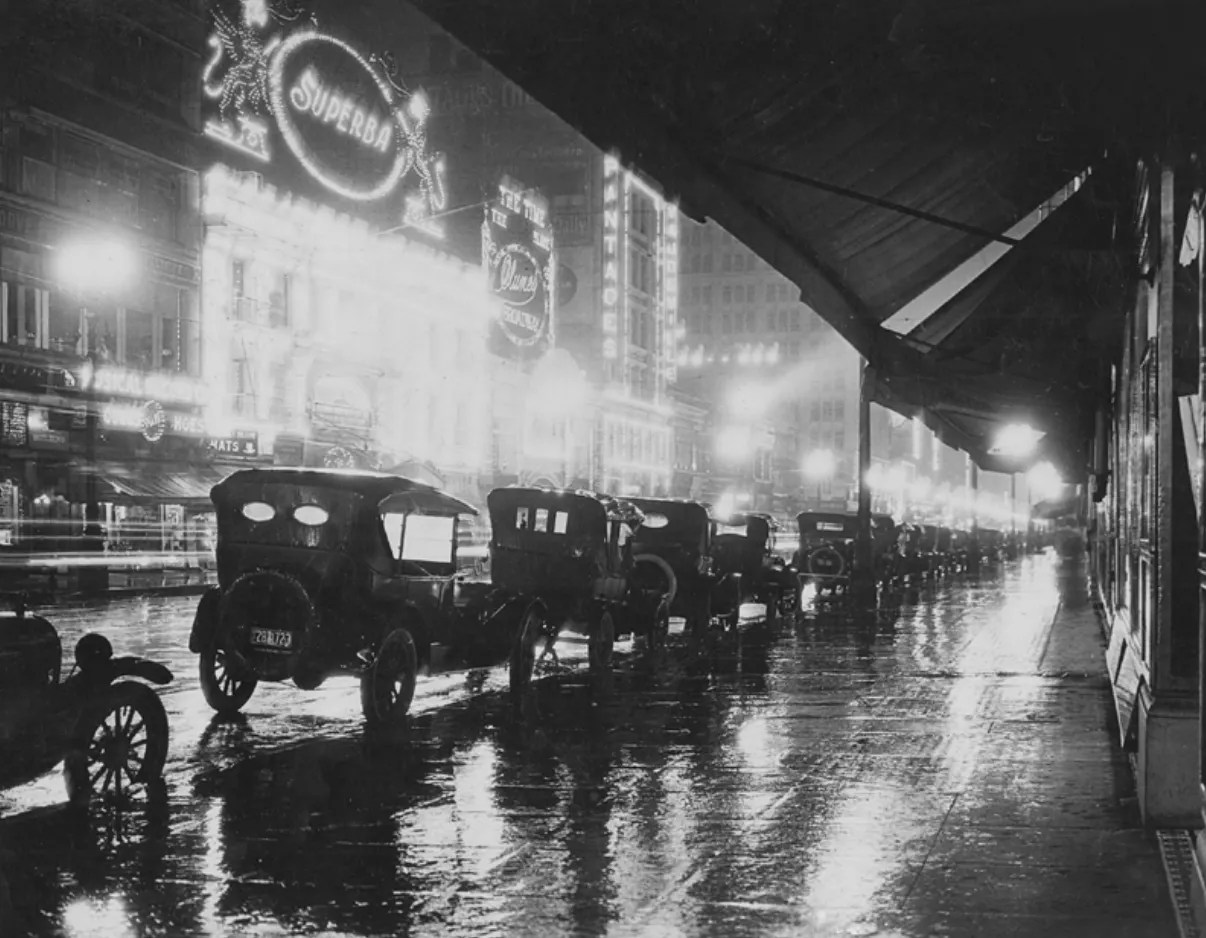
At 19, you move from the countryside to an urban apartment, as one small drop in the migratory flood from farm to city. Jobs in manufacturing and retail are easy to find. They’re also easy to lose. Temporary unemployment is the norm. You earn $100 a month and put some away for a rainy day, confident that the bustling city will provide another job in a few months. (Unemployment insurance does not exist; neither does Social Security.) In the evenings, you “radio”; yes, it’s a verb, too. Every weekend, you visit a cineplex, where the movies are black-and-white and silent. Sometimes, you down a few prohibited cocktails and go dancing with flappers. Several times a week, you drive around in a black Model T.
The year 1926 has been good to you. City life is a blur of high-velocity machines—cars, assembly lines, and radio broadcasts—and you sometimes miss the ancient rhythms of your farmland home. One year from now, Charles Lindbergh will shock the world by flying across the Atlantic. In two years, at 28, you’ll be married. In three years, you’ll have a baby. And in four years, in 1930, just months after the biggest stock market crash in American history, the world as you know it will be over…
Thompson goes on to unpack the details of the economy and employment, the migration from farm to city, the extraordinary centrality of the automobile, changing mores and gender roles, the primacy of literature and the rise of radio, and so much more. He concludes…
The authors of Recent Social Trends were astonishingly prescient about the direction of technology. In one paragraph, they somehow anticipated the rise of audiobooks, YouTube, Netflix, smartphone cameras, musical software, ubiquitous air conditioning, and the electric battery revolution:
It may be that the world will find much use for talking books; school and college students may listen to lectures by long-running phonographs or talking pictures; moving pictures may be transmitted by wireless into houses; seeing with that new electric eye, the photo-electric cell, and recording what is seen, appear to have almost unlimited applications; new musical instruments different from any now in use may be given to us by electricity; the production of artificial climate may become widespread; an efficient storage battery of light weight and low cost might produce changes rivaling those of the internal combustion engine. And these are only a few of the myriad possibilities from new inventions in the future!
In an equally oracular section, the authors predicted the emergence of remote work and declining geographic mobility, anticipating that “the transmission of goods, of the voice and possibly of vision may act as a retarding influence on human mobility in the future and may cause a development of more remote and impersonal direction and controls.”
But the social scientists did not see these trends as altogether good. They worried that modern life, defined in equal parts by urbanization and technology, obliterated people’s values and their sense of self. Even as they gawked at the increase in patents—which grew more than 20-fold between the 1850s and the 1920s—they worried that a growing number of discoveries would bring “problems of morals, of education, of law, of leisure time, of unemployment, of speed, of uniformity and of differentiation.”
Social scientists of the 1920s saw machines pushing workers off of farms and competing with workers in manufacturing plants. How long, they wondered, until they would replace human workers in all tasks? “A larger proportion of work by machines, and a smaller proportion of human labor, is to be expected in the future,” they wrote. “There are indeed a few cases of wholly automatic factories and automatic stores and many automatic salesmen.” It is extraordinary to read these fears and not reflect on the AI jobs panic of the present, while also marveling at the thousands of occupations that are possible today precisely because machines made old jobs obsolete.
The dawn of the age of the machine drove us mad. Physicians of the day warned that the frail human mind was no match for the car, predicting at the time that “diseases of the wheel” would afflict the youth who rode bicycles and cars without restraint. It was not entirely obvious that they were wrong. In Germany, the number of patients registered in mental hospitals grew from 40,375 in 1870 to 220,881 in 1910. Over the same period, the share of patients admitted to general hospitals for illnesses of the nervous system rose from 44 to 60 percent.
Most perceptively, social critics of the age recognized that the urban-technological revolution of the early 20th century—what we might even call “modernity”—transformed not only our minds but also our values. Machines and systems that pulled Americans off the farm, away from the family home, and into churning markets of people and products threatened to replace the Judeo-Christian values that had bound the country for centuries with a new system of values dictated by markets. In 1903, the sociologist Georg Simmel anticipated the anxieties of the Twenties—ours and theirs—when he observed that in cities “money takes the place of all the manifoldness of things” and becomes “a common denominator of all values.” Money “hollows out the core of things, their peculiarities, their specific values, and their uniqueness and incomparability in a way which is beyond repair.”
One hundred and twenty years after the publication of that essay, the Wall Street Journalasked thousands of Americans what values were still important to them. While a declining share of Americans endorsed the worthiness of patriotism, religion, community, and children, the share who said “money” was “very important to them” went up. It sometimes seems as if markets and money are the last value standing, the final common denominator beneath all human endeavor.
On its 250th birthday, the U.S. similarly defines itself through markets. Those famous words of Calvin Coolidge, America’s president in 1926, could just as well serve this American president and this American moment: “The chief business of the American people is business.”…
You can find the full text of Recent Social Trends in the United States- Report of the President’s Research Committee on Social Trends, from the collection of the remarkable Prelinger Library, at the invaluable Internet Archive: Volume 1 and Volume 2.
* Will and Ariel Durent, The Lessons of History (in which, also: “Progress is an improvement in the means that we use for achieving the same old ends. I sometimes wonder if the progress is only of means without any progress in ends.”)
###
As we hear the echo, we might recall that today marks the anniversary of a signature advance during the period covered by Recent Social Trends in the United States: on this date in 1928, sliced bread was sold for the first time, by the Chillicothe Baking Company of Chillicothe, Missouri.
The estimable economic historian Louis Hyman has been engaged in an on-going “friendly debate” with his equally-estimable friend and Johns Hopkins colleague Rama Chellappa on “what AI means”…
… As I see this debate, this question of our age, there are two main questions that history can shed some light on.
Is AI a complement or a substitute for labor? That is, will it increase demand for and the productivity of workers, or decrease it?
Will AI be controlled by the few or be accessible to the many?
A Complement or a Substitute?
Consider a some of the most important technologies of the past 200 years.
When I am asked about what automation might look like, I inevitably discuss agriculture. Roughly all of our ancestors were farmers and approximately none of us today are. Yet we still eat bread made from wheat. That shift is possible because of automation.
The mechanical thresher, used to process wheat, was a substitute for the most backbreaking work of the harvest. But it also enabled more land to be cultivated, and that land was cultivated more efficiently, allowing for greater harvests. Mechanization of the farm, like the thresher, turned the American Midwest into the breadbasket of the world.
Those displaced farmers found work on railroads, moving all that. And those jobs, according to people at the time, were a kind of liberation from the raw animal labor of threshing. On net, it created demand for more workers at better wages in work more fit for people than beasts. For those that remained farmers, they found other higher-value work to be done. On a farm, there is always more work to do.
The failure, then and now, is to think farmers were only threshers. That was one part of their jobs. Today, our work, for most people, is also a bundle of tasks. Workers then and now could and can focus on parts of their job that are of higher value. And in a new economy, new tasks in new industries will be created. Many of the jobs that we do today (web designer, UI expert) were simply unimaginable in 1850. That is a good thing.
Consider now the assembly line. I’m sure you all know about the staggering increases in productivity that come from the division of labor. If you take my class in industrial history, you would learn deeply about the story of the automobile. With the assembly line, and no other change in technology, car assembly went from 12 and a half hours to about 30 minutes (once they worked out the kinks). Did this reduce the demand for workers? No. It reduced the price of cars. And that increased the demand for workers, who eventually could demand even higher wages through unionization.
It is important here to realize that better tools don’t make us get paid worse. They generally make us get paid more. Why? Because the tool, without the person, is useless. Even for today’s most cutting-edge AIs, that is true. It can code, but it can only code what I imagine it to code. It can draw, but only what I imagine it to draw. That is true for AIs as it was true for the thresher.
So, I would offer that AI will create more growth, more abundance. In the long run, all growth comes from higher productivity.
I would add one more piece to this story. Economic inequality has worsened since roughly 1970. It has worsened, therefore, not in the industrial era, but the digital era. I have argued elsewhere that this happened because for decades we did not use computers as tools of automation but as glorified typewriters (and then as televisions). Our productivity did not increase, especially to justify the expense of computers. Economists have debated for decades now over the lack of increase in productivity that came with the “digital age” of computing, but it is simple. We don’t use them as computers. Now we can.
For the first time now, normal people with their normal problems can use their computers to solve and automate their problems. AI can write code. AI can automate their tedium. The digital age did not bring any gains because it had no yet arrived. We were living through the last gasp of the industrial economy.
It is now here.
This technology will unleash unimaginable productivity gains. It will level the playing field between coders and the rest of us. Coders will lose their jobs, to be sure, but for the rest of us, the bundle of workplace tasks will become much better.
And truthfully, the demand for real computer scientists will probably increase in the era of vibe-coding. Computer science itself is a bundle of skills, of which coding is just one. The more important skill – software and data architecture – will only increase in demand as the usefulness of software expands…
[Hyman goes on to explore the dangers of monopolization (which, for reasons he explains, he believes are overstated); the future of softward (which, he believes, will skew to open-sorce), and of hardware (which, he believes will not be a bottleneck). He concludes…]
… Put together we come to a very different picture of what the digital age will be. The industrial age required massive investments to build the factories to make the products that were in demand. In the digital age, in contrast, the factories to build digital products will be made by the AI on your laptop. That is not inequality. That is equality.
The physical products of the Fordist industrial age were made for the mass market. In contrast, the digital products of the post-fordist digital age will be long-tail products. I don’t need to make mass market products; I can make them for a small niche, or just for myself.
Rather than fostering inequality, AI, then, is a great equalizer. To make products for a global market you don’t need a billion-dollar factory. You just need a laptop. That is astonishing.
That said, it will not be all sunshine and rainbows. Will AI solve the inequities of capitalism or its reliance on externalities as a source of primitive accumulation? Probably not.
But at the same time, AI is not a normal technology in that it has the potential to radically undermine many of the tendencies to concentrate capital that we have seen in the industrial age. We have been automated out of work before, that is nothing new, but it has always concentrated capital in the hands of the few. For the first time, there is potentially an alternative path forward.
AI will bring the digital age out of the hands of the coders. AI will not widen the gap—it will bridge it. Its ubiquity will mean that AI will be a tool that nearly all of us will be able to use in our daily work, which will make ordinary people more productive and prosperous…
Even as Hyman’s message is reassuring in the context of the flood of jeremiads in which we’re awash, it’s worth remembering that eerily-similar points were made a couple of decades ago about the threat/promise of digital publishing/commerce. Given the then-current conditions and then-plausible futures, those predictions might have come true… but in the event, they didn’t pan out as projected. That said, things are changing, so maybe this time things are different?
As we resolve to remain rosy, we might send productive birthday greetings to Andrew Meikle; he was born on this date in 1719. A Scottish millwright, he invented the threshing machine (for removing the husks from grain, as mentioned above). One of the key developments of the British Agricultural Revolution in the late 18th century., it was also one of the main causes of the Swing Riots— an 1830 uprising by English and Scottish agricultural workers protesting agricultural mechanization and harsh working conditions.
Threshing machine, invented by Andrew Meikle (source)
Jason Kottke on one artist’s attempt to illuminate those talents and the lives of those who practiced them…
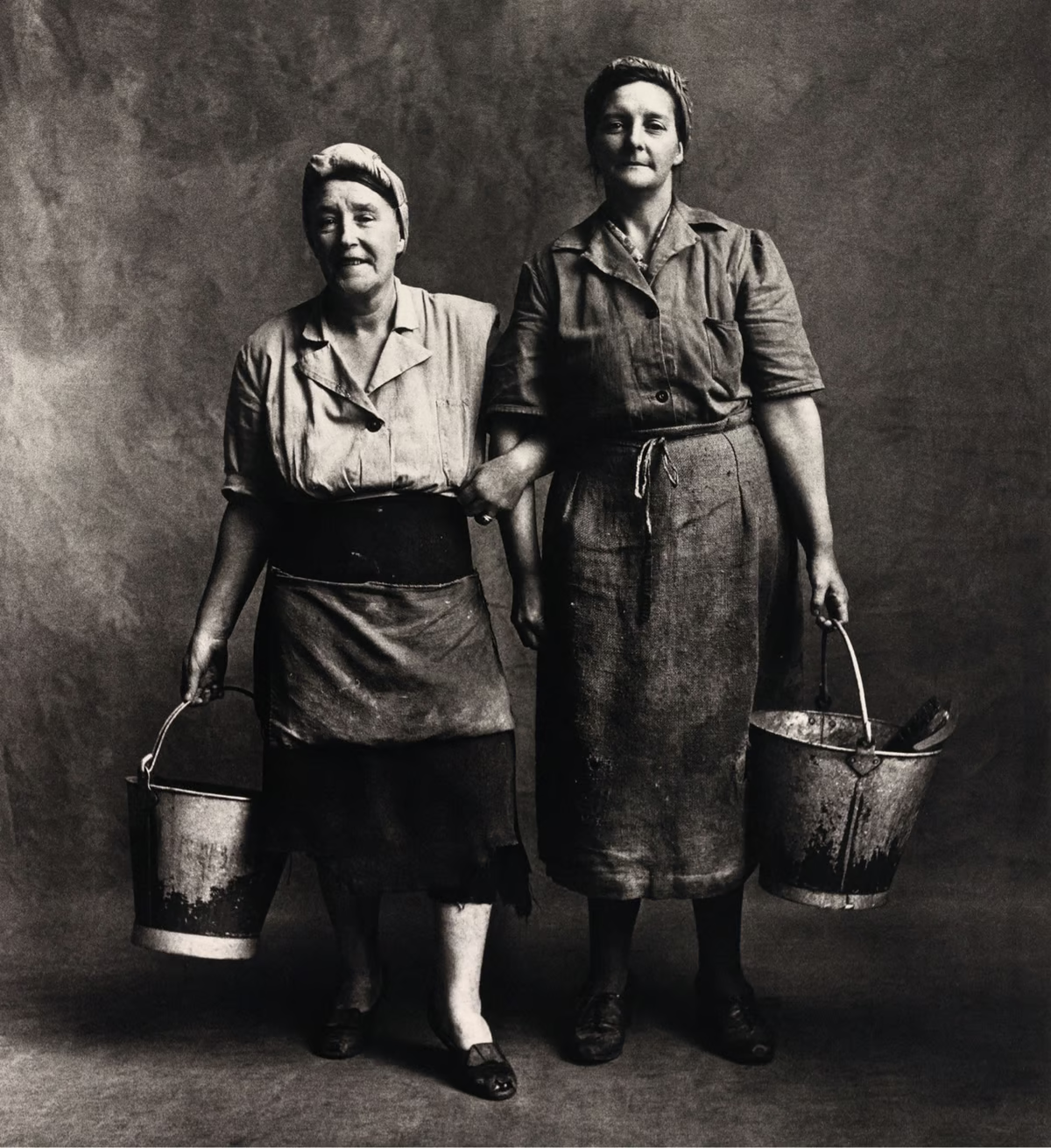
In 1950, master photographer Irving Penn set up a simple studio in Paris and started to photograph people of all kinds of professions, each wearing their work clothes and carrying the tools of their trade.
Working in the tradition of representing the petits métiers, Penn photographed fishmongers, firefighters, butchers, bakers, divers, baseball umpires, chefs, bike messengers, and sellers of goods of all kinds.
Penn continued photographing workers in New York and London, collecting the photos into a project called Small Trades.
Like everyone else who has recorded the look of tradesmen and workers, the author of this book was motivated by the fact that individuality and occupational pride seem on the wane. To a degree everyone has proved right, and since these photographs were made, London chimney sweeps have all but disappeared and in New York horseshoers — hard to find in 1950 — now scarcely exist…
As we peruse professions, we might send muckraking birthday greetings to Upton Sinclair; he was born on this date in 1878. A writer, activist, and politician, he is probably best remembered for his classic novel, The Jungle, which exposed labor and sanitary conditions in the U.S. meatpacking industry, causing a public uproar that contributed in part to the passage a few months later of the 1906 Pure Food and Drug Act and the Meat Inspection Act.
Many of his novels can be read as historical works. Writing during the Progressive Era, Sinclair describes the world of the industrialized United States from both the working man’s and the industrialist’s points of view: e.g., King Coal (1917, covering John D. Rockefeller and the 1914 Ludlow Massacre in the coal fields of Colorado), Oil! (1927, the Teapot Dome Scandal), and The Flivver King (1937, Henry Ford– his “wage reform,” his company’s Sociological Department, and his decline into antisemitism) describe the working conditions of the coal, oil, and auto industries at the time.
Sinclair ran (as a Democrat) for Governor of California in 1934, during the Great Depression, under the banner of the End Poverty in California campaign, but was defeated in the general election.
He was awarded he Pulitzer Prize for Fiction in 1943 for Dragon’s Teeth, which portrayed the Nazi takeover of Germany during the 1930s.
It is difficult to get a man to understand something, when his salary depends upon his not understanding it.
Upton Sinclair, ruminating on his gubernatorial loss
All of us know the pains (and at least occasional pleasures) of work; but as Kayla Zhu and Sabrina Lam explain, some also know its danger…
Some jobs inherently carry significant risks due to factors such as hazardous working conditions, exposure to harmful substances, and the physical demands of the tasks.
Unfortunately, work injuries can sometimes be fatal, with the U.S. Bureau of Labor Statistics recording 5,486 fatal work injuries in 2022.
2022 saw a 5.7% increase from the 5,190 fatal work injuries in 2021, and meant that a worker died every 96 minutes from a work-related injury that year.
This graphic visualizes the six occupations in the U.S. with the highest rates of fatal work injuries per 100,000 full-time workers, and their number of fatal work injuries in 2022.
… While logging workers saw the highest fatal work injury rate, over 1,000 truck drivers died due to work injuries in 2022—the most fatalities out of any occupation…
As we take care, we might send carefully-conserved birthday greetings to Gifford Pinchot; he was born on this date in 1865. An American forester, he became the first chief of the Forest Service in 1905. By 1910, with President Theodore Roosevelt’s backing, he built 60 forest reserves covering 56 million acres into 150 national forests covering 172 million acres. Roosevelt’s successor, President Taft– no environmentalist– fired Pinchot, who went on to champion environmental causes (in particular, arguing against the wide-scale commercial logging of federal forests that was undertaken after he was ousted) and to serve two terms as Governor of Pennsylvania. In all, Pinchot’s efforts earned him the honorific, “the father of conservation.”
Further to yesterday’s post on the poverty created by manufacturing displacement, and in the wake of the sturm und drang occasioned by the coup at OpenAI, the estimable Rana Foroohar on the politics of AI…
… Consider that current politics in the developed world — from the rise of Donald Trump to the growth of far right and far left politics in Europe — stem in large part from disruptions to the industrial workforce due to technology and globalisation. The hollowing out of manufacturing work led to more populist and fractious politics, as countries tried (and often failed) to balance the needs of the global marketplace with those of voters.
Now consider that this past summer, the OECD warned that white-collar, skilled labour representing about a third of the workforce in the US and other rich countries is most at risk from disruption by AI. We are already seeing this happen in office work — with women and Asians particularly at risk since they hold a disproportionate amount of roles in question. As our colleague John Burn-Murdoch has charted [image above], online freelancers are especially vulnerable.
So, what happens when you add more than three times as many workers, in new subgroups, to the cauldron of angry white men that have seen their jobs automated or outsourced in recent decades? Nothing good. I’m always struck when CEOs like Elon Musk proclaim that we are headed towards a world without work as if this is a good thing. As academics like Angus Deaton and Anne Case have laid out for some time now, a world without work very often leads to “deaths of despair,” broken families, and all sorts of social and political ills.
Now, to be fair, Goldman Sachs has estimated that the productivity impact of AI could double the recent rate — mirroring the impact of the PC revolution. This would lead to major growth which could, if widely shared, do everything from cut child poverty to reduce our burgeoning deficit.
But that’s only if it’s shared. And the historical trend lines for technology aren’t good in that sense — technology often widens wealth disparities before labour movements and government regulation equalise things. (Think about the turn of the 20th century, up until the 1930s). But the depth and breadth of AI disruption may well cause unprecedented levels of global labour displacement and political unrest.
I am getting more and more worried that this is where we may be heading. Consider this new National Bureau of Economic Research working paper, which analyses why AI will be as transformative as the industrial revolution. It also predicts, however, that there is a very good chance that it lowers the labour share radically, even pushing it to zero, in lieu of policies that prevent this (the wonderful Daron Acemoglu and Simon Johnson make similar points, and lay out the history of such tech transformation in their book Power and Progress…
We can’t educate ourselves out of this problem fast enough (or perhaps at all). We also can’t count on universal basic income to fix everything, no matter how generous it could be, because people simply need work to function (as Freud said, it’s all about work and love). Economists and political scientists have been pondering the existential risks of AI — from nuclear war to a pandemic — for years. But I wonder if the real existential crisis isn’t a massive crisis of meaning, and the resulting politics of despair, as work is displaced faster than we can fix the problem…
As we equilibrate, we might recall that it was on this date in 1874 that electrical engineer, inventor, and physicist Ferdinand Braun published a paper in the Annalen der Physik und Chemie describing his discovery of the electrical rectifier effect, the original practical semiconductor device.
(Braun is better known for his contributions to the development of radio and television technology: he shared the 1909 Nobel Prize in Physics with Guglielmo Marconi “for their contributions to the development of wireless telegraphy” (Braun invented the crystal tuner and the phased-array antenna); was a founder of Telefunken, one of the pioneering communications and television companies; and (as the builder of the first cathode ray tube) has been called the “father of television” (shared with inventors like Paul Gottlieb Nipkow).





You must be logged in to post a comment.