Posts Tagged ‘religion’
“Man is a Religious Animal. He is the only Religious Animal. He is the only animal that has the True Religion–several of them.”*…

Further, in a fashion, to last Saturday’s post, a look at how religions have changed from their inceptions until now– and how we know…
Five histories told in order, a chapter at a time: Hinduism from the farmers of Mehrgarh, Judaism from the hill villages of Iron Age Canaan, Buddhism from the Ganga plain, Christianity from Galilee and Islam from late antique Arabia. Every claim names the verse, inscription, excavation or study behind it, and says how settled the evidence is…
… How It Evolved tells the history of religions the way a good historian would explain it to a curious friend: chronologically, with the evidence on the table, and honest about where the evidence runs out.
Most writing about religion falls into one of two camps. Devotional accounts describe a tradition as it sees itself, often as timeless and unchanging. Polemical accounts go looking for ammunition. Neither is much use to someone who simply wants to know what changed, when, and how we know. That is the only question this site sets out to answer.
Every claim shows its receipt. Statements cite the specific verse, excavation, inscription, manuscript or peer-reviewed study they rest on, with numbered references on every page.
Every claim says how sure we can be. Confidence tags (Consensus, Majority, Contested, Speculative, Political) mark how far the evidence stretches.
Disagreements are stated, not resolved by fiat. Where scholars disagree, each chapter gives the strongest form of each position, including the ones we do not adopt.
Primary sources in the original. Key passages are quoted in their original script, transliterated and translated, followed by what the passage does and does not prove.
Each religion gets a series: a sequence of chapters from its earliest traceable roots to the present, with shorter pages that answer the questions people most often ask about it.
The five series published so far:
- How Hinduism Evolved, 7000 BCE – present, in 13 chapters. From Neolithic Mehrgarh and the Rigveda to bhakti, the Raj and the present.
- How Buddhism Evolved, c. 600 BCE – present, in 14 chapters. From the śramaṇa movements of Magadha to Theravāda, Mahāyāna, Zen and Tibet.
- How Christianity Evolved, c. 30 CE – present, in 14 chapters. From a Jewish apocalyptic movement to councils, schisms, reformations and a global church.
- How Islam Evolved, c. 300 CE – present, in 14 chapters. From late antique Arabia to the caliphates, law schools, Sufism and modern reform.
- How Judaism Evolved, c. 1250 BCE – present, in 14 chapters. From Yahweh among the gods to the Torah, the rabbis, the diaspora and the modern movements.
Series on Sikhism are in preparation. Each is published only when every chapter meets the same standard.
The series are written to be read together. Where traditions grew up side by side, as Buddhism did beside the Vedic religion of ancient India, the same evidence appears in more than one series, told from each side, and the chapters link to each other…
Plus there are maps shows the spread of each religion and a (very large) chart tracing the development of all five, side by side.
Absolutely fascinating: “How It Evolved“… puts one in mind of the telephone game.
(Image above: source)
* Mark Twain
###
As we get religion, we might recall that today is (in the Christian tradition) All Souls Day, a day of prayer and remembrance for the departed. It is also (the final day of) All Souls Day’s predecessor (and variation on its pagan inspiration), The Day of the Dead…
The Day of the Dead (el Día de los Muertos), is a Mexican holiday where families welcome back the souls of their deceased relatives for a brief reunion that includes food, drink and celebration.
A blend of Mesoamerican ritual, European religion and Spanish culture, the holiday is celebrated each year from October 31-November 2. While October 31 is Halloween, November 1-2 is All Souls Day or the Day of the Dead. According to tradition, the gates of heaven are opened at midnight on October 31 and the spirits of children can rejoin their families for 24 hours. The spirits of adults can do the same on November 2.
The roots of the Day of the Dead—celebrated in contemporary Mexico and among those of Mexican heritage in the United States and around the world—go back some 3,000 years to the rituals honoring the dead in pre-Columbian Mesoamerica.
The Aztecs and other Nahua peoples living in what is now Mexico held a cyclical view of the universe and saw death as an integral, ever-present part of life. Upon dying, a person was believed to travel to Chicunamictlán, the Land of the Dead. Only after getting through nine challenging levels, involving a journey of several years, could the person’s soul finally reach Mictlán, the final resting place.
In Nahua rituals honoring the dead, traditionally held in August, family members offered food, water and tools to aid the deceased on this difficult journey. This inspired the modern Day of the Dead practice of leaving food and other offerings on loved ones’ graves or setting them on makeshift home altars, called ofrendas.
In ancient Europe, pagan celebrations of the dead also took place in the fall and featured bonfires, dancing and feasting. Some of these customs survived after the rise of the Roman Catholic Church, which informally absorbed the pagan traditions into its observances of two holy days—All Saints Day and All Souls Day—celebrated on the first two days of November. – source

“Hell is empty and all the devils are here”*…

Today is, of course, All Hallows Eve. Let us pause to consider the patron “saint” of the occasion. From Ross MacFarlane…
“While the idea of God has received much attention from philosophers and progressive theologians, its counterpart, the dark figure of the Evil One, has been much neglected”. So begins The History of the Devil, wherein this perceived wrong is to be righted by Paul Carus [see here], a self-described “theologian of science”.
Although an unfamiliar name now, at the end the nineteenth century Carus was hailed for his attempts to “conciliate science and religion”. He also played a key role in the introduction of Buddhist thought to the United States, to which he emigrated from his native Germany in the mid-1880s. A prolific author — The History of the Devil was one of the seventy-five books he published in his lifetime — Carus also edited two philosophical journals (The Open Court and The Monist), through which he published some of the most notable thinkers of his day.
His work reflected the intellectual climate of the times. Educated at Strasburg and then Tübingen, he used rigorous historical techniques such as textual analysis in his comparative studies of religion and mythology. Carus was also conceptually influenced, like many other writers of the period, by the ideas of Edward Tylor, an English anthropologist, who applied Darwinian principles to the evolution of the social world. Carus’ view that “the belief in magic is a natural phase in the evolution of mankind” closely aligned with Tylor’s theory that societies evolve from savagery to barbarism and finally to civilisation.
The History of Devil, then, brings the same sensibility to bear on the Evil One. The approach is broad, sweeping, and comparative. “The Gnostic Christian view of Doomsday and Hell”, Carus tells us, “embodies many ancient traditions of Egyptian, Indian, and Persian mythology and foreshadows at the same time the later Roman Catholic view as represented in mediaeval art, finding its poetical consummation in Dante’s Divina Comedia”. It is also inherently Tylorean: “Demonolatry, or Devil-worship, is the first stage in the evolution of religion, for we fear the bad, not the good”, he declares.
Carus pays particular attention to the era of European witch trials, arguing that beliefs in witchcraft and the selling of souls marked “a new period in the evolution of mankind”. So too was their later decline, which “ceased naturally with the ascendancy of science”, a development that Carus sees as interlinked with the rise of Protestantism. Indeed, in his interpretation, the Reformation played a major role in how the Devil was understood, with the notion of evil changing from a real-life personification to a more abstract notion or principle. By the nineteenth century, the Devil’s powers had declined from their medieval peak, with “his main office . . . that of a general mischief-worker in the universe”; a figure of fun rather than of fear, he had now become a laughable character in folktales, easily outwitted by old women and children.
For Carus, the changing status of the Devil was intimately linked to a similar transformation in perceptions of the Christian God — less of a regular interventionist and more the background orchestrator of a harmonious universe…
… In this changing conception of Christianity, Carus sees civilised society as one where science alters but does not replace religion, “passing out of the old stage of magic into the higher stage of a direct comprehension of facts . . . as astrology changed into astronomy, so the religion of miracles will give way to the religion of science”. In other words, “faith in the objective authority of truth is the next step in the religious evolution of mankind.”
Although The History of the Devil is easy to critique from the standpoint of the twenty-first century — how to explain the witch hunts that took place in Protestant lands during and after the Reformation? — its attempts to show the complex nature of the development of religious beliefs still hold relevance to our contemporary world. The book also anticipates later, better-known ideas: Carus’ schema for the growth of a sceptical worldview — where excessive religious faith is beaten back by the rationality of science — prefigures in part Max Weber’s thesis on the “Disenchantment of the World”. If nothing else, The History of the Devil deserves attention as a work of comparative scholarship as such. Carus builds his argument in a chronological fashion with the help of over three hundred illustrations. Highlighting similarities and differences between gods and goddesses across different belief systems, he ranges across history, philosophy and theology, providing a more ambitious work of comparative mythology than the volume’s title suggests.
Finally, the book reveals the mind and character of a humane and thoughtful individual. Carus is nothing if not an optimist in his belief that science and religion can exist in harmony, and he often exhibits wry humour about evil and the human condition. He thus concludes The History of the Devil with a suggestion that a little devilish mischief may go a long way in achieving a happy life:
If we took away from life its satire, jokes, and other “devilries,” it would lose part of its most fragrant zest, and if constructing a man consisting of virtues only, would not that fellow be the most unbearable bore in the world, wearisome beyond description? For it is a sprinkling of petty vices that makes even a great man human. A mere ethical machine would neither be attractive nor arouse our sympathies.
“Paul Carus’ The History of the Devil and the Idea of Evil (1899),” from @publicdomainrev.bsky.social.
* Shakespeare, The Tempest, Act 1, Scene 2
###
As we deal with the devil, we might recall that on this date– Halloween– in 2005, Gary Estrada, met his goal visiting and taking the ride at Walt Disney World’s Magic Kingdom Haunted Mansion 999 times. Estrada had begun riding in January of that year and finished on Halloween in just ten months. Why 999 times? Because that is how many “happy haunts” are said to live there.

“There’s been most uncommon bad weather in them latitudes, there’s no denyin'”*…
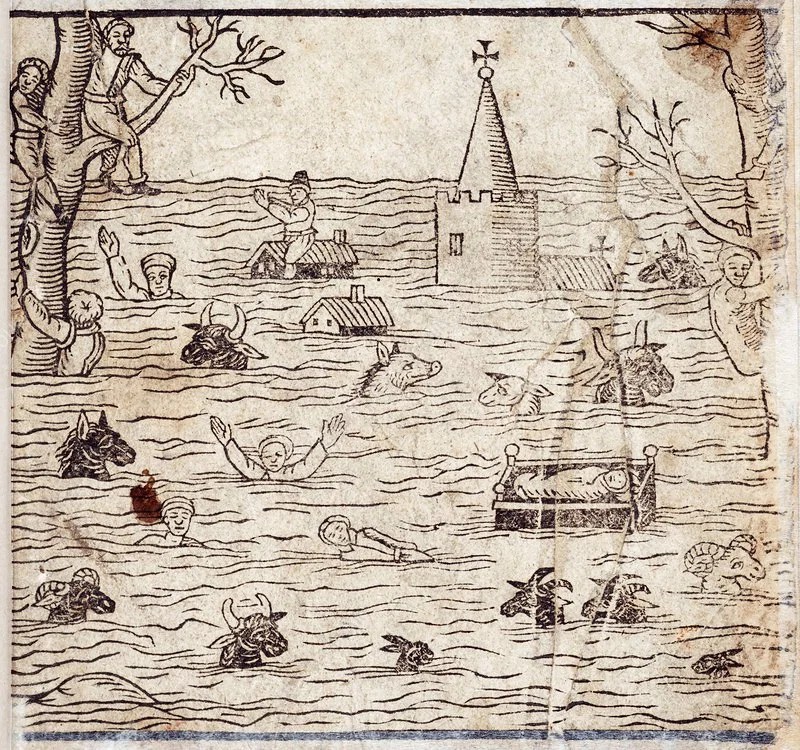
When the Bristol Channel flooded in 1607, it was not just one of the worst natural disasters in British history, it was also a sign, for many, that they had strayed from the path of God. Erik Crnkovich examines the overlap of miraculous weather and the early modern printing industry, which cultivated a thirst for all things occult, exotic, and odd…
When the Bristol Channel flooded on January 30, 1607, pamphlets describing it as God’s warning to a wayward people likewise flooded out of London’s booming presses. Rare weather events of all sorts are ironically commonplace in seventeenth-century news — a century otherwise tempestuous in its frequent, often literal, chopping and changing in church and state. In fact, the two are reflections of each other. True, British weather was consistently inconsistent during the Little Ice Age, a period of prolonged cold and wet that would not end for another two centuries. But the headlines reporting “prodigious” thunderstorms, “miraculous” apparitions, and “terrible” earthquakes were often followed by interpretations of them as moral weathervanes — divine providence, a sign to repent and return to the proverbial straight and narrow.
It is perhaps little surprise, then, that the pamphleteer William Jones rushed to the presses when a storm surge inundated 518 square kilometres surrounding the Bristol Channel. Present scholarship counts 2,000 recorded deaths, making it one of Britain’s worst natural disasters and, according to Jones, a judgement from God…
To date, recent responses to climate disasters have been notably devoid of “divine” interpretation; indeed, if anything, they’ve largely been written off as “just the weather being the weather.” As further extreme weather wreaks havoc and our online version of the “early modern printing” continues to unfold, could that change?
Floods and foreboding in 17th-Century Britain: “Wonderful Weather,” from @publicdomainrev.bsky.social.
* Charles Dickens, Dombey and Son
###
As we seek higher ground, we might recall that it was on this date in 1991 that the “Perfect Storm” formed…
On October 30, 1991, the so-called “perfect storm” formed in the North Atlantic, producing remarkably large waves along the New England and Canadian coasts. Over the next several days, the storm spread its fury over the ocean off the coast of Canada. The fishing boat Andrea Gail and its six-member crew were lost in the storm. The disaster spawned the bestselling book The Perfect Storm by Sebastian Junger and a blockbuster Hollywood movie of the same name.
On October 27, Hurricane Grace formed near Bermuda and moved toward the coast of the southeastern United States. Two days later, Grace continued to move north, where it encountered a massive low pressure system moving south from Canada. The clash of systems over the Atlantic Ocean caused 40-to-80-foot waves on October 30—unconfirmed reports put the waves at more than 100 feet in some locations. This massive surf caused extensive coastal flooding, particularly in Massachusetts; damage was also sustained as far south as Jamaica and as far north as Newfoundland… – source

“Justice is the first virtue of social institutions, as truth is of systems of thought… Each person possesses an inviolability founded on justice that even the welfare of society as a whole cannot override.”*…

Stephen Colbert once observed that “reality has a well-known liberal bias.” And indeed, liberalism— the political/moral philosophy rooted in individual liberty, consent of the governed, and equality before the law– has been a major ideology through modern times… and, of course, the major ideology animating the founding of the United States.
But as Easten European states turn to authoritarians, Western European nations wrestle with the rise of nationalist far-right parties, and the U.S. is “steered” by MAGA using Project 2025‘s “map,” there’s a concern that liberalism’s days may be past.
Persuasion is running a series of essays on “Liberal Virtues and Values.”
The series, made possible with the generous support of the John Templeton Foundation, will make the case that liberalism has its own distinctive set of virtues and values that are capable not only of responding to the dissatisfaction that drives authoritarianism, but also of restoring faith in liberalism as an ideology worth believing in—and defending—on its own terms.
The latest installment is from Martin Gurri, who argues that Liberalism needs a new foundation (and that how we handle AI will matter fundamentally)…
That liberal democracy is in a state of terminal decline I take to be beyond dispute. Like Alice in the rabbit hole, those of us who dwell in democratic societies suffer from a nauseating sense of falling without ever landing on solid ground. The usual suspects blamed for this tumble—populism, inequality, the economy—are mere surface symptoms of an internal breakdown. We have arrived at the conclusion of a world-historical cycle. Liberal democracy is the procedural embodiment of Enlightenment ideology—and after two centuries of dominance, that ideology has lost all purchase and stands utterly exhausted.
Radical alternatives confront us. Either we reorient our system to post-Enlightenment principles or we risk staggering into the nihilist’s paradise I have called the Endarkenment.
Enlightenment philosophers placed their faith in reason and science. These are purely critical disciplines: liberal propagandists wielded criticism like a scalpel to dissect conservative laggards and utopian revolutionaries alike. Once triumphant at the “end of history,” liberal democracy turned the knife on itself—a process of self-criticism and self-doubt that has shredded its own ideals to ribbons.
The positive values inherited from the Enlightenment—equality, individualism, compassion—were always parasitic on Christianity. But Christianity, like all religions, has no place in a universe ruled by reason and science. Nietzsche long ago brought us the troubling news: the Christian God is dead. Oblivious to the implications of this calamity, liberal democracy kept marching like a cartoon character over the edge of the abyss, until the laws of moral gravity asserted themselves. So began the Great Fall.
Criticism is a force for progress so long as there are blatant irrationalities, like slavery or Jim Crow discrimination, to overcome. But under the hammer of Enlightenment ideals, modern society has been flattened, centralized, and rationalized. Deprived of obvious superstitions to debunk and totalitarian rivals to defeat, liberal democracy has been revealed in all its internal contradictions.
One such contradiction, I contend, pits the cherished principle of equality against the chosen few who actually practice reason and science: let’s call this the problem of the elites.
A second contradiction finds freedom of the press and of opinion arrayed against the need to protect objective truth: call it the problem of information.
Finally, freedom of worship and the life of the spirit collide head-on with the materialist criticism favored by Enlightenment ideology: the problem of meaning.
Each of these contradictions could prove fatal to the democratic project, but none is insoluble, and the search for solutions offers an opportunity for renewal. While there are no guarantees, we could emerge from the crisis with a better understanding of the reach and limits of equality, a more transparent information sphere, and even, it may be, a rich infusion of the transcendental into everyday life…
[Gurri unpacks each of those contradictions…]
… So what is to be done?
The first, obvious step is to move the question to the center of our shared conversations. The most capacious thinkers of the age should contemplate first principles and ultimate goals with at least as much intensity as they invest in Donald Trump or the latest economic report. There’s nothing artificial about this. Science and reason are necessary for modernity. Meaning and moral aspiration are necessary for humanity. A balance must be struck that preserves the one and gives full weight to the other.
Materialism, we must understand, is a valuable perspective for science but not a realistic appraisal of the human condition. Scientists work as if on a geometric point, abstracted from nature and indifferent to its dispositions. In reality, however, we come from nature, we are of nature, and we are far from indifferent to our place in it. Our intuitions are internal to the system: humanity’s spiritual quest is, in every sense, nature reflecting on itself. One such intuition is agency—the belief that, at the crossroads, I am free to go right or left, and I alone make the choice. Another is faith in causation. These stances are irrational, or rather pre-rational, but without them liberal democracy as well as science itself would be impossible.
In the end, materialism is self-defeating. To say, “I choose to be a materialist” is to fall into an absurd fallacy. Either our bodies, which consist of matter, obey unchanging laws, or the mind, transcending matter, is capable of choice. There can be no middle ground.
Politics, in a metaphysical age, will resume its traditional place as a secondary activity—a means to an end. This will leave liberal democracy vulnerable to false prophets who are willing to trample on individual rights in pursuit of some apocalyptic scheme. The interesting question is whether the post-truth condition will make the peril greater or lesser. On the one hand, the lack of universal firewalls might make it easier for a fanatic to flood the system. Yet post-truth itself, I believe, is the strongest kind of firewall. In our fractured, eternally contested environment, the progress of any totalizing doctrine will be painfully slow. The quest for meaning and the struggle over frames of reference are, in the end, really one and the same.
We have inherited a rich and evocative spiritual vocabulary, but it belongs to a worldview thousands of years old. “King of kings,” to cite just one example, should sound archaic in a democratic age. Can we awaken the scientific world to the spirit? Is it possible to sanctify our largely instrumental relations? This shouldn’t entail a belief in fairies and goblins, or even necessarily in religion. Any good empiricist will admit that the richest human lives are lived symbolically. Can we climb the symbolic ladder to the mountaintop, where meaning and modern humanity come harmoniously together—anchoring, it may be, a loftier understanding of equality and social life, and of the sanctity of truth?
We won’t know until we try. Pessimism, let me suggest, is unwarranted. History moves in mysterious ways. We may be due for a second coming of historian Karl Jaspers’ “Axial Age”: preachers and philosophers who conceived a drastically updated transcendental vision, with the rational and the sacred, truth and meaning, reconciled with political freedom.
For 200 years, we placed society under the sway of universal principles. That’s gone with the wind. We have entered an era of radical contingency, in which even truth is indeterminate. The natural tendency is to retreat to the certainties of the past—but there’s no going back. If we hope to preserve the gains from Enlightenment society, and resolve its many contradictions, we’ll have to do so within a new and wildly unstable conceptual framework.
With the spell of the Enlightenment broken, liberal democracy will have to redefine what “created equal” means. This process could end in a rigid caste system, with the institutions in the hands of self-selected mandarins who wield the power of the state to impose their “solutions.” Preferably, and more likely given the thrust of the new technology, we’ll see a flattening of the institutions and the continued trampling by the public into the sacred spaces of politics and communication.
Equality, however understood, will be forged in the will of the citizenry rather than granted by a benevolent God. That will make it contingent like everything else, and so liable to variation and in constant need of defense. And if perfect equality is an impossible dream, eternal inequality requires impossible discipline. The current elite class, already under enormous pressure, may lose its cohesion and melt into the impermanence of the age, divided among the various schools and sects and frames of reference.
The structure of information will follow the definition of equality. The commanding heights will be control over AI. If AI development and deployment is a closed game, the elites could set themselves up as intermediaries in the oracle of an omniscient divinity. If AI is a competitive product, the public will gain the upper hand. In that case, we can expect a flowering of eccentric applications, the individualization of commerce and industry, and the final overthrow of the expert class. The information sphere will remain the mirror to our passions, divisions, and metaphysical longings. Freedom of speech, no longer “endowed by our Creator,” will become the battleground on which the question of equality is ultimately settled.
Here I finally reveal myself in my true colors. I’m an analyst. My task is to describe reality, and that’s what this essay is about. But I also lead an active life inside the world that I’m describing—and I have preferences. I see equality as a factor of opportunity, law, and human dignity, not of perfect outcomes. I think truth emerges from examining a subject from a large number of perspectives, even those that may seem disturbing or false. I hope that my story—as a person, a father, a grandfather—connects to other stories in the past and will connect to more in the future, in a pattern that is not entirely devoid of meaning. And I believe fervently in liberal democracy, because—born in Cuba—I have tasted the alternative.
The breakdown of Enlightenment ideology is only the latest challenge liberal democracy has faced in my lifetime. I’m not entitled, as an analyst, to downplay the perils ahead, but I’m allowed, as an American, to have faith that they will once again be overcome…
Eminently worth reading in full: “The Search for a Post-Enlightenment Democracy”
###
As we renew, we might send free-thinking birthday greetings to Henri-Benjamin Constant de Rebecque (or as he’s usually called, Benjamin Constant); he was born on this date in 1767. A French political thinker, activist, and writer on political theory and religion (whose work influenced, among many others, Sir Isaiah Berlin), Constant was a committed republican from 1795, backing the coup d’état of 18 Fructidor in1797, and the following one on 18 Brumaire, in 1799. He became the leader of the Liberal opposition in 1800, during the Consulate. Constant fell out with Napoleon, and had to flee (first to Switzerland, then to Saxony). Nonetheless, after his return to France, Constant sided with the Emperor during the Hundred Days, drafting the Charter of 1815. He became politically active again during the Bourbon Restoration and was elected to the Chamber of Deputies in 1818 (where he remained until his death in 1830). As the head of the Liberal opposition, known as Indépendants, Constant was one of the most notable orators in the Chamber, especially in his role as a proponent of the parliamentary system.

“There are no shortcuts to any place worth going”*…

As Anne Lawrence-Mathers explains, centuries before Neo instantly mastered Kung Fu in The Matrix, and AI emerged promising quick command of any subject to any of us, medieval scholars found a shortcut to years of difficult study: a magical manuscript that promised to fast-track advanced learning. Anne Lawrence-Mathers investigates the Ars notoria, its supposed powers, and the demonic influence it had upon some users…
Mastering the full range of subjects taught in medieval universities normally required many years of hard and expensive study. From the thirteenth century on, however, an anonymous work known as the Ars notoria promised, through diagrams, incantations, and arcane rituals, to rapidly transmit to scholars the total knowledge of anything they might need. Condemned by church authorities, the fifty-six extant manuscripts nevertheless testify to the seductiveness of that offer.
Its complex diagrams were at the center of its appeal. Unlike diagrams in other magical texts, those in Ars notoria do not illustrate what the text is seeking to communicate. Nor do they act as models to be replicated in three-dimensional form as pieces of magical equipment. Instead, they supposedly work almost in the same way as religious icons. That is, faithful possession and use of them can offer direct contact with powerful and benign supernatural forces — and ultimately even with God. The diagrams themselves are the route to magic and consist of arrangements of symbolic and geometric forms, patterns, and symbols, interspersed with “words”, which are frequently unintelligible combinations of letters.3 Practitioners who opened their minds to receive and imprint these labyrinthine images, while reciting complex verbal formulae and strings of mysterious, almost unpronounceable words and names, are engaging in a significant act of trust.
Several factors made the Ars notoria fundamentally different from other magical texts. First, this is not a text in conflict with the church. In fact, the rituals framing and shaping usage of the images are presented as extremely pious, and the texts to be recited are identified as prayers. The alien words, names, and characters are explained as coming from ancient languages such as Greek, Hebrew, and “Chaldean”, and are claimed to preserve both the names of angels and words used to communicate with them. Second, the advantages offered are relatively virtuous: contact with spiritual beings and full knowledge of the subjects taught in medieval universities. Such claims cut little ice with thirteenth-century theologians, however, who saw clear links to things condemned as superstitious and demonic by St Augustine, despite the text’s assertion that it contains wisdom revealed to King Solomon.
St Thomas Aquinas was worried enough by the Ars notoria to name and condemn it specifically in his Summa theologiae — one of the most authoritative summaries of Christian teaching. He dealt with the very serious issue of superstition in Book Two, Part 2 — Question 96 is effectively devoted to the Ars notoria. Aquinas’ conclusion is wholly negative: the “art” is both “unlawful and futile”. It is futile because it cannot deliver what it promises. Still more seriously, its “signs” are neither understood by humans (like ordinary words and letters) nor sent by God (as sacraments are), and thus are precisely the type of thing that lures humans into contact and compact with demons.
That may seem a conclusive case for the rejection of the Ars notoria, especially as Aquinas’ objections were echoed by other major theologians. However, the number of surviving medieval copies of the work, and the fact that it was copied and owned in religious institutions until the end of the medieval period, show that the church ultimately had neither the interest nor ability to stamp it out. Moreover, it was translated in the early modern period and also went into print, demonstrating an ongoing — and more widespread — interest…
[Professor Lawrence-Mathers explains how the Ars notoria was used…]
… For some users, the rituals were so powerful that they seemed demonic. One of these was Brother John, an early fourteenth-century monk of the abbey of Morigny, near Étampes. John’s account of his introduction to the text, his powerful attraction to it, and the terrifying experiences he underwent while using it, was given in several chapters of John’s own, visionary work, the early fourteenth century Liber florum celestis doctrine.6
The great attraction of the Ars notoria for John was its promise of quick access to advanced scholarly knowledge. He recounts his continuing wish to study, and how he was lent a copy of a book of necromancy by “a certain cleric”. He copied much of it and wanted more. This led to an encounter with a “medical expert” from Lombardy, who informed John that what he needed was the Ars notoria, and that a copy of it was to be found within the walls of the school (at Orléans) where John had been sent. These details provide important evidence of the liminal status of works of ritual magic. They were recognised as dangerous, and were far from being officially approved, and yet were well known, owned and recommended by educated individuals, including monks and clerics.
For John, the Ars notoria was dangerous not in some abstract way, but very directly. He confesses that it struck him at first as beautiful and holy, and seemed to offer miraculous gifts rather than demonic temptations. It became apparent, however, that the book was utterly deceptive, a work of the Devil, a “sick pleasure” that was actually fatally poisonous to the soul, not only to the body…
Medieval “technology”: “Artificial Intelligence– Ars Notoria and the Promise of Instant Knowledge,” from @publicdomainrev.bsky.social.
Pair with: “The Cost of Seamlessness” from @taotuner.bsky.social, and “Experience vs. Efficiency: Why the Human Still Matters in Learning,” from @lnddave.bsky.social.
Also a (vaguely) apposite, but (very) amusing (in a macabre kind of way) report on a piece of OpenAI’s handiwork: “US government map of Africa mislabels every country at global conference.”
* Beverly Sills
###
As we do the work, we might recall that it was on this date in 1965 that Frank Herbert’s Dune was published.
Herbert published a three-part serial Dune World in the monthly Analog, from December 1963 to February 1964. The serial was accompanied by several illustrations that were not published again. After an interval of a year, he published the much slower-paced five-part The Prophet of Dune in the January–May 1965 issues. The first serial became “Book One: Dune” in the final published Dune novel, and the second serial was divided into “Book Two: Muad’dib” and “Book Three: The Prophet”. The serialized version was expanded, reworked, and submitted to more than twenty publishers, each of whom rejected it. The novel, Dune, was finally accepted and published in August 1965 by Chilton Books, a printing house better known for publishing auto repair manuals. Sterling Lanier, an editor at Chilton, had seen Herbert’s manuscript and had urged his company to take a risk in publishing the book. However, the first printing, priced at $5.95 (equivalent to $60.79 in 2025), did not sell well and was poorly received by critics as being atypical of science fiction at the time. Chilton considered the publication of Dune a write-off and Lanier was fired. Over the course of time, the book gained critical acclaim, and its popularity spread by word-of-mouth to allow Herbert to start working full time on developing the sequels to Dune, elements of which were already written alongside Dune.
– source
Herbert died in 1986; his son Brian Herbert and author Kevin J. Anderson continued the series in over a dozen additional novels since 1999. Among them was Dune: The Butlerian Jihad, a prequel which chronicles the fictional Butlerian Jihad, a crusade by the last free humans in the universe against the thinking machines, a violent and dominating force led by the sentient computer Omnius.

You must be logged in to post a comment.