Archive for October 2024
“There is virtue in work and there is virtue in rest. Use both and overlook neither.”*…
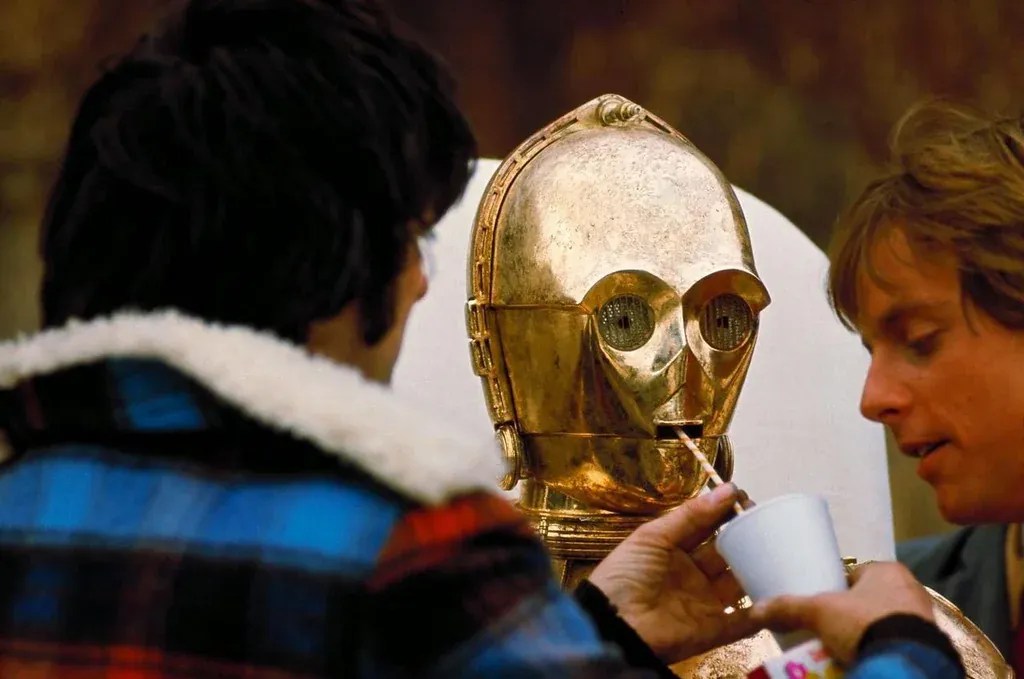
As we unwind into the weekend, sci-fi art curator Adam Rowe, with a collection of photos of famed sci-fi characters (and monsters) taking a break…


More at: “Break Time,” from @AdamRRowe.
* Alan Cohen
###
As we give it a rest, we might recall that it was on this date in 1984 that The Terminator was released. Directed by James Cameron and produced by Gale Anne Hurd, it starred Arnold Schwarzenegger as the Terminator, a cybernetic assassin sent back in time from 2029 to 1984 to kill Sarah Connor (Linda Hamilton), whose unborn son will one day save mankind from extinction by Skynet, a hostile artificial intelligence in a post-apocalyptic future. Kyle Reese (Michael Biehn) played a soldier sent back in time to protect Sarah. The screenplay was credited to Cameron and Hurd, while co-writer William Wisher Jr. received an “additional dialogue” credit.
Defying low pre-release expectations, The Terminator topped the United States box office for two weeks, eventually grossing $78.3 million against a modest $6.4 million budget. It is credited with launching Cameron’s film career and solidifying Schwarzenegger’s status as a leading man. The film’s success led to a franchise consisting of several sequels, a television series, comic books, novels and video games. In 2008, The Terminator was selected by the Library of Congress for preservation in the United States National Film Registry.

“History gives answers only to those who know how to ask questions”*…

Scott Spillman on the uses– and abuses– of popular history…
The story of popular historical writing since the middle of the twentieth century is often told as a narrative of decline: there were giants on the earth in those days, but now academic historians have forsaken their responsibility to write for a broader public, which in any case doesn’t really care what they have to say. Back in the golden days, or so the story goes, great scholars such as Arthur Schlesinger, Richard Hofstadter and C. Vann Woodward could make field-defining contributions—such as Schlesinger’s The Age of Jackson (1945), Hofstadter’s The American Political Tradition (1948) and Woodward’s The Strange Career of Jim Crow (1955)—that also crackled with energy, reached a wide audience and informed public debates. But since the 1960s, academic historians have splintered into narrow subfields that speak only to one another in increasingly esoteric jargon, while the public has become incurious and incapable of reading anything longer than a few paragraphs. Popular history has come to mean political biography and military history, two fields that academic historians often avoid or even disdain.
This story is obviously a caricature. Like all caricatures it gets certain major features right, albeit in exaggerated or distorted form. It also leaves a lot out—not only the details that would bring our gauzy image of the golden days into sharper focus, but also a better sense of what popular history actually looks like today. Because history remains popular. As I write, in the spring of 2024, Erik Larson’s new book about the start of the Civil War, The Demon of Unrest, is the bestselling nonfiction book in the country, while David Grann’s The Wager, about an eighteenth-century shipwreck, has consistently ranked in the top fifteen for more than a year. These are particularly fine examples of a certain genre of history—heavy on character and plot, somewhat lighter on analysis—that is perennially popular and, in the hands of a Larson or a Grann, can be quite rewarding.
But I want to think about a different kind of popular history. What books by writers like Larson and Grann don’t offer, at least not usually, is a broader interpretation of the world, a new perspective on the past that also leads to a new understanding of the present, something that is accessible to a reasonably broad public and offers at least the potential to rearrange a reader’s mental furniture. That, or something like it, is what people mean when they refer with nostalgia to the mid-century moment of Schlesinger, Hofstadter and Woodward.
This kind of serious but popular history does still exist. Our most well-known academic historian in this mode is probably Jill Lepore, the Harvard professor whose snappy essays in the New Yorker have won her a large and admiring readership for the way they put a human face on the historical antecedents of our own time. Yet if Lepore represents the liberal center, the driving force of contemporary interest in history has been the challenges we have seen to the liberal order from the left and the right, symbolized originally by the Tea Party and Occupy Wall Street, and more recently by Donald Trump and Black Lives Matter—challenges that have sent readers searching through the past for lessons about revolution, capitalism, fascism, racism and liberalism itself…
… In broader public discussions it often seems to be taken for granted that history, and historians, can help us to understand the problems we face. But this consensus obscures deep disagreements about what that help should look like. So it is worth asking: What role do we really want history to be playing in our public life? And is the history we have actually doing that work?…
[There follows a fascinating– and enlightening– historiography of the last 75 years or so.]
… One major role of the humanities, in addition to enabling us to understand ourselves, must surely be to open our minds to lives and perspectives that are very different from our own. It should come as no surprise, then, that the ongoing half-century decline in humanistic education, which has only accelerated in the past fifteen years, has been accompanied by a striking decrease in our ability to understand ideas that diverge significantly from our own, or to imagine ourselves in the position of the people who hold them. Sometimes it seems as if we no longer believe in the possibility of such an act.
Contemporary academic historians who aim to influence public debate often make the problem worse. In the postwar period, Hofstadter could criticize the reform movements that shaped his own political education, while Woodward could express sympathy for both civil rights activists and aristocratic slaveholders. In contrast, historians today are more apt to take sides with their historical heroes lest they give any comfort to their present-day enemies. Often in their books you see a neat division of the past into two teams, such that history becomes little more than a spectator sport…
In the work of these authors, the people whom they supposedly care about are too often depicted as passive creatures who would choose correctly (that is, support civil rights and gun control and national health care) if only they weren’t being hoodwinked and manipulated by nefarious forces beyond their control. If only everyone knew the correct story of American history—namely, the story told in these books—then they would all see the light and be proper liberals. The books often lack any acknowledgment that people of good faith might hold conflicting ideas about the story of American history or that, even if they agree about the basic story, they might draw starkly different lessons from it…
… The purpose of serious popular history should be to make people more self-conscious about their society, to unearth its underlying values and assumptions and to show how past events, in all their contingency and subterranean logic, managed to produce the world we live in today. With the neoliberal order having come to an end, we are at a moment when the meaning of American society is up for grabs in a way that it hasn’t been since the late 1960s and 1970s. It was in that earlier period when many of the writers we think of as the great postwar historians—Hofstadter and Woodward above all—sold tens of thousands of books a year, helping Americans make sense of who they were and what they wanted their society to be. Particularly with the 250th anniversary of independence arriving soon, we may be entering a similar period today.
With that in mind, it’s worth looking ahead to a more hopeful project, still in progress, from the Princeton historian Matthew Karp. Like the popular mid-century historians, Karp’s political and historical outlook was forged by a few searing experiences in young adulthood: America’s failed adventure in Iraq, which shaped the questions he asked in his first book (a look at the expansive foreign policy of another group of conservatives, the slaveholders of the Old South), and then the presidential campaigns of Bernie Sanders, which turned him from a liberal into a Marx-quoting Democratic Socialist. “I was really swept away by the ideas and the energy behind that campaign in 2016,” he later recalled. “It felt distinct from anything I had experienced in my life not just in terms of what the campaign stood for, but the extent to which it felt like it had developed a mass base for what it was fighting for.”
In addition to his day job as a historian at Princeton, Karp became a contributing editor at Jacobin, where he has been a sharp analyst of election returns. In contrast to historians who merely pretend that their expertise affords special insight into contemporary electoral politics, Karp has actually put in the work. His chief concern has been what is known as “class dealignment,” with upper-class voters now breaking more Democratic while lower-class voters trend Republican. Karp has prodded his readers to honestly grapple with this phenomenon precisely because it poses such a deep challenge to his preferred form of class-based politics, at least insofar as that project might be pursued through the current Democratic Party. Refreshingly, he does not regard the mass of American workers as former or future fascists, but instead as voters who, just like the rest of us, can be won over with better politics and policies. “Underneath the partisan fear and loathing,” he wrote in his first Easy Chair column for Harper’s, published in June of this year, “‘a wide and arduous national life’ still murmurs on, linking city and countryside, crossing lines of race, gender, and culture, waiting to take hold in our politics.” The column used the novels of George Eliot to suggest some of the moral and political limitations of the typical urban Democrat’s condescending attitude toward rural workers.
For his next project, Karp is looking at the greatest example in American history of a political party that assembled a winning coalition around radical class politics: the Republican Party of the 1850s, which managed to go in six short years from nonexistence to control of the federal government by rallying Northern farmers and workers around the politics of anti-slavery. Karp published the first overview of his new research in 2019, just as the presidential campaigns were gearing up, in Jacobin and its more scholarly companion Catalyst. The piece made no present-day comparisons, but it did note that slaveholders in the 1850s made up only one percent of the American population and that the Republicans were successful in overthrowing their power and completely reorienting the policies of the federal government precisely by “building a mass movement to overthrow a ruling-class oligarchy.” “The Republican achievement in the 1850s,” he declared, “was not to isolate moral, cultural, or economic arguments against slavery, but to combine them into a compelling and victorious whole.”
Here, in other words, was a road map for radical movements today, a precursor that people could be proud of and from which they might take some inspiration. Notice that this does not require Karp to whitewash the past or to pretend its arc has always been progressive. More historians might follow his example of reminding readers that American history is at heart not a Manichean tale of good versus bad, or a deterministic tale based on some original sin, but a story of real people struggling to make moral and political decisions in a complex world. Perhaps then more of us would realize that we can exercise a similar agency and responsibility, humor and hope, in the choices we make in our own lives.
This is, and has always been, part of the promise of America—the promise that our inheritance need not define our experience, and that even as we rely on the past for our models we might also begin the world anew. The past can be instructive and informative, but it is not determinative; it surely constrains, but it doesn’t coerce. History can tell us something about who we are and where we have been, but it cannot tell us everything. At its best, it does not consign the story of the present either to epilogue or to tautology, but rather prepares us to appreciate the irony, the unpredictability and the unforeseen possibilities of the chapter we are writing for ourselves…
Eminently worth reading in full: “Popular History” in @thepointmag.bsky.social.
###
As we ponder the past, we might send side-eyed birthday greetings to Thomas Babington Macaulay, 1st Baron Macaulay; he was born on this date in 1800. A historian and politician, Macaulay’s hugely-influential The History of England, which manifest his belief the superiority of the Western European culture and of the inevitability of its sociopolitical progress, was an exemplar of the sorts of history against which Spillman argues.
As a Whig politician, Macaulay put the “lessons” of his history to work: he served as the Secretary at War between 1839 and 1841 and as the Paymaster General between 1846 and 1848; he also played a substantial role in determining India’s education policy.

“Zero is powerful because it is infinity’s twin. They are equal and opposite, yin and yang.”*…

… and like infinity, zero can be a cognitive challenge. Yasemin Saplakoglu explains…
Around 2,500 years ago, Babylonian traders in Mesopotamia impressed two slanted wedges into clay tablets. The shapes represented a placeholder digit, squeezed between others, to distinguish numbers such as 50, 505 and 5,005. An elementary version of the concept of zero was born.
Hundreds of years later, in seventh-century India, zero took on a new identity. No longer a placeholder, the digit acquired a value and found its place on the number line, before 1. Its invention went on to spark historic advances in science and technology. From zero sprang the laws of the universe, number theory and modern mathematics.
“Zero is, by many mathematicians, definitely considered one of the greatest — or maybe the greatest — achievement of mankind,” said the neuroscientist Andreas Nieder, who studies animal and human intelligence at the University of Tübingen in Germany. “It took an eternity until mathematicians finally invented zero as a number.”
Perhaps that’s no surprise given that the concept can be difficult for the brain to grasp. It takes children longer to understand and use zero than other numbers, and it takes adults longer to read it than other small numbers. That’s because to understand zero, our mind must create something out of nothing. It must recognize absence as a mathematical object.
“It’s like an extra level of abstraction away from the world around you,” said Benjy Barnett, who is completing graduate work on consciousness at University College London. Nonzero numbers map onto countable objects in the environment: three chairs, each with four legs, at one table. With zero, he said, “we have to go one step further and say, ‘OK, there wasn’t anything there. Therefore, there must be zero of them.’”
In recent years, research started to uncover how the human brain represents numbers, but no one examined how it handles zero. Now two independent studies, led by Nieder and Barnett, respectively, have shown that the brain codes for zero much as it does for other numbers, on a mental number line. But, one of the studies found, zero also holds a special status in the brain…
Read on to find out the ways in which new studies are uncovering how the mind creates something out of nothing: “How the Human Brain Contends With the Strangeness of Zero,” from @QuantaMagazine.
Pair with Percival Everett’s provocative (and gloriously entertaining) Dr. No.
* Charles Seife, Zero: The Biography of a Dangerous Idea
Scheduling note: your correspondent is sailing again into uncommonly busy waters. So, with apologies for the hiatus, (R)D will resume on Friday the 25th…
###
As we noodle on noodling on nothing, we might send carefully-calculated birthday greetings to Erasmus Reinhold; he was born on this date in 1511. A professor of Higher Mathematics (at the University of Wittenberg, where he was ultimately Rector), Reinhold worked at a time when “mathematics” included applied mathematics, especially astronomy– to which he made many contributions and of which he was considered the most influential pedagogue of his generation.
Reinhold’s Prutenicae Tabulae (1551, 1562, 1571, and 1585) or Prussian Tables were astronomical tables that helped to disseminate calculation methods of Copernicus throughout the Empire. That said, Reinhold (like other astronomers before Kepler and Galileo) translated Copernicus’ mathematical methods back into a geocentric system, rejecting heliocentric cosmology on physical and theological grounds. Both Reinhold’s Prutenic Tables and Copernicus’ studies were the foundation for the Calendar Reform by Pope Gregory XIII in 1582… and both made copious use of zeros.

“The whole problem with the world is that fools and fanatics are always so certain of themselves, and wiser people so full of doubts”*…

In a recent post we considered “agnotology”—the study of ignorance. Today, John Timmer unpacks a related phenomenon…
The world is full of people who have excessive confidence in their own abilities. This is famously described as the Dunning-Kruger effect, which describes how people who lack expertise in something will necessarily lack the knowledge needed to recognize their own limits. Now, a different set of researchers has come out with what might be viewed as a corollary to Dunning-Kruger: People have a strong tendency to believe that they always have enough data to make an informed decision—regardless of what information they actually have.
The work, done by Hunter Gehlbach, Carly Robinson, and Angus Fletcher, is based on an experiment in which they intentionally gave people only partial, biased information, finding that people never seemed to consider they might only have a partial picture. “Because people assume they have adequate information, they enter judgment and decision-making processes with less humility and more confidence than they might if they were worrying whether they knew the whole story or not,” they write. The good news? When given the full picture, most people are willing to change their opinions…
[Timmer explains the experiment and runs through the particulars of the results]
… This is especially problematic in the current media environment. Many outlets have been created with the clear intent of exposing their viewers to only a partial view of the facts—or, in a number of cases, the apparent intent of spreading misinformation. The new work clearly indicates that these efforts can have a powerful effect on beliefs, even if accurate information is available from various sources…
The full PLOS One paper is here.
When given partial info, most feel confident that’s all they need to know: “People think they already know everything they need to make decisions,” from @jtimmer.bsky.social in @arstechnica.com.
* Bertrand Russell
###
As we read widely, we might spare a thought for a victim of just this sort of misplaced confidence, John Scopes; he died on this date in 1970. A teacher in Dayton, Tennessee, he was prosecuted in 1925 for teaching evolution in the local high school.
… [Scopes] was accused of violating Tennessee’s Butler Act, which had made it illegal for teachers to teach human evolution in any state-funded school. The trial was deliberately staged in order to attract publicity to the small town of Dayton, Tennessee, where it was held. Scopes was unsure whether he had ever actually taught evolution, but he incriminated himself deliberately so the case could have a defendant.
Scopes was found guilty and was fined $100 (equivalent to $1,700 in 2023), but the verdict was overturned on a technicality. The trial served its purpose of drawing intense national publicity, as national reporters flocked to Dayton to cover the high-profile lawyers who had agreed to represent each side. William Jennings Bryan, three-time presidential candidate and former secretary of state, argued for the prosecution, while Clarence Darrow served as the defense attorney for Scopes. The trial publicized the fundamentalist–modernist controversy, which set modernists, who said evolution could be consistent with religion, against fundamentalists, who said the word of God as revealed in the Bible took priority over all human knowledge. The case was thus seen both as a theological contest and as a trial on whether evolution should be taught in schools…
… In 1958 the National Defense Education Act was passed with the encouragement of many legislators who feared the United States education system was falling behind that of the Soviet Union. The act yielded textbooks, produced in cooperation with the American Institute of Biological Sciences, which stressed the importance of evolution as the unifying principle of biology. The new educational regime was not unchallenged. The greatest backlash was in Texas where attacks were launched in sermons and in the press. Complaints were lodged with the State Textbook Commission. However, in addition to federal support, a number of social trends had turned public discussion in favor of evolution. These included increased interest in improving public education, legal precedents separating religion and public education, and continued urbanization in the South. This led to a weakening of the backlash in Texas, as well as to the repeal of the Butler Law in Tennessee in 1967…

“Journalism is the first draft of history”*…

… and newsreels were the first available footage. Pathé News was a producer of newsreels and documentaries from 1910 to 1970 in the United Kingdom. Its founder, Charles Pathé, was a pioneer of moving pictures in the silent era.
The Pathé News archive is known today as “British Pathé,” and contains all of Pathé’s work, along with the archives of Reuters, Gaumont, Visnews and others…
Before television, people came to movie theatres to watch the news. British Pathé was at the forefront of cinematic journalism, blending information with entertainment to popular effect. Over the course of a century, it documented everything from major armed conflicts and seismic political crises to the curious hobbies and eccentric lives of ordinary people. If it happened, British Pathé filmed it….
… Spanning the years from 1896-1978, its collections include footage from around the globe of major events, famous faces, fashion trends, travel, science, and culture. It is an invaluable resource for broadcasters, documentary producers, museum curators, and researchers worldwide. The entire archive of 85,000 films is available to view for free on the British Pathé website while licences can be acquired for other uses.
British Pathé also represents content from partner organisations, such as Reuters’ historical collection, which includes more than 130,000 items dating from 1910 to the end of 1984…
The entire Pathé collection has been available on its website since 2002. Now the 85,000 Pathé News items are also available on YouTube.
Explore!
###
As we rewind, we might recall that it was on this date in 1910 that the British ocean liner RMS Olympic was launched. The lead ship of the White Star Line‘s trio of Olympic-class liners, Olympic had a career spanning 24 years from 1911 to 1935, in contrast to her short-lived sister ships, Titanic and Britannic. This included service as a troopship during the First World War, which gained her the nickname “Old Reliable”, and during which she rammed and sank the U-boat U-103. She returned to civilian service after the war and served successfully as an ocean liner throughout the 1920s and into the first half of the 1930s, although increased competition, and the slump in trade during the Great Depression after 1930, made her operation increasingly unprofitable. Olympic was withdrawn from service and sold for scrap in 1935.
Olympic was the largest ocean liner in the world for two periods during 1910–13, interrupted only by the brief tenure of the slightly larger Titanic, which had the same dimensions but higher gross register tonnage, before the German SS Imperator went into service in June 1913.
Pathe has the footage…
You must be logged in to post a comment.