Posts Tagged ‘Voltaire’
“Stercus accidit”*…
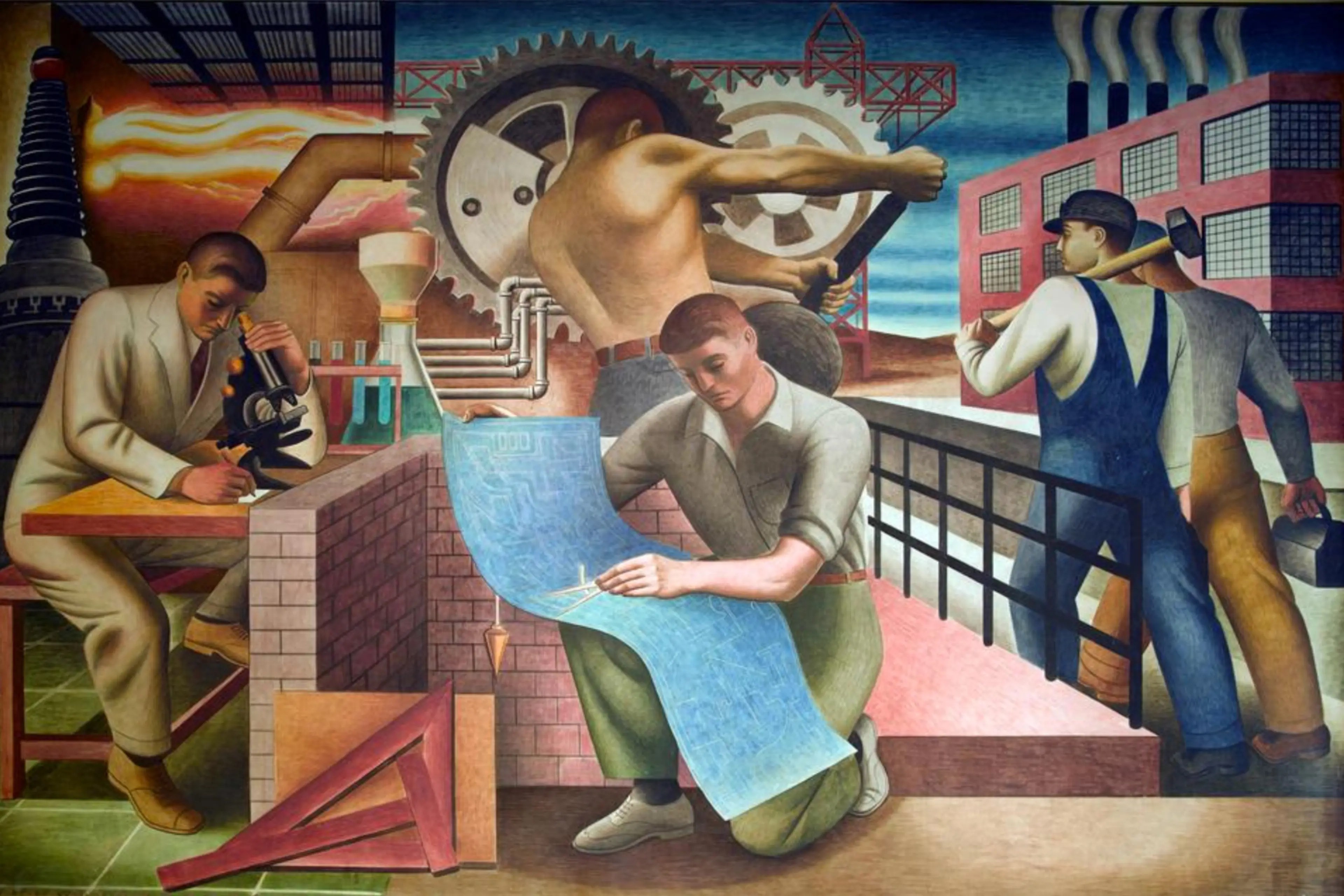
As we try to understand the rifts afflicting our nation and world, many turn to Marx and his framework of class. But in a provocative essay, Catherine Nichols suggests that it was David Hume (in an 1752 essay that identified the unfettering of wealth from land) who identified the origin of our political divisions…
Describing the political map in terms of Left and Right is an accepted convention all over the world, almost to the point of cliché. Yet it is surprisingly complicated to explain whose interests lie on each side of this spectrum. For example, if the Left supports the interests of workers over the interests of employers, why are Left-leaning regions of the United States and elsewhere in the world among the richest? When Japan and South Korea sought to become economic powerhouses in the later 20th century, they adopted Leftist policies such as strong public education, universal healthcare and increased gender equality – if countries seeking to compete in capitalist arenas adopt broadly Leftist policies, then how do we explain why Leftists are always talking about overthrowing capitalism? And if the Left is somehow both the party of workers’ rights and the party of material wealth, then whose interests are supported by the Right? Given such contradictions, how did these terms become so central to modern politics?
The terms ‘left’ and ‘right’ come from the seating arrangements in the National Assembly during the French Revolution, where the combatants used the medieval estate groupings to define their battle lines. According to their writings, land-owning aristocrats (the Second Estate) were the party of the Right, while the interests of nearly everyone else (the Third Estate) belonged to the Left. This Third Estate included peasants working for the landowners but also every other kind of business owner and worker. Decades later, Karl Marx offered a different analysis of capitalism: he put owners of both land and businesses together on one side (the bourgeoisie), while grouping workers from fields and factories on the other side (the proletariat) in a single, world-wide class struggle. The trouble with both these ways of parsing Left and Right is that voting patterns never seem to line up with class. Both historic analyses leave us with questions about the contemporary world – and not just the paradox of why so many Left-leaning places are so rich. Why, for example, do working-class conservatives appear to vote against their material interests, year in and year out, across generations?
The 18th-century philosopher and political theorist David Hume had answers to these questions, though he was writing decades before the French Revolution. While his essay ‘Of Public Credit’ (1752) was a warning about the dangers of Britain’s increasing reliance on debt financing, his apocalyptic vision of the future turned out to describe some features of our current political map surprisingly well. Hume was writing because he believed that debt financing had the power to upend Europe’s traditional power structure and culture by creating a new source of money divorced from tradition or responsibility: stocks and bonds. Unlike land, anyone with some cash could buy war bonds and get an immediate passive income in the form of interest. This was the thin end of the wedge caused by the debt financing that Hume believed was destroying every part of society. The governments of antiquity, Hume argued, saved money to use in battle and then waged wars in self-defence, or else to expand their territory. But the British had invented a new form of warfare that Hume saw no precedent for, even in the merchant states of Nicollò Machiavelli’s Italy: war for trade, funded with money borrowed from private stockholders…
[Nichols unpacks Hume’s observations (centrally, that three groups with stakes in the status quo, heretability, and the sanctity of “family and family hierarchy”tradition”– landowners, aging parents, and want to preserve old power structures, including the family– and traces their relevance, from Hume’s time to ours…]
… There are many reasons for people aligning Right or Left, which is why analyses of class and material interests fall short of describing the realities of people’s politics. Hume foresaw that these specific groups would resent the economic sea-change of the 18th century – and he was correct. Many people would rather have land and power than money and liberty.
Still, the power of the Right hasn’t doomed the Left – no more than the Spanish Inquisition doomed the rise of the Left in 18th-century England and France. As long as governments want to keep the value of their currencies from falling, someone in their ranks will be using the methods of the Left and inventiveness that brought us everything from our banking system to gay marriage. We don’t need to resurrect communism or focus narrowly on class, following Marx. The experiments are far from over, and we should remember that the Left is generally where money comes from in modern times. We give away too much power when we forget it…
Rethinking Right and Left: “Landholder vs stockholder,” from @catherinenichols.bsky.social in @aeon.co.
As for how it’s going at the moment (and further to Hume and the quote in this post’s title), see: “MAGA’s Betrayal of Small Business,” from @pkrugman.bsky.social.
* “shit happens”– often attributed to David Hume, reflecting his skeptical view that human understanding, particularly of cause-and-effect, is limited to habitual belief from experience, implying that unforeseen, messy outcomes (“shit”) inevitably occur in life despite our reasoning.
###
As we sort the Whigs from the Tories, we might recall that it was on this date 1656 that Blaise Pascal (writing under the pseudonym Louis de Montalte) published the first of his Provential Letters (Lettres provinciales), a series of eighteen polemical letters using humor to attack Jesuits for their use of casuistry and their moral laxity. Though the Letters were a popular success, they had little immediate effect on politics or the clergy. But they influenced later French writers like Voltaire and Jean-Jacques Rousseau and ultimately persuaded Pope Alexander to condemn “laxity” in the church and order a revision of casuistic texts.

“No one knows toward what center human things are going to gravitate in the near future, and hence the life of the world has become scandalously provisional”*…

The estimable Ted Gioia has pulled a 2022 essay from his newsletter up from behind the paywall. It was very relevant then; if anything, more relevant now…
Back in 2014, I sketched out a widely-read outline of an alternative interpretation of cultural conflict. Curiously enough, the conceptual tools I used came from a 1929 book from philosopher José Ortega y Gasset entitled The Revolt of the Masses—a work that offers surprisingly timely insights into our current situation.
That article stirred up a lot of debate at the time, but the whole situation has intensified further since 2014. Everything I’ve seen in those eight years has made painfully clear how insightful Ortega had been. The time has come to revisit that framework, summarizing its key insights and offering predictions for what might happen in the future.
Here’s part of what I wrote back in 2014:
First, let me tell you what you won’t find in this book. Despite a title that promises political analysis, The Revolt of the Masses has almost nothing to say about conventional party ideologies and alignments. Ortega shows little interest in fascism or capitalism or Marxism, and this troubled me when I first read the book. (Although, in retrospect, the philosopher’s passing comments on these matters proved remarkably prescient—for example his smug dismissal of Russian communism as destined to failure in the West, and his prediction of the rise of a European union.) Above all, he hardly acknowledges the existence of ‘left’ and ‘right’ in political debates.
Ortega’s brilliant insight came in understanding that the battle between ‘up’ and ‘down’ could be as important in spurring social and cultural change as the conflict between ‘left’ and ‘right’. This is not an economic distinction in Ortega’s mind. The new conflict, he insists, is not between “hierarchically superior and inferior classes…. upper classes or lower classes.” A millionaire could be a member of the masses, according to Ortega’s surprising schema. And a pauper might represent the elite.
The key driver of change, as Ortega sees it, comes from a shocking attitude characteristic of the modern age—or, at least, Ortega was shocked. Put simply, the masses hate experts. If forced to choose between the advice of the learned and the vague impressions of other people just like themselves, the masses invariably turn to the latter. The upper elites still try to pronounce judgments and lead, but fewer and fewer of those down below pay attention.
This dynamic is now far more significant than it was eight years ago. So I want to share 15 observations on the emerging vertical dimension of cultural conflict—these both define the rupture and try to predict how it will play out…
Read on for: “15 Observations on the New Phase in Cultural Conflict” from @tedgioia.bsky.social.
(Image above: source)
* José Ortega y Gasset in The Revolt of the Masses… where he also observed: “Liberalism – it is well to recall this today – is the supreme form of generosity; it is the right which the majority concedes to minorities and hence it is the noblest cry that has ever resounded in this planet. It announces the determination to share existence with the enemy; more than that, with an enemy that is weak. It was incredible that the human species should have arrived at so noble an attitude, so paradoxical, so refined, so acrobatic, so antinatural. Hence, it is not to be wondered at that this same humanity should soon appear anxious to get rid of it. It is a discipline too difficult and complex to take firm root on earth.”
###
As we contend with contention, we might send rational birthday greetings to an avatar of the Enlightenment (which did so much to spawn liberalism), Francois-Marie Arouet, better known as Voltaire; he was born on this date in 1694. The Father of the Age of Reason, he produced works in almost every literary form: plays, poems, novels, essays, and historical and scientific works– more than 2,000 books and pamphlets (and more than 20,000 letters). He popularized Isaac Newton’s work in France by arranging a translation of Principia Mathematica to which he added his own commentary.
A social reformer, Voltaire used satire to criticize the intolerance, religious dogma, and oligopolistic privilege of his day, perhaps nowhere more sardonically than in Candide.

“Romanticism is precisely situated neither in choice of subject, nor exact truth, but in the way of feeling”*…

The estimable Ted Gioia is exploring the possibility that we are at the cusp of a major change in the zeitgeist– the beginning of a new age of Romanticism…
I made a flippant remark a few months ago. It was almost a joke.
But then I started taking it seriously.
I said that technocracy had grown so oppressive and manipulative it would spur a backlash. And that our rebellion might resemble the Romanticist movement of the early 1800s.
We need a new Romanticism, I quipped. And we will probably get one.
A new Romanticism? Could that really happen? That seems so unlikely.
Even I didn’t take this seriously (at first). I was just joking. But during the subsequent weeks and months, I kept thinking about my half-serious claim.
I realized that, the more I looked at what happened circa 1800, the more it reminded me of our current malaise.
- Rationalist and algorithmic models were dominating every sphere of life at that midpoint in the Industrial Revolution—and people started resisting the forces of progress.
- Companies grew more powerful, promising productivity and prosperity. But Blake called them “dark Satanic mills” and Luddites started burning down factories—a drastic and futile step, almost the equivalent of throwing away your smartphone.
- Even as science and technology produced amazing results, dysfunctional behaviors sprang up everywhere. The pathbreaking literary works from the late 1700s reveal the dark side of the pervasive techno-optimism—Goethe’s novel about Werther’s suicide, the Marquis de Sade’s nasty stories, and all those gloomy Gothic novels. What happened to the Enlightenment?
- As the new century dawned, the creative class (as we would call it today) increasingly attacked rationalist currents that had somehow morphed into violent, intrusive forces in their lives—an 180 degree shift in the culture. For Blake and others, the name Newton became a term of abuse.
- Artists, especially poets and musicians, took the lead in this revolt. They celebrated human feeling and emotional attachments—embracing them as more trustworthy, more flexible, more desirable than technology, profits, and cold calculation.
That’s the world, circa 1800.
The new paradigm shocked Europe when it started to spread. Cultural elites had just assumed that science and reason would control everything in the future. But that wasn’t how it played out.
Resemblances with the current moment are not hard to see.
These considerations led me, about nine months ago, to conduct a deep dive into the history of the Romanticist movement. I wanted to see what the historical evidence told me.
…
I’m now structuring my research in chronological order—that’s a method I often use in addressing big topics.
I make no great promises for what I share below. These are just notes on what happened in Western culture from 1800 to 1804—listed year-by-year.
Sharing these is part of my process. I expect this will generate useful feedback, and guide me on the next phase of this project…
Because music is always my entry point into cultural changes, it plays a key role here in how I analyze past (and present) events. I firmly believe that music is an early indicator of social change. The notes below are offered as evidence in support of that view…
[There follows a fascinating– and compelling– account of those five years, featuring Napoleon, Haydn, Beethoven, Woodsworth, Coleridge, Herder, Schelling, the Marquis de Sade, Novalis, Ann Radcliffe, and others]
… Beethoven turns against Napoleon—and this is emblematic of the aesthetic reversal sweeping through Europe. Not long ago, Beethoven and other artists looked to French rationalism as a harbinger of a new age of freedom and individual flourishing. But this entire progress-obsessed ideology is unraveling.
It’s somehow fitting that music takes the lead role in deconstructing a tyrannical rationalism, and proposing a more human alternative.
Could that happen again?
- Imagine a growing sense that algorithmic and mechanistic thinking has become too oppressive.
- Imagine if people started resisting technology as a malicious form of control, and not a pathway to liberation, empowerment, and human flourishing—soul-nurturing riches that must come from someplace deeper.
- Imagine a revolt against STEM’s dominance and dictatorship over all other fields?
- Imagine people deciding that the good life starts with NOT learning how to code.
If that happened now, wouldn’t music stand out as the pathway? What could possibly be more opposed to brutal rationalism running out of control than a song?
But what does that kind of music sound like? In 1800, it was Beethoven. And today?…
Why it may be 1800 all over again: “Notes Toward a New Romanticism,” from @tedgioia in his terrific newsletter, The Honest Broker.
* Charles Baudelaire
###
As we review vibes on the verge, we might send rational birthday greetings to an avatar of the Enlightenment against which the Romantics rebelled, Francois-Marie Arouet, better known as Voltaire; he was born on this date in 1694. The Father of the Age of Reason, he produced works in almost every literary form: plays, poems, novels, essays, and historical and scientific works– more than 2,000 books and pamphlets (and more than 20,000 letters). He popularized Isaac Newton’s work in France by arranging a translation of Principia Mathematica to which he added his own commentary.
A social reformer, Voltaire used satire to criticize the intolerance, religious dogma, and oligopolistic privilege of his day, perhaps nowhere more sardonically than in Candide.
“Whoever pays the consultant gets pretty much what they want to hear”*…

For as long as there has been business, there have been consultants– outsiders hired hired by organizations to advise (on strategy or marketing or whatever), find opportunities, or fix problems. And like any large class of vendors, it’s been a mixed bag; some of those counselors have been helpful, some less less so, and some, downright harmful. What we come to think of as “management consulting” has grown up over the last century or so.
But over the last four decades consulting has changed in a way analogous (and not altogether unrelated) to the rise of the financial sector over roughly that same period (e.g., from about 5% of GDP in the U.S to nearly 8%; globally, the World Bank estimates that financial services have grown to 20-25% of the world economy). While there are still myriad consulting firms offering an astounding array of services, “consulting” has come to denote an industry dominated by firms like McKinsey & Company, Boston Consulting Group, Bain & Company, PricewaterhouseCoopers, and Deloitte– an industry that has had astonishing growth in recent decades. The worldwide market for consulting services is now worth somewhere between $500 billion and $1 trillion a year.
Mariana Mazzucato and Rosie Collington‘s new book, The Big Con: How the Consulting Industry Weakens Our Businesses, Infantilizes Our Governments, and Warps Our Economies, traces that growth, and it’s too-often painful consequences…
The authors race through a medley of involvement in misconduct — price gouging vital medicines; corruption in South Africa and Angola; forest destruction from Brazil to Guyana; ICE detention camps; the asset-stripping of public services from health care to railways; brutal economic restructures of struggling economies; mass layoffs; tax-dodging; the 2008 crash; and the Enron scandal, to name a few. One quickly gains the impression that there isn’t a single major act of state or corporate malevolence in our lifetimes free of the big consultancies’ fingerprints.
But despite a roll call of cartoonish villainy, The Big Con is more of an academic intervention than a boilerplate attack on unscrupulous businesses. First, it challenges the consultancies’ fundamental value proposition: that the industry’s success is based on increasing efficiency and profits even in a narrow sense. Second, it interrogates and historicizes consultancies’ success, rooting it in the peculiar history of recent capitals. And finally, it makes a strident call not merely for undermining the power of McKinsey and similar companies, but for reinventing how we produce value in a time of huge challenges…
Collington and Mazzucato focus on several particular forms of business. There are the “Big Three” strategy consultancies; the “Big Four” accounting firms whose profit is today based far more in consultancy than in their original functions; the “outsourcing” firms that claim to offer specific services to government such as IT or security but in practice effectively perform the role of government; and smaller firms based in similar models.
This sector has been at the heart of a decades-long transformation in both business and government. In-house expertise and specialized knowledge have been eroded and replaced by dependence on consultancies and their short-term, one-size-fits-all methods.
Mass privatization is, of course, a far broader phenomenon than consultancies. NATO’s wars in Iraq and Afghanistan saw private military and security contractors explode in size relative to the armed forces, resulting in both huge financial costs and human tragedy…
The privatization doctrine has also been enforced on the developing world, with brutal results. In every case, the public purse assumes most of the risks and the private sector profits most of the rewards.
Twin ideological doctrines have underpinned such a shift. In business, the “managerial revolution” — in which internal expertise is deprioritized, workers are ignored, downsizing solves everything, and all incentives are subordinated to short-term shareholder value — has been comprehensive. Recently the Boeing 737 MAX incident, in which passenger aircraft were effectively programmed to crash themselves, was attributed to the consequences of this revolution.
And in government, the historic experience of state-led innovation from NASA to the UK National Health Service (NHS) has been forgotten, and replaced with the inflexible view that the state is always less efficient than the private sector; public servants cannot be trusted to work for the common good; and where government has to exist it should resemble business…
A powerful– and painful– critique of consultants: Nathan Akehurst on The Big Con: “Consultancies Have Been the Handmaidens of Neoliberalism,” in @jacobin.
See also: “Need a consultant? This book argues hiring one might actually damage your institution” (source of the image above)…
While the modern consulting industry has a history stretching back over a century, Mazzucato and Collington write that the use of consultants really exploded after the 1980s. That’s when proponents of freer markets, like Ronald Reagan and Margaret Thatcher, began dismantling government bureaucracies and regulations. More left-leaning “Third Way” leaders, like Bill Clinton and Tony Blair, continued in their wake. “Public sectors were transformed under the credo of New Public Management — a policy agenda that sought to make governments function more like businesses and diminished faith in the abilities of civil servants,” Mazzucato and Collington write.
As governments lost the faith and capacity to do things themselves, they increasingly turned to consultants to help them accomplish tasks. Governments began using consultants for seemingly everything, from devising new tax rules to advising armies to overseeing the privatization of state industries to administering IT departments to devising strategies on how to cut carbon emissions.
At the same time, private corporations also increasingly turned to consultants to help them become more profitable. And here, Mazzucato and Collington portray consultancies as opportunistically surfing wave after wave of destructive capitalism. McKinsey & Company, for example, was involved in the Enron scandal and profited from the opioid crisis, helping Purdue Pharma “turbocharge” sales of its OxyContin painkiller.
“The Big Con is of course not responsible for all the ills of modern capitalism, but it thrives on its dysfunctionalities — from speculative finance to the short-termist business sector and the risk-averse public sector,” Mazzucato and Collington write…
@NPR
* Matthew Stewart (an author and philosopher who worked in consulting for seven years before turning away)
###
As we look askance at avaricious advice, we might recall that it was on this date in 1767, in a letter to Frederick II of Prussia, that Voltaire wrote “Doubt is an uncomfortable condition, but certainty is a ridiculous one.”

“If names be not correct, language is not in accordance with the truth of things”*…

What’s in a name?…
The goal of this article is to promote clear thinking and clear writing among students and teachers of psychological science by curbing terminological misinformation and confusion. To this end, we present a provisional list of 50 commonly used terms in psychology, psychiatry, and allied fields that should be avoided, or at most used sparingly and with explicit caveats. We provide corrective information for students, instructors, and researchers regarding these terms, which we organize for expository purposes into five categories: inaccurate or misleading terms, frequently misused terms, ambiguous terms, oxymorons, and pleonasms. For each term, we (a) explain why it is problematic, (b) delineate one or more examples of its misuse, and (c) when pertinent, offer recommendations for preferable terms. By being more judicious in their use of terminology, psychologists and psychiatrists can foster clearer thinking in their students and the field at large regarding mental phenomena…
From “a gene for” through “multiple personality disorder” and “scientific proof” to “underlying biological dysfunction”: “Fifty psychological and psychiatric terms to avoid: a list of inaccurate, misleading, misused, ambiguous, and logically confused words and phrases.”
[TotH to @BoingBoing, whence the photo above]
* Confucius, The Analects
###
As we speak clearly, we might send carefully-worded birthday greetings to Francois-Marie Arouet, better known as Voltaire; he was born on this date in 1694. The Father of the Age of Reason, he produced works in almost every literary form: plays, poems, novels, essays, and historical and scientific works– more than 2,000 books and pamphlets (and more than 20,000 letters). He popularized Isaac Newton’s work in France by arranging a translation of Principia Mathematica to which he added his own commentary.
A social reformer, Voltaire used satire to criticize the intolerance, religious dogma, and oligopolistic privilege of his day, perhaps nowhere more sardonically than in Candide.

You must be logged in to post a comment.