Posts Tagged ‘trends’
“Unless we change direction, we are likely to end up where we are headed”*…

The economy is in a very confusing place. Happily, the good folks at Full Stack Economics weigh in with data in the form of illuminating charts….
It’s a turbulent time for the US economy. The economy largely shut down in March 2020 only to come roaring back a year later with the highest inflation in almost 40 years. No one is sure what’s going to happen next.
At Full Stack Economics, we believe that charts are an essential way to understand the complexities of the modern economy. So in recent weeks, I’ve been looking far and wide for the most surprising and illuminating charts about the US economy. I’ve compiled 18 of my favorites here. I hope you enjoy it…
Speaking for myself, I did enjoy (and appreciate) it. I’m still confused, but I’m confused at a much higher level.
Take a look for yourself: “18 charts that explain the American economy,” from @fullstackecon (@AlanMCole and @binarybits)
* Chinese proverb (often mis-attributed to Lao Tzu)
###
As we ponder the portents, we might recall that it was on this date in 1937, on NBC Radio, that The Guiding Light premiered. A soap opera created by Irna Phillips, who helped develop the template for the day-time serial drama targeted to women, it ran for a decade before shifting to CBS Radio, where it ran until 1956. But in 1952, CBS transplanted the series to television, where it ran as a daily (weekday afternoon) staple until 2009.
Irna went on to create other soaps (e.g., Another World) and in the process to introduce and mentor the giants of the form (including William J. Bell, James Lipton, and the great Agnes Nixon). With 72 years of radio and television runs, Guiding Light is the longest running soap opera, ahead of General Hospital, and is the fifth-longest running program in all of broadcast history– behind only the country music radio program Grand Ole Opry (first broadcast in 1925), the BBC religious program The Daily Service (1928), the CBS religious program Music and the Spoken Word (1929), and the Norwegian children’s radio program Lørdagsbarnetimen (1924–2010).
“A prudent question is one-half of wisdom”*…

What a difference five decades makes…
1971 was an eventful year: Intel released the world’s first commercial microprocessor, the 4004; the Aswan Dam was completed; Charles Manson and three of his followers received the death penalty: National Public Radio (NPR) broadcast for the first time; Walt Disney World opened in Florida: Mount Etna erupted (again): The “Pentagon Papers” were made public; the Attica Prion riots happened; the 26th Amendment (lowering the voting age to 18) was ratified; Amtrak, FedEx, the Nasdaq, and Greenpeace were created; China was admitted to the U.N.; Qatar and what is now the UAE were freed from British colonial rule; and so very much more…
Richard Nixon was U.S. President. Average income in the U.S. was $10,600; the average home price was $25,250. A movie ticket cost $1.50; a gallon of gas, $0.33. We listened to music the featured the albums pictured above; we saw Dirty Harry, A Clockwork Orange, The Last Picture Show, and Diamonds Are Forever at the movies; and we watched The Mary Tyler Moore Show, The Partridge Family, McCloud, and Walter Cronkite on TV.
As we look back fifty years, we can see that 1971 seems– beyond the idiosyncratic consequences of the many events that distinguished it– to have been a point of inflection, of sustained changes in direction economically, politically, socially, and culturally:


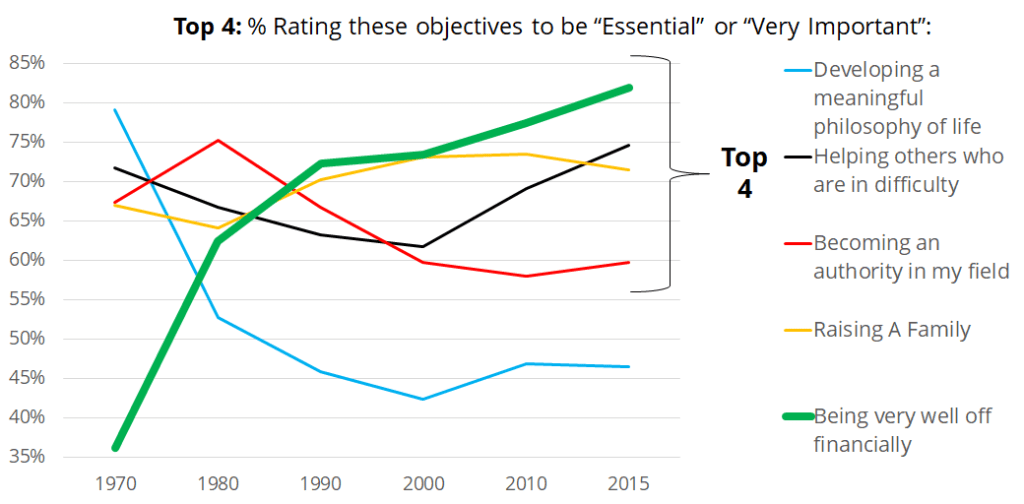


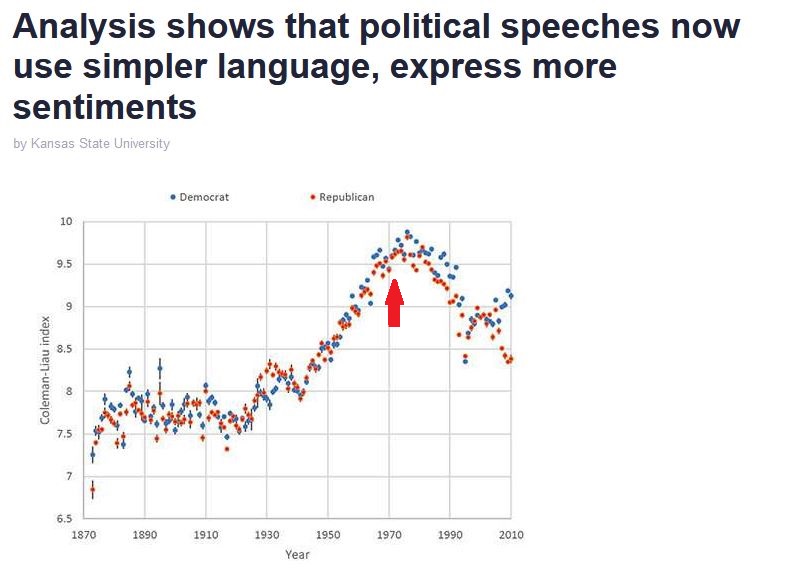

A small selection from a plethora of charts that ask: “WTF Happened In 1971?“
* Francis Bacon
###
As we hit the stacks, we might recall that it was on this date in 1964 that the Surgeon General of the United States, Dr. Luther Terry, M.D., published the landmark report Smoking and Health: Report of the Advisory Committee to the Surgeon General of the United States saying that smoking may be hazardous to health– and sparking national (and worldwide) anti-smoking efforts. While it wasn’t the first such declaration (nor even the first declaration by a U.S. official), it is notable for being arguably the most famous such declaration for its lasting and widespread effects both on the tobacco industry and on the worldwide perception of smoking. A federal ban on cigarette advertising on television went into effect… in 1971.

“Our goal at DOOM! will be to consider a plurality of futures and then doing everything that we can to prevent nuclear war, oblivion and ruin”*…

Readers may recall a recent post featuring an essay written by GPT-3, a machine-learning language model: “Are Humans Intelligent?- a Salty AI Op-Ed.” Our friends at Nemesis (@nemesis_global; see here) have upped the ante…
The end of trends has been heralded by various outlets for years (see here, here and many more on our Are.na channel).
But COVID time is crazy. We had a hunch that the hype cycle itself was finally in its true death throes – related to economic collapse, popular uprising, a general sense of consumer fatigue, and the breakdown of a consensus reality in which such trends could incubate. Since trends are a temporal phenomenon (they have to start, peak, fade away, typify a time, bottle the zeitgeist, etc.) we began with a simple survey about the breakdown of narrative time, first circulated through our personal social media accounts…
Then we ran the same questions through an online survey distributed to 150 randomly chosen respondents, deployed in collaboration with General Research Laboratories. These responses, which will likely appear in a future memo, ranged from deeply personal to millenarian to an extreme form of ‘new optimism’.
Then our process took a crazier turn. In July 2020, OpenAI released GPT-3 for beta testing – a natural language processing system (colloquially, an “AI”) that uses deep learning to produce human-like text. K Allado-McDowell, writer, co-founder of the Artists + Machine Intelligence program at Google AI and friend of Nemesis, had started doing experimental collaborative writing with GPT-3. By exploring its quirks, K was already building an empirical understanding of GPT-3’s ability to articulate the nature of consciousness, memory, language, and cosmology… We were drawn to the oracular quality of the text generated by GPT-3, and became curious about how it could interact with the material we had gathered.
With the generous help of K – who had quickly become a skilled GPT-3 whisperer – we began feeding it our survey results, in the form of essayistic synopses that summarized the key points of the respondents and quoted choice answers. We left open-ended, future-facing sentence fragments at the end of these and let GPT-3 fill in the rest, like a demented version of Gmail’s suggestive text feature….
As we worked, GPT-3 quickly recognized the genre of our undertaking: a report concerned with the future written by some kind of consultancy, expert group, or think tank. So it inadvertently rebranded us, naming this consultancy DOOM!…
What follows is a text collaboratively composed by Nemesis, GPT-3, K Allado-McDowell and our survey respondents, but arguably authored by none of us, per se. Instead you could say this report was written by the “third mind” of DOOM! which spontaneously arose when we began to process this information together with the conscious goal of generating predictions about the future. The outputs of our GPT-3 experiments have been trimmed, edited for grammar, minorly tweaked and ordered into numbered chapters….
An AI-written “report of the future,” eminently worthy of a close reading at (at least) two levels: “The DOOM! Report.”
* GPT-3’s renaming of and mission statement for its “client”
###
As we welcome contemplate centaurs, we might we might send freaky (if not altogether panicked) birthday greetings to John W. “Jack” Ryan; he was born on this date in 1926. A Yale-trained engineer, Ryan left Raytheon (where he worked on the Navy’s Sparrow III and Hawk guided missiles) to join Mattel. He oversaw the conversion of the Mattel-licensed “Bild Lili” doll into Barbie (contributing, among other things, the joints that allowed “her” to bend at the waist and the knee) and created the Hot Wheels line. But he is perhaps best remembered as the inventor of the pull-string, talking voice box that gave Chatty Cathy her voice.

You must be logged in to post a comment.