Posts Tagged ‘Grand Ole Opry’
“Listening is like running down a mountain on a switchback trail, the sound of surprise generating its own momentum. There’s a punk glee inside the bluegrass craft– and a punk vehemence inside the bluegrass smile.”*…
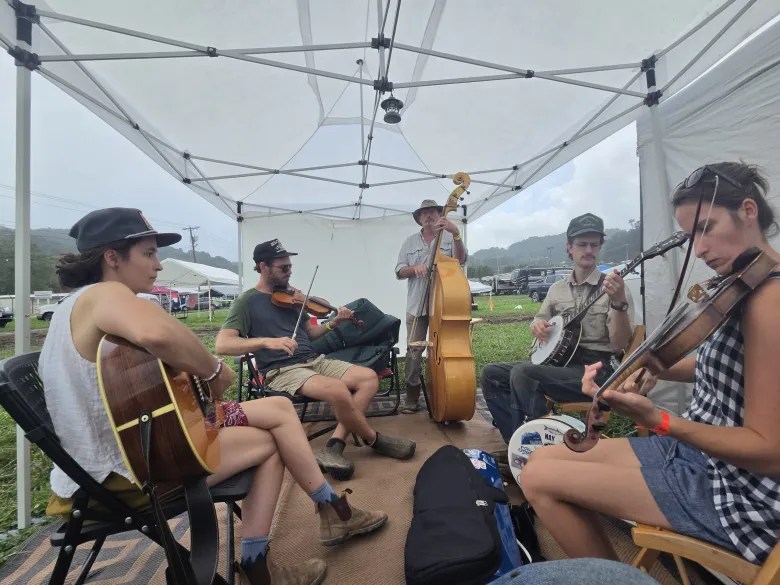
On the heels of Hardy Strictly Bluegrass [and here], Warren Hellman‘s gift to San Francisco, the most recent annual installment of which was last weekend, a lovely piece by David Alm on a more traditional event…
I got off Interstate 81 to give my soul a break. The back roads of southwest Virginia wind, crest, and plunge through lush valleys of oak, poplar, birch, and maple trees. It’s easy to lose track of time and distance there. People drive slower. Cows graze in pastures. And there are no placards festooned with Motel 6 and Starbucks logos, flattening the American landscape into a homogeneous blur. Any signs you might see are low to the ground and handmade, protesting a data center, for instance, or thanking Jesus.
I’d gone to this rural pocket of the country for the 90th annual Old Fiddler’s Convention in Galax, an independent city of just under 7,000 near the North Carolina border whose population, for six days in early August, balloons to around four times that. They arrive in RVs and Casitas, camper vans and cars to stake out 20-by-35-foot plots in Felts Park, a 28-acre fairground in the heart of Galax, transforming it into a massive, muddy parking lot sprinkled with portable toilets and a cluster of food trucks, offering loaded potatoes, funnel cake, and blooming onions.
The Old Fiddler’s Convention—or just Galax, as the diehards call it—is the oldest and largest fiddlers’ convention in the world, a place where banjo pickers, guitar players, and other maestros of old-time strings gather to see how they stack up. Founded in 1935, Galax has been canceled only twice since then: once during World War II, due to travel restrictions, and again in 2020, due to the COVID-19 pandemic. Many Galaxers have been going every year for decades, some for as long as they’ve been alive.
There are scads of rules: If you play clawhammer-style banjo in the bluegrass band competition, you will get disqualified. Same if you play bluegrass-style banjo in the old-time competition. If you break a string while performing, you must stop immediately. Playing time during competition is limited to two minutes and 30 seconds. And, crucially, no electric instruments of any kind are allowed, either on stage or in the tightly packed fairgrounds, where self-described hillbillies, accountants, firefighters, and session musicians pick day and night in blistering, impromptu jams amid the RVs.
One does not merely attend Galax. It’s not a music festival. There are no headliners, and no full-set performances. There is a single stage, and over the course of six days, contestants take it one after another to play one song for a panel of judges and a smattering of spectators. There are more than a dozen categories, little changed in the past century: old-time fiddle, guitar, dulcimer, folk song. Cash prizes for individual players range from $35 to $285; a campsite and contestant pass together cost $175. “The prestige of being judged a ‘winner at Galax,’ and the respect for one’s musical talent that goes along with it, far outweighs any monetary award,” wrote Fred Burton in the March 1984 issue of Bluegrass Unlimited…
…
… An old-time jam goes something like this: Anywhere from two to umpteen musicians gather in a circle, knee-to-knee, and someone—usually the fiddler—calls a tune. Before you know it, you’re carried away by a cyclone of fiddles, mandolins, banjos, and guitars, all locked into a swirling rhythm that can, when it’s good, take you to church.
The tradition dates to the mid-1700s, when Scots-Irish immigrants first settled in Appalachia. Even then, coastal property was for the elite, forcing poorer immigrants inland and south, through the Shenandoah Valley to southwest Virginia, where land was plentiful and cheap. Their music quickly took root. “The Scots brought fiddles and liquor,” Ted McAllister, one of my neighbors in Felts Park, told me. “The Germans brought church music and beer.”
Over time, Scottish fiddle tunes evolved, as oral traditions do, and began to mix with the musical traditions of enslaved Africans, who had brought with them gourd instruments that would evolve into the American banjo, along with rhythms the Scots had never heard before. Old-time music, in other words, is the music of diasporas, fed into a blender and then worked into a froth. A lot of traditional folk songs came out of this period, too. One that I learned at Galax, “Going to the West,” tells the story of a young man who leaves the mountains of his birth, “where labor is in vain,” to seek the fertile plains out west. It’s the story of my own Scottish forebears, who settled in South Dakota before moving to what is now suburban Chicago, and later, Florida.
Bluegrass, by contrast, was born in the 1940s, when Bill Monroe and The Blue Grass Boys took those mountain sounds, combined them with Southern church music and blues, and tightened it all into something you might call an uncle of rock ’n’ roll. There’s a reason that Billy Strings plays to sold-out arenas and pickers from around the world can play classics like “Blue Ridge Cabin Home” at the drop of a one-chord.
Where bluegrass is punchy and clean, designed for the stage, old-time is ecstatic, designed for participation. Bluegrass jams attract spectators who marvel at the players’ pyrotechnics; old-time jams get people on their feet. At Galax, some folks drag big pieces of plywood around the fairgrounds looking for old-time jams, where they’ll lay the board down at the edge of the circle and dance. Flatfooters they’re called: the percussion section…
Eminently worth reading in full.
In a southwest Virginia fairground, thousands of musicians gather every August to keep a centuries-old tradition from flickering out: “A Place Among the Fiddlers,” from @longreads.com.
###
As we pick, we might recall that it was on this date in 1939 that George D. “Judge” Hay, the creator and producer of The Grand Ole Opry, invited Bill Monroe and the Blue Grass Boys to audition for a spot on the prestigious radio broadcast. The audition was a success, and Monroe chose “Muleskinner Blues” for their debut. According to observers, when the curtain went up, the audience and Opry regulars alike (including stars such as Roy Acuff, Uncle Dave Macon, and Pee Wee King) were awed by the furious tempo of the Blue Grass Boys. Band member Cleo Davis later observed that the audience “couldn’t think as fast as we played.”
Monroe quickly scored a recording contract, and switched personnel to establish the line-up that became famous, surrounding himself (on mandolin) with Lester Flatt (guitar), Earl Scruggs (banjo), Chubby Wise (fiddle), and Cedric Rainwater (bass). Together, they polished the traditional mountain music celebrated at Galax into a genre that took its name from their group. and Monroe is remembered as “the Father of Bluegrass.”

“Unless we change direction, we are likely to end up where we are headed”*…

The economy is in a very confusing place. Happily, the good folks at Full Stack Economics weigh in with data in the form of illuminating charts….
It’s a turbulent time for the US economy. The economy largely shut down in March 2020 only to come roaring back a year later with the highest inflation in almost 40 years. No one is sure what’s going to happen next.
At Full Stack Economics, we believe that charts are an essential way to understand the complexities of the modern economy. So in recent weeks, I’ve been looking far and wide for the most surprising and illuminating charts about the US economy. I’ve compiled 18 of my favorites here. I hope you enjoy it…
Speaking for myself, I did enjoy (and appreciate) it. I’m still confused, but I’m confused at a much higher level.
Take a look for yourself: “18 charts that explain the American economy,” from @fullstackecon (@AlanMCole and @binarybits)
* Chinese proverb (often mis-attributed to Lao Tzu)
###
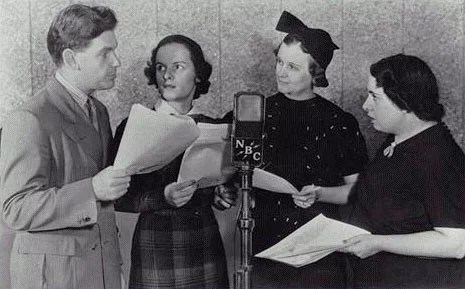
As we ponder the portents, we might recall that it was on this date in 1937, on NBC Radio, that The Guiding Light premiered. A soap opera created by Irna Phillips, who helped develop the template for the day-time serial drama targeted to women, it ran for a decade before shifting to CBS Radio, where it ran until 1956. But in 1952, CBS transplanted the series to television, where it ran as a daily (weekday afternoon) staple until 2009.
Irna went on to create other soaps (e.g., Another World) and in the process to introduce and mentor the giants of the form (including William J. Bell, James Lipton, and the great Agnes Nixon). With 72 years of radio and television runs, Guiding Light is the longest running soap opera, ahead of General Hospital, and is the fifth-longest running program in all of broadcast history– behind only the country music radio program Grand Ole Opry (first broadcast in 1925), the BBC religious program The Daily Service (1928), the CBS religious program Music and the Spoken Word (1929), and the Norwegian children’s radio program Lørdagsbarnetimen (1924–2010).
“I’m not offended by all the dumb blonde jokes because I know I’m not dumb… and I also know that I’m not blonde”*…

– Dolly Parton helped bring the seminal and beloved TV show Buffy the Vampire Slayer into existence. Her production company, Sandollar Productions, will be familiar to you from the end credits.
– The Ku Klux Klan sent Dolly Parton death threats in the mid-2000’s because Dollywood hosted an annual “Gay Day.” Dolly: “God tells us not to judge one another, no matter what anyone’s sexual preferences are or if they’re black, brown or purple. And if someone doesn’t believe what I believe, tough shit.”
– Dolly Parton once lost a Dolly Parton drag contest.
“I just over-exaggerated—made my beauty mark bigger, the eyes bigger, the hair bigger, everything. All these beautiful drag queens had worked for weeks and months getting their clothes. So I got in the line and I walked across, and they just thought I was some little short gay guy. I got the least applause.”
… just some of The Awl‘s “Facts about Dolly Parton” (on the occasion of her 70th birthday).
* Dolly Parton
###
As we swear our undying love, we might also remark on Emmylou Harris. A solo artist, bandleader, interpreter of other composers’ works, singer-songwriter, backing vocalist, and duet partner, she has collaborated with artists including Gram Parsons, Bob Dylan, John Denver, Linda Ronstadt, Roy Orbison, the Band, Patty Griffin, Mark Knopfler, Delbert McClinton, Guy Clark, Willie Nelson, Bright Eyes, Rodney Crowell, John Prine, Neil Young, Steve Earle, Ryan Adams…. and of course, Dolly Parton. Harris became a member of the Grand Ole Opry on this date in 1992.

You must be logged in to post a comment.