Posts Tagged ‘The Price Is Right’
“How television stages the world becomes the model for how the world is properly to be staged”*…
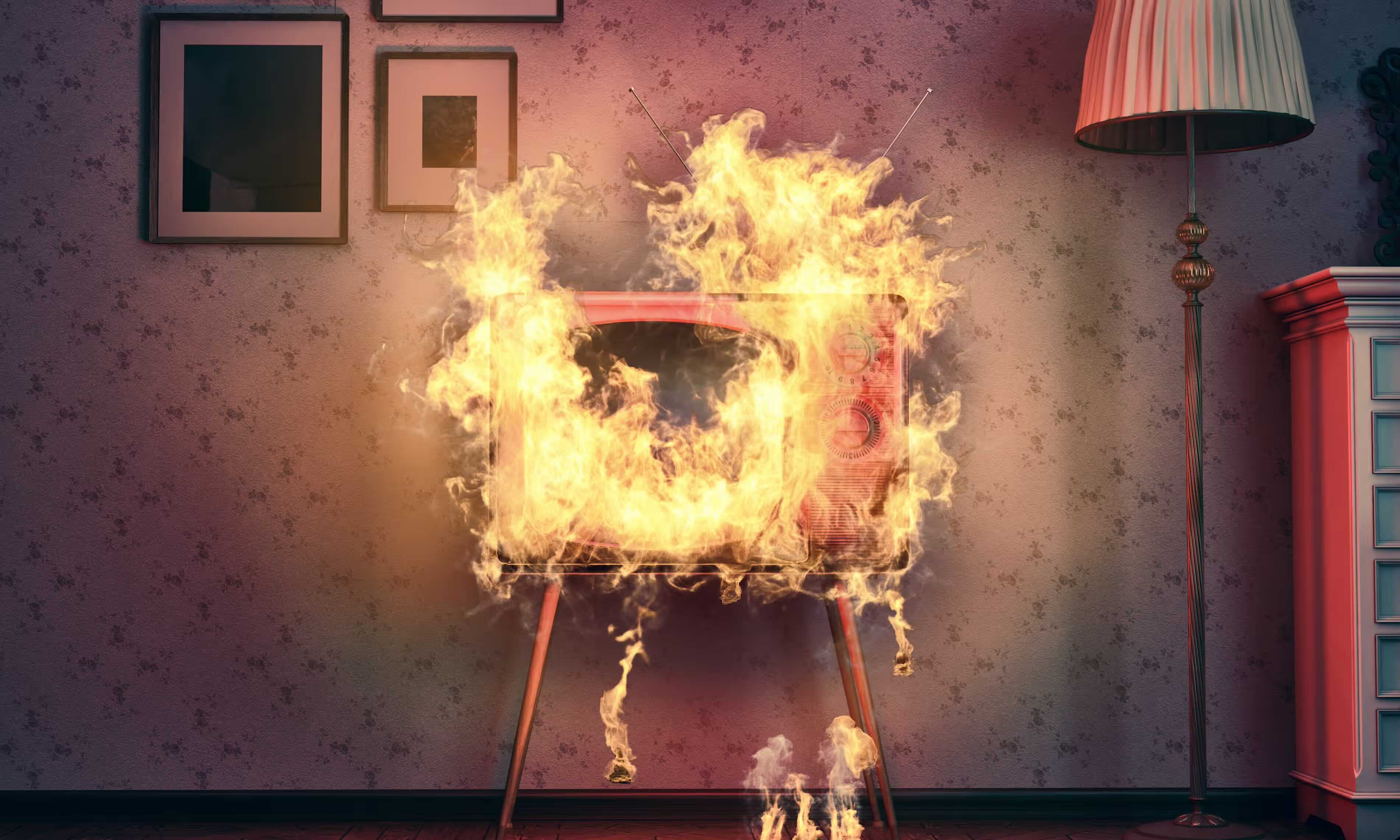
… and, as Mark Sweney reports, that staging is undergoing a fundamental transition. Case in point: Warner Bros Discovery’s recent massive write-down of traditional broadcast assets as it struggles to play catch-up with streaming and video services…
Warner Bros Discovery’s announcement… of a $9bn (£7bn) writedown in the value of its TV networks is a stark acknowledgment of the damage the streaming wars are inflicting on traditional broadcasting models.
The astonishing figure, which pushed the US entertainment group to a quarterly net loss of $10bn (£7.9bn) and sent shares sliding 12% in early trading on Thursday, lays bare how channels such as CNN, TLC and the Food Network can no longer rely on a captive cable subscriber base.
The rapid consumer shift away from high-priced TV packages, coupled with the inexorable decline in advertising, has forced traditional TV companies to invest billions in low-cost streaming services to catch up with first movers such as Netflix.
The question is now whether companies such as WBD – home to TV and film content including Furiosa: A Mad Max Saga, Godzilla x Kong: The New Empire, The Big Bang Theory, Succession, Friends and all Olympics events – can build the scale and make significant profits from their streaming operations before the death of linear television delivered by cable, satellite or aerial…
…
… Disney has more than 200 million global streaming subscribers, and WBD exceeds 100 million globally, with Discovery+ now the fastest-growing service in the UK thanks to winning the rights to show every Olympic discipline. But the battle is not just to continue to drive scale.
Boosting revenue and profits per subscriber has become critical through strategies including rapid rounds of price increases – Disney has just announced a set of price rises for later this year – as well as driving slightly cheaper ad-funded tiers to pull in cost-conscious consumers.
While traditional TV companies struggle with managing the decline in their legacy businesses, with drastic rounds of cost-cutting after a decade of profligate spending on content in the first decade of the streaming wars, Netflix points to a viable future.
The streaming giant, which once struggled with mounting losses running into tens of billions of dollars, has seen its market value surge by more than 50% over the past year after turning the profitability corner while continuing to see significant growth in subscribers.
WBD’s chief executive, David Zaslav, who has considered breaking up the company but concluded that is not currently the best option, said the market was being hit by a “generational disruption” that requires traditional TV companies to take “bold, necessary steps”.
Richard Broughton, director at Ampere Analysis, said: “Legacy TV businesses are in decline but the shift is not so rapid that it can’t be managed. There are still a lot of broadcast TV viewers, they have the time to pivot to profitability in the streaming world.”…
Dealing with disruption: “‘Traditional TV is dying’: can networks pivot and survive?” from @marksweney in @guardian.
Corollary damage: “two venerable TV trade publications, Broadcasting & Cable and Multichannel News, will shut down“
See also: “The music industry is suffering from a streaming hangover” (gift link) and on a more upbeat note, “Radio shows surprising resilience even in a rapidly changing media world.”
For (just one example of) the kind of speculation that tectonic shifts of this sort can elicit: “Why Apple should buy Warner Bros. Discovery. No, seriously.“
And for one take on why all of this is underway: “The Addiction Economy.”
* Neil Postman, Amusing Ourselves to Death
###
As we muse on media, we might spare a thought for Dominick George “Don” Pardo Jr.; he died on this date in 2014. A member of the Television Hall of Fame, Pardo had a 70-year tenure with NBC, working as the announcer for early incarnations of such notable shows as The Price Is Right, Jackpot, Jeopardy!, Three on a Match, Winning Streak, and NBC Nightly News. His longest, and best-known, announcing job was for NBC’s Saturday Night Live, a job he held for 38 seasons, from the show’s debut in 1975 until his death.

“We all live in each other’s shadow”*…

Further, in a fashion, to yesterday’s post, Nathan Gardels, editor of Noema Magazine, on a new book by Children of a Modest Star, “A clear-eyed and urgent vision for a new system of political governance to manage planetary issues and their local consequences” by Jonathan Blake and Nils Gilman…
Globalization was about markets, information flows and technology crossing borders. The planetary is about borders crossing us, embedding and entangling human civilization in its habitat. That, in a nutshell, is the core thesis of a new paradigm-shifting book by Jonathan Blake and Nils Gilman titled “Children of a Modest Star: Planetary Thinking for the Age of Crises.”
The concept of planetarity describes a new condition in which humans recognize not only that we are not above and apart from “nature,” but that we are only beginning to understand the complexities of our interdependencies with planetary systems.
“If Copernicus’s heliocentrism represented the First Great Decentering, displacing the Earth from the center of the heavens, and Darwin’s theory of evolution by natural selection the Second Great Decentering, then the emergence of the concept of the Planetary represents the Third Great Decentering, and the one that hits closest to home, supplanting the figure of the human as the measure and master of all things,” Blake and Gilman write.
As further argued by the authors in a forthcoming Berggruen Press volume, “the Planetary as a scientific concept focuses on the Earth as an intricate web of ecosystems, with myriad layers of integration between various biogeochemical systems and living beings — both human and non-human. Drawing on earth system science and systems biology, this holistic understanding is being enabled by new planetary-scale technologies of perception – a rapidly maturing technosphere of sensors, networks, and supercomputers that collectively are rendering the planetary system increasingly visible, comprehensible and foreseeable. This recently-evolved smart exoskeleton — in essence a distributed sensory organ and cognitive layer — is fostering an unprecedented form of planetary sapience.”
The open question is how, and if, human governance in the late-stage Anthropocene can align with the knowledge we are now attaining.
Paradoxically, planetary-scale connectivity is also what divides us. Convergence entails divergence because the universalizing and rationalizing logic of technology and economics that ties the world together operates in a wholly different dimension than the ethos of politics and culture, rooted in emotion and ways of life cultivated among one’s own kind.
While the emergent world-spanning cognitive apparatus may be sprouting the synapses of a synchronized planetary intelligence, it clashes with the tribal ingathering of nations and civilizations that remain anchored in their historical and spatial identity.
Consequently, this new domain of encompassing awareness is — so far — as much the terrain of contestation as of common ground…
[ Gardel unpacks Blake’s and Gilman’s proposition, which would devolve some decision-making on some issues, even as it globalized others. By way of addressing the Herculean challenge of creating the equitable, workable global system for addressing global challenges they [propose– a task made the more difficult by the divergence in values discussed yesterday— he invokes an episode from American history…]
… At the turn from the 19th to the 20th century, America was morphing from an agricultural, largely rural society into an urban and industrial one. Cultural norms and familiar ways of living were in upheaval. Political institutions that had become dysfunctional were challenged — not so unlike the disruptive transition to digital society and planetarity we are experiencing at present.
The turmoil of transition in those days gave birth to what became known as the Progressive Era. Its progenitors sought to address the new social concerns of a more complex society — working hours and safety conditions in newfangled factories, women’s suffrage, public health exposure from mass food processing, poor urban infrastructure from housing to water and electricity, the concentration of power in the railroad and banking trusts as well as exploitative private utility companies.
The Progressive Era response in the American states was to move in two directions at once. The movement promoted direct democracy whereby citizens could make laws and enforce accountability directly, skirting the corrupt and bought-off legislators of the patronage machines, through the citizens’ ballot initiative, the referendum and the recall of elected officials. At the same time, elected Progressive governors delegated authority to nonpartisan experts for commissions that regulated commerce, banking, railroads and electric utilities on behalf of the public interest. Professional city managers, unelected but accountable to direct democracy and the elected officials who appointed them, came into being for the first time to competently administer ever more complex urban environments.
In time, the reforms that resulted from this pairing of citizen engagement and technocracy percolated up to the national level into institutions such as the Interstate Commerce Commission or the Food and Drug Administration and led to the abolition of child labor, the eight-hour working day and women’s right to vote.
The point of this brief detour into American history is not to suggest the unworkable proposition of direct democracy at a planetary scale, but simply to say that it is well within the capacity of the political imagination to marry modes of consent with delegated authority in a way that confers legitimacy.
The paradigm shift and governing innovations Blake and Gilman propose in “Children of a Modest Star” are no less realizable over time than what has come before because, now just as then, changing circumstances demand it…
A paradigm shift from globalization to planetary governance? “The Third Great Decentering,” @NoemaMag @JonathanSBlake @nils_gilman.
* Irish proverb (in Gaelic, “Ar scáth a chéile a mhaireann na daoine”), quoted by Irish Prime Minister Michael Martin
###
As we think systemically, we might recall that on this date in 1998 The Price Is Right aired its milestone 5,000th episode (the longest-running game show in history, it’s over 10,000 episodes to date, and still chugging along). Every prize given away on that episode was a car.
“He who controls the money supply of a nation controls the nation”*…

In all economies, neither the amount of deposits nor the money supply hinge on national or household savings. When households and companies save, they do not alter the money supply. Banks also create deposits/money out of thin air when they buy securities from non-banks. As banks in China buy more than 80 per cent of government bonds, fiscal stimulus also leads to substantial money creation. In short, when banks engage in too much credit origination — as they have done in China — they generate a money bubble.
Over the past 10 years, Chinese banks have been on a credit and money creation binge. They have created Rmb144tn ($21tn) of new money since 2009, more than twice the amount of money supply created in the US, the eurozone and Japan combined over the same period. In total, China’s money supply stands at Rmb192tn, equivalent to $28tn. It equals the size of broad money supply in the US and the eurozone put together, yet China’s nominal GDP is only two-thirds that of the US. In a market-based economy constraints are in place, such as the scrutiny of bank shareholders and regulators, which prevent this sort of excess. In a socialist system, such constraints do not exist. Apparently, the Chinese banking system still operates in the latter.
[Emphasis added]
[image above: source]
* James A, Garfield
###
As we practice parsimony, we might recall that it was on this date in 1972 that the longest running game show on American television, The Price is Right, hosted by Bob Barker, premiered on CBS. Originally called The New Price Is Right to distinguish it from the earlier/original version (1956–65) hosted by Bill Cullen, it proved so popular in its own right that, in June 1973, the producers decided to drop the word “New” from its title. In 2007, Drew Carey took over from barker as host. Now in its 47th season, The Price Is Right has aired over 8,000 episodes since its debut and is one of the longest-running network series of any sort in United States television history.

Who – Where – How?…

In 1949, a solicitor’s clerk in Birmingham, Anthony Pratt, sold the rights to “Murder,” a board game he had invented, to English publisher Waddington’s, which in turn licensed North American rights to Parker Bros. Later that year, the two companies introduced, respectively, Cluedo and Clue…. since when, tens of millions of people around the world have struggled to deduce who killed poor, perpetually-murdered Mr. Black (or “Mr. Boddy” in North American versions)– and have read the children’s books, played the video and iPod/iPhone games, put together the jig saw puzzles, and seen the television games shows, the Broadway musical, and the feature film all based on the game.

Readers can trace the evolution of the game here (from whence, the images above) or here, and can discover the (surprisingly complex) back-stories of the characters here.
As we adjust our deerstalkers, we might recall that it was on this date in 2007 that the continuity of America’s longest-running television game show, The Price Is Right, was maintained, as Bob Barker passed the microphone to Drew Carey. Barker had taken over in 1972 from founding host Bill Cullen, who premiered the show in 1956.
 Carey and Barker (source)
You must be logged in to post a comment.