Posts Tagged ‘rock’
“Music is liquid architecture and architecture is frozen music”*…
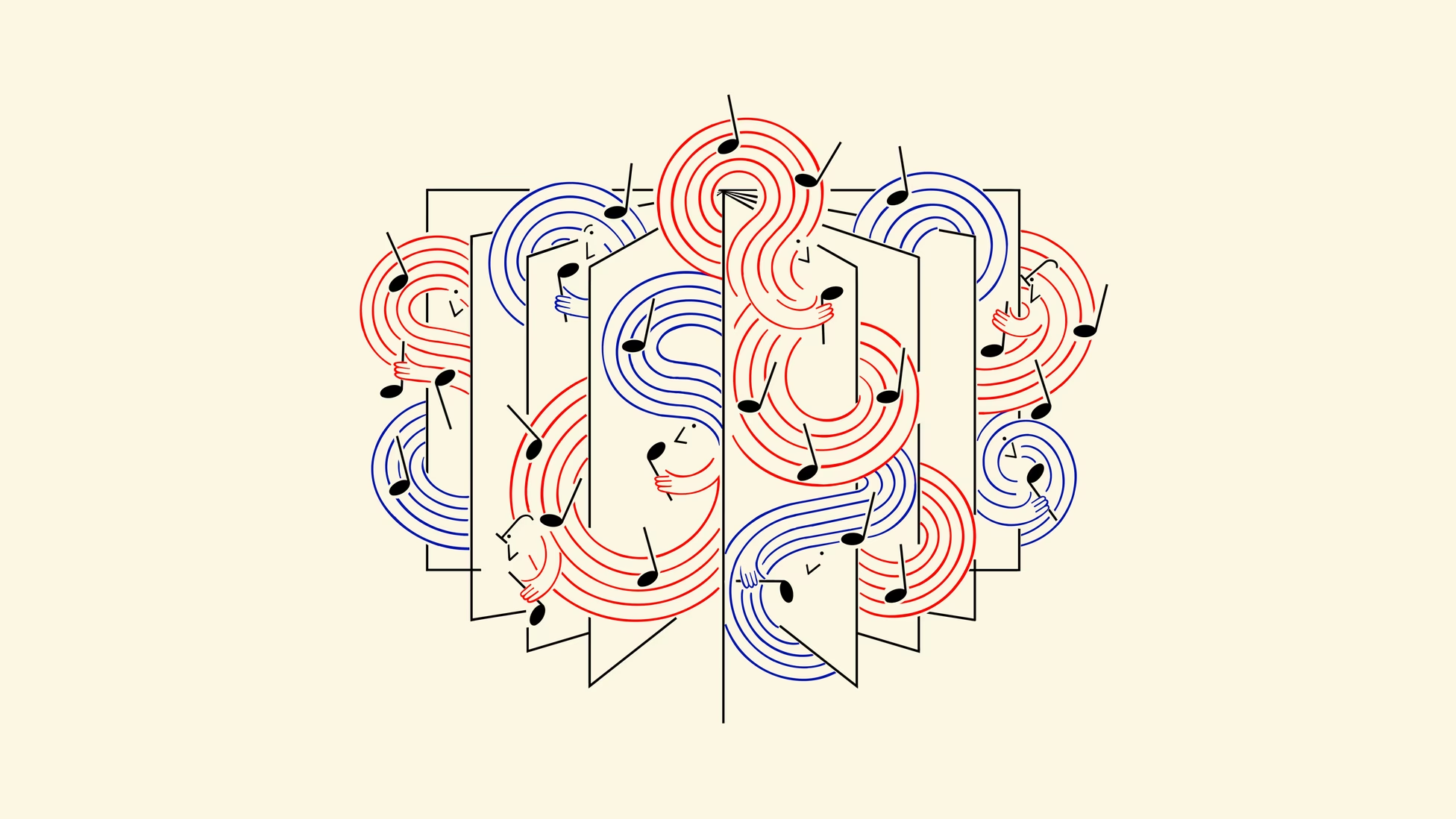
“Classical music” is a label applied to radically different compositions across more than 1,000 years of history. Composer, conductor, writer, pianist, and 2018 MacArthur Fellow Matthew Aucoin that we need a better definition…
… What is classical music, whom is it for, and what about it is worth defending?
Our answers to these questions will depend on what exactly we love about this music, and what we care about preserving, enriching, and expanding. Claiming that classical music deserves a prominent place in American culture merely because we want to safeguard a particular sound, style, or cultural or ethnic lineage—“music that sounds like Brahms,” or “music from one of three Central European countries”—would be a losing cause.
But a better answer is out there. Rather than defend the “classical” in classical music, I want to champion a particular creative process. What links Hildegard von Bingen and Kaija Saariaho, Johann Sebastian Bach and George Benjamin, is not a specific sound or aesthetic but a shared technology of transmission. At its core, classical music isn’t “classical.” It is written music.
By “written music,” I mean music that comes into being through the act of composition. Music from practically any tradition can, of course, be written down. If you’re a Beatles fan, you can buy a collection of Beatles sheet music, and if you want to plunk out your favorite jazz standard, you can order a copy of The Real Book, which contains the essential harmonic and melodic information for hundreds of well-traversed tunes. (Both a Real Book and a 1,136-page tome called The Beatles: Complete Scores are sitting on my piano as I write this.)
Though all music can be documented and experienced in multiple ways—scores, recordings, live performances—one approach to distinguishing musical traditions is to ask which form a given tradition treats as authoritative. It would be odd, for instance, to claim that a collection of printed scores constitutes a definitive document of the Beatles canon, because the unquestioned reference point is the band’s studio albums. My Beatles compendium proudly declares its own contingency: Printed on the front cover is an all-caps proclamation that its pages contain FULL TRANSCRIPTIONS FROM THE ORIGINAL RECORDINGS.
In other words: albums first, scores later. Taylor Swift’s 2019 decision to rerecord her earlier albums was a potent gesture, even a radical one, precisely because in pop music, the studio album typically possesses an authority upon which all subsequent iterations—whether live performances or written transcriptions—are based. Only by returning to the studio could Swift achieve control over her master recordings and literally set the record(s) straight.
Jazz musicians and aficionados tend to have a different perspective. Even though certain albums (Kind of Blue, A Love Supreme ) have attained the status of holy relics in the minds of many listeners, I think most jazz lovers would agree that the genre is not defined by the worship of specific studio recordings. Fans are more likely to value the evanescent moment of live performance, with its potential for spontaneous expression, for the very reason that a familiar tune can sound different every time it’s performed. A major artist such as Miles Davis might have performed and recorded a certain song—“My Funny Valentine,” for example—many times throughout his career, and there’s no reason to automatically treat a particular performance as the authoritative version. In spite of The Real Book’s name, jazz musicians rarely consider the printed score to be “the real thing” either. No self-respecting jazz musician would play a Real Book score exactly as written.
Western classical music is an unusual case. The reference point for a given piece of music is the score, rather than a studio recording or a live performance. Beethoven’s symphonies have been recorded hundreds—if not thousands—of times, and they’ve been performed many more times than that, but every one of those performances and recordings refers to the same score. For a composer, the score is the foundational site of creativity, and the act of score-making links together artists who could hardly sound more different from one another—say, an Italian composer of the late Renaissance and early Baroque period like Claudio Monteverdi and a 20th-century American avant-gardist like John Cage. Even an extreme case, such as Cage’s famous 4’33”—a work in which performers refrain from playing their instrument for four minutes and 33 seconds—depends on its score, a simple and playful set of written instructions. (In fact, to a greater degree than most notated music, 4’33” is inconceivable as a work of art without those directions.)
If we let ourselves be guided by this basic question—which musical artists regard the score as a creative starting point?—we arrive at the broadest and most welcoming definition of “classical” music. All kinds of unexpected affiliations and affinities emerge beyond music that’s typically thought of as belonging to the tradition. Many of the big-band masterpieces of Duke Ellington and Billy Strayhorn, for instance, strike me as indistinguishable, in their creative genesis, from orchestral works by Igor Stravinsky and Aaron Copland that were being written around the same time: They are notated in exquisite detail, usually for large ensembles, and Strayhorn’s gorgeously balanced wind and brass voicings remind me in particular of Stravinsky’s. To my ear, Strayhorn is a symphonist at heart. His work—in its fundamental writtenness—has more to do with that of many so-called classical composers than it does with, for example, that of an artist like Ornette Coleman, a free-jazz master who ostensibly hails from a tradition that is continuous with Strayhorn’s, but whose method could hardly be more different.
Written music matters for the same reason written langauge does: To write is to free oneself from the constraints of memory. It’s possible, in a novel or an essay or a nonfiction narrative or a book of poems, to devise an aesthetic structure full of details, depths, and digressions that would be far harder to construct in a purely oral storytelling tradition, one in which verbal transmission works through either memorization or improvisation. When you write, you don’t simply set down your thoughts; in the process of writing, your thoughts are transformed, and allowed to assume a newly complex shape—the miraculous scaffolding that emerges from the accumulation of thoughts on the page.
Our world is awash in written language, but not written music. The musical genres that dominate mainstream American culture are all more or less oral traditions….
… Musical literacy is a highly specialized skill; to become a fluent reader of music, a student needs to be given the kind of focused instruction that not all public schools have the funding to provide. Exposure to music education, beyond the rudiments, all too often becomes a question of whose family can afford expensive private lessons. We can react to this fact by feeling guilty about it, and letting notated music be tainted by its association with elitism, or we can push for an expansion of musical education. We all understand that to teach a child to read and write is to endow them with potent means of expression and self-discovery. Why should musical literacy be any different? Even a basic grounding in musical notation can transform a child’s sense of what can be communicated to another human being, especially—and this is crucial—if notation is treated as a tool of creativity rather than simply an unpleasant test of the ability to play all the right notes or else.
If we understand that writing, in music as in language, has the potential to be a force for liberation, and that it can transcend localized questions of style and aesthetic, we might come to a fuller sense of what music can be in our lives—the many forms it can take, the many truths it can tell. And if I could prescribe one thing for our world at this moment, it would be to deepen and expand our understanding of what it is to listen…
Eminently worth reading in full: “Do You Actually Know What Classical Music Is? Does Anyone?” (gift article) from @theatlantic.com.
* Johann Wolfgang von Goethe (though we might recall that Martin Mull observed that “writing about music is like dancing about architecture”)
###
As we read and write, we might recall that this date– National Opera Day— is the anniversary of the premiere in 1874 of Modest Mussorgsky‘s (and here) Boris Godunov at the Mavrinsky Theater in St. Petersburg. (Some sources give the date as January 27 of that year.) Mussorgsky’s only completed opera, it is considered his masterpiece.
Mussorgsky composed the work, based on Pushkin‘s 1825 play Boris Godunov (and here), between 1868 and 1873. By the 1980s In the 1980s, Boris Godunov had moved closer to the status of a repertory piece than any other Russian opera, even Tchaikovsky‘s Eugene Onegin, and is the most recorded Russian opera.

“I Want My MTV!”*…

You’ve probably seen a variation of this news on social media over the past few days: MTV officially shut down on New Year’s Eve, ending their final broadcast the same way the network started: With the clip “Video Killed the Radio Star” by The Buggles.
But those posts are misinformed. It’s New Year’s Day 2026, and MTV is still around. Granted, today the channel is playing a marathon of “The Big Bang Theory” sitcom repeats, so your interpretation of “MTV is still around” may vary…
– Variety, January 1, 2026
Indeed, the reality shows and network re-runs are still flowing. But the new owners of MTV’s parent, Paramount Global, did end its dedicated, 24/7 music channels (like MTV Music, MTV 80s, MTV 90s) at the close of 2025 across most international markets, effectively ceding the video music turf to YouTube.
So it’s a propitious moment to pause and reflect on the legacy, the impact of MTV…
… MTV, the Music Television that launched a thousand careers and redefined a generation, is finally shutting down [as a music channel]. It’s bittersweet to see it go, but it’s also a perfect moment to reflect on just how profoundly this channel, born in a blaze of sound and vision, altered the landscape of music, media, and even society itself.
It’s hard to imagine now, but before August 1, 1981, music was primarily an auditory experience. You listened to it on the radio, on records, or at concerts. The idea of a 24-hour channel dedicated solely to music videos was revolutionary, a gamble by Warner-Amex Satellite Entertainment. They saw the burgeoning popularity of music videos, then mostly promotional tools for artists, and envisioned a dedicated platform. The very first video ever played, fittingly, was “Video Killed the Radio Star” by The Buggles – a prophetic title if there ever was one.
MTV’s early days were a chaotic, vibrant mix of rock, pop, and new wave, with VJs (video jockeys) becoming household names. It was raw, experimental, and deeply intertwined with the youth culture of the 80s. But what started as a niche cable channel quickly exploded into a global phenomenon, forever altering how we consumed and understood music. So, as we bid adieu, let’s explore ten ways MTV truly changed everything…
Remember them at: “MTV: A Farewell to the Channel That Changed Our World,” from Eric Alper (@thatericalper.com)
* The tag line of MTV’s initial ad campaign (aimed at getting cable viewers to press their cable suppliers to carry MTV)
###
As we recollect rock, we might recall that it was on this date in 1972 that David Bowie released “Changes,” from his 1971 album Hunky Dory. Co-produced by Bowie and Ken Scott, it featured Rick Wakeman on piano and the musicians who would later become known as the Spiders from Mars—Mick Ronson, Trevor Bolder and Mick Woodmansey.

“When I use a word, it means just what I choose it to mean—neither more nor less”*…

In an piece adapted/updated from his recent book, Unabridged: The Thrill of (and Threat to) the Modern Dictionary, Stefan Fatsis explores process(es) that determine our “Word[s] of the Year”…
Thirty-five years ago, the late English professor Allan Metcalf [see here] had an idea. “I was thinking that Time magazine has its Person of the Year,” he told me, “and why can’t we do for words what Time did for people?”
Metcalf assumed that the language pros at the American Dialect Society, which held the first WOTY vote in 1990, would nominate words “headed straight for our everyday vocabulary and secure places in the dictionaries.” But he misjudged human behavior. Lexicography is sober research committed quietly and alone. Word of the Year is a key party: You can’t be sure who you’ll go home with. The inaugural winner, bushlips, meaning “insincere political rhetoric,” barely lasted a news cycle.
After some eye-rolling, criteria were established: Was the word completely new? Had it been used before in other contexts? Was it “a major focus of human activity or behavior” in the previous year? Did it have staying potential? WOTY could be brand-new or newly popular. But it had to have been used widely and reflect the zeitgeist of the annum gone by.
Today there are around a dozen Words of the Year (Word of the Years?) in English, and WOTY season runs from late fall to early January. Dictionaries duke it out for attention, some touting their scientific methodology for picking a winner, others offering a nebulous alchemy of number-crunching and feel. The dialect society, the WOTY OG, conducts a live popular vote in a hotel ballroom at a language conference, the outcome based more often than not on vibes alone.
No matter the formula, selecting one word to define a year is serious business. It’s about the sharp lines of language and usage, how society adopts and spreads new terminology, and, increasingly, the dramatic ways that social media influence the way we write, talk, and interact. As a culture we’re forever searching for ways to make sense of our big, complicated, confusing world. WOTY neatly boxes up 365 days in a single, simple word (technically a “vocabulary item”; phrases, compounds, and affixes also are eligible). It’s media catnip and hot-take gold.
“It gives people this sense of ownership,” says New York Times Wordplay columnist Sam Corbin, who’s writing a book about what she calls the WOTY-verse. “We have always been exploring new ways to fill gaps in vocabulary but also respond to culture with words. It’s delicious.”
For the dialect society, which crowns a champ last, the job is so weighty that it takes two days to pick a winner—nominations one night, balloting the next. I’ve participated in around a decade’s worth of votes. I check my journalistic objectivity at the door and do my linguistic duty. Every year, a pattern emerges. A few words totally surprise, some a product of Gen Z (or Gen Alpha) or gamer culture that’s bypassed middle-aged me (hello, skibidi, a 2023 nominee). Recency bias is common—as you’d expect in a vote of trending language. So is observer bias, with crowd approval often directly proportional to shock value (the suffix -ussy winning in 2022; rawdog in 2024).
Looking at the victorious words from a distance, you might nod in recognition of a specific event (chad, 2000; bailout, 2008), cringe at terminology that dates you (World Wide Web, 1995), or wonder what the hell people were thinking (to pluto, a verb meaning to demote, as in what happened to Pluto when it was reclassified from full-fledged to dwarf planet, 2006). But that’s the genius of Word of the Year. We’re suckers for media-driven argument engines. It’s a short walk from “LeBron is better than Jordan!” to “They should have picked rizz!”
Since around 2010, when the newsy app defeated the funner nom—as in the onomatopoetic nomnomnom, to connote eating—younger voters (mostly grad students and junior faculty) have tilted the conversation away from dictionary-type words toward social media and online slang. “It’s generally who makes the best argument in the room, and you can’t predict that,” says Ben Zimmer, chair of the society’s New Words Committee.
A couple of votes stand out for me, for linguistic and cultural reasons. One was in Austin, Texas, in January 2017. Donald Trump had just been elected president, and nearly half of the WOTY nominees were related to him: post-truth, basket of deplorables, unpresidented, alt-right, fake news, locker-room banter, yuuuge. But the mood was ominous, not apocalyptic. It was, after all, pre-inauguration, pre-Charlottesville, pre-impeachments, pre-pandemic, pre-2020 election, pre-January 6, pre-felony indictments, pre-felony convictions, pre-assassination attempts, pre-2024 election, pre-ICE raids: pre-everything.
WOTY promised closure, and everyone was down for that. In the middle of the room, Dan Villareal, a linguistics postdoc, stood up. “Okay,” he said. “It’s 2016. Dumpster fire?” Earlier in the evening, the fire emoji, and also the trashcan and fire emojis used together to represent dumpster fire, won the emoji category. One of the older attendees had asked what dumpster fire meant. “It is used to describe an incredibly catastrophic situation,” Zimmer explained. “Like some people think 2016 was one long dumpster fire.”
Normalize, post-truth, and the fire emoji also got WOTY nominations—the first time an emoji had made the final group. So did woke. “Granted it’s been around a while,” cherubic Stanford linguist John Rickford, a titan in the field, said. “But only if you stay woke can you put out the dumpster fire.” The house was brought down, and I figured it was game over. But then another postdoc, Nicole Holliday, lobbied against the word—“because it was appropriated from the Black solidarity movement in the 1960s and I think that we are so late to this game and last year was anything but woke,” she said. Dumpster fire beat woke in a runoff.
The journey of the two words since then demonstrates WOTY’s unpredictability and its historical value. Dumpster fire was relatively new and the WOTY early-warning system worked; Merriam-Webster added it just 14 months later. Woke, by contrast, would take a far more disturbing linguistic ride. The dialect society voters who (literally) snapped their fingers in approval for woke would watch it get twisted by political commentators and a demagogic right-wing into what was tantamount to a slur.
The dialect society’s last two votes also feel, in hindsight, like markers. When the group gathered in New York to pick the 2023 winner, Joe Biden was president and Trump was a long shot to return to power. The Israel-Hamas war drew a nomination of ceasefire, but the Barbie movie, AI, and online slang dominated the discourse. The most spirited debate was over a word that didn’t appear in Sam Corbin’s Times write-up of the event: cunty, “having an audaciously exceptional appearance or attitude.”
The winner straddled the line between serious and fun: enshittification, meaning a gradual deterioration in the quality of internet platforms like Facebook, Twitter, and TikTok. The word captured the growing frustration with internet subservience and AI overlords. The 2024 vote, in Philadelphia, also was relatively apolitical; maybe we were all terrified about Trump’s impending inauguration. Rawdog was subversive and fun. The runner-up, sanewashing, was doomy, but more of a criticism of how the media handled Trump than of Trump himself.
Kicking off the 2025 WOTY campaign, Dictionary.com eschewed the perilous state of the union and opted for the ubiquitous (and annoying, to adults) Gen Alpha nonsense catchphrase 67 (also written 6-7 or six seven). The British dictionary Collins went with the AI term vibe coding, which it said “captures something fundamental about our evolving relationship with technology.” Other dictionaries are likely to lean into our quick descent into competitive authoritarianism and choose an existing word that was of the moment and looked up a lot: totalitarian, fascism (for which former Dictionary.com editor John Kelly made the case), deportation, crackdown, tariff, shutdown. (Surreal and unprecedented, fyi, have already had a turn; chaos is available.)
For the American Dialect Society voters, current-events words need to capture the seriousness of the political moment, possess some cultural stickiness, and be lexically dynamic. Language writer Nancy Friedman, who tracks potential WOTYs on her Substack, Fritinancy, flagged DOGE as a verb meaning to fire or purge and as a “combining form,” as in DOGEboys or DOGEbags. Various tariff spinoffs—such as tariffied, which has appeared in lots of headlines—also show promise. Other candidates unite the sober and the clever: Kavanaugh stop, broligarchy, trolligarchy, sadopopulism.
Brianne Hughes, a linguist and writer, maintains a running list of 2025 WOTY hopefuls on the alt-dictionary site Wordnik—around 250 of them so far, including #NoKings, Coldplayed, clanker, aura farming, Straw Hat Pirates, Gen Z stare, and chopped unc, a combo of the internet slang chopped and unc. (Some late additions: Young Republicans, in the wake of a Politico story revealing racist banter in a GOP group chat; Trumpstein files; and Gestapo Barbie, a derogative nickname for Homeland Security Secretary Kristi Noem.)
“Choosing the Word of the Year is No Easy Feat“- the history of who and how, from @stefanfatsis.bsky.social in @literaryhub.bsky.social
See also Fatsis on the precarious status of the dictionary: “I was reading the dictionary. I thought it was a poem about everything.”
* Lewis Carroll (Humpty Dumpty in Through the Looking-Glass)
###
As we contemplate coinage, we might recall that it was on this date in 1964 that The Animals recorded “Don’t Let Me Be Misunderstood,” which had been first recorded by Nina Simone earlier that year. It was the first single released from their album Animal Tracks (followed by “We Gotta Get Out of This Place”).

“Sitting with a deck of cards in your hand all day is an obsession”*…
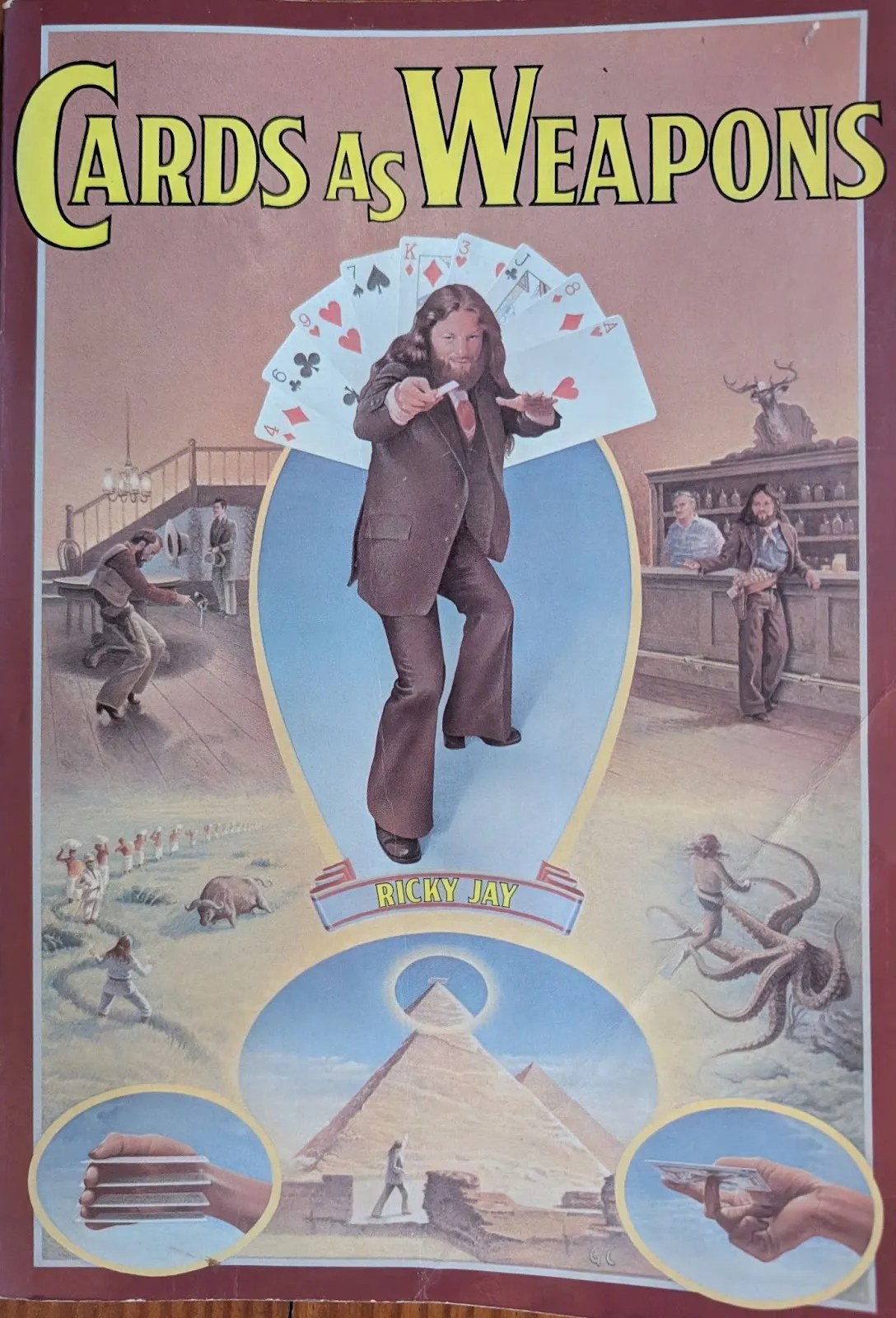
Long-time reader will know of your correspondent’s affection and respect for the late, great Ricky Jay (see. e.g., here and here). The estimable Quentin Hardy (and here), recalls the happy experience of seeing Jay perform his remarkable stage show, “Ricky Jay and His 52 Assistants” (“who were, of course, an ordinary deck of cards, serving under his complete domination”) and the realization that it triggered…
… Ricky Jay – it seems absurd to reduce that mellifluous name to its given or surname components, and parodically stuffy to write “Mr. Jay” – was primarily a close magician, moving cards and coins in all sorts of magical ways. He was also renowned as a card thrower, onstage penetrating a watermelon at 10 paces, and tossing a card as far as 190 feet, or at 90 miles per hour. He was an actor, an engaging writer, a bibliophile, and a deeply learned historian of freaks, cons, conjurers, armless calligraphers, and other nonstandard humans.
What I saw of his secret, I believe, illuminated his talent and his other motivating interests.
I don’t remember details of his lacerating onstage game, though it was excellent entertainment for us marks and his audience. After a couple of minutes we were swept off so he could move on to another amazement. But not before I saw his thumb.
Ricky Jay’s thumb was a seemingly unassuming digit, at rest beneath the clever patter, the astonishing cards dancing across the table, and the beautiful fingers controlling the cards’ movements, then recalling them to their correct place in the deck. By chance, I noticed this thumb running alongside the deck in between deals, and even though the magician was talking to me I sensed a sensitive side communication between the thumb and the man.
It was akin to watching wild nature, when an animal’s excellence is at one with its environment. No, it was better: It was wild nature guided by a fierce human intelligence. I saw him talking to the audience, but he was in a side conversation with a thumb that knew by feel where every card was. This knowledge was the outcome of focused years, which had extended the man’s talent beyond his body into the deck of cards. The state would be aspirational, except a dolt such as I (and, sorry, likely you too, dear reader) can hardly imagine this state of perfection.
What was his trick? The trick was training so deep that his thumb knew where every card was, and could say where it needed to go next. While he was talking, he was checking in with it, making sure everything was in its place as he readied himself for the next seamless adventure.
This may sound comical, but I was awed by a moment of man and thumb, and all that had gone into it. I saw hours of work, a pursuit beyond training with the goal of melding oneself with an object, until the practitioner and the object are completely attuned.
There are other examples of this fusion of identity with an action or object. Jimi Hendrix, as he moved from a band guitarist to a phenomenon, practiced leaning against a wall, so he wouldn’t hurt himself when he fell asleep. W.C. Fields, like Ricky Jay the product of a childhood he’d as soon forget, practiced the juggling that made him a vaudeville star over a boardinghouse bed, so he could likewise collapse, then get up and resume. The classical violinist Chee-yun Kim, who fell asleep playing the piano at age 3 (her mother, terrified, moved her to the fiddle), once forgot to eat during a three-day recording session. There are many more examples…
… I think about Ricky Jay’s thumb, and practicing so hard that part of you enters a physical object, when I think of his breakthrough book, “Learned Pigs and Fireproof Women.” A compendium of extraordinary performers in history, it memorializes the high divers, master memorizers, poison drinkers and fire resisters, and the woman who wrote, simultaneously, four different words with her hands and feet. Some performers are mountebanks, but the most moving passages are about people whose circumstances compelled them to will themselves into something superhuman.
It may be necessity, as in the case of the armless pianist who played with his toes. Or it may be pure chance, as befell Leon Rauch, a hallucinating teenage runaway who met a conjuror, and threw himself into close magic and contortionism. He gained worldwide fame as LaRoche, when he trapped himself in a small sphere and shifted his center of gravity sufficiently to roll up a 50-foot vertical spiral, an adult curled up like a fetus, dazzling the world as he climbed far above them. Far from his origins, too. Call it “dedication” or “obsession.” The goal is transformation, and an escape into a new self.
Ricky Jay, and many other extraordinary entertainers, encourage their reputation as hard-edged guys in a hard world. Indeed, both he and his mentor, the magician Dai Vernon, sought out card cheats, con men, fakes, and other scoundrels. They were searching for the mechanics of their treachery on the unwitting. These villains were presumably not interested in transformation, but simply grift.
Over the years. I have given copies of “Learned Pigs” to more than one acquaintance going through a difficult time, and to this day I keep a few spare copies on hand. It works like magic. Until today I have not disclosed Ricky Jay’s secret: There is no secret, there is only the desire and will for transformation that is inside us all…
A great magician, and an estimable escape artist of a different kind: “Ricky Jay’s Thumb.”
* Ricky Jay
###
As we shuffle and cut, we might recall that it was on this date in 1975 that the master tapes of the ELO album, Face the Music, went to the pressing plant. It featured “Strange Magic” and was their first to earn a platinum record.

“If you tried to give rock and roll another name, you might call it ‘Chuck Berry'”*…

Alex Abramovich with a dispatch on the headwaters of rock and roll…
‘There are ten thousand freedoms,’ the late Joshua Clover once said, ‘but rock freedom is definitely set – in the first instance – in a car, when it’s late outside. It can be ecstatic, it can be boring, it can be adjectiveless freedom, but you have reached escape velocity, faster miles an hour, you have no particular place to go, and you have the radio on.’
Chuck Berry’s ‘Maybellene’ recently turned seventy. Recorded on 21 May 1955 in a studio on the South Side of Chicago, it tells the story of a man chasing his girlfriend down the highway. He’s in a Ford V8, she’s driving a Cadillac. She’s cheating, the car’s overheating, he’s trying to catch her before she gets away for good. ‘Maybellene’ isn’t Chuck Berry’s best song but it was his first single. Without it there’d be no Bob Dylan. No rock and roll as we know it. It’s a miracle.
There’s a story about the song, too….
Read on: “Escape Velocity” (archived link), from @lrb.co.uk.
* John Lennon
###
As we roll over, we might send tuneful brithday greetings to Steve Young, a musical pioneer who followed Berry (the first singer-songwriter in the new era of popular music, Roy Orbison suggested)… and took a different path; he was born on this date in 1942. A singer, songwriter, and guitarist, known for his song “Seven Bridges Road” (on Young’s albums Rock Salt & Nails & Seven Bridges Road, but probably best known in the version by The Eagles). He was a pioneer of the country rock, Americana, and alternative country sounds– a vital force behind the outlaw movement.

Oh, and in 1979 this was also “‘The Night Disco Died’ — Or Didn’t.”
You must be logged in to post a comment.