Posts Tagged ‘population’
“The braid is always stronger than the strand”*…

From Grace Ebert, a novel look at the world’s densest “city”…
At its height in the 1990s, Kowloon Walled City in Hong Kong housed about 50,000 people. Its population is unremarkable for small cities, but what set Kowloon apart from others of its size was its density. Spanning only 2.6 hectares, the tiny enclave contained [the equivalent of] 1,255,000 people per square kilometer, making it the densest city in the world. For context, New York City boasts about 11,300 per square kilometer, while Manila, the most highly concentrated municipality today, tops out at about 42,000.
Kowloon was built as a small military fort around the turn of the 20th century. When the Chinese and English governments abandoned it after World War II, the area attracted refugees and people in search of affordable housing. With no single architect, the urban center continued to grow as people stacked buildings on top of one another and tucked new structures in between existing ones to accommodate the growing population without expanding beyond the original fort’s border.
With only a small pocket of community space at the center, Kowloon quickly morphed into a labyrinth of shops, services, and apartments connected by narrow stairs and passageways through the buildings. Rather than navigate the city through alleys and streets, residents traversed the structures using slim corridors that always seemed to morph, an experience that caused many to refer to Kowloon as “a living organism.”
The city devolved into a slum with crime and poor living conditions and was razed in 1994. Before demolition, though, a team of Japanese researchers meticulously documented the architectural marvel, which had become a sort of cyberpunk icon that even inspired a gritty arcade as tribute.
For a now out-of-print book titled Kowloon City: An Illustrated Guide, artist Hitomi Terasawa drew a meticulous cross-sectioned rendering of the urban phenomenon to preserve its memory. The massive panorama peers into the compact neighborhood, glimpsing narrow dance halls, laundry dangling from balconies, and entire factories tucked inside cramped quarters.
Thanks to psychologist Greg Jensen, we now have a stunning high-resolution scan of Terasawa’s illustration complete with annotations and diagramming. It’s worth viewing the full panorama in its entirety to zoom in on all the details of this infamous city [and here, animated]. And, for photos of Kowloon and its inhabitants, check out this incredibly informative video detailing its history…
A real-life human hive: “A Rare Cross-Section Illustration Reveals the Infamous Happenings of Kowloon Walled City,” from @Colossal.
* Ryan Graudin, The Walled City
###
As we pack it in, we might we might send the simplest of birthday greetings to a writer, philosopher, and naturalist who might not have gravitated naturally to Kowloon City, Henry David Thoreau; he was born on this date in 1817. From 1845 to 1847, Thoreau lived in a small cabin on the banks of Walden Pond, a small lake near Concord, Massachusetts. Striving to “simplify, simplify,” he strictly limited his expenditures, his possessions, and his contact with others, intending “to live deliberately, to front only the essential facts of life, and see if I could not learn what it had to teach.”
Thoreau became a pillar of New England Transcendentalism, embracing and exemplifying the movement’s belief in the universality of creation and the primacy of personal insight and experience. Perhaps best remembered for his advocacy of simple, principled living, his writings on the relationship between humans and the environment also helped define the nature essay.

“Anyone who believes exponential growth can go on forever in a finite world is either a madman or an economist”*…

… something that nature seems to know. The population of the world, now roughly 8.1 billion, seems poised to shrink. To some, this is good news; to others, a cause for alarm. Phoebe Arslanagić-Wakefield and Anvar Sarygulov, co-founders of Boom, fall into that latter camp. But their provocative analysis of the dynamics of the Baby Boom is relevant to anyone concerned with the future of population on earth…
… In the countries that it touched, the Baby Boom created generations massive in size. In the US alone, 76 million babies were born in its peak 18 years, 30 million more than were born in the previous 18, a demographic difference bigger than the 1960 population of Egypt, the Philippines, or Ethiopia. By 1965, people born during the Baby Boom made up 40 percent of America’s population.
Today, a fifth of both the UK’s and the USA’s population are baby boomers and we live in the world they created. Despite that, as mentioned above, the most widely known piece of information about the Boom is its most pervasive myth, that it was caused by the end of World War Two.
The Baby Boom was not the result of people making up for lost time during the war: it saw total lifetime fertility rates rise, meaning that people did not simply shift when they had their children but had more of them overall. And in many countries, including the US, UK, Sweden and France, the rise in birth rates began years before the war had even started, while neutral Ireland and Switzerland experienced Booms that began during the war, in 1940.
Instead, to explain the Baby Boom, we must consider why it was that the iron law of fertility – that as incomes go up, births must come down – was suspended for this extraordinary period of time…
Fascinating and important: “Understanding the Baby Boom,” from @PMArslanagic and @ASarygulov.
By way of further background on our current situation: “Population bomb, bust – or boon? New UNFPA report debunks 8 myths about a world of 8 billion.“
[image above: source]
###
As we grapple with growth, we might send hygienic birthday greetings to Melville Bissell; he was born on this date in 1843. An inventor and entrepreneur, he created and marketed the first modern carpet sweeper… which, as explained in the article featured above, was a seminal contribution to the advances in household technology that helped fuel the Baby Boom.

“When you leave the Island of Pentam and sail about 100 miles, you reach the Island of Java”*…
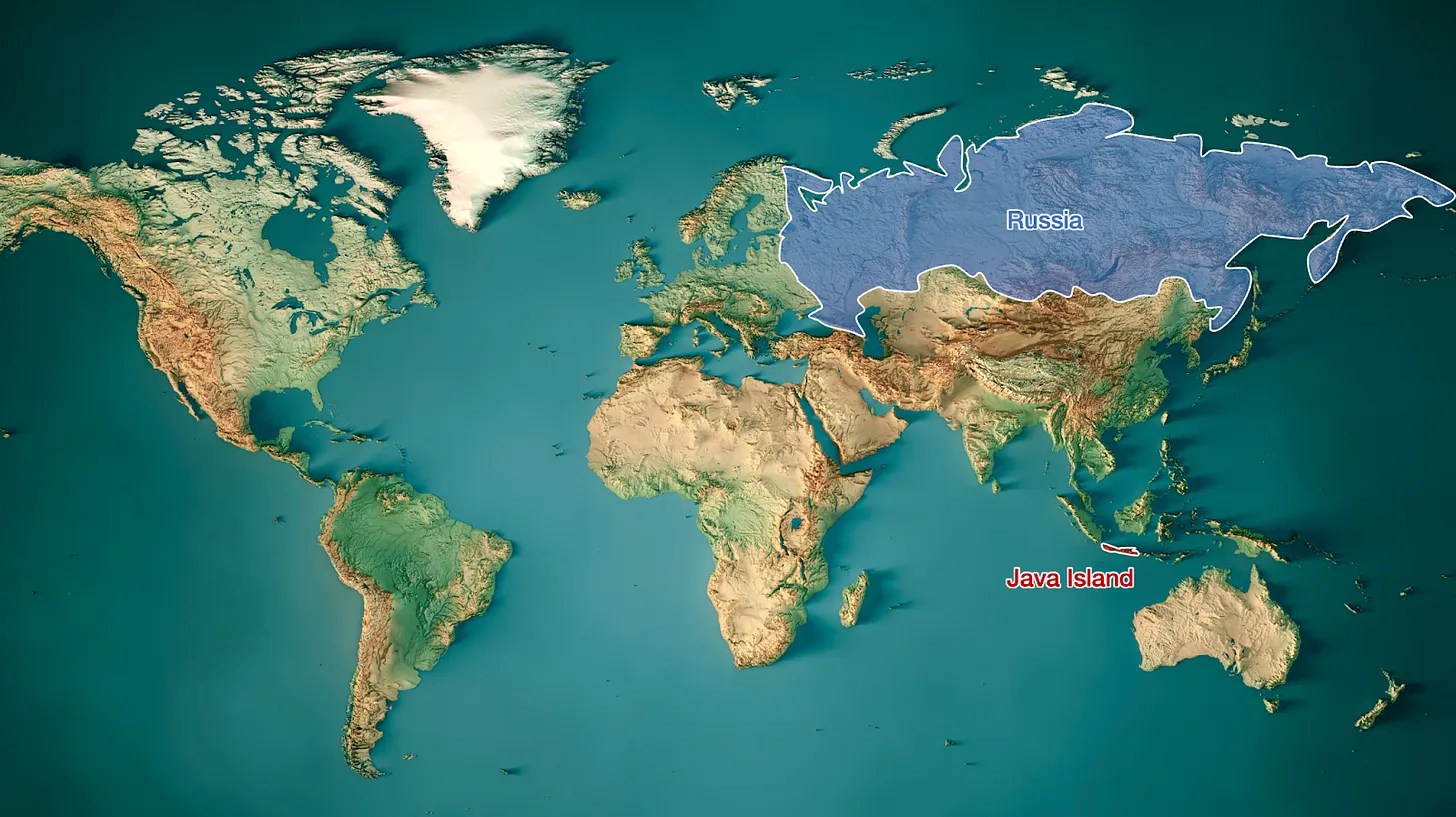
Indonesia is the 14th largest country by area at 735,358 square miles; Java, the island on which the capital Jakarta is located, is only 58,000 square miles– but Java is home to over half the Indonesian population, over 150 million people. It’s the most populous island in the world, and one of its most populous places. Tomas Pueyo explores the reasons why…
Java’s population density is 1,100 people per square km. This is 3x the density of Japan or the Philippines, 7x that of China, 30x that of the US. It’s nearly the density of Houston, Texas. For an entire island! With volcanoes!
Even weirder: Its neighboring islands in Indonesia are not that densely populated. Compared to its big neighboring islands, it’s 8x more densely populated than Sumatra and 30x more than Borneo.
Why!? What made this island so special?
Read on for a fascinating explanation: “Why is Java So Weird?!” from @tomaspueyo via his wonderful newsletter Uncharted Territories.
* Marco Polo (who was probably, it turns out, actually talking about Sumatra)
###
As we dig into development, we might recall that it was on this date in 1497 that Dominican friar and populist agitator Girolamo Savonarola, having convinced the populace of Florence to expel the Medici and recruited the city-state’s youth in a puritanical campaign, presided over “The Bonfire of the Vanities,” the public burning of art works, books, cosmetics, and other items deemed to be vessels of personal aggrandizement. Many art historians, relying on Vasari’s account, believe that Botticelli, a partisan of Savonarola, consigned several of his paintings to the flames and “fell into very great distress.” Others are not so certain. In any case, it seems sure that the fire consumed works by Fra Bartolomeo, Lorenzo di Credi, and many other painters, along with a number of statues and other antiquities.

“Demography is destiny”*…

But what destiny? Strong population growth has fueled economic development in some countries (where the phenomenon of economic growth tends to moderate population growth), and it has exacerbated problems in others. Conversely, a shrinking population can vex the prospects for development and growth. The Economist weighs in with thoughts on the world’s two most populous nations– one shrinking, the other growing…
China has been the world’s most populous country for hundreds of years. In 1750 it had an estimated 225m people, more than a quarter of the world’s total. India, not then a politically unified country, had roughly 200m, which ranked it second. In 2023 it will seize the crown. The UN guesses that India’s population will surpass that of China on April 14th. India’s population on the following day is projected to be 1,425,775,850.
The crown itself has little value, but it is a signal of things that matter. That India does not have a permanent seat on the UN Security Council while China does will come to seem more anomalous. Although China’s economy is nearly six times larger, India’s growing population will help it catch up. India is expected to provide more than a sixth of the increase of the world’s population of working age (15-64) between now and 2050.
China’s population, by contrast, is poised for a steep decline. The number of Chinese of working age peaked a decade ago. By 2050 the country’s median age will be 51, 12 years higher than now. An older China will have to work harder to maintain its political and economic clout. [See also:”For the first time since the 1960s, China’s population is shrinking” and “Here’s why China’s population dropped for the first time in decades.”]
Both countries took draconian measures in the 20th century to limit the growth of their populations. A famine in 1959-61 caused by China’s “great leap forward” was a big factor in persuading the Communist Party of the need to rein in population growth. A decade later China launched a “later, longer, fewer” campaign—later marriages, longer gaps between children and fewer of them. That had a bigger effect than the more famous one-child policy, introduced in 1980, says Tim Dyson, a British demographer. The decline in fertility, from more than six babies per woman in the late 1960s to fewer than three by the late 1970s, was the swiftest in history for any big population, he says.
It paid dividends. China’s economic miracle was in part the result of the rising ratio of working-age adults to children and oldsters from the 1970s to the early 2000s…
India’s attempt to reduce fertility was less successful. It was the first country to introduce family planning on a national scale in the 1950s. Mass-sterilisation campaigns, encouraged by Western donors, grew and were implemented more forcefully during the state of emergency declared by Indira Gandhi, the prime minister, in 1975-77… Though brutal, the campaign was not thorough enough to cause a dramatic drop in India’s birth rate. India’s fertility has dropped, but by less, and more slowly than China’s. With a median age of 28 and a growing working-age population, India now has a chance to reap its own demographic dividend. Its economy recently displaced Britain’s as the world’s fifth-biggest and will rank third by 2029, predicts State Bank of India. But India’s prosperity depends on the productivity of its youthful people, which is not as high as in China. Fewer than half of adult Indians are in the workforce, compared with two-thirds in China. Chinese aged 25 and older have on average 1.5 years more schooling than Indians of the same age.
That will not spare China from suffering the consequences of the demographic slump it engineered. The government ended the one-child policy in 2016 and removed all restrictions on family size in 2021. But birth rates have kept falling. China’s zero-covid policy has made young adults even more reluctant to bear children. The government faces resistance to its plans to raise the average retirement age, which at 54 is among the lowest in the world. The main pension fund may run out of money by 2035. Yet perhaps most painful for China will be the emergence of India as a superpower on its doorstep…
The contrasting demographic dynamics of China and India, and what they might mean: “India will become the world’s most populous country in 2023,” from @TheEconomist.
* attributed to Auguste Comte
###
As we ponder population, we might recall that it was on this date in 1829 that the first part of the tragic play Faust by Johann Wolfgang von Goethe premiered. Originally published in 1808, the tale of Dr. Faust’s deal with Memphistopheles is considered by many to be the greatest work of German literature.

“Without geography you’re nowhere”*…

Finding meaning in maps…
You may not know it, but you’ve probably seen the Valeriepieris circle – it’s that circle on a map of the world, alongside the text ‘There are more people living inside this circle than outside of it’. The name ‘Valeriepieris’ is from the Reddit username of the person who posted it and in 2015 the circle was looked at in more detail by Danny Quah of the London School of Economics under the heading ‘The world’s tightest cluster of people‘. But of course it’s not actually a circle because it wasn’t drawn on a globe and it’s also a bit out of date now so I thought I’d look at this topic because I like global population density stuff. I’ll begin by posting a map of what I’m calling ‘The Yuxi Circle’ and then I’ll explain everything else below that – with lots of maps. As in the original circle, I decided to use a radius of 4,000 km, or just under 2,500 miles. Why Yuxi? Well, out of all the cities I looked at (more than 1,500 worldwide), Yuxi had the highest population within 4000km – just over 55% of the world’s population as of 2020…
More– including fascinating comparisons– at “The Yuxi Circle,” from Alasdair Rae (@undertheraedar)
* Jimmy Buffett
###
As we ponder population, we might recall that it was on this date in 1995 that the day-time soap opera As The World Turns aired its 10,000th episode. Created by Irna Phillips, it aired for 54 years (from April 2, 1956, to September 17, 2010); its 13,763 hours of cumulative narrative gave it the longest total running time of any television show. Actors including, Marissa Tomei, Meg Ryan, Amanda Seyfried, Julianne Moore, and Emmy Rossum all appeared on the series.

You must be logged in to post a comment.