Posts Tagged ‘media’
“One cries because one is sad. For example, I cry because others are stupid, and that makes me sad.”*…

From our friends at The Pudding, a case study in Chinese censorship: Manyun Zou watched the first 100 episodes of The Big Bang Theory that stream in the U.S. and on the Chinese streaming site Youku, side by side, and tracked 206 missing scenes from the Youku version…
Growing up in China, I had a blast watching American TV shows. They not only helped me learn English, but also introduced me to fresh perspectives and worldviews. The Big Bang Theory was among my favorites.
I quickly became a fan of the sitcom when it was officially introduced in China on a video streaming website in 2011. But when I rewatched the show in 2022 on Youku, a Chinese video streaming website backed by e-commerce giant Alibaba, I couldn’t help but notice weird jumps, pauses, and disconnected canned laughter…
What happened to the show?
To understand that, we have to back up a bit. This change can be traced to a sudden political decision in 2014. According to the state-owned media outlet Xinhua, streaming platforms received a private notification from regulators to remind them of one key rule:
“imported American and British TV shows must be ‘reviewed and approved by officials before streaming to the public.’”
Shortly thereafter, The Big Bang Theory was among a handful of imported shows pulled from Chinese websites. Audiences were only left with a black screen and a line: “video has been removed due to policy reasons.”
When these shows resurfaced, they were full of these weird jumps, signaling that scenes were removed during censorship because someone somewhere thought it would be inappropriate or illegal to stream such content.
So the question has to be asked: what kind of content has been removed, and why?
To find out, I compared 100 episodes of the original version of The Big Bang Theory with the edited Youku version to understand what was cut out and decipher the logic behind the decision…
A fascinating look at what Chinese censors fear: “The Big [Censored] Theory,” from @Manyun_Zou in @puddingviz.
* “Sheldon,” The Big Bang Theory, “The Gorilla Experiment” (Season 3, Episode 10)
###
As we contemplate censorship, we might spare a thought for Immanuel Kant; he died on this date in 1804. One of the central figures of modern philosophy, Kant is remembered primarily for his efforts to unite reason with experience (e.g., Critique of Pure Reason [Kritik der reinen Vernunft], 1781), and for his work on ethics (e.g., Metaphysics of Morals [Die Metaphysik der Sitten], 1797) and aesthetics (e.g., Critique of Judgment [Kritik der Urteilskraft], 1790). But he made important contributions to mathematics and astronomy as well; for example: Kant’s argument that mathematical truths are a form of synthetic a priori knowledge was cited by Einstein as an important early influence on his work. And his description of the Milky Way as a lens-shaped collection of stars that represented only one of many “island universes,” was later shown to be accurate by Herschel.
Act so as to treat humanity, whether in your own person or in that of another, at all times also as an end, and not only as a means.

“Nothing is so painful to the human mind as a great and sudden change”*…
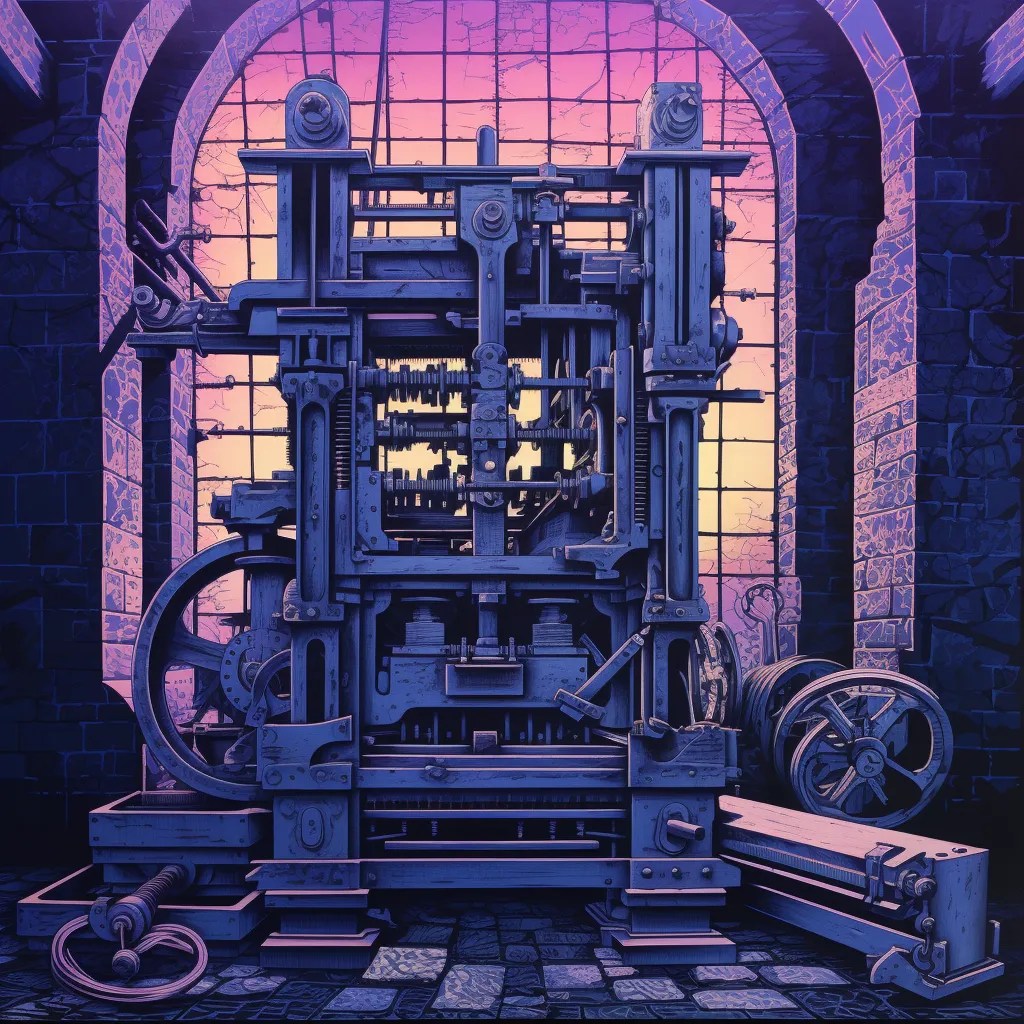
If an AI-infused web is the future, what can we learn from the past? Jeff Jarvis has some provocative thoughts…
The Gutenberg Parenthesis—the theory that inspired my book of the same name—holds that the era of print was a grand exception in the course of history. I ask what lessons we may learn from society’s development of print culture as we leave it for what follows the connected age of networks, data, and intelligent machines—and as we negotiate the fate of such institutions as copyright, the author, and mass media as they are challenged by developments such as generative AI.
Let’s start from the beginning…
In examining the half-millennium of print’s history, three moments in time struck me:
- After Johannes Gutenberg’s development of movable type in the 1450s in Europe (separate from its prior invention in China and Korea), it took a half-century for the book as we now know it to evolve out of its scribal roots—with titles, title pages, and page numbers. It took another century, until this side and that of 1600, before there arose tremendous innovation with print: the invention of the modern novel with Cervantes, the essay with Montaigne, a market for printed plays with Shakespeare, and the newspaper.
- It took another century before a business model for print at last emerged with copyright, which was enacted in Britain in 1710, not to protect authors but instead to transform literary works into tradable assets, primarily for the benefit of the still-developing industry of publishing.
- And it was one more century—after 1800—before major changes came to the technology of print: the steel press, stereotyping (to mold complete pages rather than resetting type with every edition), steam-powered presses, paper made from abundant wood pulp instead of scarce rags, and eventually the marvelous Linotype, eliminating the job of the typesetter. Before the mechanization and industrialization of print, the average circulation of a daily newspaper in America was 4,000 (the size of a healthy Substack newsletter these days). Afterwards, mass media, the mass market, and the idea of the mass were born alongside the advertising to support them.
One lesson in this timeline is that the change we experience today, which we think is moving fast, is likely only the beginning. We are only a quarter century past the introduction of the commercial web browser, which puts us at about 1480 in Gutenberg years. There could be much disruption and invention still ahead. Another lesson is that many of the institutions we assume are immutable—copyright, the concept of creativity as property, mass media and its scale, advertising and the attention economy—are not forever. That is to say that we can reconsider, reinvent, reject, or replace them as need and opportunity present…
Read on for his suggestion for a reinvention of copyright: “Gutenberg’s lessons in the era of AI,” from @jeffjarvis via @azeem in his valuable newsletter @ExponentialView.
* Mary Wollstonecraft Shelley, Frankenstein
###
As we contemplate change, we might spare a thought for Jan Hus. A Czech theologian and philosopher who became a Church reformer, he was burned at the stake as a heretic (for condemning indulgences and the Crusades) on this date in 1415. His teachings (which largely echoed those of Wycliffe) had a strong influence, over a century later, on Martin Luther, helping inspire the Reformation… which was fueled by Gutenberg’s technology, which had been developed and begun to spread in the meantime.

“It is at Dusk that the most interesting things occur, for that is when simple differences fade away. I could live in everlasting Dusk.”*…

L. M. Sacasas on time and temporality…
… I’m tempted, as I often am, by the grand generalization, and I will yield. Pre-industrial culture was synchronized by the rhythms of nature, rhythms which were often imbued with sacral significance (a unity suggested by the shared root of cult, culture, and cultivate). Industrial culture was, as Lewis Mumford observed, driven not by the steam-engine but by the clock. Industrial time overthrew pre-industrial time—agricultural time, if you like—but yielded a new set of rhythms and patterns, with the 9-5 workday perhaps at its heart. Mass media, which is to say industrialized media, supplied its own public temporalities to the industrial age, a new quasi-sacral calendar with daily, seasonal, and yearly rituals, some of which were artificial simulations of the old pre-industrial rituals.
What we have now is a new temporal order. It is not a negation of industrial time, but a further development built upon the precision of mechanical time. Industrial time enabled the mass synchronizations industrial culture required. But now digital technology enables a new desynchronized society through even more refined timekeeping coupled with the computational capacity to mobilize and organize society along more fluid, just-in-time, and, yes, from a human perspective, stochastic patterns.
To put this another way, a culture ordered in its patterns, language, ethics, and imagination by the rhythms of the natural world gave way to a culture ordered in its patterns, language, ethics, and imagination by the rhythms of industrialized labor and mass media. While we might disagree as to the timing of the transition, it seems safe to say that we now inhabit yet another cultural configuration. To put it this way may seem like a banal restatement of the well-worn and contested pre-modern/modern/post-modern sequence. But I think it is useful to draw out the temporal dimension of these social dynamics. If we press into each of these four categories—patterns, language, ethics, and imagination—we will find surprising and profound links to the temporal heart beating out the dominant cultural rhythms, whether it be nature or the machine.
…
Inhabiting the order of measured, quantified time, as most of us do, already inhibits our capacity to imagine another way of being in time. Our enclosure within the human-built world, in both its analog and digital dimensions, obscures the markers of alternative temporal orders. It is possible, of course, to frame this as a liberation from the limits of time just as it is possible to frame our uprootedness as a liberation from the constraints of place. And, indeed, it sometimes is just that. But it is also possible that our liberation from older cultural forms, forms which were more directly informed by a place and its time, has been used against us. To be disembedded and desynchronized is also to become subject to the stochastic order of the digital economy.
The computer, after all, is, among other things, an agent of social organization and an instrument of control. But what forms of social organization does it enable and what forms of control does it make possible?
…
The most tempting thing is to go back to the kind of empirically verifiable harms which I mentioned in passing at the outset. That’s the surest way to make the case for a different set of practices, but, of course, that is itself part of the problem. Yes, there’s a case to be made on the grounds of basic health and well-being, ours and our fellow creatures, for seeking another way of ordering our material environment.
But I find myself reaching beyond such concerns to something more ambivalent and amorphous, toward not just the healthy but the good, toward a deep recalibration of our being in the world according to a different order of time. And perhaps in thinking again about the meaning of our experience of light and dark and, perhaps especially, the transitions between the two, we can discern a different set of rhythms. “We are not only creatures of the light,” Kohák reminds us. “We are creatures of the rhythm of day and night, and the night, too, is our dwelling place.”…
Eminently worth reading in full: “Whose Time? Which Temporality?” from @LMSacasas.
* Olga Tokarczuk, Drive Your Plow Over the Bones of the Dead
###
As we contemplate chronology, we might recall that it was on this date in 1918 that the U.S. Congress “standardized” time: the Standard Time Act (AKA, the Calder Act) became effective. Passed earlier in the year, it implemented across the U.S. both Standard Time (the creation of time zones anchored in UTC, the successor to GMT) and Daylight Saving Time.

“To ask whether the mainstream media has a conservative or liberal bias is like asking whether al-Qaida uses too much oil in their hummus.”*…

What we talk about when we talk about “the mainstream media”…
Everyone is constantly yelling about the mainstream media, and rarely are we referring to the same thing. Just take the recent whirlwind of news about Andrew Cuomo, the governor of New York: A guest on Tucker Carlson’s Fox News show said that the mainstream media, too busy hating on Trump, gave Cuomo a pass on his leadership during the pandemic. The Washington Post’s Max Boot wrote that Cuomo’s various scandals show how the mainstream media is tougher on Democrats than on Republicans. David Sirota, founder of the Daily Poster, argued that the “media machine” was too busy celebrating Cuomo to cover him adequately. The Poynter Institute weighed in: “It might be time to dispel the thinking that the so-called ‘mainstream media’ is protecting” Cuomo. Brian Flood, a media reporter for Fox News, contended that the mainstream media went easy on Cuomo while he botched the early vaccine rollout. Meantime, Cuomo’s camp apparently believed that his bad press was manufactured by “a mainstream media desperate for clicks.”
There are many ways to think about what constitutes the mainstream media, if such a thing exists at all. It can refer, simply, to any newspaper or to your local daytime talk show; at its most pernicious, the “mainstream media” represents a conspiracy of gatekeepers. “The elite media set a framework within which others operate,” Noam Chomsky wrote. “That framework works pretty well, and it is understandable that it is just a reflection of obvious power structures.” A popular academic argument describes the mainstream media as actors who wield “power over discourse,” which conjures a certain image: wealthy, white, male. As independent local news withers, and media companies become increasingly corporatized—under the control of large conglomerates and hedge funds—that critique rings all the more true. To Sheryl Kennedy Haydel, a scholar of historically Black college and university newspapers at Louisiana State, the term “mainstream media” remains useful as long as journalism has an equity problem. “The people who are the decision-makers, or even the reporters, don’t look like the nation you and I live in,” she told me…
To some, “mainstream” can be synonymous with “popular”; yet Fox News, consistently ranked the most-watched cable network, is perhaps the loudest megaphone ranting against the mainstream media’s “corrupt cabal.” In May, the Pew Research Center released a report finding “wide agreement” among Americans surveyed that a certain set of outlets are in the mainstream media: ABC News, CNN, the New York Times, MSNBC, the Wall Street Journal; 73 percent said that Fox News belongs to the mainstream. Yet The Sean Hannity Show did not make the mainstream ranks. And among respondents who rely on Fox for political news, as well as those who tune in to NPR, majorities said they believe their preferred source to be mainstream yet different from most other outlets. HuffPost might be the mainstream media, the poll said, but BuzzFeed probably isn’t. The more one looks at the results, the more contradictory they appear.
What is clear is that those of us who use the phrase “mainstream media” have only a loosely shared understanding of reality, at best. And yet we continue to use the same term, one weighted with history, to describe a phenomenon that sounds assured and entrenched but is actually amorphous and dynamic. Perhaps the ambiguity of “the mainstream media” reveals something profound about the messy information ecosystem we’re in…
The history and the current state of a concept– “mainstream media”– that obscures more than it clarifies: “Inside the Lines,” from Savannah Jacobson (@srjacobson1) in @CJR.
* Al Franken
###
As we honor honest inquiry, we might recall that it was on this date in 1969 that police raided The Stonewall Inn in New York City’s Greenwich Village, resulting in three days of demonstrations by members of the gay community that launched the gay rights movement.

“The crisis consists precisely in the fact that the old is dying and the new cannot be born; in this interregnum a great variety of morbid symptoms appear.”*…

The [New York] Times is becoming a newsy entertainment outlet, à la Jon Oliver, with a business model more like Netflix or Hulu than catchphrases like All The News That’s Fit to Print might suggest. The Times says so itself, announcing a slew of movie and TV deals with Netflix and Amazon, the Hollywood writing room replaced by the New York newsroom. To quote [the Times‘ media columnist, Ben] Smith in a recent piece slamming one of his colleagues: “The paper is in the midst of an evolution from the stodgy paper of record into a juicy collection of great narratives, on the web and streaming services.”
The customer always gets what they want: In the case of an ads-driven business model where the advertiser is the true customer, that’s balanced political news alongside frivolous lifestyle stories as a canvas for ads. In the case of subscribers, it’s being flattered by having their own worldviews echoed back at themselves in more articulate form. Nobody actually pays for news, unless your livelihood depends on it, which is why outlets like The Wall Street Journal and Bloomberg will still flourish, but nothing vaguely resembling news will otherwise remain in a subscription-driven world…
Ideology is like body odor: someone else’s absolutely reeks if strong enough, but you can’t even notice your own. If you remain convinced, in the year 2020 AD, that this or that national outlet remains the megaphone of disinterested chroniclers and selfless truth-seekers, then the BO in question is surely your own. But don’t expect everyone else to put up with the stink.
The Times will triumph financially, dramatically so, and utterly fail as an intellectual institution, at least by its former standards. Sure, the Times staff, like fourth-century Roman emperors intoning the half-remembered tropes of the Roman republic, will speak of ‘objectivity’ and ‘the first draft of history’. But only they and their subscribers will actually believe it. The editorial branding will be august pronouncements about ‘the paper of record’, but the business model is pure Netflix: All The News Fit To Binge.
Advertising-funded journalism is not, as some journalists persist in believing, some ineluctable law of the universe. It’s an entirely contingent artifact of a weird confluence of factors: industrialization and the mass consumer economy, urbanization and burgeoning immigration, plus the secular decline of 19th-century Jacksonian political machines.
As I’ve written before, in century-ago-seeming 2019, and which is doubly correct now, American media is in the process of regressing to 19th (or perhaps even 18th) century models of journalism. Ben Franklin posted under two-dozen different pseudonyms including such bangers as Silence Dogood and Alice Addertongue, and displayed as much nastiness or wit as such modern-day lights like @neontaster or @ComfortablySmug.
Gonzo journalism? Samuel Adams helped organize the Boston Tea Party, and then reported about it after the fact, a level of ‘gonzo’ that even Tom Wolfe and Hunter S. Thompson never quite reached. Through almost the end of the 19th-century, the revenue model for most newspapers was subscriptions from party loyalists when a paper like The Press Democrat meant just that: the Democratic paper in that town giving that faction’s version of events (with some anodyne wire-service news mixed in).
We assume that this idiosyncratic late-20th-century form of American journalism is an essential ingredient to liberal democracy, the sine qua non juju that makes civil liberties and accountable government possible. And yet, our Western European peer nations, which one side of the American political spectrum loves to draw comparisons with when they’re not threatening to move there, have an utterly different journalistic culture…
Antonio Garcia-Martinez (@antoniogm) muses on his interview with Martin Gurri (author of The Revolt of The Public and the Crisis of Authority in the New Millennium)… Into the morbid interregnum? “Twilight of the Media Elites.”
Garcia-Martinez’s full piece is eminently worth reading in full– and best understood in tandem with his conversation with Gurri: “The Prophet of the Revolt.” (For a variation on this diagnosis, see also: “Why Facts Are Overrated.”)
For an argument that yes, the full range of facts and the journalism that reports them do matter, but no, we’re not necessarily doomed to a cacophonous interregnum– that journalistic institutions, while troubled, can be saved– see “The First Amendment in the age of disinformation” by Emily Bazelon (in the New York Times…).
And for a set of painful reminders that this conversation is taking place against an active set of campaigns to widen social and cultural divisions via disinformation, see “The Media Manipulation Casebook.”
* Antonio Gramsci, Prison Notebooks
###
As we sieve signal from noise, we might recall that it was on this date in 1924, four days before a British General Election, that the [London] Daily Mail published the “Zinoviev letter.” Purportedly a directive from Grigory Zinoviev, the head of the Communist International (Comintern) in Moscow, to the Communist Party of Great Britain, ordering it to engage in seditious activities, it “predicted” that the resumption of British-Soviet diplomatic relations (by a Labour government) would hasten the radicalization of the British working class. Offensive to many British voters and frightening to others, the letter– now widely-viewed by scholars as a forgery– aided a Conservative landslide.
But historian A. J. P. Taylor argued that the more important impact was on the psychology of Labourites, who in his estimation for years afterwards blamed foul play for their defeat. Though that was accurate, it distracted them from grappling with the broad political forces at work in Britain and postponed what (Taylor argued were) necessary reforms in the Labour Party.

You must be logged in to post a comment.