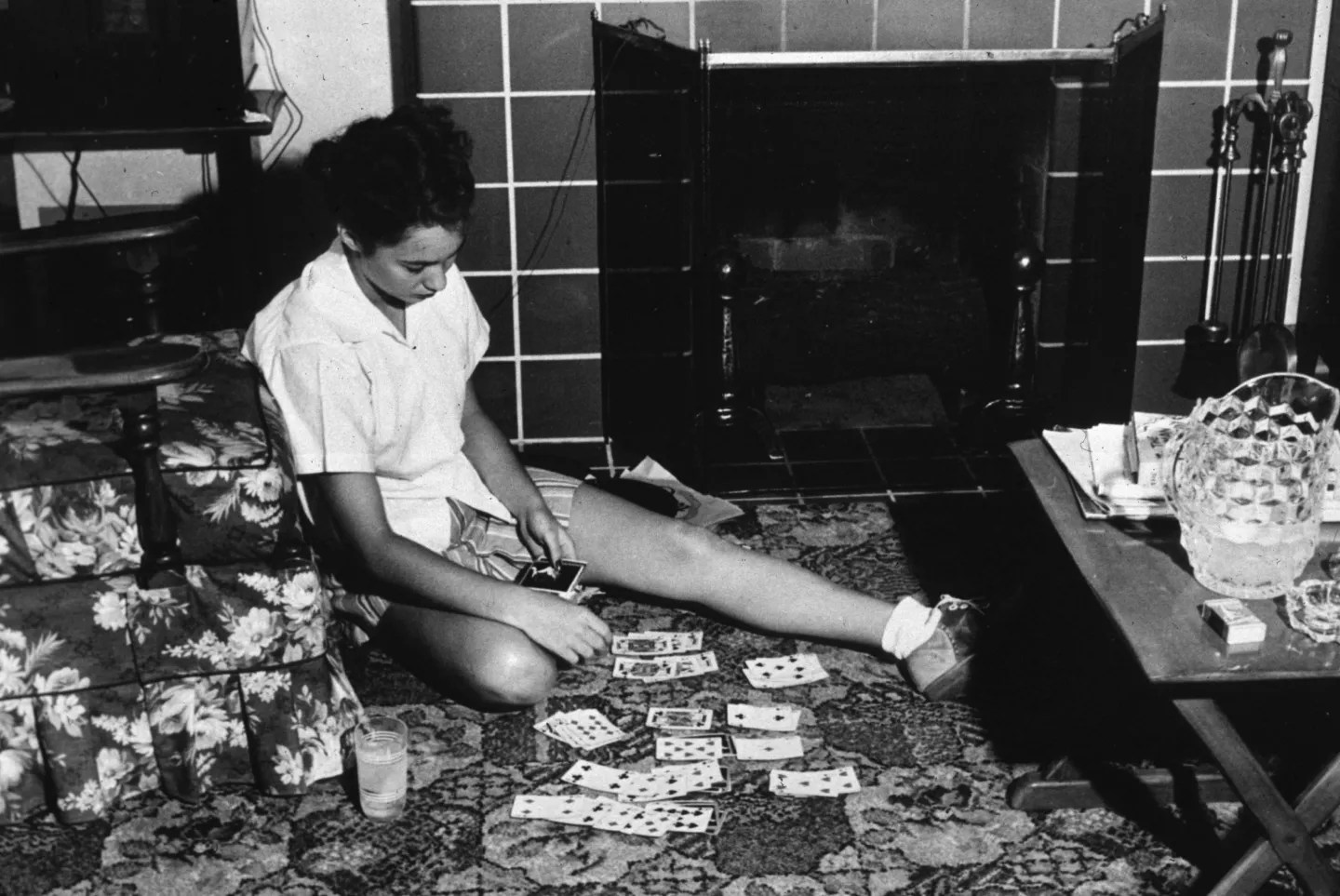
During the dark final days of 2024, I was averaging 12 wins per day in Sawayama Solitaire, one of the Solitaires created by developer Zachtronics. Sawayama Solitaire is a variant of Klondike — the one that’s been bundled into every version of Windows since 1990.
Some games of Sawayama Solitaire felt impossible. Some were absurdly easy. Most of them were a satisfying detangling of cards that had me immediately pressing that “new game” button once I got the win.
How was the most basic card game on Earth owning my life like this?
I think it’s because we don’t understand playing cards.
In 1969, as protests raged against the Vietnam War and counterculture made waves across the nation, a magician [and dear friend of Ricky Jay] named Persi Diaconis went to college.
Diaconis had been a professional magician since age 14, and was skilled in sleight-of-hand tricks. But it was probability that fascinated him.
“One of the embarrassment of applied probability is that we can not analyze the original game of solitaire,” he wrote in the abstract for an academic talk called “The Mathematics of Solitaire,” given at the University of Washington in 1999. The talk has been given several times over the years, and is currently viewable on YouTube. One of his most recent appearances, in 2024, reiterates that despite all the technical advances we’ve made in science and mathematics, the complexity of cards is still somewhat a black box.
“What’s the chance of winning, how to play well, how do various changes of rules change the answers?” Diaconis wrote. “Surely you say, the computer can do this. Not at present, not even close.”
It’s not hard to see the relationship between magic and math. Cards contain limitless possibilities. In fact, math tells us there are more combinations of cards in a 52-card deck than there are atoms on Earth.
Writing for Quanta Magazine, Erica Klarreich asked mathematician Ron Graham what that means in practice. He told her, “If everyone had been shuffling decks of cards every second since the start of the Earth, you couldn’t touch 52 factorial,” the number of possible arrangements of a 52-card deck. Klarreich goes on: “Any time you shuffle a deck to the point of randomness, you have probably created an arrangement that has never existed before.”
As we shuffle along, we might spare a thought for Christiaan Huygens; he died on this date in 1695. A mathematician, physicist, engineer, astronomer, and inventor, he was a key figure in the Scientific Revolution. In physics, Huygens made seminal contributions to optics and mechanics, while as an astronomer he studied the rings of Saturn and discovered its largest moon, Titan. As an engineer and inventor, he improved the design of telescopes and invented the pendulum clock, the most accurate timekeeper for almost 300 years. A talented mathematician and physicist, his works contain the first idealization of a physical problem by a set of mathematical parameters, and the first mathematical and mechanistic explanation of an unobservable physical phenomenon.
Relevantly to the piece above, Huygens also contributed to the development of probability theory and statistics. In 1665 he visited Paris and encountered the work of Fermat and Pascal, which led him to write what was, at the time, the most coherent presentation of a mathematical approach to games of chance in De Ratiociniis in Ludo Aleae (On reasoning in games of chance)– a work contains early game-theoretic ideas.
As Gregory Barber explains, two new notions of infinity challenge a long-standing plan to define the mathematical universe…
It was minus 20 degrees Celsius, and while some went cross-country skiing, Juan Aguilera, a set theorist at the Vienna University of Technology, preferred to linger in the cafeteria, tearing pieces of pulla pastry and debating the nature of two new notions of infinity. The consequences, Aguilera believed, were grand. “We just don’t know what they are yet,” he said.
Infinity, counterintuitively, comes in many shapes and sizes. This has been known since the 1870s, when the German mathematician Georg Cantor proved that the set of real numbers (all the numbers on the number line) is larger than the set of whole numbers, even though both sets are infinite. (The short version: No matter how you try to match real numbers to whole numbers, you’ll always end up with more real numbers.) The two sets, Cantor argued, represented entirely different flavors of infinity and therefore had profoundly different properties.
From there, Cantor constructed larger infinities, too. He took the set of real numbers, built a new set out of all of its subsets, then proved that this new set was bigger than the original set of real numbers. And when he took all the subsets of this new set, he got an even bigger set. In this way, he built infinitely many sets, each larger than the last. He referred to the different sizes of these infinite sets as cardinal numbers (not to be confused with the ordinary cardinals 1, 2, 3…).
Set theorists have continued to define cardinals that are far more exotic and difficult to describe than Cantor’s. In doing so, they’ve discovered something surprising: These “large cardinals” fall into a surprisingly neat hierarchy. They can be clearly defined in terms of size and complexity. Together, they form a massive tower of infinities that set theorists then use to probe the boundaries of what’s mathematically possible.
But the two new cardinals that Aguilera was pondering in the Arctic cold behaved oddly. He had recently constructed them, along with Joan Bagaria of the University of Barcelona and Philipp Lücke of the University of Hamburg, only to find that they didn’t quite fit into the usual hierarchy. Instead, they “exploded,” Aguilera said, creating a new class of infinities that their colleagues hadn’t bargained on — and implying that far more chaos abounds in mathematics than expected.
It’s a provocative claim. The prospect is, to some, exciting. “I love this paper,” said Toby Meadows, a logician and philosopher at the University of California, Irvine. “It seems like real progress — a really interesting insight that we didn’t have before.”
But it’s also difficult to really know whether the claim is true. That’s the nature of studying infinity. If mathematics is a tapestry sewn together by traditional assumptions that everyone agrees on, the higher reaches of the infinite are its tattered fringes. Set theorists working in these extreme areas operate in a space where the traditional axioms used to write mathematical proofs do not always apply, and where new axioms must be written — and often break down.
Up here, most questions are fundamentally unprovable, and uncertainty reigns. And so to some, the new cardinals don’t change anything. “I don’t buy it at all,” said Hugh Woodin, a set theorist at Harvard University who is currently leading the quest to fully define the mathematical universe. Woodin was Bagaria’s doctoral adviser 35 years ago and Aguilera’s in the 2010s. But his students are cutting their own path through infinity’s thickets. “Your children grow up and defy you,” Woodin said…
As we get down with Gödel, we might send insightful birthday greetings to John Allen Paulos; he was born on this date in 1945. A mathematician, he is best known as an advocate for– and a skilled teacher of– mathematical literacy. His book Innumeracy: Mathematical Illiteracy and its Consequences (1988) was a bestseller, and A Mathematician Reads the Newspaper (1995) extended the critique. Paulos was a regular columinst for both The Guardian and ABC News. And in 2001 he created and taught a course on quantitative literacy for journalists at the Columbia University School of Journalism– an exercise that stimulated further programs at Columbia and elsewhere in precision and data-driven journalism.
From Kim (Scott) Morrison‘s and Dror Bar-Natan‘s, The Knot Atlas, “a complete user-editable knot atlas, in the wiki spirit of Wikipedia“– a marvelous example of a wide-spread urge in mathematics to find order through classification. As Joseph Howlett explains, that quest continues, even as it proves vexatious…
Biology in the 18th century was all about taxonomy. The staggering diversity of life made it hard to draw conclusions about how it came to be. Scientists first had to put things in their proper order, grouping species according to shared characteristics — no easy task. Since then, they’ve used these grand catalogs to understand the differences among organisms and to infer their evolutionary histories. Chemists built the periodic table for the same purpose — to classify the elements and understand their behaviors. And physicists made the Standard Model to explain how the fundamental particles of the universe interact.
In his book The Order of Things, the philosopher Michel Foucault describes this preoccupation with sorting as a formative step for the sciences. “A knowledge of empirical individuals,” he wrote, “can be acquired only from the continuous, ordered and universal tabulation of all possible differences.”
Mathematicians never got past this obsession. That’s because the menagerie of mathematics makes the biological catalog look like a petting zoo. Its inhabitants aren’t limited by physical reality. Any conceivable possibility, whether it lives in our universe or in some hypothetical 200-dimensional one, needs to be accounted for. There are tons of different classifications to try — groups, knots, manifolds and so on — and infinitely many objects to sort in each of those classifications. Classification is how mathematicians come to know the strange, abstract world they’re studying, and how they prove major theorems about it.
Take groups, a central object of study in math. The classification of “finite simple groups” — the building blocks of all groups — was one of the grandest mathematical accomplishments of the 20th century. It took dozens of mathematicians nearly 100 years to finish. In the end, they figured out that all finite simple groups fall into three buckets, except for 26 itemized outliers. A dedicated crew of mathematicians has been working on a “condensed” proof of the classification since 1994 — it currently comprises 10 volumes and several thousand pages, and still isn’t finished. But the gargantuan undertaking continues to bear fruit, recently helping to prove a decades-old conjecture that you can infer a lot about a group by examining one small part of it.
Mathematics, unfettered by the typical constraints of reality, is all about possibility. Classification gives mathematicians a way to start exploring that limitless potential…
[Howlett reviews attempts to classify numbers by “type” (postive/negative, rational/irrational), and mathematical objects by “equivalency” (shapes that can be stretched or squeezed into the other without breaking or tearing, like a doughnut and and coffee cup (see here)…]
… Similarly, classification has played an important role in knot theory. Tie a knot in a piece of string, then glue the string’s ends together — that’s a mathematical knot. Knots are equivalent if one can be tangled or untangled, without cutting the string, to match the other. This mundane-sounding task has lots of mathematical uses. In 2023, five mathematicians made progress on a key conjecture in knot theory that stated that all knots with a certain property (being “slice”) must also have another (being “ribbon”), with the proof ruling out a suspected counterexample. (As an aside, I’ve often wondered why knot theorists insist on using nouns as adjectives.)
All these classifications turn math’s disarrayed infinitude into accessible order. It’s a first step toward reining in the deluge that pours forth from mathematical imaginings…
As we sort, we might spare a thought for the author of our title quote, Sir Isaac Newton; he died in this date in 1727. A polymath, Newton excelled in– and advanced– mathematics, physics, and astronomy; he was a theologian and a government offical (Master of the Mint)… and a dedicated alchemist. He was key to the Scientific Revolution and the Enlightenment that followed.
Newton’s book Philosophiæ Naturalis Principia Mathematica (Mathematical Principles of Natural Philosophy), first published in 1687, achieved the first great unification in physics and established classical mechanics (e.g., the Laws of Motion and the principle of universal gravitation). He also made seminal contributions to optics, and shares credit with German mathematician Gottfried Wilhelm Leibniz for formulating infinitesimal calculus. Indeed, Newton contributed to and refined the scientific method to such an extent that his work is considered the most influential in the development of modern science.
In order to bridge the yawning gulf between the humanities and the sciences, Gordon Gillespie suggests, we must turn to an unexpected field: mathematics…
In 1959, the English writer and physicist C P Snow delivered the esteemed Rede Lecture at the University of Cambridge [a talk now known as “The Two Cultures,” see here]. Regaled with champagne and Marmite sandwiches, the audience had no idea that they were about to be read the riot act. Snow diagnosed a rift of mutual ignorance in the intellectual world of the West. On the one hand were the ‘literary intellectuals’ (of the humanities) and on the other the (natural) ‘scientists’: the much-discussed ‘two cultures’. Snow substantiated his diagnosis with anecdotes of respected literary intellectuals who complained about the illiteracy of the scientists but who themselves had never heard of such a fundamental statement as the second law of thermodynamics. And he told of brilliant scientific minds who might know a lot about the second law but were barely up to the task of reading Charles Dickens, let alone an ‘esoteric, tangled and dubiously rewarding writer … like Rainer Maria Rilke.’
Sixty-plus years after Snow’s diatribe, the rift has hardly narrowed. Off the record, most natural scientists still consider the humanities to be a pseudo-science that lacks elementary epistemic standards. In a 2016 talk, the renowned theoretical physicist Carlo Rovelli lamented ‘the current anti-philosophical ideology’. And he quoted eminent colleagues such as the Nobel laureate Steven Weinberg, Stephen Hawking and Neil deGrasse Tyson, who agreed that ‘philosophy is dead’ and that only the natural sciences could explain how the world works, not ‘what you can deduce from your armchair’. Meanwhile, many humanities scholars see scientists as pedantic surveyors of nature, who may produce practical and useful results, but are blind to the truly deep insights about the workings of the (cultural) world. In his best-selling book The Fate of Rome (2017), Kyle Harper convincingly showed that a changing climate and diseases were major factors contributing to the final fall of the Roman Empire. The majority of Harper’s fellow historians had simply neglected such factors up to then; they had instead focused solely on the cultural, political and socioeconomic ones…
The divide between the two cultures is not just an academic affair. It is, more importantly, about two opposing views on the fundamental connection between mind and nature. According to one view, nature is governed by an all-encompassing system of laws. This image underlies the explanatory paradigm of causal determination by elementary forces. As physics became the leading science in the 19th century, the causal paradigm was more and more seen as the universal form of explanation. Nothing real fell outside its purview. According to this view, every phenomenon can be explained by a more or less complex causal chain (or web), the links of which can, in turn, be traced back, in principle, to basic natural forces. Anything – including any aspect of the human mind – that eludes this explanatory paradigm is simply not part of the real world, just like the ‘omens’ of superstition or the ‘astral projections’ of astrology.
On the opposing view, the human mind – be it that of individuals or collectives – can very well be regarded separately from its physical foundations. Of course, it is conceded that the mind cannot work without the brain, so it is not entirely independent of natural forces and their dynamics. But events of cultural significance can be explained as effects of very different kinds of causes, namely psychological and social, that operate in a sphere quite separate from that of the natural forces.
These divergent understandings underpin the worldviews of each culture. Naive realists – primarily natural scientists – like to point out that nature existed long before humankind. Nature is ordered according to laws that operate regardless of whether or not humans are around to observe. So the natural order of the world must be predetermined independently of the human mind. Conversely, naive idealists – including social constructivists, mostly encountered in the humanities – insist that all order is conceptual order, which is based solely on individual or collective thought. As such, order is not only not independent of the human mind, it’s also ambiguous, just as the human mind is ambiguous in its diverse cultural manifestations.
The clash of cultures between the humanities and the natural sciences is reignited over and over because of two images that portray the interrelationship of mind and nature very differently. To achieve peace between the two cultures, we need to overcome both views. We must recognise that the natural and the mental order of things go hand in hand. Neither can be fully understood without the other. And neither can be traced back to the other…
… The best mediator of a conciliatory view that avoids the mistake of the naive realist and the naive idealist is mathematics. Mathematics gives us shining proof that understanding some aspect of the world does not always come down to uncovering some intricate causal web, not even in principle. Determination is not explanation. And mathematics, rightly understood, demonstrates this in a manner that lets us clearly see the mutual dependency of mind and nature.
For mathematical explanations are structural, not causal. Mathematics lets us understand aspects of the world that are just as real as the Northern Lights or people’s behaviour, but are not effects of any causes. The distinction between causal and structural forms of explanation will become clearer in due course. For a start, take this example. Think of a dying father who wants to pass on his one possession, a herd of 17 goats, evenly to his three sons. He can’t do so. This is not the case because some hidden physical or psychological forces hinder any such action. The reason is simply that 17 is a prime number, so not divisible by three…
… In his ‘two cultures’ speech, Snow located mathematics clearly in the camp of the sciences. But… mathematics doesn’t adhere to the explanatory paradigm of causal determination. This distinguishes it from the natural sciences. Nevertheless, mathematics tells us a lot about nature. According to Kant, it does so because it tells us a lot about the human mind. Mind and nature are inseparable facets of the world we inhabit and conceive. So, why should the humanities not also count as a science? They can tell us just as much about that one world on a fundamental level as the natural sciences. Mathematics demonstrates this clearly…
… Mathematics undermines the causal explanatory paradigm not only in its natural scientific manifestations, but also in its uses in the humanities. We give explanations for a wide variety of phenomena by hidden causes way too often and way too fast, where the simple admission to having no explanation would not only be more honest, but also wiser. Wittgenstein spoke of the disease of wanting to explain. This disease shows itself not just in our private everyday exchanges and in the usual public debates, but also in scholarly discourse of the humanities. When confronted with individual or collective human thinking and behaviour, it is tempting to assume just a few underlying factors responsible for the thinking and behaviour. But, more often than not, there really is no such neat, analysable set of factors. Instead, there is a vast number of natural, psychological and societal factors that are all equally relevant for the emergence of the phenomenon one wants to explain. Perhaps a high-end computer could incorporate all these factors in a grand simulation. But a simulation is not an explanation. A simulation allows us to predict, but it doesn’t let us understand.
The aim of the humanities should not be to identify causes for every phenomenon they investigate. The rise and fall of empires, the economic and social ramifications of significant technological innovations, the cultural impact of great works of art are often products of irreducibly complex, chaotic processes. In such cases, trying to mimic the natural sciences by stipulating some major determining factors is a futile and misleading endeavour.
But mathematics shows that beyond the causal chaos there can be order of a different kind. The central limit theorem lets us see and explain a common regularity in a wide range of causally very different, but equally complex, natural processes. With this and many other examples of structural mathematical explanations of phenomena in the realm of the natural sciences in mind, it seems plausible that mathematical, or mathematically inspired, abstraction can also have fruitful applications in the humanities.
This is by no means meant to promote an uncritical imitation of mathematics in the humanities and social sciences. (The overabundance of simplistic econometric models, for instance, is a huge warning sign.) Rather, it is meant to motivate scholars in these fields to reflect more upon where and when causal explanations make sense. Complexity can’t always be reduced to a graspable causal explanation, or narrative. To the contrary, often the most enlightening enquiries are not those that propose new factors as the true explainers, but those that show by meticulous analysis that far more factors are crucially in play than previously thought. This, in turn, should motivate scholars to seek aspects of their subject of interest beyond causality that are both relevant and amenable to structural forms of explanation. Besides probability theory, chaos theoretical methods and game theory come to mind as mathematical sub-disciplines with potentially fruitful applications in this regard.
However, the main point of our discussion is not that mathematical applications in the humanities might bridge the gap between the natural sciences and the humanities. The point is that mathematics, not really belonging to either camp, shows them to be on an equal footing from the start. The natural scientific paradigm of explanation is not the role model any respectable form of enquiry has to follow. Mathematics shows that natural causes can’t explain every phenomenon, not even every natural phenomenon and not even in principle. So, there is no need for the humanities, the ‘sciences of the mind’, to always strive for explanations by causes that can be ‘reduced’ to more elementary, natural forces. Moreover, mathematics shows that causality, of any kind, is not the only possible basis on which any form of explanation ultimately has to stand. Take for example the semantic relationships between many of our utterances. It is not at all clear that these can be explained in terms of psychological causes, or any other causes. It is not unreasonable to believe that the world is irreducibly structured, in part, by semantic relations, just as it is structured by probabilistic relations…
… The divide between the natural sciences and the humanities does not stem from the supposed fact that only those mental phenomena are real that are explainable in natural-scientific terms. Nor is the divide due to some extra-natural mental order, determined by causal relationships of a very different kind than those studied in the natural sciences. The mental world and the physical world are one and the same world, and the respective sciences deal with different aspects of this one world. Properly understood, insofar as they deal with the same phenomena, they do not provide competing but complementary descriptions of these phenomena.
Mathematics provides the most impressive proof that a true understanding of the world goes beyond the discovery of causal relationships – whether they are constituted by natural or cultural forces. It is worth taking a closer look at this proof. For it outlines the bond that connects mind and nature in particularly bright colours. Kant understood this bond as a ‘transcendental’ one. The late Wittgenstein, on the other hand, demonstrated its anchoring in language – not in the sense of a purely verbal and written practice, but in the sense of a comprehensive practice of actions the mental and bodily elements of which cannot be neatly separated. In the words of Wittgenstein, ‘commanding, questioning, recounting, chatting are as much a part of our natural history as walking, eating, drinking, and playing.’
Mathematics too is part of this practice. As such, like every science, it is inseparably rooted in both nature and the human mind. Unlike the other sciences, this dual rootedness is obvious in the case of mathematics. One only has to see where it resides: beyond causality.
* C. P. Snow, The Two Culturesand the Scientific Revolution
###
As we come together, we might send carefully calculated birthday greetings to a man with a foot in each culture: Frank Plumpton Ramsey; he was born on this date in 1903. A philosopher, mathematician, and economist, he made major contributions to all three fields before his death (at the age of 26) on this date in 1930.
While he is probably best remembered as a mathematician and logician and as Wittgenstein’s friend and translator, he wrote three paper in economics: on subjective probability and utility (a response to Keynes, 1926), on optimal taxation (1927, described by Joseph E. Stiglitz as “a landmark in the economics of public finance”), and optimal economic growth (1928; hailed by Keynes as “”one of the most remarkable contributions to mathematical economics ever made”). The economist Paul Samuelson described them in 1970 as “three great legacies – legacies that were for the most part mere by-products of his major interest in the foundations of mathematics and knowledge.”
Matteo Wong talks with mathematician Terence Tao about the advent of AI in mathematical research and finds that Tao has some very big questions indeed…
Terence Tao, a mathematics professor at UCLA, is a real-life superintelligence. The “Mozart of Math,” as he is sometimes called, is widely considered the world’s greatest living mathematician. He has won numerous awards, including the equivalent of a Nobel Prize for mathematics, for his advances and proofs. Right now, AI is nowhere close to his level.
But technology companies are trying to get it there. Recent, attention-grabbing generations of AI—even the almighty ChatGPT—were not built to handle mathematical reasoning. They were instead focused on language: When you asked such a program to answer a basic question, it did not understand and execute an equation or formulate a proof, but instead presented an answer based on which words were likely to appear in sequence. For instance, the original ChatGPT can’t add or multiply, but has seen enough examples of algebra to solve x + 2 = 4: “To solve the equation x + 2 = 4, subtract 2 from both sides …” Now, however, OpenAI is explicitly marketing a new line of “reasoning models,” known collectively as the o1 series, for their ability to problem-solve “much like a person” and work through complex mathematical and scientific tasks and queries. If these models are successful, they could represent a sea change for the slow, lonely work that Tao and his peers do.
After I saw Tao post his impressions of o1 online—he compared it to a “mediocre, but not completely incompetent” graduate student—I wanted to understand more about his views on the technology’s potential. In a Zoom call last week, he described a kind of AI-enabled, “industrial-scale mathematics” that has never been possible before: one in which AI, at least in the near future, is not a creative collaborator in its own right so much as a lubricant for mathematicians’ hypotheses and approaches. This new sort of math, which could unlock terra incognitae of knowledge, will remain human at its core, embracing how people and machines have very different strengths that should be thought of as complementary rather than competing…
A sample of what follows…
The classic idea of math is that you pick some really hard problem, and then you have one or two people locked away in the attic for seven years just banging away at it. The types of problems you want to attack with AI are the opposite. The naive way you would use AI is to feed it the most difficult problem that we have in mathematics. I don’t think that’s going to be super successful, and also, we already have humans that are working on those problems.
… Tao: The type of math that I’m most interested in is math that doesn’t really exist. The project that I launched just a few days ago is about an area of math called universal algebra, which is about whether certain mathematical statements or equations imply that other statements are true. The way people have studied this in the past is that they pick one or two equations and they study them to death, like how a craftsperson used to make one toy at a time, then work on the next one. Now we have factories; we can produce thousands of toys at a time. In my project, there’s a collection of about 4,000 equations, and the task is to find connections between them. Each is relatively easy, but there’s a million implications. There’s like 10 points of light, 10 equations among these thousands that have been studied reasonably well, and then there’s this whole terra incognita.
There are other fields where this transition has happened, like in genetics. It used to be that if you wanted to sequence a genome of an organism, this was an entire Ph.D. thesis. Now we have these gene-sequencing machines, and so geneticists are sequencing entire populations. You can do different types of genetics that way. Instead of narrow, deep mathematics, where an expert human works very hard on a narrow scope of problems, you could have broad, crowdsourced problems with lots of AI assistance that are maybe shallower, but at a much larger scale. And it could be a very complementary way of gaining mathematical insight.
Wong: It reminds me of how an AI program made by Google Deepmind, called AlphaFold, figured out how to predict the three-dimensional structure of proteins, which was for a long time something that had to be done one protein at a time.
Tao: Right, but that doesn’t mean protein science is obsolete. You have to change the problems you study. A hundred and fifty years ago, mathematicians’ primary usefulness was in solving partial differential equations. There are computer packages that do this automatically now. Six hundred years ago, mathematicians were building tables of sines and cosines, which were needed for navigation, but these can now be generated by computers in seconds.
I’m not super interested in duplicating the things that humans are already good at. It seems inefficient. I think at the frontier, we will always need humans and AI. They have complementary strengths. AI is very good at converting billions of pieces of data into one good answer. Humans are good at taking 10 observations and making really inspired guesses…
As we go figure, we might think recursively about Benoit Mandelbrot; he died on this date in 2010. A mathematician (and polymath), his interest in “the art of roughness” of physical phenomena and “the uncontrolled element in life” led to work (which included coining the word “fractal”, as well as developing a theory of “self-similarity” in nature) for which he is known as “the father of fractal geometry.”





You must be logged in to post a comment.