Posts Tagged ‘intellectual property’
“If people had understood how patents would be granted when most of today’s ideas were invented, and had taken out patents, the industry would be at a complete standstill today.”*…
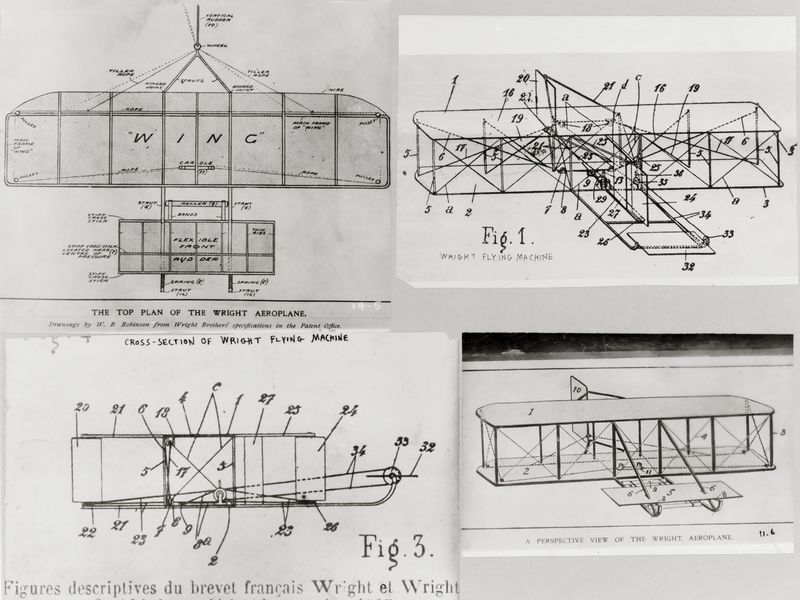
… It’s illuminating to point out that all three transformative technologies of the twentieth century – aviation, the automobile, and the digital computer – started off in patent battles and required a voluntary suspension of hostilities (a collective decision to ignore patents) before the technology could truly take hold.
The Wright brothers won every patent case they fought, and it did them absolutely no good. The prospect of a fortune wasn’t what motivated them to build an airplane, but ironically enough they could have made a fortune had they just passed on the litigation. In 1905, the Wrights were five years ahead of any potential competitor, and posessed a priceless body of practical knowledge. Their trade secrets and accumulated experience alone would have made them the leaders in the field, especially if they had teamed up with Curtiss. Instead, they got to watch heavily government-subsidized programs in Europe take the technical lead in airplane design as American aviation stagnated.
If you are someone who believes that the Internet and computer software are a transformative technology on a par with aviation, you may find it interesting to note that there is now a patent cease-fire in effect in the world of software, the occasional high-profile infringement case notwithstanding. The reason for the cease-fire is simple: if companies like IBM, Xerox, and Sun were to begin fully enforcing their patent portfolios, it would mean an apocalypse of litigation for all software developers. Everyone understands that the health and growth of the Internet are contingent on ignoring the patent system as much as possible.
At the same time, more patents are being granted than ever before, for broader claims, and with an almost complete disregard for prior art. Entire companies – and not just legal firms – are basing business models on extracting money from the patent system without actually creating any products. And the boundaries of patent law are expanding. For the first time in history, it’s possible to patent pure mathematical ideas (in the form of software patents), or even biological entities. The SARS virus was patented shortly after being isolated for the first time.
But if the patent system doesn’t even work for the archetypal example – two inventors, working alone, who singlehandedly invent a major new technology – why do we keep it at all? Who really benefits, and who pays?…
Learning from (the unhappy experiences of) the Wright Brothers– Maciej Cegłowski explains why the U.S. patent system is counter-productive: “100 Years of Turbulence.” Eminently worthy of reading in full.
See also, Bruce Perens: “Software Patents vs. Free Software.”
* Bill Gates, Challenges and Strategy Memo, Microsoft, May 16, 1991
###
As we apply our intellects to intellectual property, we might recall that it was on this date in 1976 that Steve Jobs, Steve Wozniak, and Ronald Wayne signed a partnership agreement that established the company that would become Apple Computer, Inc.– a company all about the IP– on January 3, 1977.
Wayne left the partnership eleven days later, relinquishing his ten percent share for $2,300.

“Patents need inventors more than inventors need patents”*…

Patents for invention — temporary monopolies on the use of new technologies — are frequently cited as a key contributor to the British Industrial Revolution. But where did they come from? We typically talk about them as formal institutions, imposed from above by supposedly wise rulers. But their origins, or at least their introduction to England, tell a very different story…
How the 15th century city guilds of Italy paved the way for the creation of patents and intellectual property as we know it: “Age of Invention: The Origin of Patents.”
(Image above: source)
* Fun IP, Fundamentals of Intellectual Property
###
As we ruminate on rights, we might recall that it was on this date in 1981 that IBM introduced the IBM Personal Computer, commonly known as the IBM PC, the original version of the IBM PC compatible computer design… a relevant descriptor, as the IBM PC was based on open architecture, and third-party suppliers soon developed to provide peripheral devices, expansion cards, software, and ultimately, IBM compatible computers. While IBM has gone out of the PC business, it had a substantial influence on the market in standardizing a design for personal computers; “IBM compatible” became an important criterion for sales growth. Only Apple has been able to develop a significant share of the microcomputer market without compatibility with the IBM architecture (and what it has become).

“He who receives an idea from me, receives instruction himself without lessening mine”*…

Article I Section 8 | Clause 8 of the U.S. Constitution provides that “[The Congress shall have power] To promote the progress of science and useful arts, by securing for limited times to authors and inventors the exclusive right to their respective writings and discoveries.” And so that family of protections/rights in the intangible things that we now know as “intellectual property” was enshrined at our nation’s birth. But has that affordance gotten out of hand? More specifically, is the concept of “intellectual property” itself a problem?
The grand term ‘intellectual property’ covers a lot of ground: the software that runs our lives, the movies we watch, the songs we listen to. But also the credit-scoring algorithms that determine the contours of our futures, the chemical structure and manufacturing processes for life-saving pharmaceutical drugs, even the golden arches of McDonald’s and terms such as ‘Google’. All are supposedly ‘intellectual property’. We are urged, whether by stern warnings on the packaging of our Blu-ray discs or by sonorous pronouncements from media company CEOs, to cease and desist from making unwanted, illegal or improper uses of such ‘property’, not to be ‘pirates’, to show the proper respect for the rights of those who own these things. But what kind of property is this? And why do we refer to such a menagerie with one inclusive term?
The phrase ‘intellectual property’ was first used in a legal decision in 1845 and acquired formal heft in 1967 with the establishment of the World Intellectual Property Organization (WIPO), a specialised agency of the United Nations that represents and protects the commercial interests of holders of copyrights, patents, trademarks and trade secrets. The ubiquitous use of ‘intellectual property’ began in the digital era of production, reproduction and distribution of cultural and technical artifacts. As a new political economy appeared, so did a new commercial and legal rhetoric. ‘Intellectual property’, a central term in that new discourse, is a culturally damaging and easily weaponised notion. Its use should be resisted…
Samir Chopra (@EyeOnThePitch) argues that copyrights, patents and trademarks are all important, but the term ‘intellectual property’ is nonsensical and pernicious: “End intellectual property.”
[Image above: source]
* “He who receives an idea from me, receives instruction himself without lessening mine; as he who lights his taper at mine, receives light without darkening me.” — Thomas Jefferson
###
As we share and share alike, we might recall that it was on this date in 1937 that Wallace Carothers, a chemist at DuPont, was granted U.S. Patent #2071250A for “Monocomponent artificial filaments or the like of synthetic polymers; [and the] Manufacture thereof from homopolycondensation products”– or as we know the product in question, nylon.
Nylon was the first commercially successful synthetic thermoplastic polymer. It’s first commercial use was in a nylon-bristled toothbrush in 1938, followed more famously by its use in women’s stockings or “nylons” which were shown at the 1939 New York World’s Fair and first sold commercially in 1940. During World War II, almost all nylon production was diverted to the military for use in parachutes and parachute cord. But these wartime uses of nylon (and other DuPont-patented plastics) greatly increased the market for the new materials– and thus, for DuPont’s patents– in the post-war era.

Carothers in his lab, stretching a sample of nylon fabric
“The human body is the best picture of the human soul”*…

DID YOU KNOW:
• Bill Gates is actually worth $1,956
• Canadian pop star Justin Bieber has five times fewer cells in his brain than in his liver
• Top tennis player Serena Williams has 24.5 trillion red blood cells powering her body
• Internet and social media pioneer Mark Zuckerberg’s body contains 800MB of data
• President Barack Obama’s head rules his heart; his brain weighs 1.4kg, his heart just 0.4kgWelcome to The Making of Me and You, a unique, new digital interactive from BBC Earth that details extraordinary personalised facts.
Just input your date of birth, sex at birth, height and weight, and choose the metric or imperial units that make most sense to you.
And instantly find out:
• The chemical ingredients that make up you, and what your body is worth
• How many atoms you are made of, and what can be made with them
• How many fat, blood, skin and brain cells you have
• How much genetic data is inside you
• How many other microbes live on your body with you
• The size and weight of your internal organs
• How much wee, poo, sperm or eggs you have produced so far
• How many times you have blinked, breathed, yawned and farted
• And so much more
Try it at: “The Making of You and Me.”
* Ludwig Wittgenstein
###
As we take our measures, we might recall that it was on this date in 1988 that the United States Patent and Trademark Office granted U.S. Patent 4,736,866 to Harvard College for “a transgenic non-human mammal whose germ cells and somatic cells contain a recombinant activated oncogene sequence introduced into said mammal…”– the first U.S. patent issued on a mammalian life form. The Oncomouse (as it was known, a mouse altered to be highly susceptible to breast cancer) was called the product of the year by a major financial magazine.
Although the mouse was genetically modified following a process designed by Philip Leder and Timothy A Stewart of Harvard, and the patent was owned by Harvard Medical School, it was developed with funding from DuPont, which scored a commercialization arrangement that entitled DuPont to exclusive license of the patent. Until the patent was ruled expired in 2005, DuPont claimed patent protection on any anticancer product derived from the mice.
The first patent for a life form was issued seven years earlier for a genetically engineered bacterium.

“Widespread public access to knowledge, like public education, is one of the pillars of our democracy, a guarantee that we can maintain a well-informed citizenry”*…

Top Row (left to right): André Breton; Buster Keaton; László Moholy-Nagy Middle Row (left to right): Gertrude Stein; H. G. Wells; Frank O’Hara; Alfred Stieglitz Bottom Row (left to right): Evelyn Waugh; D. T. Suzuki; Paul Nash; Mina Loy
Via Public Domain Review…
Pictured above is our top pick of those whose works will, on 1st January 2017, enter the public domain in many countries around the world. Of the eleven featured, five will be entering the public domain in countries with a “life plus 70 years” copyright term (e.g. most European Union members, Brazil, Israel, Nigeria, Russia, Turkey, etc.) and six in countries with a “life plus 50 years” copyright term (e.g. Canada, New Zealand, and many countries in Asia and Africa) — those that died in the year 1946 and 1966 respectively. As always it’s a varied gaggle who’ve assembled for our graduation photo, including the founder of the Surrealist movement, a star of the silent film era, the Japanese author behind the popularisation of Buddhism in the West, two female writers at the heart of the Modernist scene, and one of the “fathers of science fiction”…
More on each of the “graduates” at Class of 2017.
* Scott Turow, attorney, author, President of the Author’s Guild
###
As we share and share alike, we might send foresightful birthday greetings to Erasmus Darwin; he was born on this date in 1731. Erasmus was an accomplished doctor (he declined an offer to be personal physician to Charles III). He was also a restless inventor, devising both a copying machine and a speaking machine to impress his friends (inventions he shared rather than patenting). But he is better remembered as a key thinker in the “Midlands Enlightenment”– a founder of the Lunar Society of Birmingham and author of (among other works) The Botanic Garden, a poem that anticipates the Big Bang theory in its description of an explosion, a “mass” which “starts into a million suns,” and Zoonomia, or, The Laws of Organic Life, which contained one of the first formal theories of evolution… one that foreshadowed the theories of Erasmus’ reader– and grandson– Charles… all of which are in the public domain.

You must be logged in to post a comment.