Posts Tagged ‘inequality’
“An imbalance between rich and poor is the oldest and most fatal ailment of all republics”*…

… so, how we measure it matters…
In 2015, Greece, Thailand, Israel, and the UK were equally unequal. That is, all four countries had the same Gini coefficient, a common measure of income inequality.
The number suggests that the spread of incomes in the four nations was the same. However, a close look at the poorest and wealthiest in those societies reveals a very different picture. The ratio between income held by the richest 10% and the poorest 10% ranged significantly, from 13.8 in Greece to 4.2 in the UK.
The fact is, just because the Gini coefficient is so well known doesn’t mean it’s a particularly useful measurement. Its appeal comes from its simplicity—a number between 0 and 1 that can encapsulate a complex distribution in a single figure—as well as its popularity. It is also regularly published and updated by powerful international organizations like the OECD, the World Bank, and the International Monetary Fund.
However, it has a number of serious limitations. So many, in fact, that the World Inequality Database, one of the world’s leading sources of income inequality data, steers clear. And it’s not alone. While some economists defend the Gini coefficient’s continued use, most agree that as a way to understand income inequality, it’s insufficient on its own…
A primer on the dominant measure of economic inequality, and on some alternatives/supplements to it: “Gini coefficient: An introduction.”
* Plutarch
###
As we aim to understand, we might note that today is the Summer Solstice, the day on which the earth’s north pole is maximally tilted toward sun, and there are more hours of daylight than on any other day of the year (in the Northern Hemisphere; in the Southern, it is the Winter Solstice, the shortest day). The June solstice is the only day of the year when all locations inside the Arctic Circle experience a continuous period of daylight for 24 hours. And perhaps more immediately, it is the “official” start of Summer.
(The 21st is the traditional date; in the event, the solstice falls on the 20th, 21st, or 22nd– this year, on the 20th… still, the traditional date is the one folks tend to mark.)
Not coincidentally, today is also National Daylight Appreciation Day.

“Justice is not the work of the law: on the contrary, the law is only the declaration and application of what is just in all circumstances where men have relations with one another”*…

This essay proposes a new model of personal and public wealth-building that can address the current crisis of inequality in the United States. We place contemporary American wealth inequality into its historical context by tracing how federal government policies have worked to support personal and public wealth building across three periods: the First Industrial Revolution of the mid-19th century, the Second Industrial Revolution of the early 20th century, and the Information and Communication Technology revolution of the late-20th century. We then suggest a series of potential governmental policies that can help to ensure a more equitable wealth distribution in the future. Our proposed “mutualist” model of political economy would allow for the large-scale diffusion of productivity gains that may follow the installation of deployment of the next wave of general-purpose technologies. This new social contract will move beyond the welfare state’s focus on insurance toward a more radical notion of shared ownership of returns on capital via universal individual capital endowments and new public investment channels that control shares in firms and intellectual property…
Addressing inequality in the U.S.: “The Mutualist Economy: A New Deal for Ownership“– Nils Gilman (@nils_gilman) and Yakov Feygin (@BuddyYakov) offer a powerfully-provocative proposal.
They join a growing chorus. See also, e.g., Louis Hyman (toward the end of this essay) and Lynn Forester de Rothschild (in this interview).
[Image above: source]
* Pierre-Joseph Proudhon, describing an ideal state
###
As we rethink what isn’t working, we might send gilded birthday greetings to Johns Hopkins; he was born on this date in 1795. A businessman who is largely remembered as a philanthropist, he operated wholesale and retail businesses in the Baltimore area; he built his fortune by judiciously investing his proceeds in myriad other ventures, most notably, the Baltimore and Ohio (B & O) Railroad. In 1996, Johns Hopkins ranked 69th in “The Wealthy 100: From Benjamin Franklin to Bill Gates – A Ranking of the Richest Americans, Past and Present“
His bequests founded a number institutions bearing his name, the best-known of which are, of course, Johns Hopkins Hospital and Johns Hopkins University.
Although Hopkins is widely-noted as an abolitionist, recent research indicates that Johns Hopkins was a slave owner for at least part of his life.

“A prudent question is one-half of wisdom”*…

What a difference five decades makes…
1971 was an eventful year: Intel released the world’s first commercial microprocessor, the 4004; the Aswan Dam was completed; Charles Manson and three of his followers received the death penalty: National Public Radio (NPR) broadcast for the first time; Walt Disney World opened in Florida: Mount Etna erupted (again): The “Pentagon Papers” were made public; the Attica Prion riots happened; the 26th Amendment (lowering the voting age to 18) was ratified; Amtrak, FedEx, the Nasdaq, and Greenpeace were created; China was admitted to the U.N.; Qatar and what is now the UAE were freed from British colonial rule; and so very much more…
Richard Nixon was U.S. President. Average income in the U.S. was $10,600; the average home price was $25,250. A movie ticket cost $1.50; a gallon of gas, $0.33. We listened to music the featured the albums pictured above; we saw Dirty Harry, A Clockwork Orange, The Last Picture Show, and Diamonds Are Forever at the movies; and we watched The Mary Tyler Moore Show, The Partridge Family, McCloud, and Walter Cronkite on TV.
As we look back fifty years, we can see that 1971 seems– beyond the idiosyncratic consequences of the many events that distinguished it– to have been a point of inflection, of sustained changes in direction economically, politically, socially, and culturally:


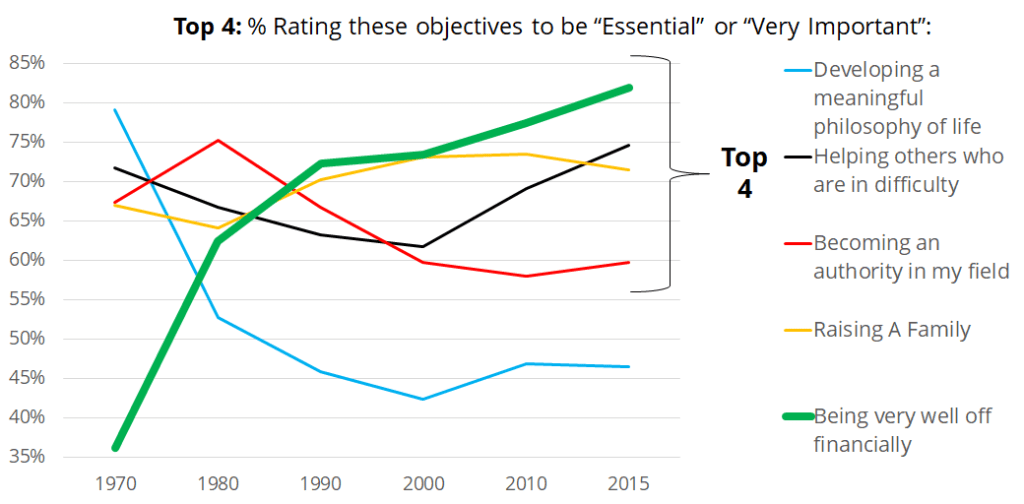


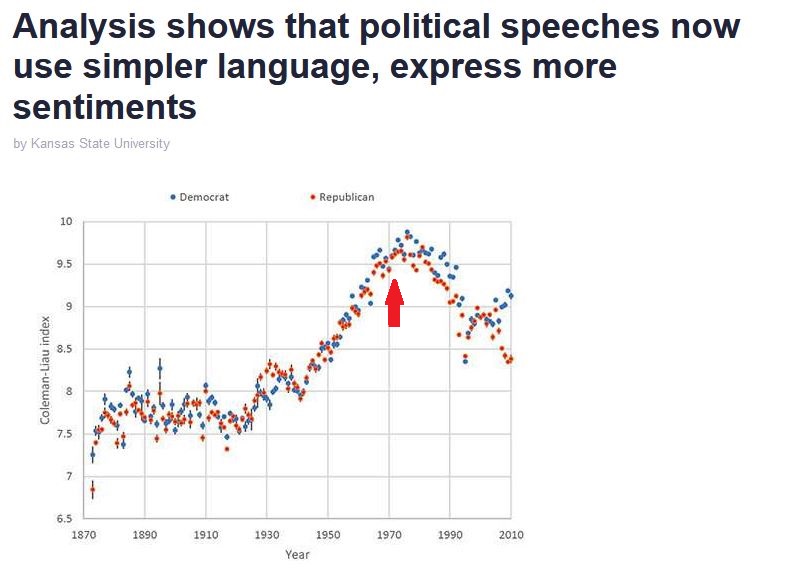

A small selection from a plethora of charts that ask: “WTF Happened In 1971?“
* Francis Bacon
###
As we hit the stacks, we might recall that it was on this date in 1964 that the Surgeon General of the United States, Dr. Luther Terry, M.D., published the landmark report Smoking and Health: Report of the Advisory Committee to the Surgeon General of the United States saying that smoking may be hazardous to health– and sparking national (and worldwide) anti-smoking efforts. While it wasn’t the first such declaration (nor even the first declaration by a U.S. official), it is notable for being arguably the most famous such declaration for its lasting and widespread effects both on the tobacco industry and on the worldwide perception of smoking. A federal ban on cigarette advertising on television went into effect… in 1971.

“There’s class warfare, all right, but it’s my class, the rich class, that’s making war, and we’re winning”*…

In the past few decades, the Gini coefficient—a standard measure of income distribution across population segments—increased within most high-income economies. The United States remains the most unequal high-income economy in the world. The disparity reflects a surge in incomes for the richest population segments, along with sluggish or even falling incomes for the poorest, especially during bad economic times.
At the same time, the middle class is shrinking. The percent of Americans in the middle class has dropped since the 1970s, from 61 percent in 1971 to 51 percent in 2019. Some have moved up the income ladder, but an increasing number are also moving down. The middle class has also shrunk considerably in countries like Germany, Canada, and Sweden, but other advanced economies have generally experienced more modest declines.

From the introduction to the Petersen Institute for International Economics report “How to Fix Economic Inequality?”
Founded by Pete Petersen (Lehman Brothers Chair, Nixon’s Secretary of Commerce, and co-founder, with Trump supporter Stephen Scharzman, of investment giant Blackstone), and overseen by trustees who include Larry Summers, Alan Greenspan, and George Schultz, PIIE is hardly a “progressive” think tank. But they are worried: quite apart from its obvious humanitarian toll, inequality at the scales that have emerged is highly unlikely to be sustainable (even at the human cost that we’ve so far been willing to pay). Put more bluntly, it is ever more likely to torpedo the domestic (and large hunks of the global) economy and indeed to threaten the stability of democratic society.
Other sources suggest that they have very good reason for concern:
• Even as the stock market hits new highs, 26 million Americans are suffering food insecurity (See also: “The boom in US GDP does not match what’s happening to Americans’ wallets.”
• The distribution of assets in the US (and other developed economies, but most egregiously in the U.S.) is even more skewed than income: see data in the PIIE report and “The Asset Economy.”
• And lest we think that this issue is confined to the U.S., social democracies throughout the developed world are feeling the same pressures (albeit mostly less dramatically).
FWIW, your correspondent doesn’t have terrifically strong confidence in the remedies mooted in the PIIE report. Even as the authors recognize that the issues are deeply structural, they confine themselves to recommending (what seem to your correspondent) relatively timid and incremental steps– which, even if taken (and most require legislative or regulatory action) are more likely to slow the polarization underway than to reverse it.
But they are worth contemplating, if only to provoke us to more fundamental measures (e.g., here). And in any case, it’s telling– and one can only hope, encouraging– that determined champions of the very neoliberal economics that have gotten us here recognize, at least, that unless we change course, we’re speeding into a dead end.
* Warren Buffett
###
As we agree that fair’s fair, we might recall that it was on this date in 2001 that Enron, once #7 in the Fortune 500, declared bankruptcy. Six months earlier, it’s stock had traded as high as $90; it closed November 30th at 26 cents, wiping out billions in wealth (a appreciable part of it disappearing from employees’ pension plans). At the time, Enron had $63.4 billion in assets, earning it the honor of being the nation’s largest bankruptcy to that date. (It would be surpassed by the WorldCom bankruptcy a year later.)
Jeff Skilling, Enron’s CEO served 11 years in prison on several counts of fraud; Andy Fastow, Enron’s CFO, would served about 5 years. Chairman Ken Lay was also found guilty, but died before his sentencing. Enron’s accounting firm, Arthur Andersen (at the time a leader among the “Big 5”), which at least “missed” the egregious fraudulent practices in their audits of Enron, was effectively forced to dissolve after the scandal.

“Crises and deadlocks when they occur have at least this advantage, that they force us to think”*…

In the spirit of Nehru’s sage injunction…
The COVID19 pandemic has exposed a strange anomaly in the global economy. If it doesn’t keep growing endlessly, it just breaks. Grow, or die.
But there’s a deeper problem. New scientific research confirms that capitalism’s structural obsession with endless growth is destroying the very conditions for human survival on planet Earth.
A landmark study in the journal Nature Communications, “Scientists’ warning on affluence” — by scientists in Australia, Switzerland and the UK — concludes that the most fundamental driver of environmental destruction is the overconsumption of the super-rich.
This factor lies over and above other factors like fossil fuel consumption, industrial agriculture and deforestation: because it is overconsumption by the super-rich which is the chief driver of these other factors breaching key planetary boundaries.
The paper notes that the richest 10 percent of people are responsible for up to 43 percent of destructive global environmental impacts.
In contrast, the poorest 10 percent in the world are responsible just around 5 percent of these environmental impacts…
It confirms that global structural inequalities in the distribution of wealth are intimately related to an escalating environmental crisis threatening the very existence of human societies.
Synthesising knowledge from across the scientific community, the paper identifies capitalism as the main cause behind “alarming trends of environmental degradation” which now pose “existential threats to natural systems, economies and societies.”…
The research provides an important scientific context for how we can understand many earlier scientific studies revealing that industrial expansion has hugely increased the risks of new disease outbreaks.
Just last April, a paper in Landscape Ecology found that deforestation driven by increased demand for consumption of agricultural commodities or beef have increased the probability of ‘zoonotic’ diseases (exotic diseases circulating amongst animals) jumping to humans. This is because industrial expansion, driven by capitalist pressures, has intensified the encroachment of human activities on wildlife and natural ecosystems.
Two years ago, another study in Frontiers of Microbiology concluded presciently that accelerating deforestation due to “demographic growth” and the associated expansion of “farming, logging, and hunting”, is dangerously transforming rural environments. More bat species carrying exotic viruses have ended up next to human dwellings, the study said. This is increasing “the risk of transmission of viruses through direct contact, domestic animal infection, or contamination by urine or faeces.”
It is difficult to avoid the conclusion that the COVID19 pandemic thus emerged directly from these rapidly growing impacts of human activities. As the new paper in Nature Communications confirms, these impacts have accelerated in the context of the fundamental operations of industrial capitalism.
The result is that capitalism is causing human societies to increasingly breach key planetary boundaries, such as land-use change, biosphere integrity and climate change.
Remaining within these boundaries is essential to maintain what scientists describe as a “safe operating space” for human civilization. If those key ecosystems are disrupted, that “safe operating space” will begin to erode. The global impacts of the COVID19 pandemic are yet another clear indication that this process of erosion has already begun…
Humanity’s “own goal”? “Capitalism is destroying ‘safe operating space’ for humanity, warn scientists.”
Pair with “A New Land Contract“…
Weirdly enough, the land system that we have today has its origins in a problem specific to medieval kings, which is ‘how do I fund military campaigns and defence, without paying to keep a standing army?’
And it was William the Conqueror who perfected the answer. It was a piece of paper. And on that piece of paper was basically an agreement between the Crown and a noble, saying ‘if you provide men for military campaigns when I ask, in exchange I will grant you a monopoly over your own private fiefdom, where you can levy as high taxes as people can bear to pay’.
So effectively — rent is the original tax, paid via lords to the King.
In fact the word ‘feudal’ derives from the latin word feudalis — for ‘fee’. In other words, rent. So the whole system of government by which the Normans ruled over the Anglo Saxons was based on rent…
So what you’re left with is a set of power relations in society: an enforced system of servitude and control. As the economist Henry George pointed out, it is essentially a diluted version of slavery.
“Ownership of land always gives ownership of people… Place one hundred people on an island from which there is no escape. Make one of them the absolute owner of the others — or the absolute owner of the soil. It will make no difference — either to owner or to the others — which one you choose. Either way, one individual will be the absolute master of the other ninety-nine.”
And “Basic income isn’t just a nice idea. It’s a birthright“…
A basic income might defeat the scarcity mindset that has seeped so deep into our culture, freeing us from the imperatives of competition and allowing us to be more open and generous people. If extended universally, across borders, it might help instil a sense of solidarity – that we’re all in this together, and all have an equal right to the planet. It might ease the anxieties that gave us Brexit and Trump, and take the wind out of the fascist tendencies rising elsewhere in nativism that is spreading across much of the world.
We’ll never know until we try. And try we must, or brace ourselves for a 21st century of almost certain misery…
As Paul Romer (and so many others) have observed, a crisis is a terrible thing to waste”…
[TotH to Patrick Tanguay (@inevernu)]
* Jawaharlal Nehru
###
As we ruminate on remedies, we might recall that it was on this date in 1864 that President Abraham Lincoln signed the Yosemite Valley Grant Act (Senate Bill 203), giving California the Yosemite Valley and the nearby Mariposa Big Tree Grove “upon the express conditions that the premises shall be held for public use, resort, and recreation.”
 Mirror Lake, Yosemite
Carleton E. Watkins, photographer, circa 1860.
source: Library of Congress
You must be logged in to post a comment.