Posts Tagged ‘exploration’
“Oh the places you’ll go”*…
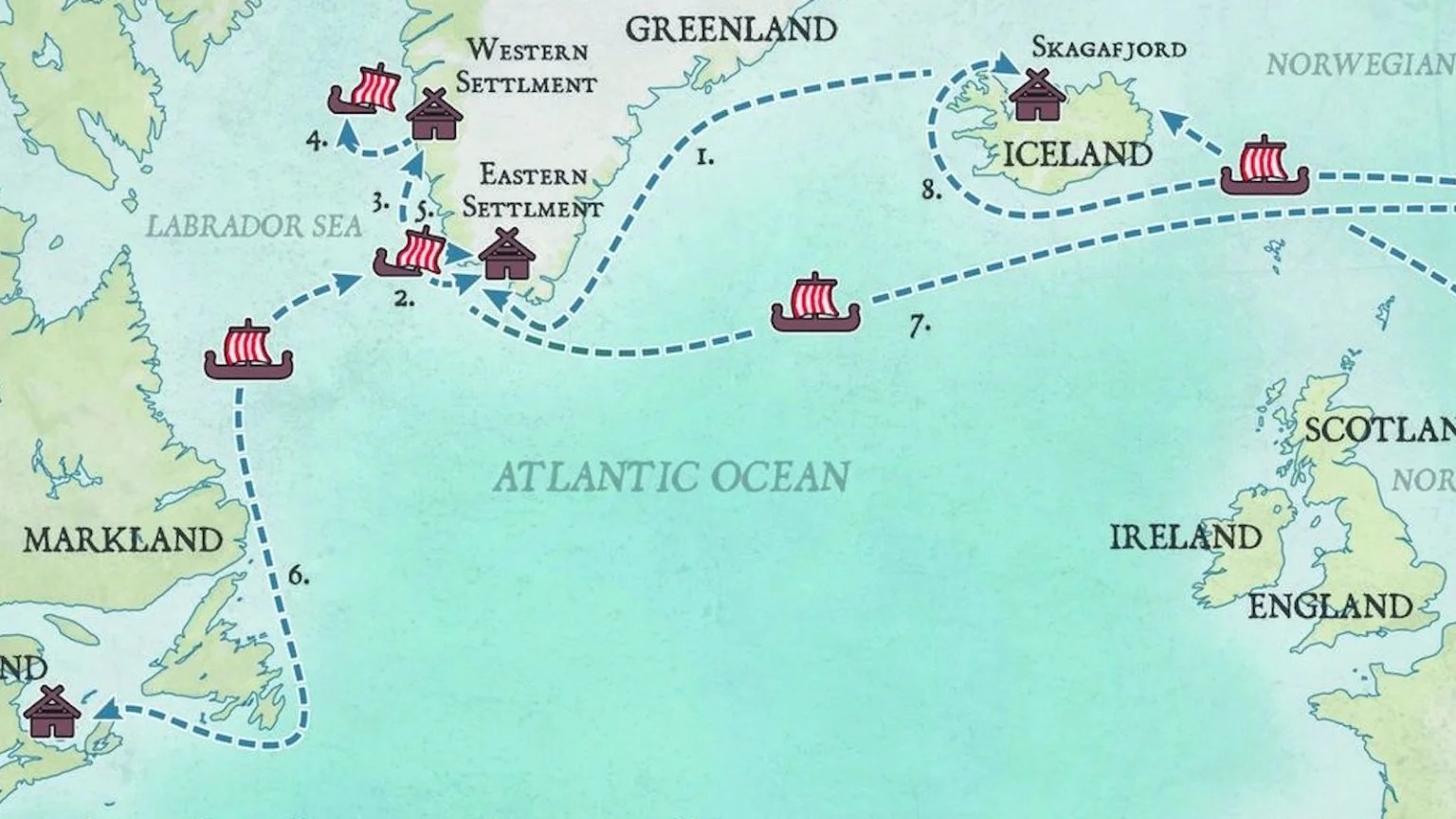
The amazing life of “Gudrid the Far-Traveled” has, Frank Jacobs argues, been unjustly overshadowed by her in-laws, Erik the Red and Leif Erikson…
She’s been called “the greatest female explorer of all time,” and the “best-traveled woman of the Middle Ages.” Just after the year 1000 AD, she gave birth to the first European baby in North America. And she concluded her global odyssey with a pilgrimage on foot to Rome. Yet few today can name this extraordinary Viking lady, even if they have heard of Erik the Red and Leif Erikson, her father- and brother-in-law…
An extraordinary story: “The Viking woman who sailed to America and walked to Rome,” from @VeryStrangeMaps in @bigthink.
* Dr. Seuss
###
As we tag along, we might recall that this date in 2014 was purportedly the date of the final battle in Ragnarök, a series of events (many natural disasters) culminating in a catastrophic battle and the end of the world-as-we-know-it: giants and demons approach from all points of the compass and attack the gods (Odin, Thor, Týr, Freyr, Heimdall, Loki, et al.), who meet them and face death like heroes. At the conflict’s end, the sun darkens, the stars vanish, and the earth sinks into the sea. (Happily, afterward, the earth rises again, the innocent Balder returns from the dead, and leads hosts of the just to a life in a hall roofed with gold.)
In the event, of course, the world did not end that day. The prediction had been promoted by the Jorvik Viking Centre in York, England, intended to draw attention to an event that the institution was to hold on that date. In an obvious lift from the 2012 Mayan Prophecy frenzy, the Centre attributed the claim to a “Viking Calendar,” though no such calendar is known to have existed. Authentic scholars were predictably (and understandably) irked, though as philologist Joseph Hopkins noted, the media response was an example of a broad revival of interest in the Viking Age and ancient Germanic topics.
(Historians believe that Gudrid did in fact exist and did make the journeys discussed above.)

“Life is like riding a bicycle. To keep your balance, you must keep moving.”*…

As Dylan Matthews explains, 80 percent of young Americans still live within 100 miles of where they spent their teenage years…
A new paper by Harvard’s Ben Sprung-Keyser and Nathaniel Hendren, and the Census Bureau’s Sonya Porter, takes an in-depth look at young adults leaving home. The big takeaway is … they do not.
At age 26, the authors find, 30 percent of Americans live in the census tract they lived in at 16. Fifty-eight percent live less than 10 miles away;80 percent live less than 100 miles away; 90 percent live less than 500 miles away. Census tracts are tiny, hyper-local designations, with populations between 1,200 and 8,000 each; mine is only 0.2 square miles in area. The small town where I grew up has three tracts within it. Staying within your tract is an extreme level of residential stasis, but 30 percent of young adults do just that…
As the demographers and sociologists reading this are likely to point out, the finding that people mostly stay put is not new. Indeed, residential mobility inside the US has been cratering for years, and kept falling even during the pandemic, despite narratives about city residents fleeing…
How race and class play into this trend, how distant job opportunities don’t, and what might be done to change the pattern: “The great millennial migration that wasn’t,” from @dylanmatt at @voxdotcom.
* Albert Einstein
###
As we get moving, we might recall that it was on this date in 1610 that explorer and navigator, Henry Hudson and his crew sailed into (what we now know as) Hudson Bay in (what we now know as) Canada. While Hudson is rightly remembered for this and his other explorations and chartings of the northern reaches of North America, it was at the time a disappointment: Hudson initially believed that he had finally found the Northwest Passage through the continent. Months of further exploration and mapping, of course, proven him wrong.

“Sharks. I never saw that coming.”*…

While many land-based predators (like wolves) avoid cities, scientists tracking sharks in Florida’s Biscayne Bay found the fish spent just as much time near Miami as away from it. Warren Cornwall explains…
Certain kinds of wildlife are notorious for thriving in urban settings. Think rats, rock pigeons and even the occasional coyote. Now, Florida scientists have added another creature to the list: sharks.
While many large predators show little appetite for city living, an intriguing project tracking the movements of sharks as fearsome as hammerheads revealed the fish are unexpectedly tolerant of life up close to the 6 million humans of greater Miami.
“We were surprised to find that the sharks we tracked spent so much time near the lights and sounds of the busy city, often close to shore, no matter the time of day,” said Neil Hammerschlag, director of the University of Miami’s Shark Research and Conservation Program.
Ecologists group animals into two main categories when it comes to their tolerance for human development. Some, like raccoons or rats, have figured out how to capitalize on the trash we make and the nooks and crannies we build. They are “urban exploiters.” Then there are the animals like mountain lions, lynxes and wolves that generally give human infrastructure a wide berth, often abandoning habitat where roads or buildings encroach. These are the “urban avoiders.”
As that list suggests, on land, big, toothy predators generally keep their distance from the din of the city. But less is known about their aquatic counterparts. So, a group of researchers set out to see if the sharks of Miami’s Biscayne Bay might shed some light on the matter…
“The new wildlife in town: Sharks,” from @WarrenCornwall in @AnthropoceneMag.
###
As we hug the shore, we might send deep birthday greetings to Robert Ballard; he was born on this date in 1942. An oceanographer, explorer, retired naval officer, and professor, he noted for his work in underwater archaeology: maritime archaeology and archaeology of shipwrecks. He is probably best known for his discoveries of the wrecks of the RMS Titanic in 1985, the battleship Bismarck in 1989, the aircraft carrier USS Yorktown in 1998, and the wreck of John F. Kennedy’s PT-109 in 2002. But he believes that his most important discovery was the existence of hydrothermal vents.

“Geographers never get lost. They just do accidental field work.”*…

An image from The Catalan Atlas, 1375
When Christopher Columbus first set foot in what’s now the Bahamas, it was the lucky sum of a 1,400-year-old cartographical error and Columbus’s own miscalculations of the globe. The Genoese explorer believed the Eurasian landmass to cover nearly 2/3 of the earth’s circumference—the actual distance from Spain eastward to his target of eastern Asia was closer to 1/3 of the circumference.
Columbus’s image of the world was based on ancient maps that greatly overestimated the size of the Eurasian continent and depicted the planet’s circumference some 25 percent smaller than it actually was—a misjudgment compounded by his own wishful thinking and erroneous math. By his calculation, India lay within a 2,500-mile voyage west of Spain. He was off by about 8,000 miles.
Columbus’s errors are only a chapter in a series of discoveries, theories, and mistakes that tell the story of maps and mapmaking. Maps are a 10,000-year journey of humans trying to understand Earth. In 1492, most people had no idea what the world looked like; even some impressively accurate maps were full of myths and mistakes, from fantastical monsters to entire missing continents to swaths of terra incognita, or “unknown territory.”
Over time, errors were corrected and empty spaces were filled in, and today, much of the population walks around with a map of the entire Earth in their pocket that’s so detailed you can see your own front door…
Eight maps, from antiquity to today, that changed how we see the world: “Why Maps Are Civilization’s Greatest Tool.”
###
As we find our way, we might might recall that it was on this date in 1415 that Henry the Navigator led Portuguese forces to victory over the Marinids at the Battle of Ceuta, the Muslim port on the North African coast across the Straits of Gibraltar from the Iberian Peninsula– which marked the beginning of the Portuguese Empire in Africa. Henry remained a central figure in the early days of the Portuguese Empire and was a key driver of the 15th-century European maritime discoveries and maritime expansion. Through his administrative direction– including his patronage of cartographers– he is regarded as the main initiator of what would be known as the Age of Discovery.

“We are each our own devil, and we make this world our hell”*…

Artist unknown (Cristovão de Figueiredo?), Hell, Museu da Arte Antiga, Lisbon, ca. 1515. Oil on oak, 119 x 217.5 cm.
Naked people are tumbling into the picture through a circular opening at top right, their features immediately blurred by rising heat and smoke. Below, various bodies are being put to the flames, a traditional punishment for those consumed by lust in their lifetimes…
No one knows who painted this depiction of hell, or who asked for it to be made, or even what purpose it served. We only know that it was done in about 1515 in Lisbon. To my eye, the facial types resemble those of the royal painter Cristovão de Figueiredo, who died in 1525. Several of the strange motifs—the figure with bent knee on a crutch, the pig orifice, the spurting fire, the beak-nosed figure, and the albino monster—are closely drawn from a triptych by Hieronymus Bosch that was in Portugal (probably in the Portuguese royal collection) at the time, and now hangs in the same museum as this painting.
Our painting of hell is big, much bigger than you might expect from looking at a photo. It doesn’t fit clearly into any category of picture known at the time. It is an independent panel, not a scene in a fresco cycle that gains meaning from the larger program. It’s not an altarpiece, nor is it a typical private devotional image, which would have been smaller. Its oblong shape suggests it was not part of a larger structure, as in triptychs by Bosch and others, where hell occupies one compartment, one part of a larger statement about human life and the world. This is a big stand-alone painting of a subject that normally didn’t stand alone. The painting lowers you right down to the sub-basement of hell and lets you look. The looking begins as voyeuristic fascination and then sinks into self-reflection…
There had been paintings of hell before, showing people (much like the people for whom the paintings were made) undergoing various punishments for their sins. But this painting no longer represents generic humanity. Here, the tortured are marked as white Europeans, being punished by mostly swarthy monsters with distinctly exotic trappings drawn from the newly encountered inhabitants of the farthest ends of the world—all the way down the African coast, all the way across the (Atlantic) Western Ocean, and, possibly, as far as India. And the punishments seem to concentrate on the sins unleashed by the European expeditions, the sins of rapaciousness: lust, gluttony, and greed. The monks and friars who accompanied these expeditions, tacking missionary work onto commercial exploits, are emphatically included among the damned…
Turning the colonial gaze back on the colonizers, the painting presents the hairstyles of the Europeans, such as the tonsures, in the manner of recent European reports and images depicting the strange hair and stylings of outlandish natives. Here, Europeans themselves go naked, just as bestselling accounts were then describing the inhabitants of America, Africa, and India. Here, white people are the rapacious ones, the lusty ones, the ridiculous ones, and the defeated ones. Two faces, the albino monster to the left and the flame mask to the right, turn toward us as if to say, yes, I know you’re enjoying watching this, and have you considered this might be you?
Some images from the period—just a few—show the costs of subjection and colonization for the native populations of America, Asia, and Africa. Almost none, apart from this one, prod their viewers to imagine the costs for the colonizers themselves…
Alexander Nagel offers a close reading of a remarkable work, a 1515 painting that turns a mirror on its viewers: “Hell is for White People” (much larger reproduction of the painting available there).
* Oscar Wilde
###
As we see ourselves in others, we might recall that Spanish conquistador Francisco Pizarro González died on this date in 1541. In the event Pizarro was assassinated in the palace he’d built himself to rule over Peru, after he’d conquered the Incas (and executed their leader Atahuapla). Pizarro’s death was in retaliation for his own murder of an old partner, then rival, Diego de Almagro.

You must be logged in to post a comment.