Posts Tagged ‘Dictionary’
“I was reading the dictionary. I thought it was a poem about everything.”*…
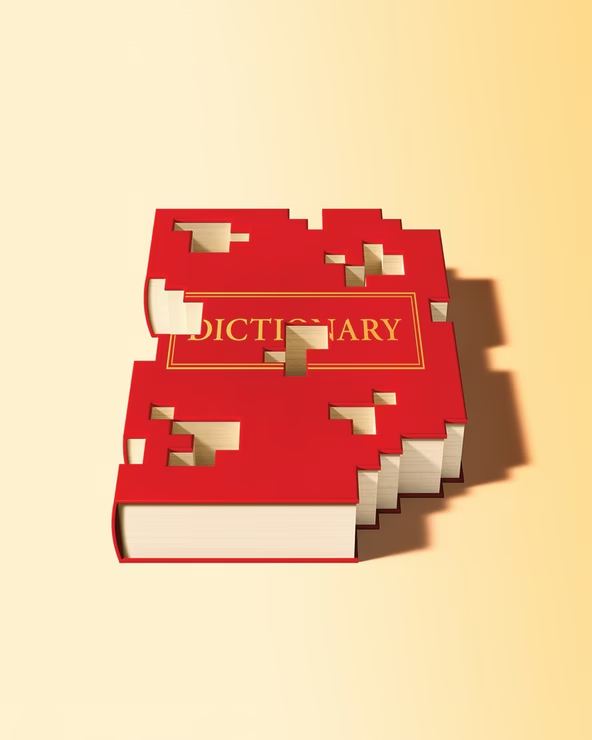
“Obsolete (adj.): no longer in use or no longer useful”… Stefan Fatsis on the challenges faced by the purveyors of today’s dictionaries…
In 2015, I settled in at the Springfield, Massachusetts, headquarters of Merriam-Webster, America’s most storied dictionary company. My project was to document the ambitious reinvention of a classic, and I hoped to get some definitions of my own into the lexicon along the way. (A favorite early drafting effort, which I couldn’t believe wasn’t already included, was dogpile : “a celebration in which participants dive on top of each other immediately after a victory.”) Merriam-Webster’s overhaul of its signature work, Webster’s Third New International Dictionary, Unabridged—a 465,000-word, 2,700-page, 13.5-pound doorstop published in 1961 and never before updated—was already in full swing. The revision, which would be not a hardback book but an online-only edition, requiring a subscription, was expected to take decades.
Not long after my arrival, though, everything changed. Pageviews were declining for Merriam-Webster.com, the company’s free, ad-driven revenue engine: Tweaks to Google’s algorithms had punished Merriam’s search results. The company had always been lean and profitable, but the financial hit was real. Merriam’s parent, Encyclopedia Britannica, was facing challenges of its own—who needed an encyclopedia in a Wikipedia world?—and ordered cuts. Merriam laid off more than a dozen staffers. Its longtime publisher, John Morse, was forced into early retirement. The revision of Merriam’s unabridged masterpiece was abandoned.
Call it the paradox of the modern dictionary. We’re in a golden age for the study and appreciation of words—a time of “meta awareness” of language, as one lexicographer put it to me. Dictionaries are more accessible than ever, available on your laptop or phone. More people use them than ever, and dictionary publishers now possess the digital wherewithal to closely track that use. Podcasts, newsletters, and Words of the Year have popularized neologisms, etymologies, and usage trends. Meanwhile, analytical software has revolutionized linguistic inquiry, enabling greater understanding of the ways language works—when, how, and why words break out; the specific contexts for expressions and idioms. And all of that was true long before the rise of AI.
But these advances are also strangling the business of the dictionary. Definitions, professional and amateur, are a click away, and most people don’t care or can’t tell whether what pops up in a search is expert research, crowdsourced jottings, scraped data, or zombie websites. Before he left Merriam, Morse told me that legacy dictionaries face the same growing popular distrust of traditional authorities that media and government have encountered…
[Fatsis recounts the recent troubled commercial history of lexicography: Merriam, Dictionary.com, et al…]
It’s hard to know what future business model might save the industry. Getting swallowed by a tech giant expecting hockey-stick growth has proved untenable. A billionaire willing to let the dictionary just be the dictionary—a self-sustaining company with a modest staff performing an outsize cultural job that might not always be profitable—looks less likely after Dan Gilbert’s foray. A grand national dictionary project—some collaboration among government, private, nonprofit, and academic institutions—feels like the Platonic ideal. But with universities and intellectual inquiry under assault in 2025, I’m not holding my breath.
At Merriam-Webster, the standard capitalist model is working, at least for now, as is its hybrid print-digital approach. The publisher has rebounded from its mid-2010s struggles. It was a social-media darling during the first Trump administration, racking up likes and retweets for its smart-alecky and politically subversive social-media persona. (When Donald Trump tweeted “unpresidented” instead of “unprecedented,” the Merriam account responded: “Good morning! The #WordOfTheDay is … not ‘unpresidented’. We don’t enter that word. That’s a new one.”) Britannica invested in software, hardware, and humans to enable Merriam to better navigate Google’s algorithms. Merriam added a phalanx of games, including Wordle knockoffs and a dictionary-based crossword, to attract and retain visitors.
Merriam has outlasted a long line of American dictionaries. But plenty of household media names have been humbled by the shifting habits of digital consumers. Even before Google’s AI Overview began taking clicks from definitions written by flesh-and-bone lexicographers, the trajectory of the industry was clear.
After Merriam shut down its online unabridged revision, I stuck around the company’s 85-year-old brick headquarters, reporting and defining. I eventually drafted about 90 definitions. Most of them didn’t make the cut. But a handful are enshrined online, including politically charged terms such as microaggression and alt-right, and whimsicalones such as sheeple and, yes, dogpile.
While I’m proud of these small contributions to lexicography, my wanderings through dictionary culture convinced me of something far more important: the urgent need to save this slowly fading business. Twenty years ago, an estimated 200 full-time commercial lexicographers were working in the United States; today the number is probably less than a quarter of that. At a time when contentious words dominate our conversations—think insurrection and fascism and fake news and woke—the need for dictionaries to chronicle and explain language, and serve as its watchdog, has never been greater…
Adapted from Fatsis” new book, Unabridged- The Thrill of and Threat to the Modern Dictionary: “Is This the End of the Dictionary?” @stefanfatsis.bsky.social in @theatlantic.com.
* Steven Wright
###
As we look it up, we might we might send carefully-chosen words of birthday greeting to William Cuthbert Faulkner; he was born on this date in 1897. A writer of novels, short stories, poetry, essays, screenplays, and one play, Faulkner is best remembered for his novels (e.g., The Sound and the Fury, As I Lay Dying, and Light in August) and stories set in “Yoknapatawpha County,” a setting largely based on Lafayette County, Mississippi, where Faulkner spent most of his life. They earned him the 1949 Nobel Prize for Literature.
Faulkner inadvertently expressed (what would pass in the context on the piece above for) confidence in the longevity of Ernest Hemingway’s work: in 1951 he observed that “he has never been known to use a word that might send a reader to the dictionary.”
On the other hand…
The past is never dead. It’s not even past.
From Requiem for a Nun, Act I, Scene III, by William Faulkner

“Language brings with it an identity and a culture, or at least the perception of it.”*…

Liz Tracey on Noah Webster’s American Dictionary of the English Language— and the way that it declared Americans free from the tyranny of British institutions and their vocabularies…
Sometimes, a dictionary is more than just words and definitions—it may be intended to serve as a declaration of linguistic independence. When Noah Webster’s first edition of the American Dictionary of the English Language was published in April 1828, it held 70,000 words, 12,000 of which were making their first appearance in dictionary form. Webster’s goals for the work were grand: “to furnish a standard of our vernacular tongue, which we shall not be ashamed to bequeath to three hundred millions of people, who are destined to occupy, and I hope, to adorn the vast territory within our jurisdiction.”
Noah Webster’s roles in the formation of the early United States were manifold: editor of the Federalist Papers, owner and editor of the first American daily newspaper [see below], textbook author, a founder of Amherst College, promoter of the first US copyright laws, and author of one of the first works on epidemiology, used by nineteenth-century medical schools.
But his 1828 dictionary is what he’s remembered for, coming at a tremendous personal cost: twenty-one years invested, and a lifelong struggle with debt. In his preface to the three-volume work, he writes of his hopes that the dictionary will result in his fellow Americans’ “improvement and their happiness; and for the continued increase of the wealth, the learning, the moral and religious elevation of character, and the glory of my country.”…
More at: “Webster’s Dictionary 1828: Annotated,” from @liztracey in @JSTOR_Daily.
* Trevor Noah, Born a Crime
###
As we vindicate vernacular, we might recall that it was on this date in 1846 that the first edition of the Cambridge Chronicle was published. One of the earliest weeklies in the U.S., it served the newly-incorporated city of Cambridge, MA– using language consistent with Webster’s dictionary. (Nearby Boston was home to the first U.S. newspaper, the Publick Occurrences Both Forreign and Domestick, which was founded in 1690 (albeit short-lived).
The Cambridge Chronicle is technically the longest continuously-published weekly newspaper in the U.S… though it ceased original serving up original content in 2022, after being purchased by Gannett. It now re-publishes regional stories from other Gannett papers.
As for Webster, he began his journalistic career in 1779, writing articles for New England newspapers justifying the Revolutionary War. In 1793, Alexander Hamilton recruited him to edit the leading Federalist Party newspaper; then in December of that year, Webster founded New York’s (and the new American nation’s) first daily newspaper American Minerva, later renamed the Commercial Advertiser, which he edited for four years (writing the equivalent of 20 volumes of articles and editorials).

“I was reading the dictionary. I thought it was a poem about everything.”*…

That seminal semanticist Samuel Johnson suggested, “dictionaries are like watches, the worst is better than none and the best cannot be expected to go quite true.” From “unabridged” to “slanguage,” Madeline Kripke’s library of lexicons is a logophile’s heaven (or hell)…
Madeline Kripke’s first dictionary was a copy of Webster’s Collegiate that her parents gave her when she was a fifth grader in Omaha in the early 1950s. By the time of her death in 2020, at age 76, she had amassed a collection of dictionaries that occupied every flat surface of her two-bedroom Manhattan apartment—and overflowed into several warehouse spaces. Many believe that this chaotic, personal library is the world’s largest compendium of words and their usage.
“We don’t really know how many books it is,” says Michael Adams, a lexicographer and chair of the English department at Indiana University Bloomington. More than 1,500 boxes, with vague labels such as “Kripke documents” or “Kripke: 17 books,” arrived at the school’s Lilly Library on two tractor-trailers in late 2021. The delivery was accompanied by a nearly 2,000-page catalog detailing some 6,000 volumes. But that’s only a fraction of the total. In summer 2023, the library hired a group of students to simply open each box and list its contents. By the fall, their count stood at about 9,700. “And they’ve got a long way to go,” says Adams. “20,000 sounds like a pretty good estimate.”
…
“This is my favorite wall,” Madeline Kripke told Narratively reporter Daniel Kreiger when he visited her West Village apartment in 2013. She shined a flashlight on glass-fronted shelves jammed with dictionaries full of the slanguage and cryptolect of small and likely overlooked communities. Kreiger listed some of the groups represented at that time, among them cowboys and flappers, mariners and gamblers, soldiers, circus workers, and thieves.
Among the first tomes Adams pulled from the boxes was a well-known example of the slang genre: The Canting Academy. This 17th-century dictionary by Richard Head is a guide to “cant,” the jargon of London’s criminal class or, as the subtitle to the second edition puts it, “The Mysterious and Villainous Practices Of that wicked Crew, commonly known by the Names of Hectors, Treppaners, Gults, &c.” (Adams wonders if a first edition is also hidden in the banker’s boxes.) With The Canting Academy, one can learn to translate the cant of the “priggs” (“all sorts of thieves”) to English: “lour” to “money,” “pannam” to “bread,” “lage” to “water.” Most of the language is indecipherable without this key, but Adams notes some usages that are common today. “To plant” something is, in centuries-old cant or modern-day English, “to lay, place, or hide.”
…
Much of what Adams has unpacked has a far less storied (and pricey) past, but, he says, the quirky and unexpected volumes in Kripke’s collection might be the most valuable to future lexicographers and historians. A bright red pamphlet with a doodle of heart on the cover might seem disposable, but it is an artifact of a particular place and time, Adams says. “Dictionaries are made by people, so they’re not just language books,” he says, “they’re culture books.”

Printed in 1962 as a marketing tool for a CBS sitcom, that slim pamphlet featuring a big heart around the faces of two 20-something actors is Dobie Gillis: Teenage Slanguage Dictionary, filled with “teen-age antics and terms.” It’s the type of thing that might have been stuffed into a cereal box or inserted in a teen magazine, says Adams. “I’m pretty sure that most people threw the copy they had away, and so this one is a fairly rare item that says something important about the representation of teen language and culture in the 1950s and 1960s.” Thanks to Kripke’s copy we know that this, at least according to the marketers behind The Many Loves of Dobie Gillis, was the era of the “keen teen” (“well-liked person”), the “cream puff” (“conceited person”), the “meatball” (“a dull guy”), and the “mathematician” (“teen who can put two and two together and get SEX”).
…
Kripke—“the mistress of slang,” in the words of one colleague—dedicated decades of her life to curating this collection of words, including countless ones we might like to forget. When she passed away without a will, the fate of her overwhelming library, plus a trove of documents on the history of dictionary making, was uncertain. Auctioning it off in lots could have brought the highest bids, but Kripke’s family worked in conjunction with the lexicographic community to preserve what Adams calls “her legacy.” That it was ultimately purchased in total by Indiana University Bloomington, a state university that committed to making the works accessible to the public, seems in keeping with the way Kripke herself viewed the collection, as a resource for the curious.
“You would go to see her in her Village apartment, and it was filled from top to bottom and side to side with books,” Adams says. It would have taken some digging but, “she would have the book that you need to see out for you and always some other specimens, too.”…
“The Low Down on the Greatest Dictionary Collection in the World,” in @atlasobscura.
* Steven Wright
###
As we look it up, we might recall that it was on this date in 1660, at Gresham College in London, that twelve men, including Christopher Wren, Robert Boyle, John Wilkins, and Sir Robert Moray decided to found a “Colledge for the Promoting of Physico-Mathematicall Experimentall Learning” to promote “experimental philosophy” (which became science-as-we-know-it). Six months later, Robert Hooke‘s first publication, a pamphlet on capillary action, was read to the group.
The Society subsequently petitioned King Charles II to recognize it and to make a royal grant of incorporation. The Royal Charter, which was passed in July, 1662 created the Royal Society of London.
In 1665, the society introduced the world’s first journal exclusively devoted to science in 1665, Philosophical Transactions (and in so doing originated the peer review process now widespread in scientific journals). Its founding editor was Henry Oldenburg, the society’s first secretary. It remains the oldest and longest-running scientific journal in the world.

“The commonplace is miraculous if rightly seen”*…

… and used. Consider, for example, this affecting example of literary collage from Jez Burrows…
The valley was enclosed by rugged peaks, security fencing and annihilative firepower—a state secret. Nothing for miles around. They sat opposite one another they sat in the shade of a tree.
“Repeat the words after me: A fish is an animal.”
“A fish is an animal.”
“A cow is an animal.”
“A cow is an animal.”
“We go to the zoo to see the animals.”
“We go to the zoo to see the animals.” She nodded in affirmation.
“Very good.”
“Very good.” She looked up with an absent smile and burst out laughing. Its mouth snapped into a tight, straight line and there was a fraught silence. Her body tensed up.
“I’m sorry! I didn’t mean to insult you!” She leaned forward to take its hand and a cross-current of electricity seemed to flow between them. She felt guilty now, and a little uneasy. She looked at it warily, this naive, simple creature, with its straightforward and friendly eyes so eager to believe appearances—a shimmering evanescent bubble of cycloid scales and yellow fur agleam in the sun. Circuitry that Karen could not begin to comprehend. Since Parker’s research did not pan out too well, now she was the linchpin of the experiment. Her voice wobbled dangerously, but she brought it under control.
“I’m really sorry if I hurt your feelings.”
To her astonishment, it smiled and emitted a sound like laughter. She felt an inward sense of relief.
“I want an apple.”
“When you ask for something you should say, ‘Please.’”
“Please give me an apple.” It rolled the word around its mouth. She smiled distantly.
“I’ll think about it, amigo.”
Collins COBUILD Primary Learner’s Dictionary
Collins English Dictionary
Merriam-Webster Collegiate Dictionary
My First Dictionary
New Oxford American Dictionary
The American Heritage Dictionary of the English Language
More very short stories composed of example sentences from dictionaries: “Dictionary Stories” from @jezburrows.
Apposite: Austin Kleon‘s newspaper blackout poetry. For example…

(Image at top: source)
* Charles Simic
###
As we juxtapose, we might send carefully constructed birthday greetings to Gertrude Stein; she was born on this date in 1874. An American ex-pat in Paris, Stein was an author, poet, and memoirist (The Autobiography of Alice B. Toklas). But she is probably best remembered as the host of a Paris salon where the leading figures of modernism in literature and art– including Pablo Picasso, Ernest Hemingway, F. Scott Fitzgerald, Sinclair Lewis, Ezra Pound, Sherwood Anderson, and Henri Matisse– regularly met.
Hemingway described her role as both a host and a mentor to a generation of artists in in A Moveable Feast. The Mother of Us All was the title of a Virgil Thomson opera for which Stein wrote the libretto. While the subject of the opera, Susan B. Anthony, certainly deserves the epithet, so, many have observed, did its author.

“Uniformity is not nature’s way; diversity is nature’s way”*…

The U.S. boasts an impressively vast array of agricultural and botanical species. In an attempt to document that fact, The United States Department of Agriculture collected over 7,500 botanical watercolour paintings of evolving fruit and nut varieties in its Pomological Watercolor Collection, assembled between 1886 and 1942…
Independent publishing house Atelier Éditions is now revisiting this documentation of American pomology with the release of its latest book: An Illustrated Catalog of American Fruits & Nuts. “I came across the collection a few years back while researching botanical artworks,” says Pascale Georgiev, editorial director of Atelier. “There was such potential for a book with this collection, and it fits with our way of building archival or collection-based volumes.” The book is a biophilic wonder, with beautiful images of fruits popping with gentle colours and careful watercolour work. Accompanying them are often texts by well-versed experts, giving a fascinating insight into the agriculture behind the produce.
“We only produce and consume a handful of varieties today, mainly hybrids that cater to our desire for a certain sweetness, juiciness, smoothness, even specific shapes and lack of seeds,” says Pascale on the importance of the book’s current publication. “In some respects, the collection is a time capsule, and a reminder about the importance of diversity and conservation,” she adds…


Joey Levenson in discussion with Pascal: “We talk to Atelier Éditions about its new Illustrated Catalog of American Fruits & Nuts,” in @itsnicethat. More at Atelier Éditions.
###
As we fancy favorite fruits, we might carefully compose a birthday greeting to Pierre Athanase Larousse, the French grammarian and lexicographer, born in Toucy on this date in 1817. In 1856 Larousse and his partner Augustin Boyer published the New Dictionary of the French Language, the forerunner of the Petit Larousse. On December 27, 1863 the first volume of Larousse’s masterwork, the great encyclopedic dictionary, the Grand dictionnaire universel du XIXe siècle (Great Universal 19th-Century Dictionary), appeared.

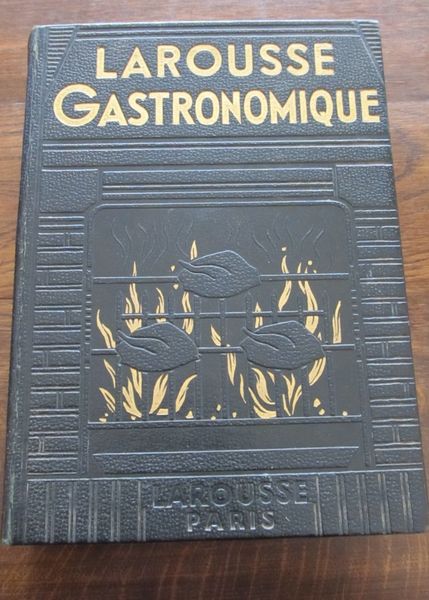
Then, in 1938, the Larousse publishing house published an encyclopedia of gastronomy, Larousse Gastronomique edited by Prosper Montagne.
And Happy Mole Day (or to be more precise, October 23 at 6:02 pm, in honor of Avogadro’s number: 6.02 x 10²³ items are in a mole — it’s the chemist’s version of a dozen)
You must be logged in to post a comment.