Posts Tagged ‘Stefan Fatsis’
“I was reading the dictionary. I thought it was a poem about everything.”*…
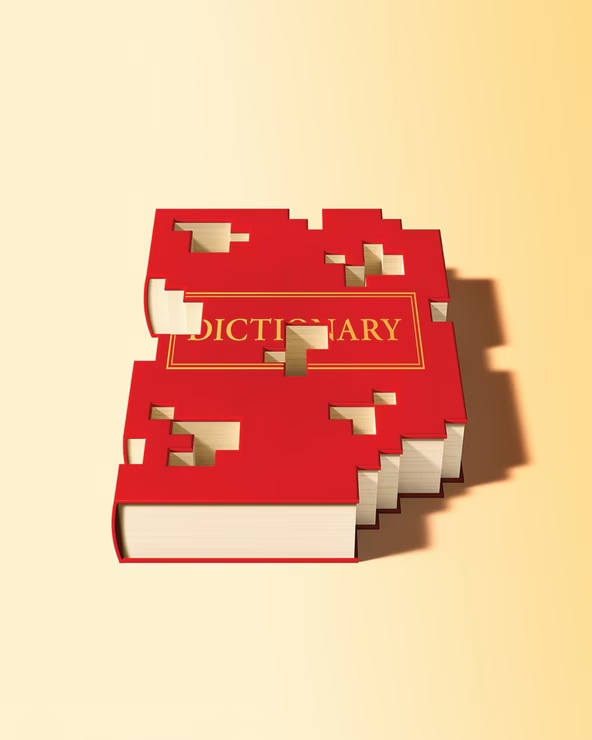
“Obsolete (adj.): no longer in use or no longer useful”… Stefan Fatsis on the challenges faced by the purveyors of today’s dictionaries…
In 2015, I settled in at the Springfield, Massachusetts, headquarters of Merriam-Webster, America’s most storied dictionary company. My project was to document the ambitious reinvention of a classic, and I hoped to get some definitions of my own into the lexicon along the way. (A favorite early drafting effort, which I couldn’t believe wasn’t already included, was dogpile : “a celebration in which participants dive on top of each other immediately after a victory.”) Merriam-Webster’s overhaul of its signature work, Webster’s Third New International Dictionary, Unabridged—a 465,000-word, 2,700-page, 13.5-pound doorstop published in 1961 and never before updated—was already in full swing. The revision, which would be not a hardback book but an online-only edition, requiring a subscription, was expected to take decades.
Not long after my arrival, though, everything changed. Pageviews were declining for Merriam-Webster.com, the company’s free, ad-driven revenue engine: Tweaks to Google’s algorithms had punished Merriam’s search results. The company had always been lean and profitable, but the financial hit was real. Merriam’s parent, Encyclopedia Britannica, was facing challenges of its own—who needed an encyclopedia in a Wikipedia world?—and ordered cuts. Merriam laid off more than a dozen staffers. Its longtime publisher, John Morse, was forced into early retirement. The revision of Merriam’s unabridged masterpiece was abandoned.
Call it the paradox of the modern dictionary. We’re in a golden age for the study and appreciation of words—a time of “meta awareness” of language, as one lexicographer put it to me. Dictionaries are more accessible than ever, available on your laptop or phone. More people use them than ever, and dictionary publishers now possess the digital wherewithal to closely track that use. Podcasts, newsletters, and Words of the Year have popularized neologisms, etymologies, and usage trends. Meanwhile, analytical software has revolutionized linguistic inquiry, enabling greater understanding of the ways language works—when, how, and why words break out; the specific contexts for expressions and idioms. And all of that was true long before the rise of AI.
But these advances are also strangling the business of the dictionary. Definitions, professional and amateur, are a click away, and most people don’t care or can’t tell whether what pops up in a search is expert research, crowdsourced jottings, scraped data, or zombie websites. Before he left Merriam, Morse told me that legacy dictionaries face the same growing popular distrust of traditional authorities that media and government have encountered…
[Fatsis recounts the recent troubled commercial history of lexicography: Merriam, Dictionary.com, et al…]
It’s hard to know what future business model might save the industry. Getting swallowed by a tech giant expecting hockey-stick growth has proved untenable. A billionaire willing to let the dictionary just be the dictionary—a self-sustaining company with a modest staff performing an outsize cultural job that might not always be profitable—looks less likely after Dan Gilbert’s foray. A grand national dictionary project—some collaboration among government, private, nonprofit, and academic institutions—feels like the Platonic ideal. But with universities and intellectual inquiry under assault in 2025, I’m not holding my breath.
At Merriam-Webster, the standard capitalist model is working, at least for now, as is its hybrid print-digital approach. The publisher has rebounded from its mid-2010s struggles. It was a social-media darling during the first Trump administration, racking up likes and retweets for its smart-alecky and politically subversive social-media persona. (When Donald Trump tweeted “unpresidented” instead of “unprecedented,” the Merriam account responded: “Good morning! The #WordOfTheDay is … not ‘unpresidented’. We don’t enter that word. That’s a new one.”) Britannica invested in software, hardware, and humans to enable Merriam to better navigate Google’s algorithms. Merriam added a phalanx of games, including Wordle knockoffs and a dictionary-based crossword, to attract and retain visitors.
Merriam has outlasted a long line of American dictionaries. But plenty of household media names have been humbled by the shifting habits of digital consumers. Even before Google’s AI Overview began taking clicks from definitions written by flesh-and-bone lexicographers, the trajectory of the industry was clear.
After Merriam shut down its online unabridged revision, I stuck around the company’s 85-year-old brick headquarters, reporting and defining. I eventually drafted about 90 definitions. Most of them didn’t make the cut. But a handful are enshrined online, including politically charged terms such as microaggression and alt-right, and whimsicalones such as sheeple and, yes, dogpile.
While I’m proud of these small contributions to lexicography, my wanderings through dictionary culture convinced me of something far more important: the urgent need to save this slowly fading business. Twenty years ago, an estimated 200 full-time commercial lexicographers were working in the United States; today the number is probably less than a quarter of that. At a time when contentious words dominate our conversations—think insurrection and fascism and fake news and woke—the need for dictionaries to chronicle and explain language, and serve as its watchdog, has never been greater…
Adapted from Fatsis” new book, Unabridged- The Thrill of and Threat to the Modern Dictionary: “Is This the End of the Dictionary?” @stefanfatsis.bsky.social in @theatlantic.com.
* Steven Wright
###
As we look it up, we might we might send carefully-chosen words of birthday greeting to William Cuthbert Faulkner; he was born on this date in 1897. A writer of novels, short stories, poetry, essays, screenplays, and one play, Faulkner is best remembered for his novels (e.g., The Sound and the Fury, As I Lay Dying, and Light in August) and stories set in “Yoknapatawpha County,” a setting largely based on Lafayette County, Mississippi, where Faulkner spent most of his life. They earned him the 1949 Nobel Prize for Literature.
Faulkner inadvertently expressed (what would pass in the context on the piece above for) confidence in the longevity of Ernest Hemingway’s work: in 1951 he observed that “he has never been known to use a word that might send a reader to the dictionary.”
On the other hand…
The past is never dead. It’s not even past.
From Requiem for a Nun, Act I, Scene III, by William Faulkner

You must be logged in to post a comment.