Posts Tagged ‘design’
“There are only patterns, patterns on top of patterns, patterns that affect other patterns. Patterns hidden by patterns. Patterns within patterns.”*…
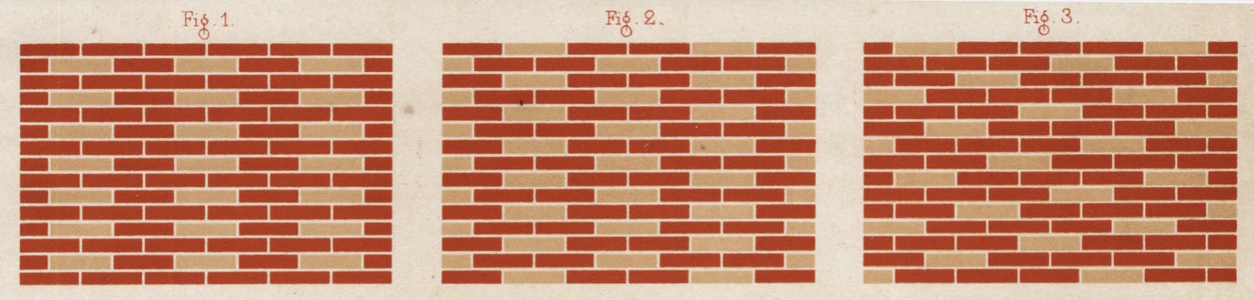


… and so many more in a beautiful 1878 book of brick patterns, published in France by architect J Lacroux: “Brick Tease,” from @presentcorrect.
* Chuck Palahniuk, Survivor
###
As we muse on masonry, we might send carefully-designed birthday greetings to John W. “Jack” Ryan; he was born on this date in 1926. A Yale-trained engineer, Ryan left Raytheon (where he worked on the Navy’s Sparrow III and Hawk guided missiles) to join Mattel. He oversaw the conversion of the Mattel-licensed “Bild Lili” doll into Barbie (contributing, among other things, the joints that allowed “her” to bend at the waist and the knee) and created the Hot Wheels line. But he is perhaps best remembered as the inventor of the pull-string, talking voice box that gave Chatty Cathy her voice.

“Variety’s the very spice of life, that gives it all it’s flavour”*…

Possibly the most remarkable city block in the world…
The Illa de la Discòrdia (Catalan pronunciation: [ˈiʎə ðə lə disˈkɔɾði.ə]) or Mansana de la Discòrdia [mənˈsanə ðə lə disˈkɔɾði.ə] — “Block of Discord”; Spanish: Manzana de la Discordia — is a city block on Passeig de Gràcia in the Eixample district of Barcelona, Catalonia, Spain. The block is noted for having buildings by four of Barcelona’s most important Modernista architects, Lluís Domènech i Montaner, Antoni Gaudí, Josep Puig i Cadafalch, and Enric Sagnier, in close proximity. As the four architects’ styles were very different, the buildings clash with each other and the neighboring buildings. They were all built in the early years of the 20th century…
Wikipedia
From the left in the photo above:
Casa Lleó M Lluís Domènech i Montaner (1905)
Casa Mulleras Enric Sagnier (1906)
Casa Bonet Marceliano Coquillat (1901/1915)
Casa Amatller Josep Puig i Cadafalch (1900)
Casa Batlló Antoni Gaudí (1877/1906)
* William Cowper
###
As we marvel, we might send boldly-sketched birthday greetings to Sir Peter Cook; he was born on this date in 1936. An architect, lecturer, and writer, he was a founder of Archigram, a group that championed neofuturistic design as a challenge to the complacency of modernism…. every solution becomes the next problem…

“HERMAN MELVILLE CRAZY”*…

as Indian isles by coral reefs.”
I first encountered the work of Peter Gorman via his glorious book Barely Maps (a gift from friend MK). Early in the pandemic, Peter picked up Moby Dick…
I read Moby-Dick in April 2020. For weeks afterward, I couldn’t stop thinking about it. I started making maps and diagrams as a way to figure it out.
Moby-Dick is infamous for its digressions. Throughout the book, the narrator disrupts the plot with contemplations, calculations, and categorizations. He ruminates on the White Whale, and the ocean, and human psychology, and the night sky, and how it all relates back to the mystery of the unknown. His narration feels like a twisting- turning struggle to explain everything.
Reading Moby-Dick actually made me feel like that—like I’d mentally absorbed its spin-cycle style. I developed a case of “Kaleidoscope Brain.” The maps I was making were obsessive and encyclopedic. They were newer and weirder and they digressed beyond straightforward geography…

gently awful stirrings seem to speak of some hidden soul beneath.”
Moby Dick, mapped and charted: Kaleidoscope Brain, from @barelymaps. It’s a free pdf download, though one has the opportunity– well-taken– to become a Patreon sponsor.
* Headline in New York Day Book, September 8, 1852
###
As we wonder about white whales, we might recall that it was on this date in 2008 that the Large Hadron Collider at CERN was first powered up. The world’s largest and highest-energy particle collider, it is devoted to searching for the new particles predicted by supersymmetry theories, and to exploring other unresolved questions in particle physics (e.g. the Higgs boson)… that’s to say, to mapping and charting existence.


“Of course I’d like to get beyond the concrete. But it’s really difficult. Very difficult.”*…

Felix Salmon is fascinated by concrete…
Greetings from my apartment in the most beautiful Brutalist tower in New York City (sorry not sorry, I.M. Pei.) My bookshelf contains such works as “Concrete,” “Concrete Concept” and “Toward a Concrete Utopia;” on my desk is “Concrete Planet.” Tl;dr: I’m a lover of concrete, not a hater. But… it’s still very problematic. And, as you’re about to find out, much more expensive than architects and contractors might have you believe…
He goes on, in his “Capital” column for Axios, to explain…
Concrete construction no longer lasts thousands of years, like the Pantheon in Rome. Instead, its lifespan is roughly 50-100 years, thanks to the way in which modern concrete is reinforced.
That means a multi-trillion-dollar bill is coming due right around now, in the form of concrete construction that needs noisy, dirty, expensive repair.
Why it matters: The collapse of a residential tower in Surfside, Florida is a stark reminder of how catastrophically concrete can fail. Just as the collapse of the Morandi Bridge in Genoa caused Italy to start paying much more attention to remedial infrastructure projects, the Surfside tragedy might help focus America on the urgent need to fix buildings that are nearing the end of their initial lifespan.
The big picture: As Robert Courland explains in “Concrete Planet,” modern concrete is poured around steel rebar, which gives it tensile strength. But tiny cracks — found in all concrete — cause water to start rusting the steel, which then expands, cracking the concrete.
Photos of the Surfside basement taken before the collapse show steel rebar breaking all the way through the concrete to the point at which it is fully exposed to the salty and humid Florida air.
By the numbers: One of the most famous concrete buildings in America, Frank Lloyd Wright’s Fallingwater, cost $155,000 to build in 1936 — about $2 million in 2001 dollars. The cost of repairs in 2001 came to $11.5 million.
Similarly, repairs to Wright’s concrete Unity Temple are estimated at roughly 20 times the original construction costs, even after adjusting for inflation.
How it works: Once rebar starts corroding, the standard fix involves jackhammering the concrete to expose the steel, brushing the steel to remove the rust, reinforcing the rebar as necessary, and then covering it all back up again with carefully color-matched new concrete.
That labor-intensive extreme noise and dust is actually the green, environmentally sensitive solution. The only alternative is demolition and replacement with an entirely new building — something that involves a much greater carbon footprint.
Between the lines: Because concrete fails from the inside out, damage can be hard to detect. And because concrete looksso solid and impregnable, necessary maintenance is often skipped, causing massive bills later on.
Local governments are in charge of ensuring building safety, but their willingness and ability to do so varies widely. The owners and residents of concrete buildings often try very hard not to think about corrosion, just because the costs of fixing it are so enormous.
The bottom line: The amount of money needed to fix existing infrastructure (nearly all of which is concrete, in one way or another) stands at roughly $6 trillion, according to the American Society of Civil Engineers. That number does not include homes, offices and other private buildings.
If you live in a concrete building that’s more than 40 or 50 years old, it’s an extremely good idea to check carefully on just how well it’s been maintained, lest you find yourself with an unexpected seven-figure repair bill — or worse.
Go deeper: WLRN’s Danny Rivero clearly explains the collective action problems involved in persuading condo owners to pay for expensive repairs.
The tragedy in Surfside is just one indication that “America’s trillion-dollar concrete bill is coming due,” as @felixsalmon explains.
###
As we muse on maintenance, we might spare a thought for Angelo Mangiarotti; he died on this date in 2012. An architect and designer, he made an early career stop in Chicago as a visiting professor for the Illinois Institute of Technology, during which met Frank Lloyd Wright, Walter Gropius, Ludwig Mies van der Rohe and Konrad Wachsmann. While Mangiarotti learned from them an appreciation of materials (perhaps especially concrete) and industrial process for buildings and design production– on both of which he built– he is perhaps best remembered for his insistence, borne out in his work, on “never forgetting the real needs of users.”

“Everyone should be able to do one card trick, tell two jokes, and recite three poems, in case they are ever trapped in an elevator”*…

Two things make tall buildings possible: the steel frame and the safety elevator. The elevator, underrated and overlooked, is to the city what paper is to reading and gunpowder is to war. Without the elevator, there would be no verticality, no density, and, without these, none of the urban advantages of energy efficiency, economic productivity, and cultural ferment. The population of the earth would ooze out over its surface, like an oil slick, and we would spend even more time stuck in traffic or on trains, traversing a vast carapace of concrete. And the elevator is energy-efficient—the counterweight does a great deal of the work, and the new systems these days regenerate electricity. The elevator is a hybrid, by design…
The history, design, economics, and psychology of the technology that made modern cities possible– the lives of elevators: “Up and Then Down.”
* Daniel Handler
###
As we press the button, we might recall that it was on this date in 1527, during the War of the League of Cognac, that an estimated 20,000 mutinous troops of Charles V, Holy Roman Emperor (angered over unpaid wages) carried out the Sack of Rome (which was then part of the papal States). For three days, they pillaged the city, grabbing valuables and demanding tributes. They overpowered (and killed most of) the Swiss Guard, and took Pope Clement VII hostage (in Castel Sant’Angelo); he was freed only after a hefty ransom was paid. Benvenuto Cellini, witnessed the Sack and described the it in his works.
In the aftermath, Rome– which had been the center of Italian High Renaissance culture– never recovered its momentum. Indeed, many historians consider the Sack of Rome the end of the Renaissance.

You must be logged in to post a comment.