Posts Tagged ‘demography’
“Well, I was born in a small town”*…

… which is, new federal designations now dictate, definitely not an urban area…
Hundreds of urban areas in the U.S. are becoming rural, but it’s not because people are leaving.
It’s just that the U.S. Census Bureau is changing the definition of an urban area. Under the new criteria, more than 1,300 small cities, towns and villages designated urban a decade ago would be considered rural.
That matters because urban and rural areas qualify for different types of federal funding. Some communities worry the change could affect health clinics in rural areas as well as transportation and education funding from federal programs…
Groups like the American Hospital Association say the changes, which are the biggest being made to the definitions in decades, could cause problems for people who need medical care in rural areas…
Different federal programs use different definitions of urban and rural, and some communities qualify for rural funding for some programs and not others. But any changes “will have significant implications for many groups and communities,” said Kenneth Johnson, a senior demographer at the University of New Hampshire who studies rural issues.
“Another likely concern for many rural communities is that if many existing urban areas are redefined as rural, competition for the limited rural funds will increase,” Johnson said…
The difference a designation can make: “100s of US urban areas will become rural with new criteria,” from @AP.
[image above: source]
* John Mellencamp, “Small Town”
###
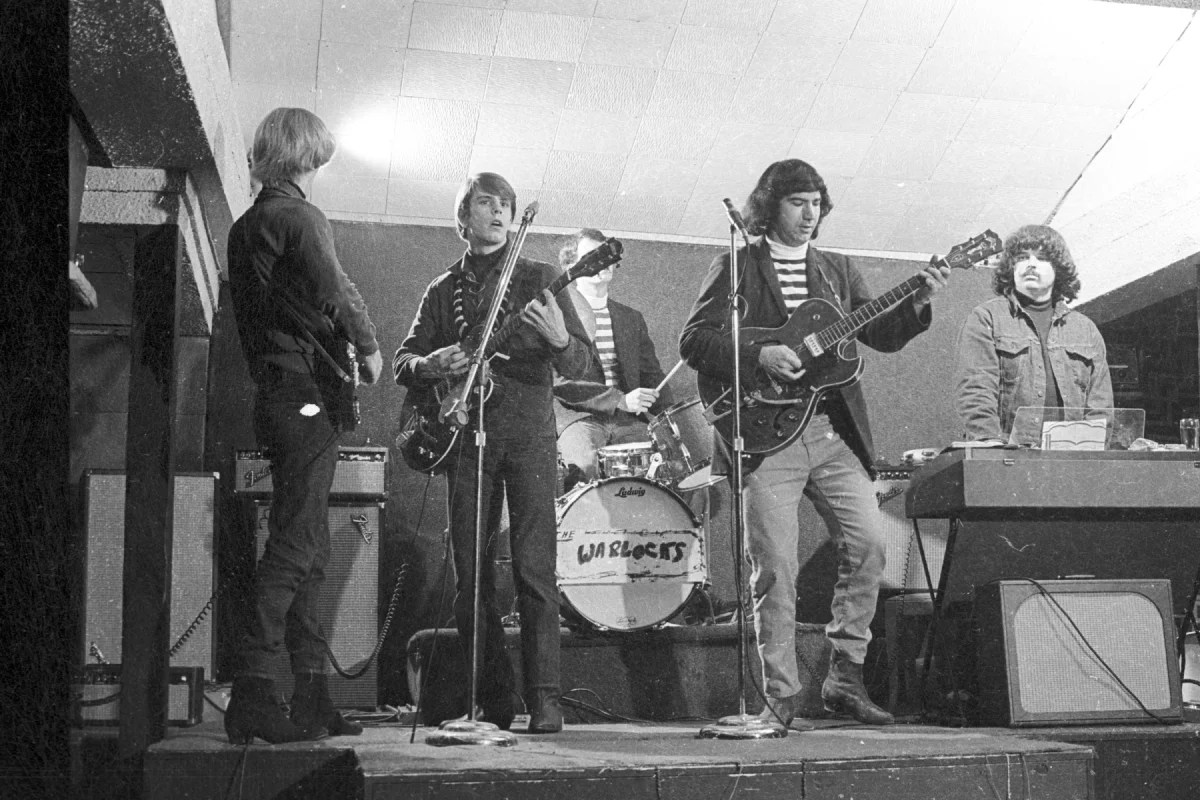
As we contemplate categories and their consequences, we might recall that it was on this date in 1965, at Magoo’s Pizza in (the then small town of) Menlo Park, CA, that Phil Lesh attended a performance of a band then known as The Warlocks. High on acid, he enjoyed it so much that he danced by himself in front of the bandstand. The Warlock’s leader, Jerry Garcia, cornered him and announced, “Hey, man-you’re going to be the bass player in this band”… and so the fundamental line-up of what became The Grateful Dead was set.
“Human history seems to me to be one long story of people sweeping down—or up, I suppose—replacing other people in the process”*…

Max Roser argues that, if we keep each other safe – and protect ourselves from the risks that nature and we ourselves pose – we are only at the beginning of human history…
… The development of powerful technology gives us the chance to survive for much longer than a typical mammalian species.
Our planet might remain habitable for roughly a billion years. If we survive as long as the Earth stays habitable, and based on the scenario above, this would be a future in which 125 quadrillion children will be born. A quadrillion is a 1 followed by 15 zeros: 1,000,000,000,000,000.

A billion years is a thousand times longer than the million years depicted in this chart. Even very slow moving changes will entirely transform our planet over such a long stretch of time: a billion years is a timespan in which the world will go through several supercontinent cycles – the world’s continents will collide and drift apart repeatedly; new mountain ranges will form and then erode, the oceans we are familiar with will disappear and new ones open up…
… the future is big. If we keep each other safe the huge majority of humans who will ever live will live in the future.
And this requires us to be more careful and considerate than we currently are. Just as we look back to the heroes who achieved what we enjoy today, those who come after us will remember what we did for them. We will be the ancestors of a very large number of people. Let’s make sure we are good ancestors…
If we manage to avoid a large catastrophe, we are living at the early beginnings of human history: “The Future is Vast,” from @MaxCRoser @OurWorldInData.
* Alexander McCall Smith
###
As we take the long view, we might recall that it was on this date in 1915 that Mary Mallon, “Typhoid Mary,” was put in quarantine on North Brother Island, in New York City, where she was isolated until she died in 1938. She was the first person in the United States identified as an asymptomatic carrier of the pathogen associated with typhoid fever… before which, she first inadvertently, then knowingly spread typhoid for years while working as a cook in the New York area.
Mallon had previously been identified as a carrier (in 1905) and quarantined for three years, after which she was set free on the condition she changed her occupation and embraced good hygiene habits. But after working a lower paying job as a laundress, Mary changed her last name to Brown and returned to cooking… and over the next five years the infectious cycle returned, until she was identified and put back into quarantine.

“I long, as does every human being, to be at home wherever I find myself”*…
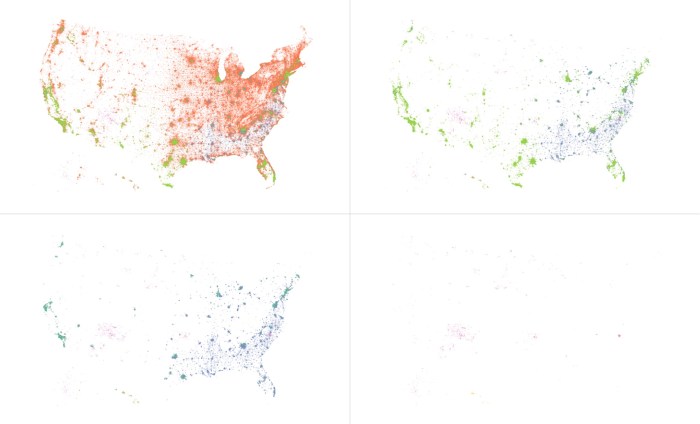
So … what if everyone went back where they came from?
The always-illuminating Nathan Yau, of Flowing Data, demonstrates that in the U.S., almost everyone comes from somewhere else. See his explanation at “If We All Left to ‘Go Back Where We Came From’.”
* Maya Angelou
###
As we contemplate commonality, we might recall that it was on this date in 1648 that Mehmed IV became Sultan of the Ottoman Empire… at the age of 6 (as a result of his father’s overthrow). He went on to become the second longest reigning sultan in Ottoman history (after Suleiman the Magnificent). Under his reign the empire reached the height of its territorial expansion in Europe.

The Ottoman Empire at its greatest extent in Europe, under Sultan Mehmed IV in the late 17th century

“The afternoon knows what the morning never suspected”*…

Change in population aged 65 and older, 2010-2023. [Screenshot: ESRI]
We’re all getting older. It’s the one thing that every single person alive right now has in common. But we’re also getting older as a population, with Americans both living longer and having fewer children. Census projections show a major demographic shift already underway and accelerating in the years to come.
At the same time, populations are not aging evenly, and issues related to aging will impact individual communities in vastly different ways, boosting economic opportunity in some areas while putting a strain on social services in others.
For instance, real estate developers that invest in progressive senior housing projects now could benefit down the road as demand for modern facilities that cater to active seniors grows. Similarly, American tech companies will see opportunity in developing innovative high-tech solutions for senior care, such as health-monitoring devices, ride-share services aimed at seniors, and care-bots. (Take a look at how Japan has embraced high-tech solutions for its aging population for more on how that might play out in the United States.)
On the flip side, social safety nets are likely to face increasing financial challenges with the continued retirement of America’s Baby Boomers, the youngest of whom will reach 67 by 2031. As that happens, rural counties—where people on average rely on Social Security as a larger portion of their overall income—may disproportionately feel the economic effects of aging.
One way to sort out who will be most impacted by aging is to look at age demographics across the country and how they will change over time…
America is aging, but not evenly: “7 maps that tell the incredible story of aging in America.”
See also this essay by Don Norman, the 83 year-old dean of user-centered design (author of The Design of Everyday Things and a former VP at Apple): “I wrote the book on user-friendly design. What I see today horrifies me.”
* Robert Frost
###
As we stand up to senescence, we might recall that it was on this date in 1965 that Peter Townsend wrote “My Generation”– inspired by the Queen Mother, who’d had his 1935 Packard hearse towed off a street in Belgravia because she was offended by the sight of it during her daily drive through the neighborhood. The song was released as a single later that year and became first a hit, then an anthem.
“Demography is destiny”*…

Every time a man ejaculates, he produces somewhere between 40 million and 1.2 billion sperm. About half of those tiny swimmers carry an X chromosome and about half carry a Y. So you’d think that the odds that one or the other would be the first to fertilize an egg would be about the same as a coin flip. And yet, for as long as people have been keeping records, nature shows a different, dependable pattern: For every 100 babies born biologically female, 105 come out biologically male. Scientists have speculated this mysteriously male-biased sex ratio is evolution’s way of evening things out, since females consistently outlive their XY-counterparts—for every man that reaches the age of 100, four women have also joined the Century Club.
This biological maxim has been so drilled into the heads of demographers—the researchers responsible for keeping tabs on how many people there are on the planet—that most don’t think twice before plugging it into any projections they’re making about how populations will change in the future. But a massive effort to catalog the sex ratios at birth, for the first time, for every country, shows that’s not such a smart strategy after all.
“For so long people just took that number for granted,” says Fengqing Chao, a public health researcher at the Institute of Policy Studies in Singapore. “But no one had ever gone to the trouble of pulling all this information together to get accurate estimates of this fundamental metric.” Chao led the five-year project, combing through decades of census data, national survey responses, and birth records to build models that could estimate national sex ratios across time. In doing so, she and her collaborators at the United Nations discovered that in most regions of the world, sex ratios diverge significantly from the historical norm. Across a dozen countries, the chasm amounts to 23.1 million missing female births since 1970. The results, published in the Proceedings of the National Academy of Sciences, provide an unprecedented look at how societal values can skew the laws of nature…
The Case of the Gone Girls (and what it might mean): “First big survey of births shows millions of missing women.”
* Ben Wattenberg and Richard M. Scammon, paraphrasing Heraclitus in The Real Majority: An Extraordinary Examination of the American Electorate (Often mis-attributed to Auguste Comte– who died before the word “demography” was first cited in print.)
###
As we become boosters for balance, we might send nurturing birthday greetings to Benjamin McLane Spock; he was born on this date in 1903. The first pediatrician to study psychoanalysis to try to understand children’s needs and family dynamics, he collected his findings in a 1946 book, The Common Sense Book of Baby and Child Care, which was criticized in some academic circles as being too reliant on anecdotal evidence, and in some conservative circles for promoting (what Norman Vincent Peale and others called) “permissiveness” by parents. Despite that push-back, it became one of the best-selling volumes in history, having sold at the time of Spock’s death in 1998 over 50 million copies in 40 languages.

You must be logged in to post a comment.