Posts Tagged ‘borders’
“What is it about maps? I could look at them all day”*…
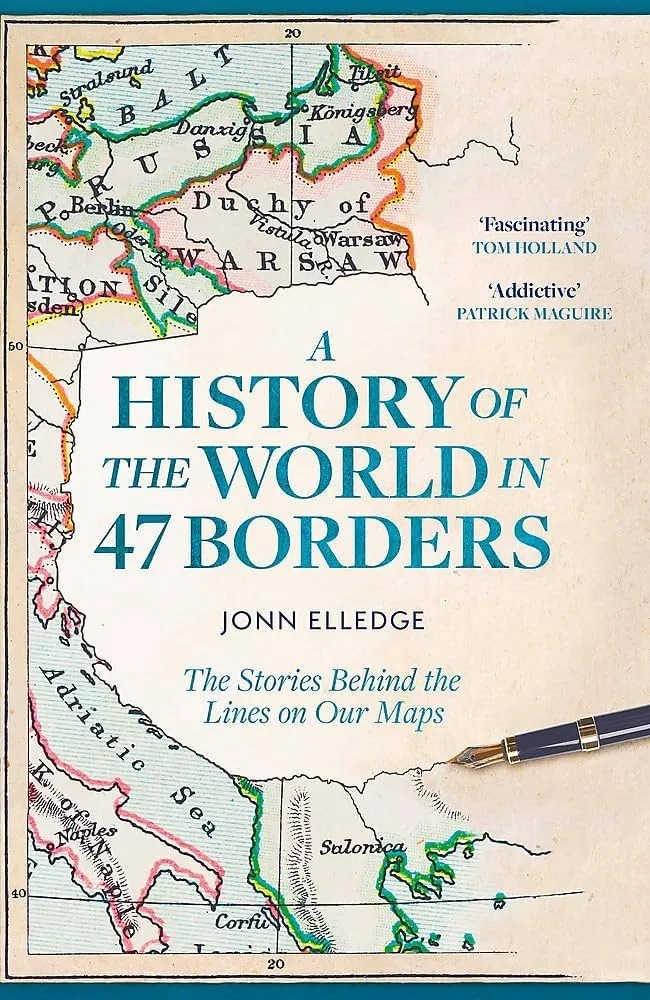
Jonn Elledge devotes the current issue of his nifty newsletter to a series of fascinating facts from his wonderful book, A Brief History of the World in 47 Borders (as it’s known in its U.S. edition, as compared to the less qualified title of the U.K. original pictured above)…
… Back in May, the good people at the UK’s leading maps and travel specialist bookshop Stanfords were kind enough to select my new book A History of the World in 47 Borders as their book of the month. And to promote it, they asked me to make a quick video, talking about it…
My initial thought was to list a single fact from each of the book’s 47 chapters, but that, I soon realised, would go on forever and take an absurd number of takes to get right. So in the end I decided on a top 10: that took an absurd number of takes to get right too, and also features me the wrong way round, for some reason, but at least it’s only three minutes long…
… as a special Christmas treat, not to mention shameless attempt to get more of you to buy the book for yourself or a loved one, here are all 47 of the facts I originally chose…
You’ll find tidbits like these:
The oldest known international border was the one between what today we call Upper Egypt and Lower Egypt. We know about it today because, sometime around 3100BCE, someone abolished it.
The Great Wall is not really one wall, but many. And the first Chinese emperor used to kidnap young men to make them build them.
The Open Borders Policies of Genghis Khan basically created the modern world.
In 1884, the great powers agreed to divide up the entire map of Africa without ever visiting. No Africans were in attendance, and one who’d asked for an invite, the Sultan of Zanzibar, was openly laughed at.
There’s a piece of Africa which two countries, Egypt and Sudan, both aggressively claim belongs to the other.
There’s an opera house in which the US/Canada border divides audience from stage.
There’s a coral atoll a thousand miles from Japan which is technically classed as a suburb of Tokyo.
Air traffic control zones cover the entire planet except the Galapagos Islands and the bit of the Arctic where Santa lives.
So much more at “47 Facts from A History of the World in 47 Borders,” from @jonnelledge.bsky.social
* Bill Bryson
###
As we muse on maps, we might send acutely observant birthday greetings to an astute student of the human animal, anthropologist Margaret Mead; she was born on this date in 1901. Best-known for her studies of the nonliterate peoples of Oceania, she was 23 when she first traveled to the South Pacific to conduct research for her doctoral dissertation. The book that resulted, Coming of Age in Samoa, was– and remains– a best-seller.

“Patriotism is, fundamentally, a conviction that a particular country is the best in the world because you were born in it”*…

The proliferation of nations around the world in the 20th century was largely a result of decolonialization; the central mechanism that arose to allow dialogue and coordination was the U.N. Kal Raustiala suggests that the 21st century and the challenges that it presents need a different understanding of statehood and a different approach to international cooperation…
The global expansion of self-determination over the past century was an essential step in human freedom that reversed centuries of racial domination, liberated hundreds of millions from European colonial control and yielded dozens of newly sovereign states. This proliferation of states nevertheless exacerbated a core weakness of the international order: the ability of humankind to solve the most dangerous challenges of the 21st century. From climate change to pandemics, many of the most pressing problems seem to require not more (and more fragmented) autonomy, but rather more collaboration.
How to square the circle of meaningful self-determination with more effective collaboration is thus a question of the utmost importance. Short of a still-undefined form of planetary politics or a radically revamped United Nations, Europe may provide the most compelling model for the future — one that properly respects self-determination but embeds it in an entity large enough to tackle the truly global challenges of today.
Meanwhile, the norm of self-determination faces a more direct attack, one that looks not forward to a post-Westphalian future but backward to an imperial past. Vladimir Putin’s war against Ukraine’s independence is an attempted reversal of self-determination, a disturbing shift after decades of movement in the other direction. It also directly challenges a largely unspoken notion: that peoples should not only enjoy self-determination, but also self-definition.
Russia is hardly alone in manipulating self-determination for its own ends. China oppresses minority peoples in Xinjiang and Tibet. The United States contains over 500 Indigenous nations as well as islands, such as Puerto Rico and Hawaii, with strong independence movements. Scotland seeks to break free of the United Kingdom; France faces Corsican and Basque nationalism.
Our world of 200 or so independent nations could easily be broken up into 300, 400, 500 sovereign states. (Indeed, the median state in the world today is already smaller than Los Angeles County in population.) True respect for the principle of self-determination might demand — or at least permit — such an outcome. Whether the world can function effectively is another matter…
…
Europe may provide the most compelling model for a future that respects self-determination but embeds it in an entity large enough to tackle the truly global challenges of today…
Who is “a people”? Which peoples should get a state and get to govern themselves? Who draws the borders? How do we manage collective threats? Eminently worth reading in full: “Who Gets A Nation?” from @NoemaMag.
* George Bernard Shaw
###
As we contemplate citizenship, we might recall that it was on this date in 1946 that U.N. General Assembly passed its first resolution, establishing the United Nations Atomic Energy Commission (UNAEC), “to deal with the problems raised by the discovery of atomic energy.” It languished, lapsing into inactivity by 1949, and was officially disbanded in 1952.
Still, the spread of “atomic technology”– and the proliferation of nuclear arms– continued apace… leading to the establishment in 1957 of the International Atomic Energy Agency (IAEA), an intergovernmental organization that seeks to promote the peaceful use of nuclear energy and to inhibit its use for any military purpose, including nuclear weapons. For example, pursuant to Treaty on the Non-Proliferation of Nuclear Weapons (signed in 1968), all non-nuclear powers are required to negotiate a safeguards agreement with the IAEA, which is given the authority to monitor nuclear programs and to inspect nuclear facilities.

…It tolled for us…
From the folks at Lucent, a nostalgic music video celebrating the contributions of Bell Labs– a facility unique in America history. The nation’s premier research facility for several decades, it was the hatching ground of radio astronomy, the transistor, the laser, information theory, the UNIX operating system, and the C programming language; work completed there earned six Nobel Prizes.
With the breakup of ATT in 1984, stewardship of the Lab passed to Lucent, and the role of Lab began to change. By August of 2008, Alcatel-Lucent announced that it was puling out of basic research altogether, to focus exclusively on more immediately marketable applications; the Bell Labs celebrated in the video is gone.
But its gifts to knowledge and society survive. Indeed, it’s surely fair to observe that, without work done there, it wouldn’t be possible to for your correspondent to be pelting readers with daily missives via the internet.
As we listen to the background noise of the universe (for the discovery of which, Arno Penzias and Robert Wilson of Bell Labs won the 1978 Nobel Prize in Physics), we might take a celebratory trip in honor of Thor Heyerdahl, the Norwegian explorer and anthropologist who became famous for his Kon-Tiki Expedition in 1947 (though he went on many others as well); he was born on this date in 1914… He once responded to an interviewer, “Borders? I have never seen one. But I have heard they exist in the minds of most people.”

![Reblog this post [with Zemanta]](https://i0.wp.com/img.zemanta.com/reblog_e.png?w=700)
You must be logged in to post a comment.