Posts Tagged ‘books’
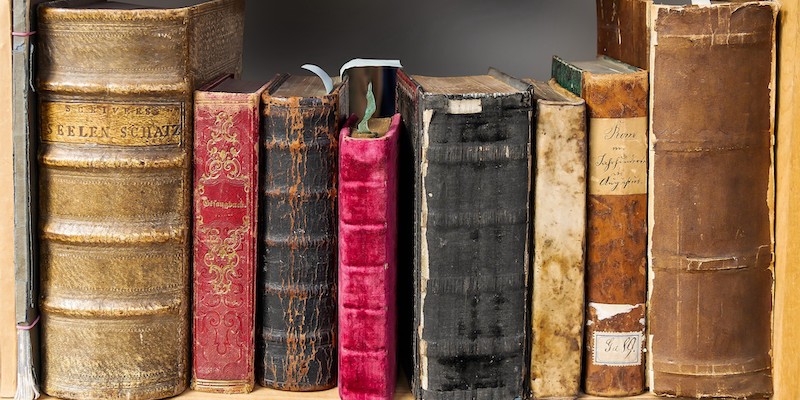
“A bookshelf is as particular to its owner as are his or her clothes; a personality is stamped on a library just as a shoe is shaped by the foot.”*…

As Anthony Powell once said, “Books do furnish a room.” But how to arrange that furniture?
The late French essayist and novelist Georges Perec understood the anxiety of shelving. In his 1978 essay “Brief Notes on the Art and Manner of Arranging One’s Books,” the title work of a newly issued collection, Perec’s discussion of the many schemes for handling your personal library only shows how utterly impossible the task is. You could, for instance, agree only to keep 361 books in your library — buy one book, get rid of one. But then, he writes, you’d have to decide what a “book” is. Is a three-volume series one book or three? Maybe it’s better to stick with 361 authors instead of books. But then some books are anonymous, and some books don’t make sense without others in the same genre, and . ..
Perec died in 1982. His home library contained more than 1,800 books.
Perec’s essay is somewhat tongue-in-cheek — he was an Oulipian, a tribe of literary gamesmen who found creativity in extreme restraint. (He’s probably most famous for his 1969 novel, translated into English as “A Void,” in which he avoided using the letter E.) But however deep the joke runs, he knew he was writing about a legitimate crisis — not so much one of shelving as of personal identity. How much mess will we accept in our lives? How much order? Shelving, he notes, exemplifies “two tensions, one which sets a premium on letting things be, on a good-natured anarchy, the other that exalts the virtues of the tabula rasa, the cold efficiency of the great arranging, one always ends by trying to set one’s books in order.”…
“Why bother organizing your books? A messy personal library is proof of life.” From Mark Athitakis (@mathitak)
[Image above: source]
* Alan Bennett
###
As we stack ’em high, we might send pointed birthday greetings to Ambrose Gwinnett Bierce; he was born on this date in 1842. His book The Devil’s Dictionary was named as one of “The 100 Greatest Masterpieces of American Literature” by the American Revolution Bicentennial Administration. His story “An Occurrence at Owl Creek Bridge” has been described as “one of the most famous and frequently anthologized stories in American literature”; and his book Tales of Soldiers and Civilians (also published as In the Midst of Life) was named by the Grolier Club as one of the 100 most influential American books printed before 1900.
A prolific and versatile writer, Bierce was regarded as one of the most influential journalists in the United States, and as a pioneering writer of realist fiction. For his horror writing, Michael Dirda ranked him alongside Edgar Allan Poe and H. P. Lovecraft. S. T. Joshi speculates that he may well be the greatest satirist America has ever produced, and can take his place with such figures as Juvenal, Swift, and Voltaire. His war stories influenced Stephen Crane, Ernest Hemingway, and others, and he was an influential and feared literary critic. In recent decades Bierce has gained wider respect as a fabulist and for his poetry.
In 1913, Bierce told reporters that he was travelling to Mexico to gain first-hand experience of the Mexican Revolution. He disappeared and was never seen again.
Conservative (noun): A statesman who is enamored of existing evils, as distinguished from the Liberal, who wishes to replace them with others.
The Devil’s Dictionary

“I suppose illustration tends to live in the streets, rather than in the hermetically sealed atmosphere of the museum, and consequently it has come to be taken less seriously”*…

But surely, it shouldn’t necessarily be so. Consider Tom Gauld (@tomgauld). He’s probably best known for his work for The New Yorker (e.g.) and The New York Times (e.g.); but he’s also an accomplished cartoonist. Your correspondent’s favorites are his on-going contributions to The Guardian Review (above and below)

… and The New Scientist…

See more of his marvelous work at his site.
* master illustrator Quentin Blake.
###
As we visualize it, we might send carefully limned birthday greetings to Richard McClure Scarry; he was born on this date in 1919. A children’s author and illustrator, he published over 300 books with total sales of over 100 million worldwide.


“It isn’t easy, coming up with book titles. A lot of the really good ones are taken. Thin Thighs in 30 Days, for example. Also The Bible.”*…
“What’s in a name?” mused Shakespeare in Romeo and Juliet (first published in print in 1597 as An Excellent Conceited Tragedie of Romeo and Juliet). Would he have said the same, one wonders, if he’d been around to hear that F. Scott Fitzgerald’s The Great Gatsby was at one point titled Trimalchio in West Egg; or that for Dracula, Bram Stoker considered The Dead Un-Dead? There is certainly an art to the great title, as demonstrated by the late English humourist Alan Coren, who when choosing a name for a collection of essays in 1975 noticed that the most popular books in Britain at that time were about cats, golf and Nazis. So he called his book Golfing for Cats and slapped a swastika on the front cover.
We also learn that care should be taken to avoid tempting an ironic fate. Bill Hillman, the American author of the 2014 guide Fiesta: How to Survive the Bulls of Pamplona, was gored by the bulls of Pamplona that same year—and again the next year. And in the 2017 British national election, the Conservative politician Gavin Barwell, author of How to Win a Marginal Seat, lost his marginal seat.
The humorous literary award known as the Bookseller/Diagram Prize for Oddest Title of the Year has been running since 1978, with past winners including Oral Sadism and the Vegetarian Personality (1986) by Glenn C. Ellenbogen, The Joy of Waterboiling (2018) by Achse Verlag and The Dirt Hole and its Variations by Charles L. Dobbins (2019). But we can go back centuries earlier to find their ancestors…
For example…
An Essay upon Wind, with Curious Anecdotes of Eminent Peteurs (1787) by Charles James Fox
Sun-beams May Be Extracted From Cucumbers, But the Process is Tedious (1799) by David Daggett
How to Cook Husbands (1898) by Elizabeth Strong Worthington
Fishes I Have Known (1905) by Arthur A. Henry Bevan
Does the Earth Rotate? No! (1919) by William Westfield
Thought Transference (Or What?) in Birds (1931) by Edmund Selous
The Boring Sponges Which Attack South Carolina Oysters (1956) by Bears Bluff Laboratories
A Weasel in My Meatsafe (1957) by Phil Drabble
Proceedings of the Second International Workshop on Nude Mice (1977) edited by Tatsuji Nomura et al.
…
Just a taste of the delights at: “77 Strange, Funny, and Magnificent Book Titles You’ve Probably Never Heard Of.” From @foxtosser.
* Dave Barry
###
As we nominate, we might send bright birthday greetings to Greg Sherwood Cohelan; he was born 70 years ago today. An accomplished marketing consultant, he is best known for his decades on the radio and television (as Greg Sherwood) in the San Francisco Bay area.
The son of Don Sherwood, “The World’s Greatest Disc Jockey” (who ruled the Bay Area airwaves in the 1950s and 60s), Greg began his on-air career while in high school as a correspondent for his father, doing a call-in show as he drove across country, “Young Man on the Road”; he followed that with a stint as a morning traffic reporter, flying around in a helicopter doing traffic reports for his dad.
After college he joined KQED, the local public television and radio organization, first as a volunteer, then as an employee. Over the years, he’s become the face of KQED-TV and the voice of KQED radio, hosting interviews, anchoring award-winning documentaries, and especially during pledge periods.
“Call right now, 1 (800) 937-8850.”

“So many books, so little time”*…
Dear The Sophist,
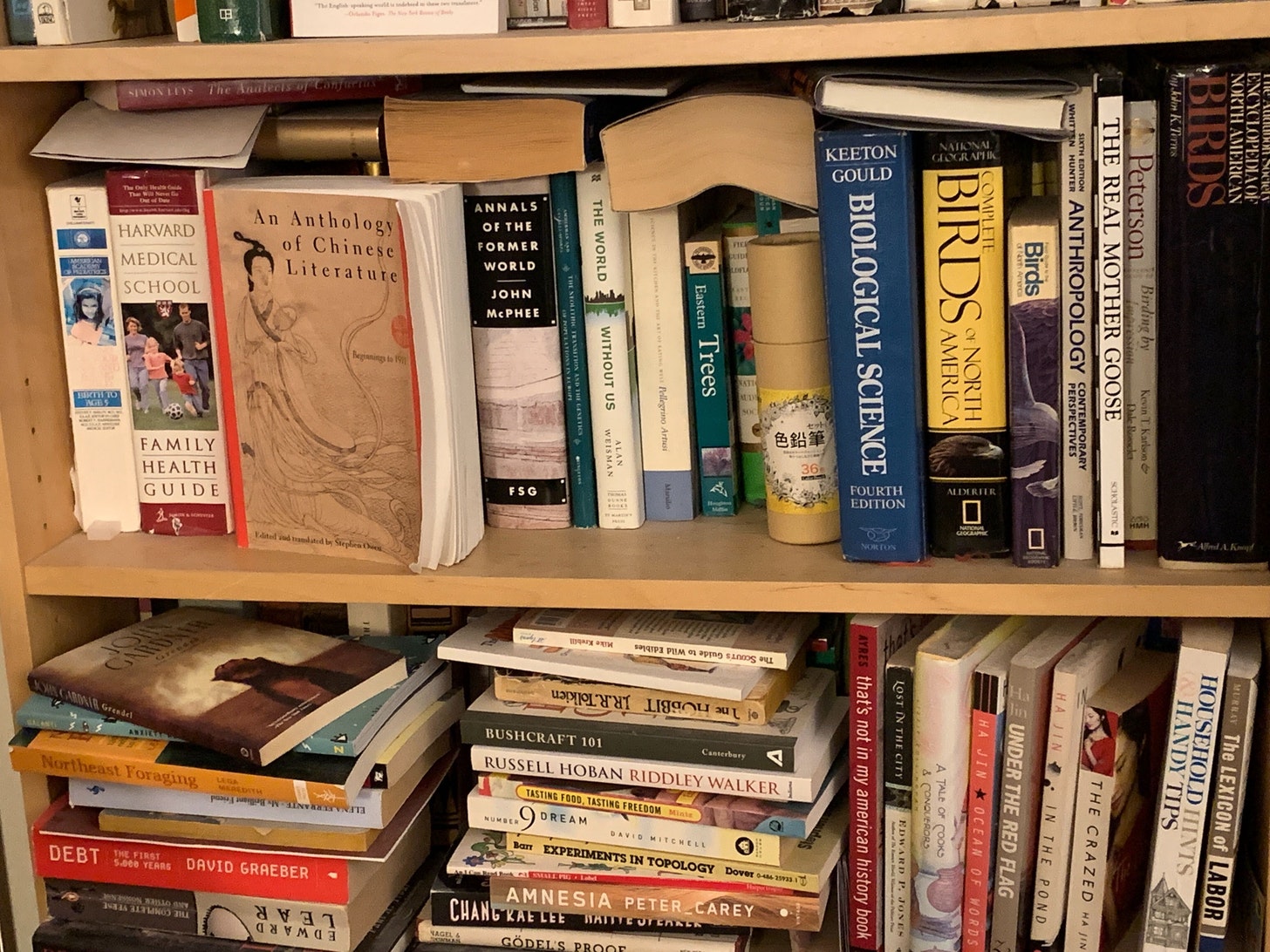
I own a lot of books, and nearly enough shelves to fit them. I haven’t read most of them—has anyone with a lot of books read most of them?—yet I still get impulses to buy more. Can you please tell me why it’s OK for me to buy more books? I should add that I live with a partner who doesn’t own a lot of books, but tolerates mine so far. So far.
—Tome-escent
Dear Volume Purchaser,
Books are ridiculous objects to buy, aren’t they? For the sake of spending a day or two, maybe a week, with some author’s thoughts and words, you take custody of this physical item that sticks around, and around, as more and more others accumulate along with it. You look at them, almost unseeingly, day after day; the walls of your rooms press in; you pay extra money to the movers to drag the extra weight around from one dwelling to the next, all because you read an interesting review once or a cover caught your eye in a bookstore.
You know what else is ridiculous? The sheer impermanence of thought. The constant yet ephemeral flickering of partial understanding across the synapses in our wet and mortal brains, and the dry circuits of the junky and even more short-lived electronic ersatz brains we rely on for backup. A book is an investment against forgetting and death—a poor investment, but it beats the alternatives. It is a slippery yet real toehold on eternity,,, If you stop the flow of new books, you stop this flow of possibilities…
Too many books? Tom Scocca (@tomscocca) explains that there’s no such thing as too many books. (via the ever-illuminating Today in Tabs)
And lest one fear that the only option is to buy books, remember the Public Library…

* Frank Zappa
###
As we reorganize our shelves, we might spare a thought for someone whose works definitely deserve places of honor thereon, Octavia Estelle Butler; she died in this date in 2006. An African American woman science fiction author, she was a rarity in her field. But her primary distinction was her extraordinary talent, as manifest in novels and stories that stretch the imagination even as they explore the all-too-real truths of the human condition. She was a multiple recipient of both the Hugo and Nebula awards, and became (in 1995) the first science-fiction writer to receive a MacArthur Fellowship.
It’s measure of her insight that her work– perhaps especially her “Parable” series— is being re-discovered as painfully prescient of our current times.

“Taxonomy is described sometimes as a science and sometimes as an art, but really it’s a battleground”*…

In a 1995 interview with Linton Weeks of the Washington Post, the Howard University librarian, collector, and self-described “bibliomaniac” Dorothy Porter (1905–95) reflected on the focus of her 43-year career: “The only rewarding thing for me is to bring to light information that no one knows. What’s the point of rehashing the same old thing?” For Porter, this mission involved not only collecting and preserving a wide range of materials related to the global Black experience, but also addressing how these works demanded new and specific qualitative and quantitative approaches in order to collect, assess, and catalog them…
As Thomas C. Battle writes in a 1988 essay on the history of the Moorland-Spingarn Research Center, the breadth of the two collections showed the Howard librarians that “no American library had a suitable classification scheme for Black materials.” An “initial development of a satisfactory classification scheme,” writes Battle, was first undertaken by four women on the staff of the Howard University Library: Lula V. Allen, Edith Brown, Lula E. Conner, and Rosa C. Hershaw. The idea was to prioritize the scholarly and intellectual significance and coherence of materials that had been marginalized by Eurocentric conceptions of knowledge and knowledge production. These women paved the way for Dorothy Porter’s new system, which departed from the prevailing catalog classifications in important ways.
All of the libraries that Porter consulted for guidance relied on the Dewey Decimal Classification. “Now in [that] system, they had one number—326—that meant slavery, and they had one other number—325, as I recall it—that meant colonization,” she explained in her oral history. In many “white libraries,” she continued, “every book, whether it was a book of poems by James Weldon Johnson, who everyone knew was a black poet, went under 325. And that was stupid to me.”
Consequently, instead of using the Dewey system, Porter classified works by genre and author to highlight the foundational role of Black people in all subject areas, which she identified as art, anthropology, communications, demography, economics, education, geography, history, health, international relations, linguistics, literature, medicine, music, political science, sociology, sports, and religion.
This Africana approach to cataloging was very much in line with the priorities of the Harlem Renaissance, as described by Howard University professor Alain Locke in his period-defining essay of 1925, “Enter the New Negro.” Heralding the death of the “Old Negro” as an object of study and a problem for whites to manage, Locke proclaimed, “It is time to scrap the fictions, garret the bogeys and settle down to a realistic facing of facts.” Scholarship from a Black perspective, Locke argued, would combat racist stereotypes and false narratives while celebrating the advent of Black self-representation in art and politics. Porter’s classification system challenged racism where it was produced by centering work by and about Black people within scholarly conversations around the world.
How Dorothy Porter assembled and organized a premier Africana research collection– and helped change academia: “Cataloging Black Knowledge.”
See also “African American Print Culture.”
* Bill Bryson, A Short History of Nearly Everything
###
As we contemplate cataloguing, we might recall that it was on this date in 1909 that a group including W. E. B. Du Bois, Mary White Ovington, Moorfield Storey, and Ida B. Wells formed the NAACP— The National Association for the Advancement of Colored People– an interracial organization dedicated to advancing justice for African Americans. 112 years later, its work continues.

You must be logged in to post a comment.