Posts Tagged ‘Beatles’
“I Got Rhythm”*…

… indeed, as Nina Kraus explains, we all do…
Why do we care about rhythm? It connects us to the world. It plays a role in listening, in language, in understanding speech in noisy places, in walking, and even in our feelings toward one another.
Rhythm is much more than a component of music. Nevertheless, music is probably what first comes to mind when we hear the word rhythm: drumming, jazz, rock and roll, marching bands, street performers with wooden spoons and five-gallon buckets, drum circles, time signatures, stomp-stomp-clap — we will, we will rock you — adventures on the dance floor, beatboxing, incantations, mantras, and prayers. Beyond music, we experience the rhythmic changes of the seasons. Some of us have menstrual cycles. We have circadian rhythms — daily cycles of mental and physical peaks and troughs. Frogs croak rhythmically to attract mates and change their rhythm to signal aggression. Tides, 17-year cicadas, lunar phases, perigees, and apogees are other naturally occurring rhythms. Human-made rhythms include the built world — street grids, traffic lights, crop fields, mowed designs in baseball diamond outfields, the backsplash behind the kitchen counter, spatial patterns in geometric visual art forms.
Maintaining rhythm is almost a biological imperative for some of us…
An exploration of the many ways in which temporal patterns plays an important role in how we perceive — and connect with — the world: “The Extraordinary Ways Rhythm Shapes Our Lives,” at @mitpress.
And for an astounding application of rhythm, the story of Niko Tosa: “The Gambler Who Beat Roulette,” (with no electronic or other help). Via @nextdraft.
* George and Ira Gershwin (The piece [performed by Gershwin here] has become a jazz standard– and gave the world a chord progression– the “rhythm changes“– that provide the foundation for many other popular jazz tunes, including Charlie Parker’s and Dizzy Gillespie’s bebop standard “Anthropology (Thrivin’ on a Riff).”)
###
As we contemplate cadence, we might recall that it was on this date in 1965 that the Beatles recorded “Help!” The title song of their 1965 film and its soundtrack album, it was released as a single in July of that year, and was number one for three weeks in the United States and the United Kingdom.
The group recorded “Help!” in 12 takes using four-track equipment. The first nine takes concentrated on the instrumental backing. The descending lead guitar riff that precedes each verse proved to be difficult, so by take 4 it was decided to postpone it for an overdub. To guide that later overdub by George, John thumped the beat on his acoustic guitar body, which can be heard in the final stereo mix.
“We can learn from history, but we can also deceive ourselves when we selectively take evidence from the past to justify what we have already made up our minds to do.”*…

Brad DeLong on the dangerous misunderstanding at the root of the current discussion of the “Thucydides’s Trap,” a phrase coined by Harvard’s Graham Allison, meant to evoke the potentially deadly tensions that arise when a major rising power (read “China”) threatens to displace a major ruling power (read “the United States). Allison’s account is very pessimistic; DeLong argues that it needn’t– shouldn’t– be so..
“Thucydides Trap” claims to be shorthand way of describing the grand-strategic dilemmas of the Classical Greek city-states of Athens and Sparta in the second half of the -400s. But it is a bowdlerized version. The actual complexities of the situation have been elided.
Thus important parts of the lessons that can be drawn from Thucydides’s description in The Peloponnesian War of the start of the war have been ignored.
And lessons can be drawn. For, as Thucydides said, he had tried to write his history as:
a treasure for all time… [because] knowledge of the past… [is] an aid to the interpretation of the future, which in the course of human things must resemble if it does not reflect it…
The situation in the second half of the -400s in the Greek world was thus:
The Spartan oligarchy had held preeminence. It had conquered and continued to dominate Laconia and Messenia. Its enserfment of their populations meant that Sparta alone, among major city-states, had a large and rich enough class of landlords who could train intensively for war, since they not have to assist in the farming themselves.
But there was a big problem with the Spartan system, as Aristotle was to note: Rich Spartan men tended to marry rich Spartan women. Thus, over time, wealth inequality grew. This diminished the size of the pool of Spartan landlords who could afford the full training régimen. The number of full Spartans in the military phalanx was dropping steadily, by perhaps a quarter in each generation.
The Athenian democracy, by contrast, was gaining in strength from generation to generation.
Athens held a central place as the maritime-commercial hub of a Greek world rapidly growing in population and wealth. Each generation saw more economic activity flow through Athens. Each generation saw Athens grow bigger and richer. Each generation saw more silver flow into its treasury. Athens had—excessively cleverly—transformed other city states’ agreements to provide warships to stave off any renewed Persian invasion into cash payments to Athens, which Athens then could and did use as it wished. Thus each generation saw the power of the Athenian state grow as well. And each generation saw a greater share of other Greek city-states become what local democrats elsewhere called “allies” and local oligarchs elsewhere called “subjects”.
In 500 Athens would have had no chance in an all-out war with Sparta. In 430 it could go toe-to-toe. By 360, had catastrophic defeat in the Peloponnesian War been avoided, Athens’s hegemony would have been near indisputible.
In this situation what, from a rational perspective, should the grand strategy of Athens in the second half of the -400s have been? It is clear:
- Do not annoy the Spartan lion.
- Focus on growing trade and commerce
- Focus on making alliances
- Focus on solidifying the nascent Athenian empire.
The future was on the side of Athens.
Korkya came to Athens at the start of the 430s, and said “we will join your alliance if you well help us push Sparta’s ally Korinth out of Epidamnos”. The Athenian answer should have been this: “You have not been our friend in the past. Join our alliance first. Then, in a generation, we will back you in all your disputes. But not now.”
Instead, Athens backed Korkyra with military force. And Korinth went to Sparta. Sparta was, usually, wary of large long-term commitments outside its heartland—the main purpose of its army, after all, was to keep the helots subservient and the taxes flowing, which was hard to do if the Spartan phalanx was far from Laconia. But Athens’s choice of open military confrontation with a key Spartan ally was enough to overcome their reluctance.
And so the Athenian Empire fell.
The lesson for a rising power? Whatever you seek to do now that may be very difficult will be easy in two generations. So postpone doing anything potentially difficult and wait for the tide to bring all the good things to you.
The lesson for a declining hegemonic power it is somewhat more complex. Outside the frame of Thucydides is the Peloponnesian war, Sparta was not the beneficiary of its generation long war against Athens. The beneficiaries were in the short-run, Persia; in the medium-run, Thebes; and in the long-run, Makedon. A declining power should take a long, hard look at itself, and consider whether curbing this particular rising power is in its own long-run interest. The task for a declining power is to create a world in which it can live comfortably when it is no longer hegemon. You can argue over whether Sparta would have had a comfortable and valued place in a counterfactual Athenian Empire circa -300. But it certainly did not have such a place in the post-Athenian Ægean world of Thebans, Argaiads, and Hellenistic despots.
From his invaluable newsletter, Grasping Reality, “The Deceptive Thucydides Trap,” @delong.
###
As we heed history, we might recall that on this date in 1966, the #1 song in the U.S was The Beatles’ “We Can Work It Out.”
“If you want to change the culture, you will have to start by changing the organization”*…

That’s perhaps especially true of cultural organizations. As Ian Leslie explains, while rock bands are known for drink, drugs, and dust-ups, they have something to teach us: beyond the debauchery lie four models for how to run a business…
… The notion that bands should make music for the love of it was always romantic and now seems positively quaint. Rock groups are mini-corporations (some of them not so mini). Bands such as Coldplay or Kings of Leon operate sophisticated corporate machines that are responsible for multiple revenue streams; at a recent conference, Metallica’s drummer spoke about the importance of using the right customer-engagement software. Yet the music machine ultimately depends on a small group of talented individuals working closely together to create something magical. Once members of a group decide that they can’t stand to be in the same room as each other, the magic stops and the money dries up.
If rock groups are businesses, businesses are getting more like rock bands. Workplaces are far more informal than they used to be, with less emphasis on protocol, rank and authority. Many firms try to cultivate the creativity that can come from close collaboration. Employers attempt to engineer personal chemistry, hiring coaches to fine-tune team dynamics and sending staff on team-building exercises. Employees are encouraged to share lunch, play table tennis and generally hang out. As the founder of Hubble, a London office-space company, put it, “We hope that our team will become friends first, and colleagues second.”…
Successful startups have to make a difficult transition from being a gang of friends working on a cool idea to being managers of a complex enterprise with multiple stakeholders. It’s a problem familiar to rock groups, which can go quickly from being local heroes to global brands, and from being responsible only for themselves to having hundreds of people rely on them for income. In both cases, people who made choices by instinct and on their own terms acquire new, often onerous responsibilities with barely any preparation. Staff who were hired because they were friends or family have their limitations exposed under pressure, and the original gang can have its solidarity tested to destruction. A study from Harvard Business School found that 65% of startups fail because of “co-founder conflict”. For every Coldplay, there are thousands of talented bands now forgotten because they never survived contact with success.
The history of rock groups can be viewed as a vast experimental laboratory for studying the core problems of any business: how to make a group of talented people add up to more than the sum of its parts. And, once you’ve done that, how to keep the band together…
The Beatles, Tom Petty and the Heartbreakers, REM, and the Rolling Stones– four bands, four models for business success: “A rocker’s guide to management,” from @mrianleslie in @1843mag.
###
As we learn from the loudest, we might recall that it was on this date in 1968 that The Beatles (one of the four cases discussed in the piece linked above) performed “Hey Jude,” the #1 song in both the U.S. and the U.K. at the time, on the television show Frost on Sunday on BBC-TV.
“A man of genius makes no mistakes. His errors are volitional and are the portals to discovery.”*…
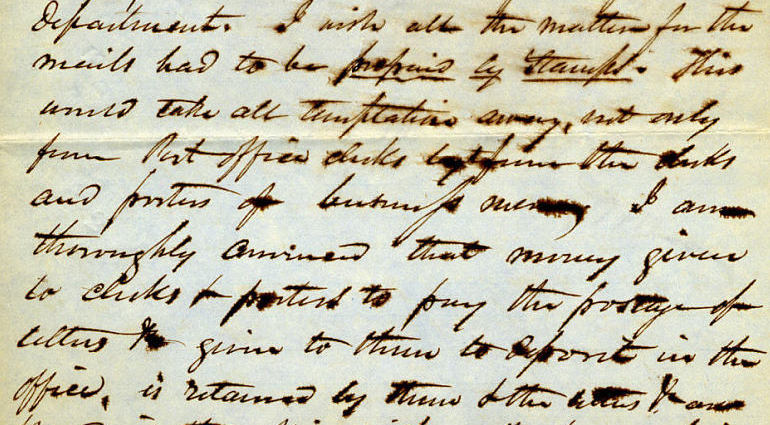
Ed Simon on errata (and other errors) in literature…
… The King James Version of the Bible has exactly 783,137 words, but unfortunately for the London print shop of Robert Barker and Martin Lucas, official purveyors to King Charles I, their 1631 edition left out three crucial letters, one crucial word—”not.” As such, their version of Exodus 20:14 read, “Thou shalt commit adultery.” Their royal patron was not amused. This edition was later deemed the “Wicked Bible.”
Literature’s history is a history of mistakes, errors, misapprehensions, simple typos. It’s the shadow narrative of expression—how we fail because of sloppiness, or ignorance, or simple tiredness. Blessed are the copyeditors, for theirs is a war of eternal attrition. Nothing done by humans is untouched by such fallenness, for to err is the universal lot of all of us. Authors make mistakes, as do editors, publishers, printers (and readers).
If error were simply an issue of a wrong comma here or an incorrect word there it wouldn’t be nearly as interesting, but mistakes undergird our lives, even our universe. They can be detrimental, beneficial, neutral. When Lockheed Martin designed the Mars Climate Orbiter using American units and NASA assumed that they’d used the metric system instead, a discrepancy that resulted in that satellite crashing into the red dust of the fourth planet from the sun—that was a mistake. And when the physician Alexander Fleming left out a culture plate which got contaminated, and he noticed the flourishing of a blue mold that turned out to be penicillin—that was a mistake. Errors in how people hear phonemes are what lead to the development of new languages; mistakes in an animal’s DNA propel evolution; getting lost can render new discoveries. Sometimes the flaw is that which is most beautiful.
Certainly, there are no shortage of them…
A wonderfully amusing history, and richly illuminating consideration of literary mistakes through the ages: “How Many Errorrs Are in This Essay?,” from @WithEdSimon in @The_Millions.
Vaguely apposite (and also really fascinating): “Panic at the Library.”
* James Joyce, Ulysses
###
As we muse on misprints, we might recall that it was on this date in 1968 that The Beatles’ record label, Apple Records, released its first single, “Hey Jude.”
The label was founded… as a creative outlet for the band and as a way to reduce their tax burden. They choose the name and image of a Granny Smith apple because in Paul McCartney’s mind, a green apple signified creative freedom and independence from commercial interests. The record was unique because it featured the image of a Granny Smith apple on side-A and the same apple sliced in half on side-B. But according to The Independent, the song was almost never released because some record executives thought that the image looked pornagraphic. In a letter sent to Apple boss Ron Kass, it said, “Here’s a wild and unanticipated problem to brighten up your day. I just received a call from a very large and influential jack jobber in the western United States. He opened the conversation by saying, ‘Are you guys serious? Do you know what you’re doing? Do you really intend to sell products bearing the new Apple label?’” He said that the Apple label was completely pornographic and the graphic nature of the art was noticed by all of his employees. He doubted that record store chains would want to stock such a record. Not only was he wrong [the single sold 8 million copies], but there is no evidence that the band had intended using a controversial image.
source
Your correspondent leaves it to the reader to deduce the supposed pornographic image. If, like him, you are stumped, see The Independent article linked in the quote above.

“People ought to stop saying, ‘Rock is dead.’ It gets old.”*…

Mo Troper (and here) offers a treatise on the hotly debated subgenre Power Pop…
What is power pop? It is a question many have asked and few have satisfyingly answered. To many, power pop is any modern idealization of mid-‘60s British pop, a sticky and sickly sweet Neapolitan of “chiming guitars,” “heavy drums” and “aching vocal harmonies.” The Raspberries, Big Star, Badfinger, Todd Rundgren — these are just a few of power pop’s pioneering practitioners.
There are entire message boards and stuffy Facebook groups dedicated to debating its origins and musical properties. Power pop fandom is as isolated as it is isolating. Most of the year it’s a pasty shut-in muttering to itself, every now and then it’s an evangelist screaming from the rooftops. To be a power pop “fan” is to be in endless pursuit of the greatest post-Beatles guitar pop single the general public has yet to hear. And once you find it: Should you share it with the world or keep it all to yourself?
To the outside world — and even to nominal double-P fans — the drama and rigorous dialectic associated with this genre is insane, and understandably so.
The gatekeeping makes a little more sense if you relate power pop to a more general aesthetic phenomenon: camp.
Susan Sontag published her essay Notes on “Camp” in 1964, the same year The Beatles conquered America. According to the Wikipedia article on camp, the phrase is “etymologically obscure” — it was once a specific cultural posture associated with working-class gay communities, but it would later be subsumed under (or, co-opted by) the postmodern umbrella. Sontag herself believed camp was fundamentally non-discriminating, although acknowledges it is by and large a sensibility created by gay men. Attempting to distinguish “camp” from other, similar aesthetics is campy.
“Camp is the consistently aesthetic experience of the world,” Sontag writes. “The whole point of camp is to dethrone the serious. Camp is playful, anti-serious. More precisely, Camp involves a new, more complex relation to ‘the serious.’ One can be serious about the frivolous, frivolous about the serious.”
Like camp art, the lines between seriousness and frivolity in power pop can be maddeningly obscure. Fountains of Wayne are often considered one of the greatest power pop bands of all time; their most celebrated record, Welcome Interstate Managers, is not power pop in the strict, sonic sense — it covers everything from Oasis and Cars pastiche to acoustic confessionals and quasi-lounge. What makes this record so great — and what makes it so campy — is the level of scholarship, commitment, and straight-faced passion the band brings to their interpretations of old hat musical tropes. Camp, according to Sontag, “reeks of self-love” even when it revels in parody.
…
“Power Pop Is Camp,” from @mo_troper.
(To Moe’s point: “That Thing You Do,” the song performed by the fictional 1960s band The Wonders in Tom Hank’s film of the same name, was written by Adam Schlesinger, co-founder of Fountains of Wayne. It succeeded both in the film as an evocation of the Beatles-inspired melodic pop of 1964-65 and as a power pop success of it own (it charted in 1997 in the U.S. and Australia and was nominated for both an Oscar and a Golden Globe.)
* Matthew Sweet
###
As we tap our toes, we might recall that it was on this date in 1961 that record store manager Brian Epstein called the Cavern Club in Liverpool to arrange to see a lunchtime performance the following day by a local group, The Beatles. After the show, he went backstage to introduce himself… returned for several subsequent shows… left his retailing career to become the group’s manager… and helped them become… well, the ultimate inspiration for Power Pop.

You must be logged in to post a comment.