Posts Tagged ‘authoritarianism’
“A republic, if you can keep it.”*

Just over a decade ago, Nils Gilman wrote an essay, The Twin Insurgency,” in which he warned of an emerging confluence of strategies between the rising global plutocratic class, on the one hand, and transnational criminal organizations, on the other. For all our sins, as you’ll see in his piece, he nailed the fundamental disposition of the tech-libertarian broligarch class. And…
One other thing I think I correctly intuited a decade ago was that a key politico-spatial implication of the Twin Insurgency was that the space of the national was fragmenting into “kaleidoscopic microsovereignties,” an argument that my friend Quinn Slobodian has recently developed at monographic length in his marvelous book Crack-Up Capitalism.
Quinn’s thesis is that the ultimate goal of what I called the plutocratic insurgents (and their intellectual and high-end service-economy henchmen) is to end the constraints that democratic nation-states impose on the privileges of the rich. These are rich men (and it is almost entirely men) who believe that their wealth should be untouchable, and that the privileges that this wealth buys should be unlimited. With Elon Musk’s DOGE, the mask is off: they are hell-bent on destroying any institutions of social care or risk-sharing that might touch their money or their privileges.
I cannot recommend Crack-Up Capitalism enough. Methodologically, is an intellectual history of the most notorious radical libertarians — from well-known assholes** like Milton Friedman and Peter Thiel to a congeries of even more colorful crackpots and kakistocrats — and their quest to craft for the perfect space for unfettered capitalism by shattering the map of allegedly sovereign territories into a variety of “exceptional” legal spaces: free ports, tax havens, special economic zones, etc. It is also an historical travelogue, taking the reader (as its cover blurb says) “from Hong Kong in the 1970s to South Africa in the late days of apartheid, from the neo-Confederate South to the former frontier of the American West, from the medieval City of London to the gold vaults of right-wing billionaires, and finally into the world’s oceans and war zones, charting the relentless quest for a blank slate where market competition is unfettered by democracy.” Best of all, Crack-Up Capitalism is wonderfully written: erudite and droll in equal measure (as the punning title itself suggests).
** I use the term “assholes” in the technical sense elaborated by Aaron James, chair of the UC Irvine philosophy department, in his 2012 book Assholes: A Theory, namely someone who “allows himself to enjoy special advantages in social relations out of an entrenched sense of entitlement that immunizes him against the complaints of other people.” I was reading the book when I wrote “The Twin Insurgency” and, even though I didn’t cite it (the anxiety of influence?), I realize now looking back how much it informed my understanding of phenomenon of the plutocratic insurgency. Conversely, I suspect the empirical fact of the rising plutocratic insurgency may well have been part of what inspired James to write his own book.
– Nils’ thoughts in full: “Revisiting the Plutocratic Insurgency.”
So, what can we expect? Steven Levitsky and Lucan A. Way paint a pretty grim picture…
… Democracy survived Trump’s first term because he had no experience, plan, or team. He did not control the Republican Party when he took office in 2017, and most Republican leaders were still committed to democratic rules of the game. Trump governed with establishment Republicans and technocrats, and they largely constrained him. None of those things are true anymore. This time, Trump has made it clear that he intends to govern with loyalists. He now dominates the Republican Party, which, purged of its anti-Trump forces, now acquiesces to his authoritarian behavior.
U.S. democracy will likely break down during the second Trump administration, in the sense that it will cease to meet standard criteria for liberal democracy: full adult suffrage, free and fair elections, and broad protection of civil liberties.
The breakdown of democracy in the United States will not give rise to a classic dictatorship in which elections are a sham and the opposition is locked up, exiled, or killed. Even in a worst-case scenario, Trump will not be able to rewrite the Constitution or overturn the constitutional order. He will be constrained by independent judges, federalism, the country’s professionalized military, and high barriers to constitutional reform. There will be elections in 2028, and Republicans could lose them.
But authoritarianism does not require the destruction of the constitutional order. What lies ahead is not fascist or single-party dictatorship but competitive authoritarianism—a system in which parties compete in elections but the incumbent’s abuse of power tilts the playing field against the opposition. Most autocracies that have emerged since the end of the Cold War fall into this category, including Alberto Fujimori’s Peru, Hugo Chávez’s Venezuela, and contemporary El Salvador, Hungary, India, Tunisia, and Turkey. Under competitive authoritarianism, the formal architecture of democracy, including multiparty elections, remains intact. Opposition forces are legal and aboveground, and they contest seriously for power. Elections are often fiercely contested battles in which incumbents have to sweat it out. And once in a while, incumbents lose, as they did in Malaysia in 2018 and in Poland in 2023. But the system is not democratic, because incumbents rig the game by deploying the machinery of government to attack opponents and co-opt critics. Competition is real but unfair.
Competitive authoritarianism will transform political life in the United States. As Trump’s early flurry of dubiously constitutional executive orders made clear, the cost of public opposition will rise considerably: Democratic Party donors may be targeted by the IRS; businesses that fund civil rights groups may face heightened tax and legal scrutiny or find their ventures stymied by regulators. Critical media outlets will likely confront costly defamation suits or other legal actions as well as retaliatory policies against their parent companies. Americans will still be able to oppose the government, but opposition will be harder and riskier, leading many elites and citizens to decide that the fight is not worth it. A failure to resist, however, could pave the way for authoritarian entrenchment—with grave and enduring consequences for global democracy.
The second Trump administration may violate basic civil liberties in ways that unambiguously subvert democracy. The president, for example, could order the army to shoot protesters, as he reportedly wanted to do during his first term. He could also fulfill his campaign promise to launch the “largest deportation operation in American history,” targeting millions of people in an abuse-ridden process that would inevitably lead to the mistaken detention of thousands of U.S. citizens.
But much of the coming authoritarianism will take a less visible form: the politicization and weaponization of government bureaucracy. Modern states are powerful entities. The U.S. federal government employs over two million people and has an annual budget of nearly $7 trillion. Government officials serve as important arbiters of political, economic, and social life. They help determine who gets prosecuted for crimes, whose taxes are audited, when and how rules and regulations are enforced, which organizations receive tax-exempt status, which private agencies get contracts to accredit universities, and which companies obtain critical licenses, concessions, contracts, subsidies, tariff waivers, and bailouts. Even in countries such as the United States that have relatively small, laissez-faire governments, this authority creates a plethora of opportunities for leaders to reward allies and punish opponents. No democracy is entirely free of such politicization. But when governments weaponize the state by using its power to systematically disadvantage and weaken the opposition, they undermine liberal democracy. Politics becomes like a soccer match in which the referees, the groundskeepers, and the scorekeepers work for one team to sabotage its rival…
[The authors explore the ways in which the government bureaucracy could be politicized: the threat of targeted prosecution, the weaponization of the IRS, and the mobilization of other executive departments to further the adminsistration’s agenda– which can, among them, punish identified opponents, reward loyalists, and operate like a “protection racket” on everyone else. For alll of that, they see a limit to the damage…]
… The Trump administration may derail democracy, but it is unlikely to consolidate authoritarian rule. The United States possesses several potential sources of resilience. For one, American institutions are stronger than those in Hungary, Turkey, and other countries with competitive authoritarian regimes. An independent judiciary, federalism, bicameralism, and midterm elections—all absent in Hungary, for instance—will likely limit the scope of Trump’s authoritarianism.
Trump is also weaker politically than many successful elected autocrats. Authoritarian leaders do the most damage when they enjoy broad public support: Bukele, Chávez, Fujimori, and Russia’s Vladimir Putin all boasted approval ratings above 80 percent when they launched authoritarian power grabs. Such overwhelming public support helps leaders secure the legislative supermajorities or landslide plebiscite victories needed to impose reforms that entrench autocratic rule. It also helps deter challenges from intraparty rivals, judges, and even much of the opposition.
Less popular leaders, by contrast, face greater resistance from legislatures, courts, civil society, and even their own allies. Their power grabs are thus more likely to fail. Peruvian President Pedro Castillo and South Korean President Yoon Suk-yeol each had approval ratings below 30 percent when they attempted to seize extraconstitutional power, and both failed. Brazilian President Jair Bolsonaro’s approval rating was well below 50 percent when he tried to orchestrate a coup to overturn his country’s 2022 presidential election. He, too, was defeated and forced out of office.
Trump’s approval rating never surpassed 50 percent during his first term, and a combination of incompetence, overreach, unpopular policies, and partisan polarization will likely limit his support during his second. An elected autocrat with a 45 percent approval rating is dangerous, but less dangerous than one with 80 percent support.
Civil society is another potential source of democratic resilience. One major reason that rich democracies are more stable is that capitalist development disperses human, financial, and organizational resources away from the state, generating countervailing power in society. Wealth cannot wholly inoculate the private sector from the pressures imposed by a weaponized state. But the larger and richer a private sector is, the harder it is to fully capture or bully into submission. In addition, wealthier citizens have more time, skills, and resources to join or create civic or opposition organizations, and because they depend less on the state for their livelihoods than poor citizens do, they are in a better position to protest or vote against the government. Compared with those in other competitive authoritarian regimes, opposition forces in the United States are well-organized, well-financed, and electorally viable, which makes them harder to co-opt, repress, and defeat at the polls. American opposition will therefore be harder to sideline than it was in countries such as El Salvador, Hungary, and Turkey.
Civil society is another potential source of democratic resilience. One major reason that rich democracies are more stable is that capitalist development disperses human, financial, and organizational resources away from the state, generating countervailing power in society. Wealth cannot wholly inoculate the private sector from the pressures imposed by a weaponized state. But the larger and richer a private sector is, the harder it is to fully capture or bully into submission. In addition, wealthier citizens have more time, skills, and resources to join or create civic or opposition organizations, and because they depend less on the state for their livelihoods than poor citizens do, they are in a better position to protest or vote against the government. Compared with those in other competitive authoritarian regimes, opposition forces in the United States are well-organized, well-financed, and electorally viable, which makes them harder to co-opt, repress, and defeat at the polls. American opposition will therefore be harder to sideline than it was in countries such as El Salvador, Hungary, and Turkey.
Weaponized states create a difficult collective action problem for establishment elites who, in theory, would prefer democracy to competitive authoritarianism. The politicians, CEOs, media owners, and university presidents who modify their behavior in the face of authoritarian threats are acting rationally, doing what they deem best for their organizations by protecting shareholders or avoiding debilitating lawsuits, tariffs, or taxes. But such acts of self-preservation have a collective cost. As individual actors retreat to the sidelines or censor themselves, societal opposition weakens. The media environment grows less critical. And pressure on the authoritarian government diminishes.
The depletion of societal opposition may be worse than it appears. We can observe when key players sideline themselves—when politicians retire, university presidents resign, or media outlets change their programming and personnel. But it is harder to see the opposition that might have materialized in a less threatening environment but never did—the young lawyers who decide not to run for office; the aspiring young writers who decide not to become journalists; the potential whistleblowers who decide not to speak out; the countless citizens who decide not to join a protest or volunteer for a campaign.
America is on the cusp of competitive authoritarianism. The Trump administration has already begun to weaponize state institutions and deploy them against opponents. The Constitution alone cannot save U.S. democracy. Even the best-designed constitutions have ambiguities and gaps that can be exploited for antidemocratic ends. After all, the same constitutional order that undergirds America’s contemporary liberal democracy permitted nearly a century of authoritarianism in the Jim Crow South, the mass internment of Japanese Americans, and McCarthyism. In 2025, the United States is governed nationally by a party with greater will and power to exploit constitutional and legal ambiguities for authoritarian ends than at any time in the past two centuries.
Trump will be vulnerable. The administration’s limited public support and inevitable mistakes will create opportunities for democratic forces—in Congress, in courtrooms, and at the ballot box.
But the opposition can win only if it stays in the game. Opposition under competitive authoritarianism can be grueling. Worn down by harassment and threats, many of Trump’s critics will be tempted to retreat to the sidelines. Such a retreat would be perilous. When fear, exhaustion, or resignation crowds out citizens’ commitment to democracy, emergent authoritarianism begins to take root…
See also: “There’s a Term for What Trump and Musk Are Doing- How regime change happens in America,” from Anne Applebaum in The Atlantic (gift article), “Trump As Sovereign Decisionist,” from Nathan Gardels and Noema, and this elaboration on Applebaum’s piece by Gilman, “What Comes after the Cleansing Fire of MAGA?“
Happily, there are some signs of the opposition for which Levitsky and Way call, among them: state’s Attorneys General, some major priviate law firms, even some red-state universities. Let us fervently hope that this is just the beginning. (Indeed, here, from the estimable Henry Farrell, a suggestion as of a step each of us can take: “Trump is weaponizing financial payments: here’s what you can do.”)
* Benjamin Franklin, in response to Elizabeth Willing Powel’s question: “Well, Doctor, what have we got, a republic or a monarchy?“
###
As we deliberate on democracy, we might recall that it was on this date in 1945 that the first anti-discrimination law in the United States, the Alaska Equal Rights Act of 1945, was signed and went into effect. The product of the Alaska Native fight against segregation and other forms of discrimination, it abolished Jim Crow laws in Alaska, then a territory (not yet a state). One wonders if such an Act will be legal in our future…

“The most effective way to destroy people is to deny and obliterate their own understanding of their history”*…

… and of their present. Anne Applebaum explores the ways in which autocrats in China, Russia, and elsewhere are now making common cause with MAGA Republicans to discredit liberalism and freedom around the world…
… Even in a state where surveillance is almost total, the experience of tyranny and injustice can radicalize people. Anger at arbitrary power will always lead someone to start thinking about another system, a better way to run society. The strength of these demonstrations, and the broader anger they reflected, was enough to spook the Chinese Communist Party into lifting the quarantine and allowing the virus to spread. The deaths that resulted were preferable to public anger and protest.
Like the demonstrations against President Vladimir Putin in Russia that began in 2011, the 2014 street protests in Venezuela, and the 2019 Hong Kong protests, the 2022 protests in China help explain something else: why autocratic regimes have slowly turned their repressive mechanisms outward, into the democratic world. If people are naturally drawn to the image of human rights, to the language of democracy, to the dream of freedom, then those concepts have to be poisoned. That requires more than surveillance, more than close observation of the population, more than a political system that defends against liberal ideas. It also requires an offensive plan: a narrative that damages both the idea of democracy everywhere in the world and the tools to deliver it…
…
… the story of how Africans—as well as Latin Americans, Asians, and indeed many Europeans and Americans—have come to spout Russian propaganda about Ukraine is not primarily a story of European colonial history, Western policy, or the Cold War. Rather, it involves China’s systematic efforts to buy or influence both popular and elite audiences around the world; carefully curated Russian propaganda campaigns, some open, some clandestine, some amplified by the American and European far right; and other autocracies using their own networks to promote the same language…
…the convergence of what had been disparate authoritarian influence projects is still new. Russian information-laundering and Chinese propaganda have long had different goals. Chinese propagandists mostly stayed out of the democratic world’s politics, except to promote Chinese achievements, Chinese economic success, and Chinese narratives about Tibet or Hong Kong. Their efforts in Africa and Latin America tended to feature dull, unwatchable announcements of investments and state visits. Russian efforts were more aggressive—sometimes in conjunction with the far right or the far left in the democratic world—and aimed to distort debates and elections in the United States, the United Kingdom, Germany, France, and elsewhere. Still, they often seemed unfocused, as if computer hackers were throwing spaghetti at the wall, just to see which crazy story might stick. Venezuela and Iran were fringe players, not real sources of influence.
Slowly, though, these autocracies have come together, not around particular stories, but around a set of ideas, or rather in opposition to a set of ideas. Transparency, for example. And rule of law. And democracy. They have heard language about those ideas—which originate in the democratic world—coming from their own dissidents, and have concluded that they are dangerous to their regimes…
The origins and the operations of today’s all-too-successful authoritarian disinformation efforts: “The New Propaganda War” (gift article) from @anneapplebaum in @TheAtlantic. Eminently worth reading in full.
Apposite: “‘Everyone is absolutely terrified’: Inside a US ally’s secret war on its American critics,” @zackbeauchamp on India’s campaign to threaten and discredit critics of the Modi regime, in @voxdotcom. Plus: “India’s YouTubers take on Narendra Modi” (gift link to @TheEconomist).
* George Orwell
###
As we analyze agitprop, we might recall that it was on this date in 1998 that Michael Fortier was sentenced to 12 years in prison and fined $200,000 for failing to warn authorities about the plot to bomb the Alfred P. Murrah Federal Building in Oklahoma City.
Carried out by right-wing (white supremacist- and militia-sympathizing) anti-government extremists Timothy McVeigh and Terry Nichols, the bombing (on April 19, 1995, at 9:02 AM) killed 168 people, injured 680, and destroyed more than one-third of the building, which had to be demolished. The blast destroyed or damaged 324 other buildings and caused an estimated $652 million worth of damage. It was the deadliest act of terrorism in U.S. history before the September 11 attacks in 2001, and still the deadliest act of domestic terrorism in U.S. history.
McVeigh had shared his plans with Fortier (his Army roommate); Fortier had accompanied McVeigh on a scouting trip to the building in advance of the blast; and Fortier had failed to warn officials of the attack.

“My spirit will arise from my grave”*…
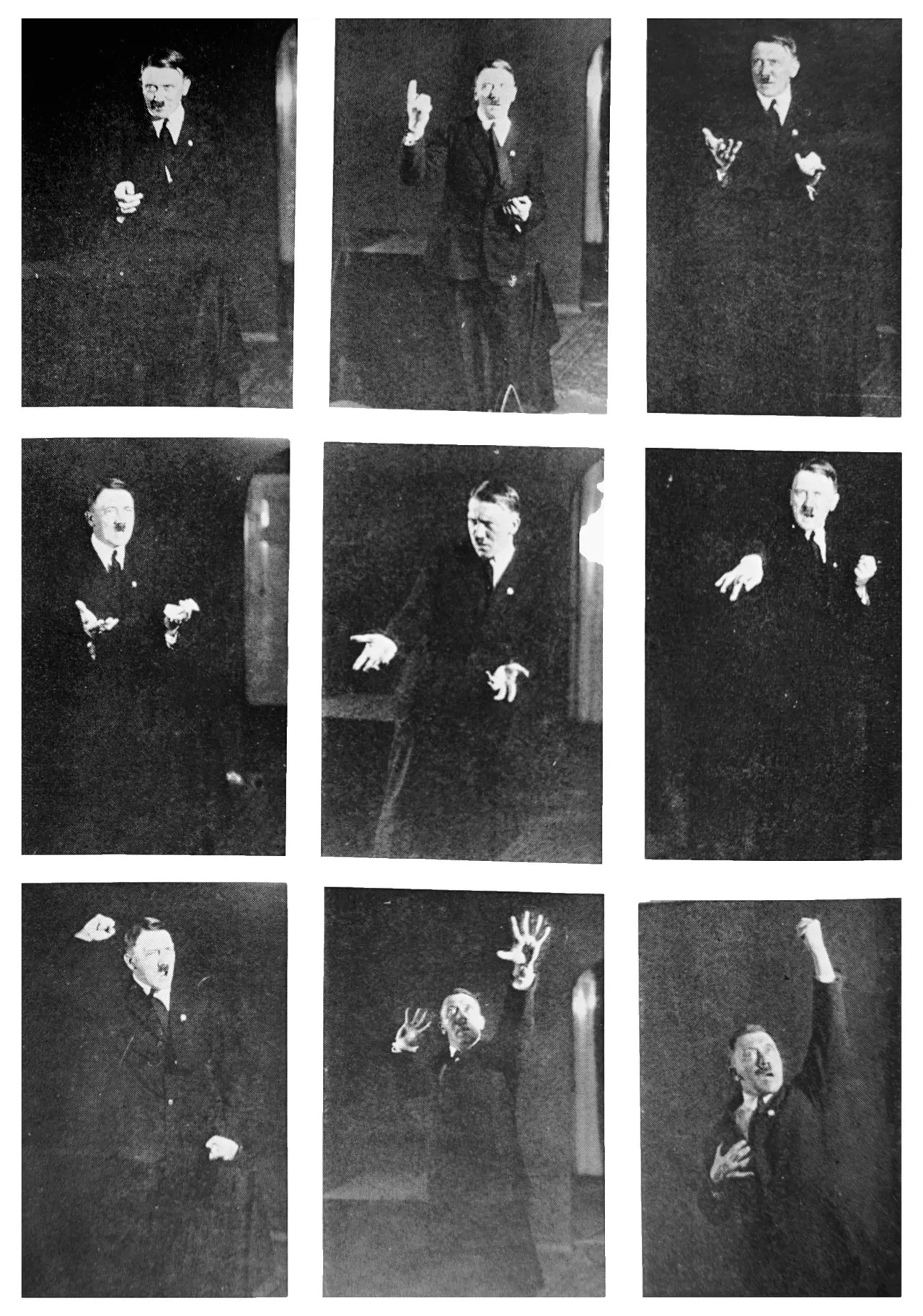
Hitler didn’t seize power; he was given it. As Adam Gopnik reports in a review of Tim Ryback‘s important new book, media lords thought that they could control him; political schemers thought that they could outwit him. The mainstream left had become a gerontocracy. And all of them failed to recognize his immunity to shame…
Hitler is so fully imagined a subject—so obsessively present on our televisions and in our bookstores—that to reimagine him seems pointless. As with the Hollywood fascination with Charles Manson, speculative curiosity gives retrospective glamour to evil. Hitler created a world in which women were transported with their children for days in closed train cars and then had to watch those children die alongside them, naked, gasping for breath in a gas chamber. To ask whether the man responsible for this was motivated by reading Oswald Spengler or merely by meeting him seems to attribute too much complexity of purpose to him, not to mention posthumous dignity. Yet allowing the specifics of his ascent to be clouded by disdain is not much better than allowing his memory to be ennobled by mystery.
So the historian Timothy W. Ryback’s choice to make his new book, “Takeover: Hitler’s Final Rise to Power” (Knopf), an aggressively specific chronicle of a single year, 1932, seems a wise, even an inspired one. Ryback details, week by week, day by day, and sometimes hour by hour, how a country with a functional, if flawed, democratic machinery handed absolute power over to someone who could never claim a majority in an actual election and whom the entire conservative political class regarded as a chaotic clown with a violent following. Ryback shows how major players thought they could find some ulterior advantage in managing him. Each was sure that, after the passing of a brief storm cloud, so obviously overloaded that it had to expend itself, they would emerge in possession of power. The corporate bosses thought that, if you looked past the strutting and the performative antisemitism, you had someone who would protect your money. Communist ideologues thought that, if you peered deeply enough into the strutting and the performative antisemitism, you could spy the pattern of a popular revolution. The decent right thought that he was too obviously deranged to remain in power long, and the decent left, tempered by earlier fights against different enemies, thought that, if they forcibly stuck to the rule of law, then the law would somehow by itself entrap a lawless leader. In a now familiar paradox, the rational forces stuck to magical thinking, while the irrational ones were more logical, parsing the brute equations of power. And so the storm never passed. In a way, it still has not…
Both the review and the book on which it focuses are eminently worth reading in full: “The Forgotten History of Hitler’s Establishment Enablers” (possible paywall; in which case, archived copy here), from @adamgopnik in @NewYorker.
* Hitler, as quoted in a letter from von Ribbentrop (to Churchill and Atlee) sent just before von Ribbentrop was captured at the end of the war
###
As we hear the echo, we might spare a thought for Ludwig van Beethoven; he died on this date in 1827. A crucial figure in the transition between the Classical and Romantic eras in Western music, he remains one of the most famous and influential of all composers. His best-known compositions include 9 symphonies, 5 concertos for piano, 32 piano sonatas, and 16 string quartets. He also composed other chamber music, choral works (including the celebrated Missa Solemnis), a single opera (Fidelio), and numerous songs.
Relevantly to the piece above…
Beethoven admired the ideals of the French Revolution, so he dedicated his third symphony to Napoleon Bonaparte… until Napoleon declared himself emperor. Beethoven then sprung into a rage, ripped the front page from his manuscript and scrubbed out Napoleon’s name. Some modern reproductions of the original title page have scrubbed out Napoleon’s name to create a hole for authenticity’s sake!
Beethoven’s temper and Symphony No. 3 ‘Eroica’
But, of course, it was too late…

“Nobody these days holds the written word in such high esteem as police states do”*…

And ’twas ever thus. Erin Maglaque explains how Robin Vose’s new history of the Index of Prohibited Books shows how Catholic censorship was, despite its totalizing ambitions, often incoherent and contradictory…
In the beginning was the Word. The trouble came afterward. How to teach the Word of God, how to translate Scripture, how to gloss and explain it: these were problems of grave concern to premodern Christians, and getting them wrong was beyond life-and-death. A bad reader’s soul was endangered for eternity. Angels didn’t have this problem. As Dante put it, angels “make themselves…completely known to each other,” communicating directly from divine spirit to divine spirit: a kind of transcendental laser beamed between celestial heads. But humans misunderstand; we grope for meaning; we struggle to be understood. From the beginning of the Catholic Church as an institution, churchmen sought to control the power of words—to shape good readers and eliminate bad ones. This meant censorship.
The Roman Index of Prohibited Books was first published in 1559. Catholic censorship persisted another four hundred years, making the Index the “longest-lived, and least understood” mechanism of censorship in history, as Robin Vose writes in a new book on the subject. At first, Catholic censorship was a relatively straightforward matter: all Protestant books, and all Protestant authors, were banned. So were books printed anonymously or without specifying a printer, date, or place of publication: these were too suspicious. It didn’t actually matter what books said; there were already too many for the Roman censors and theologians even to skim them all. By the end of the sixteenth century censors were simply copying titles from the Frankfurt Book Fair catalog into the Index. Soon, most regions—and many individual cities—had created their own indexes of prohibited books. They each had their own local persecutory flavor: in Spain, for example, the inquisitor general banned Islamic and Jewish writings, especially the Talmud. Local inquisitors in Mexico City banned books that inquisitors in Madrid found permissible.
The 1559 Index was a pet project of a conservative pope. Paul IV is maybe best known to history as the pope who had the Jews of Rome enclosed in a ghetto and gave freer rein to the persecutory impulses of the Roman Inquisition; he was hated by ordinary Romans of his own day, who burned the Inquisition office at his death. But the Index was also the culmination of pressures both inside and outside the Catholic Church, some of which had been mounting for centuries. The flourishing of heretical sects in medieval Southern Europe, such as the Cathars, and the Inquisition tribunals that arose to persecute them; the Reformation, and especially Luther’s mastery of the new technology of the printing press; the reforming voices inside the Catholic Church who sought theological uniformity and consistency: each contributed to the development of a universal Index for Catholic Europe. Soon the censors had an office in which to process great volumes of paperwork. The Congregation of the Index—a department of the Curia—was established in 1571; it worked closely with the Roman Inquisition and the Master of the Sacred Palace, the pope’s chief theologian. Everyone in Rome took a professional interest in heretical ideas.
…
Censors concerned themselves with all genres of reimagining the world, from science and political ballads to vernacular literature. Louis-Sébastien Mercier’s novel The Year 2440: A Dream If There Ever Was One (1771) tells of a Parisian who wakes up in a future society ruled by a philosopher-king, with no priests or monks, no slavery, no pastry chefs, no dance teachers, and no tobacco. (There is no accounting for utopian tastes.) It was, of course, included on the Index; Charles III of Spain was said to have burned a copy with his own hands. Other such fantasies, from Thomas More’s Utopia (1516)to Tommaso Campanella’s Città del sole (written in 1602 and printed in 1623)—which imagined a city whose walls were painted with all of human knowledge in images that “render learning easy” to its citizens—were banned too.
The promise of learning without mediation was as utopian as free love.
…
In Forbidden Knowledge: Medicine, Science, and Censorship in Early Modern Italy (2020), Hannah Marcus found that censorship in fact “catalyzed” new conversations about medicine. By asking experts to weigh in on the content of potentially heretical medical knowledge, the church effectively convened a kind of learned society for medical discussion and debate. Similarly, elite scholars were not only censored by the church but used as experts to determine whether to ban a book or how to expurgate it—that is, how to eliminate troubling passages so that the book could circulate in revised form.
Yet censorship worked as intended for the relatively impoverished and unlearned… While doctors, scientists, and aristocratic scholars could petition the Congregation of the Index to hold banned books in their private libraries, ordinary men and women in Catholic Europe had no such recourse. Some banned topics—such as forms of occult magic like divination, astrology, and hermeticism—were especially popular among elite scholars, yet laypeople couldn’t use scriptural amulets or charms for medical cures or good fortune. The Bible was translated by Catholic scholars into Polish, German, Hungarian, and Arabic, for use in conversion. But ordinary Italians were not authorized by the church to read a Bible in their own language until 1757.
…
As I scrolled through scans of printed Indexes, nearly all of which are available online, I wondered about all those authors and titles, many of which would have been lost to history if they had not been included on the Index. Possibilities of alternative worlds, alternative futures, flicker from the thousands of pages of banned books and authors and subjects: magic, flashing weapons in forbidden duels, female authors whose names are otherwise unattested, the colonization of the moon, utopian ideas, love letters, escapist romance, erotic tales, madrigals. The Indexes are a counter-archive of European history.
More difficult to account for is the toll of self-censorship: the art and literature that was never made, the religious and scientific ideas that remained unwritten—unthought, even—because of the existence of the Index, the congregation, and the Inquisition tribunal. This counterfactual European history is a history of the obscure, the impracticable, the unrecorded. It is so elusive as to remain nearly unimaginable. But for every erotic novella or psalm-inscribed jewel on the Index, a crack appears in the edifice of our historical imagination. Some light gets in. The censor is crowded out by the apparition of what might have been.
In 1574 inquisitors came to the door of Domenico, a cobbler in Spilimbergo, in the far northeast of Italy. They seized and destroyed the only three books that Domenico owned: Orlando Furioso, the Decameron, and the New Testament. Domenico responded: “I swear I shall never read again.” This was the tragedy of censorship, an unbearable narrowing of the spiritual and cultural lives of ordinary people. But I also hear in Domenico’s words his own intolerance: an intolerance of suppression, a disobedience of power. Domenico would not be told how to read. He would rather not read at all…
Too timely: “Unwanted Thoughts,” from @ErinMaglaque in @nybooks.
* Italo Calvino
###
As we listen for the rhyme, we might recall that it was on this date in 325 that Emperor Constantine, the first Roman emperor to convert to Christianity, convened the first Ecumenical Council in Nicaea (now Iznik) to discuss Arianism, a heresy arguing that Christ was subordinate to God the Father. “I entreat you,” Constantine said at the opening of the Council of Nicea, “to remove the causes of dissension among you and to establish peace.” The council attempted to resolve the bitter conflict by anathematizing Arius (Arianism’s founder) and ordering the burning of all his books. Still, the conflict raged for decades.

“Just as none of us is outside or beyond geography, none of us is completely free from the struggle over geography”*…

There are lessons to be learned from history. Noah Smith cautions us to be sure that we’re learning the right ones…
… 2022 saw authoritarian powers suddenly on the back foot. Russia’s invasion of Ukraine was a military and geopolitical disaster, and Xi’s economic mismanagement brought China’s growth to a momentary halt. Meanwhile, the U.S. started looking a bit more politically stable and started to take action to preserve its remaining industrial advantages, Asian democracies like Japan and the fast-growing India continued to flex their muscle, and Europe seemed more united than it had in…well, ever. All of this naturally had some people in the West optimistic that Cold War 2 would ultimately end much like World War 2 and the first Cold War.
Unfortunately, early optimism can easily give way to complacency and cockiness. We’re still in the opening moves of Cold War 2, and the minor victories of 2022 are likely to revert to the mean. 2023 is already shaping up to be a year in which the authoritarian powers recalibrate their strategy and find their footing.
…
Americans need to realize that Cold War 2 is fundamentally unlike Cold War 1 or World War 2. Those 20th century contests were ideological battles, where people fought and died for communism, fascism, and liberal democracy. But China is not an ideological, proselytizing power; its ideology, basically, is just “China.” Xi Jinping doesn’t care whether you have elections and protect civil rights or send minorities to the death camps, as long as you support Chinese hegemony abroad.
Cold War 2 is therefore a bit more like World War 1 — a naked contest of national power and interests. And if the U.S. tries to turn it into an ideological battle, it could backfire…
A provocative argument that we shouldn’t make too much of what are only the opening moves in “Cold War 2”: “2023 is when the empires strike back,” from @Noahpinion.
* Edward Said
###
As we grapple with geopolitics, we might recall that it was on this date in 1975 that South Vietnamese forces withdrew from the town of Xuan Loc in the last major battle of the Vietnam War. The North Vietnamese victory there occasioned the resignation of South Vietnamese President Nguyễn Văn Thiệu, who was replaced by Trần Văn Hương, who was ordered by the National Assembly to seek a negotiated peace with North Vietnam at any cost.

You must be logged in to post a comment.