Posts Tagged ‘authoritarianism’
“What wonder that gigantic corporations employ their enormous wealth and the highest legal talent to strain the laws to their upmost! What wonder that ill-gotten fortunes menace the liberties of the people!”

Tech billionaires are building a post-democratic America. Francesca Bria and a team of researchers supported by the Friedrich-Ebert-Stiftung (FES, the oldest political foundation in Germany) warn that Europe is next…
In late July 2025, deep within the Pentagon’s bureaucratic machinery, the U.S. Army quietly signed away a piece of its sovereignty.
A ten-billion-dollar contract with Palantir Technologies—one of the largest in the Department of Defense’s history—was framed as a move toward “efficiency.”
It consolidated seventy-five procurement agreements into a single contract: a strategic handover of core military functions to a private company whose founder, Peter Thiel, has declared that “freedom and democracy are no longer compatible.”…
… J.D. Vance, propelled to the vice-presidency by $15 million from Peter Thiel, became the face of tech-right governance. Behind him, Thiel’s network moved into the machinery of the state.
Under the banner of “patriotic tech“, this new bloc is building the infrastructure of control—clouds, AI, finance, drones, satellites—an integrated system we call the Authoritarian Stack. It is faster, ideological, and fully privatized: a regime where corporate boards, not public law, set the rules.
Our investigation shows how these firms now operate as state-like powers—writing the rules, winning the tenders, and exporting their model to Europe, where it poses a direct challenge to democratic governance…
[Bria an the team use elegant interactive infographics to map and explain the what’s happened so far in the U.S, then turns to Europe…]
… By mid-2025, its reverberations were already felt across Europe. In Rome, Italian defense officials moved to integrate Elon Musk’s Starlink into military communications. In Berlin, Rheinmetall and Anduril expanded their joint venture to deploy autonomous drone swarms for NATO. The German variants of its drones still run on Californian code. Musk livestreams with the AfD’s Alice Weidel, endorsing the German far-right while supplying NATO infrastructure.
In London, the NHS scaled Palantir’s £330 million Federated Data Platform across tens of millions of patient records, By May 2025, the government had to pay KPMG £8 million just to encourage hospital adoption. Meanwhile, a £1.5 billion defense partnership binds Britain to Palantir’s AI systems.
None of these decisions provoked real debate. Few reached front pages. Together, they reveal the systematic outsourcing of European sovereignty to American oligarchs whose ideology openly undermines democracy.
It is a paradox with devastating implications: pursuing digital sovereignty while ceding control through every signed contract.
Each new contract deepens the trap. Once Palantir becomes indispensable, once Anduril’s drones are NATO standard, once nuclear facilities power AI that runs everything else— the transformation is irreversible. Europe faces an existential choice: build genuine technological sovereignty now, or accept governance by platforms whose architects view democracy as an obsolete operating system.Silicon Valley’s Authoritarian Tech Right is not theorizing this world. They are already building it. The pipelines are operational. The feedback loops are functioning. The sovereignty transfers are completing.
Democracy persists as a legacy interface— maintained for stability, while being systematically hollowed out and replaced.
The question now is whether democratic societies can recognize this formation for what it is—and build alternatives before the infrastructure of control becomes too deeply embedded to dislodge…
Eminently worth reading in full: “The Authoritarian Stack,” @francescabria.bsky.social, @fesonline.bsky.social.
* President Theodore Roosevelt, in his 1907 “Provincetown Speech“
###
As we reclaim the rudiments of our republic, we might recall that it was on this date in 1970 that The Magic Christian premiered in the U.S. (having premiered in London two months earlier). Starring Peter Sellers and Ringo Starr (with appearances by John Cleese, Graham Chapman, Raquel Welch, Spike Milligan, Christopher Lee, Richard Attenborough and Roman Polanski), it was a scathing farce/satire of capitalism, greed, and human vanities, based on Terry Southern‘s 1959 novel of the same name.

“Power tends to corrupt, and absolute power corrupts absolutely”*…
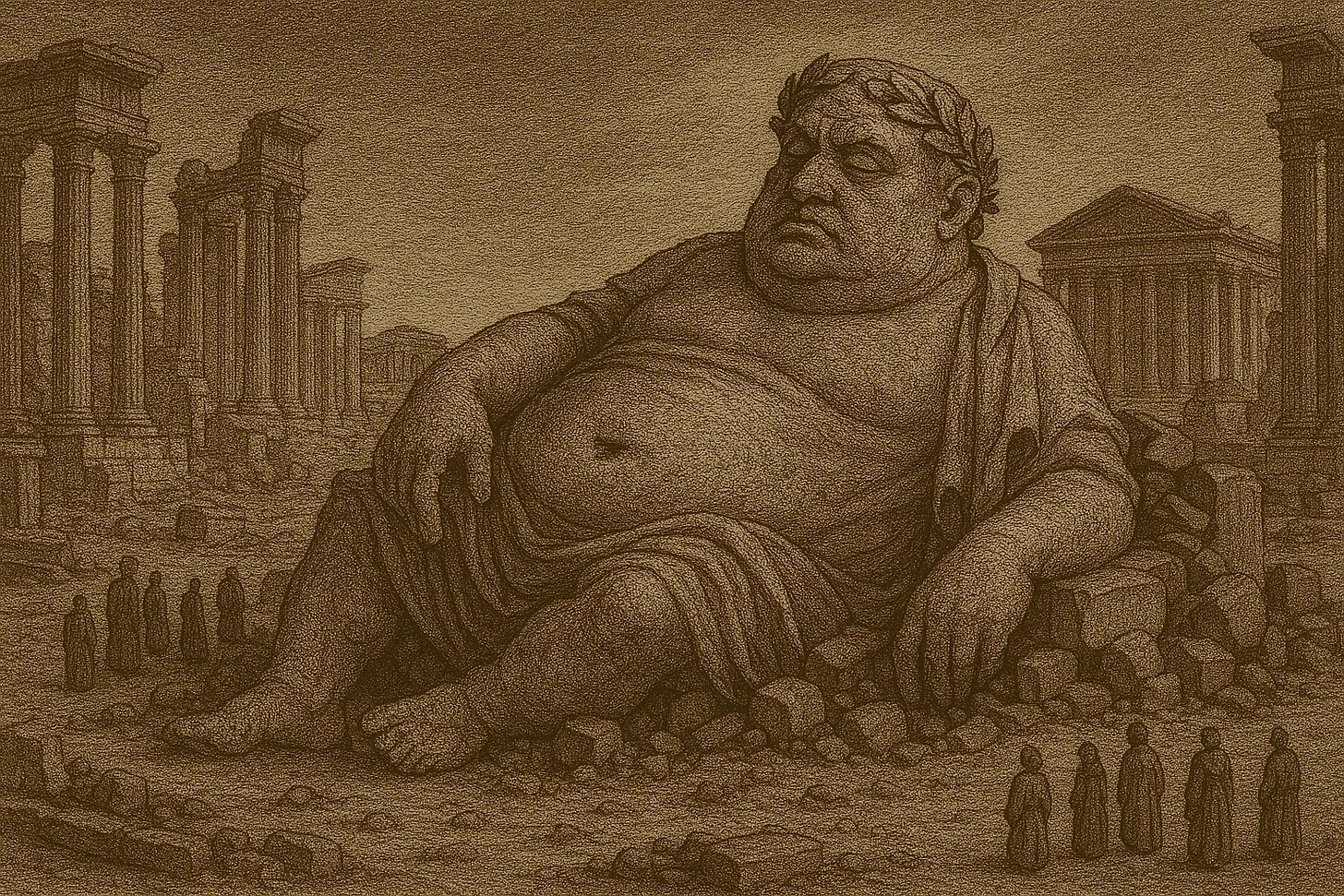
The estimable Henry Farrell has re-posted a (slightly revised) piece that was sub-linked in an early (R)D– a compelling argument that “we need, right at the moment, to think very clearly about how power is won or lost”…
… The current U.S. president is looking to seize power that he clearly is not entitled to under the law and the constitution, and that will usher through some kind of regime change if he succeeds. Many people are trying to resist. What are Trump’s strengths and weaknesses? What are the strengths and weaknesses of those who want to oppose him?
There’s a simple account of power that I think is useful here. It is developed in this paper by the late Russell Hardin, but really descends from David Hume’s understanding of politics.
The fundamental argument is this: that power in modern societies depends on social coordination. That is just as true of aspiring authoritarians like Trump as of the people who want to mobilize against him. As Hume says (quoted in Hardin):
No man would have any reason to fear the fury of a tyrant, if he had no authority over any but from fear; since, as a single man, his bodily force can reach but a small way, and all the farther power he possesses must be founded either on our own opinion, or on the presumed opinion of others.
Those who want to win power can only do so by persuading others. All tyrants must worry that their grip on power rests on such opinion. Hardin:
As a contemporary lawyer puts this argument: “No state could possibly compel people to obey all these rules at gunpoint; there would not be enough soldiers and policemen to hold the guns (a sort of Orwellian vision of society), they would have to sleep sooner or later, and then anarchy might break out.”
Equally, even if the people might overwhelm the tyrant if they ever joined together, it is very hard for them to organize against him, especially in a fully developed authoritarian state.
That is why authoritarian rulers devote a lot of time to preventing unrest from breaking out. Their best strategy for survival is to actually be popular. But that is hard to keep up. Acceptable substitutes include preventing people from discovering how unpopular the regime is, controlling media (to prevent coordination), and deploying the threat of physical violence to intimidate.
The problem with all of these strategies is that the ruler can do none of it on their own. Even the threat of violence, when looked at closely, requires some degree of willing coordination among the soldiers and policemen. That is why dictators are so careful about how they treat their armed forces. Authoritarians need to worry about the masses, but even more about their own coalitions.
More generally: struggles for power are struggles over the means of coordination. Who is capable of coordinating better, wins. And want-to-be authoritarians and mass publics face different coordination problems.
If you are an aspiring authoritarian, your strategy is to persuade others that they need to be part of your coalition. Hardin (this time on Adam Smith):
In a competitive world of pastoralists, one benefits best from association with the most powerful tribe. Hence, if someone rises to capable leadership with [sic] a tribe, others will be attracted to join with it. The result eventually will be remarkable power in the control of the leader of the tribe. Combination for the sake of survival then makes it possible not merely to survive but to thrive and even to plunder.
In more modern circumstances, your best strategy as an aspiring tyrant is likely to convince others (a) that they do live in a society of competing groups, and (b) that the smart money will always be on joining the dominant group, and not being one of the dominated ones.
Hardin continues:
This is essentially an argument from coordination. We coalesce because it is individually in our interest to do so as long as others do so as well. What we need to guide is in coalescing with others is merely the evidence of sufficient leadership and sufficient members to make our joining them clearly beneficial.
That, however, isn’t quite right. The authoritarian who wants to build a ruling coalition needs not only to make her success seem like a fait accompli. She also needs to persuade others that they will prosper rather than suffer from joining. The aspiring authoritarian needs to persuade allies that she (and they) will predate on outgroups, and that she will not predate on the allies themselves.
That process of persuasion becomes more difficult, the more unbounded the ambitions of the wannabe authoritarian are (I lay out a version of this argument here, in a paper that began from a conversation with Hardin and Margaret Levi a quarter of a century ago). The more powerful and unruly the authoritarian becomes, the more readily they can make promises or threats. Equally, the less credible those promises or threats become, both to allies and to enemies.
Absolute power implies absolute impunity: if I enjoy such power, I have no incentive to behave trustworthily to anyone. For just the same reason, no-one has any incentive to trust me. You will not believe my promises, and you may fear that if you give in to my threats, you will only open yourself to further abuse. Thus – as I, as an aspiring authoritarian move closer to unbounded control, I need to artfully balance the benefits that my power can bring to my allies with the fear those allies may reasonably have over what happens should that power be turned against them.
The problem faced by mass publics is different. For all the language about the ‘tyranny of the masses,’ they find it difficult to coordinate on rewarding friends and punishing enemies. That makes them less likely to go bad, at least in the way that tyrants can go bad. But it also makes it more difficult for them to coordinate against incipient tyranny, even when they know that everyone would be better off if they did.
On the one hand, under some circumstances, the costs of action may be quite low. If protest is cheap, then protestors are playing a nearly pure coordination game, where everyone will resist if they reasonably assume that everyone else will resist too. Hardin:
coordination may so greatly reduce costs that the latter are almost negligible, so that the slightest moral commitment may tip the scales toward action. Just as it would be odd for many Americans in communities in which voting is easy to balk at the minor cost in inconvenience, so it might seem odd for many workers or soldiers or others to balk at joining a crowd to march on the palace or the Bastille. This is not identical to a multiple coordination problem, such as that in the driving convention, in which one simply wants to go with the majority. In the revolutionary coordination, one has an active preference between the outcome of full attack and that of no attack. Still, one prefers to attack if enough others do and not to attack if enough others do not.
On the other, rulers and aspiring rulers can recognize this risk and counter-attack.
It was perhaps the startling ease with which spontaneous revolutions took control in cities that led the French under Thiers to put down the Paris Commune with such thoroughgoing brutality as to make it seem more nearly like murder than warfare. The answer to the coordination explanation of revolutionary action is draconian force. This lesson of the Commune has been learned well by many later regimes and leaders in various places, such as the Nazis in Czechoslovakia, Stalin in the Soviet Union, Pinochet in Chile, and Videla in Argentina, with their harsh, blanket suppression of dissenters and potential dissenters. They raise the likely costs of revolutionary activity enough to change its structure. … If the old state raises the costs enough to individuals for revolutionary activity, it overcomes the power of coordination to reduce the costs of revolutionary activity. It forces potential revolutionaries to see their problem overwhelmingly as a prisoner’s dilemma in which free-riding is in the individuals’ interest.
This helps explain some of the actions of Trump and those around him. Their approach to both universities and law firms has been to make simple coordination seem like a prisoner’s dilemma, by picking off opponents, one by one, and by trying to create a common understanding that collective resistance is useless, since your potential allies are likely to defect. The early decision of one extremely prominent law firm, Paul Weiss, to defect, shaped common expectations so that several others rushed immediately to defect too, for fear that they would be stranded amidst the dominated group, rather than joining the dominating coalition in a subordinated role.
To bring the different strands of the argument together, Trump’s strategy has been much less effective than it might have been. Trump has shown he is unwilling to stick by deals. Law firms that have submitted find that they are on the hook for far more than they bargained for. Columbia University, after making humiliating and profound concessions, finds that it is expected to make far greater ones, with no guarantee that even these will satisfy the Trump administration’s demands
As a whole body of research on “tying the king’s hands” argues, independent actors will prefer to flee monarchs who refuse to be bound rather than to cooperate with them, because they know that such monarchs can’t be trusted. Any deal that they make can later be un-made, and probably will be, if unmaking it is to the king’s advantage. The best option may be not to submit, especially if you believe that others are similarly unwilling to comply. This may, in effect, turn what was a prisoner’s dilemma (in which everyone’s best strategy is to defect) back into a nearly pure coordination game again, allowing easier collective resistance.
Or, it may not. If people don’t have reason to believe that others will stand up, then they still are unlikely to stand up themselves.
This then, gives us a simplified but useful understanding of where we are right now. The good news is that the Trump administration is playing its hand very badly. If Trump had been more willing to accept defectors into his camp, by sticking to deals that gave them something worth having, he would be in a much stronger situation than he is at the moment. Furthermore, and somewhat less obviously, this may also disrupt his own existing coalition. Wall Street, for example, may worry that it is next for the chopping block. Silicon Valley the same.
The bad news is that the opposition is much more disorganized than it ought to be. Coordination is bolstered by shared knowledge that others will coordinate too. We don’t have that, in part because of lack of leadership, in part because of a media landscape that makes it difficult to generate such shared knowledge. Remember Hume’s phrase about the “presumed opinion of others.” Our presumptions about what other people think can play an extraordinarily powerful role in shaping how we ourselves think, and what we are prepared to do. And in a country where such presumptions can be grossly skewed, it can be very hard to generate coordinated action. Finally, exactly because the opposition is disorganized, and because humans are human, it faces its own collective version of Trump’s temptation to humiliate and subjugate defectors from the other side, rather than welcoming them in.
The strategic implications for what to do are not surprising. Leadership is crucial. It is really, really hard to make a coalition cohere if the plausible leaders abdicate. More generally, figure out how to generate common knowledge that will enable coordination. Protests – especially if they are widespread, and especially if they happen in unusual places, or involve surprising coalitions can help generate information cascades. But getting media coverage and broader conversation is important.
Welcome in the strayed sheep, and work on widening the cracks in the other coalition. Leopard-face-eating memes may feel personally satisfying, but they usually do not ease the process of converting disillusioned opponents into active allies. As Adam Przeworski says, the Polish coalition to push back against the populists only succeeded when people who were ferociously divided over a moral issue agreed to make common cause.
Crucially, the parties forming the alliance agreed not to confront the major issue that divided them: abortion. They agreed that defending democracy was more important than whatever values divided them, and that conflicts over abortion would be managed once victory over PiS was secured. Hence, both the opponents and the supporters of the freedom of choice could promise their respective electorates that they would promote their values if democracy was restored, while claiming that the immediate task was to restore it.
If power involves coordination, coordinate! Help build your coalition as far as it can go. Do everything you can to minimize defections from it, and to maximize defections from the other side. Take advantage of the opposition’s vulnerabilities and mistakes – especially the trust problems that are likely to flourish in a coalition around an actor who aspires to untrammeled power and is deeply untrustworthy.. Assume that the other side is trying to attack your own vulnerabilities, and mitigate as much as possible. And do what you can now; things are likely to get much harder, very quickly, if the opposition’s victory becomes a self-confirming expectation…
The respective vulnerabilities of tyrants and crowds: “Absolute power can be a terrible weakness,” from @himself.bsky.social.
Pair with: “Power always reveals.”
And apposite: “Two scholars ask whether democracy can survive if AI does all the jobs,” gift article from The Economist.
###
As we get it together, we might recall that it was on this date in 1962 that Bob Dylan appeared for the first time at Carnegie Hall in New York City as part of a hootenanny which included his first public performance of “A Hard Rain’s a-Gonna Fall.”
“The clearest way to show what the rule of law means to us in everyday life is to recall what has happened when there is no rule of law”*…

There’s rule-by-law, and then there’s rule-by-law (AKA, authoritarianism).
Long-time readers will know of your correspondent’s affection and respect for the artist Banksy. He’s “struck” again– and again, he’s hit a nerve…
From the AP…
… Unlike the elusive artist’s other provocative works that are sometimes stolen or carefully removed and displayed in galleries or sold at auction for millions, his latest mural was being erased Wednesday from the record.
The stenciled spray-painting of a protester lying on the ground holding a blood-splattered placard while a judge in a traditional wig and black gown beats him with a gavel was scrubbed from wall of the iconic Royal Courts of Justice…

More of the story: “Banksy mural of a judge beating a protester is scrubbed from London court,” from @apnews.com.
* Dwight D. Eisenhower
###
As we protect what’s precious, we might recall that it was on this date in 1935 that Adolf Hitler addressed the eighth Nuremberg Rally, the “Rally of Freedom.” Following Goebbels (who had declared that history would some day pass the verdict on Hitler that by overthrowing Bolshevism he saved Germany from an immediate catastrophe and thereby brought Western civilization back from the brink of complete destruction)…
In a speech to 120,000 political functionaries on the Zeppelinwiese [here] this afternoon, Herr Hitler expressed his appreciation of their loyalty, which had been inspired by faith in him and his ideals, and which had enabled him to achieve for Germany what he had.
In an address to several thousand “Hitler” girls and women Herr Hitler said that the National-Socialist movement was providing “braver and better husbands.”
He added:- We are training real men for the women, decent, brave, and honourable. When the women see the fine Labour Service boys, dressed only in trousers and with breasts all bare, they must say, “It is nice for the women and what fine fellows are here, and conscription, what marvellous training!”, There is no equality in giving women tasks where they were men’s inferiors. Whenever I picture a woman in Parliament, I feel that she is being degraded. She does not raise the general level. She is drawn down to it herself.
– source

“Power always reveals”*…

Apposite to yesterday’s post, a provocative piece by Ben Ansell, who is reacting to a [terrific] piece by Henry Farrell in which Farrell, as he contemplates Trump’s moves, unpacks the “coordination” problems facing– and, Farrell suggests, often limiting– autocratic rulers…
… But you will notice an assumption I and Henry have been making – that Trump is like any other authoritarian leader. I suspect that in lots of ways Trump does wish to behave like one – certainly the treatment of Kilmar Abrego Garcia and his current refusal to follow court judgments meets that mark.
But Trump is attempting this in an otherwise democratic system and I think there is a risk that we overstate the degree to which that system has already deteriorated by assuming that the language and logic that we use to describe authoritarianism fits his case. Part of the risk is we give up on democracy while it’s still here. But the other danger is that we think Trump behaves like a rational authoritarian leader, a la Svolik, when it’s all just bluntly a lot dumber than that…
… In an earlier post I referred to Donald Trump as a ‘chaotic authoritarian’. I don’t think it’s implausible that a democracy could have such a figure as a leader, though I do think it’s unlikely that it would remain democratic indefinitely under such leadership.
But in the absence of already having subverted elections, stymied courts, shut down the media, banned opponents and the other types of effective institutional backsliding that are the tell-tale signs of a democracy dying, I think we might do better to think about how such a figure operates in, what for now, is a democracy.
The temptation when talking about dictators is to reach for Thomas Hobbes. We depict them as the Leviathan – imposing order on the body politic to prevent chaos but also any rivals. Hobbes’ vision was after all a painstaking justification for monarchical absolutism.
If you are not familiar with Leviathan, well do read it, it’s a banger. But the very basic gist is a theory of government built from the ground up. Hobbes even starts with a slightly rococo account of how we process sensations. But his core mechanism is to imagine a world without government – his famous state of nature – in which every individual was essentially on their own. A self-help system if you will, but not the kind in the woo-woo psychology section of the bookstore – the kind where if you don’t look after number one, you’ll get an axe in the back of the head.
The Hobbesian state of nature is anarchy and life in it is – say it with me – ‘solitary, poor, nasty, brutish and short’. And so anyone living in this state would seek to escape this ceaseless terror and have some entity that could guarantee security. Hobbes is a social contract theorist, and the contract upon which we could all be presumed to agree is a third party that can ruthlessly crush insecurity. An absolute sovereign power that would protect its subjects…
… The Hobbesian vision of the state is draconian of course and in… err… pretty sharp contrast with the social contract theories of John Locke or Jean Jacques Rousseau. But one way it has come down to us is in how we think about authoritanism. As about order and control, crushing dissent mercilessly, but also preventing anarchy, rebellion, and so forth. It is governing with an iron fist. Rational authoritarianism if you will.
Whatever Trump is trying to achieve, it’s not hitting this mark. Instead of authoritarianism containing chaos, it is chaos personified. Instead of quelling the anarchic state of nature, it is spreading anarchy and confusion. Hobbes’ frontispiece Leviathan is a steady ruler, holding sword and staff, made up out of their ordered subjects [In contrast to the disintegrating beast in the illustation above]…
… Hence, it’s not clear to me that the standard tools we use to think about authoritarianism accordingly make that much sense with Trump. Is he really thinking about how to coordinate among the elites to keep his support base? Because he’s not doing a brilliant job here having already lost the support of the Wall Street journal editorial board, a litany of very conservative judges, and increasingly corporate elites…
… what I find most interesting about Trump’s anti-Leviathan is that his rule is creating anarchy everywhere else too. And that means not only are his promises not credible but nor are his threats…
[Ansell reviews Trumps’ attack on universities, his approach to tariffs, and trade policy, his “crackdown” on immigration, and his foreign policy (or lack thereof)…]
… We will spend a lot of time over the next few years trying to figure out if Trump’s America remains a democracy. Already the main indices we use are starting to downgrade the USA. I struggle as to whether that coding is premature or not – we will of course know much more by the midterms about the stability and freedom of elections, though by then it could be too late.
It is very clear that Trump wishes to act as an authoritarian. But it is not yet obvious to me that analysing him using the logic of dictatorship makes sense. Because he lacks the control, the ruthlessness, and the rationality of normal authoritarian leaders. As Henry says in his post, ‘absolute power can be a terrible weakness.’ True. However, for many – perhaps most – dictators, absolute power is a terrible (in the original sense of that word) strength. Think to the horrors of the twentieth century.
That, however, is not Donald Trump. He may be the master of chaos. But he is not the Leviathan…
What if we abandoned the social contract for the state of nature? “Donald Trump’s Anti-Leviathan,” from @benansell.bsky.social (with @himself.bsky.social).
* “Power doesn’t always corrupt. Power always reveals. When you have enough power to do what you always wanted to do, then you see what the guy always wanted to do.” – Robert Caro (riffing on Lord Acton: “Power tends to corrupt and absolute power corrupts absolutely”) Or as David Brin put it: “it is said that power corrupts, but actually it’s more true that power attracts the corruptible.”
###
As we rein in reigns, we might recall that it was on this date in 1945 that Hermann Göring, head of the Luftwaffe and Adolf Hitler’s designated successor as leader of Nazi Germany, wired the Führer asking permission to assume leadership of the crumbling regime. The telegram caused an infuriated Hitler to strip Göring of power and to appoint new successors, Joseph Goebbels and Karl Dönitz, as chancellor and head of state, respectively.

“A republic, if you can keep it.”*

Just over a decade ago, Nils Gilman wrote an essay, The Twin Insurgency,” in which he warned of an emerging confluence of strategies between the rising global plutocratic class, on the one hand, and transnational criminal organizations, on the other. For all our sins, as you’ll see in his piece, he nailed the fundamental disposition of the tech-libertarian broligarch class. And…
One other thing I think I correctly intuited a decade ago was that a key politico-spatial implication of the Twin Insurgency was that the space of the national was fragmenting into “kaleidoscopic microsovereignties,” an argument that my friend Quinn Slobodian has recently developed at monographic length in his marvelous book Crack-Up Capitalism.
Quinn’s thesis is that the ultimate goal of what I called the plutocratic insurgents (and their intellectual and high-end service-economy henchmen) is to end the constraints that democratic nation-states impose on the privileges of the rich. These are rich men (and it is almost entirely men) who believe that their wealth should be untouchable, and that the privileges that this wealth buys should be unlimited. With Elon Musk’s DOGE, the mask is off: they are hell-bent on destroying any institutions of social care or risk-sharing that might touch their money or their privileges.
I cannot recommend Crack-Up Capitalism enough. Methodologically, is an intellectual history of the most notorious radical libertarians — from well-known assholes** like Milton Friedman and Peter Thiel to a congeries of even more colorful crackpots and kakistocrats — and their quest to craft for the perfect space for unfettered capitalism by shattering the map of allegedly sovereign territories into a variety of “exceptional” legal spaces: free ports, tax havens, special economic zones, etc. It is also an historical travelogue, taking the reader (as its cover blurb says) “from Hong Kong in the 1970s to South Africa in the late days of apartheid, from the neo-Confederate South to the former frontier of the American West, from the medieval City of London to the gold vaults of right-wing billionaires, and finally into the world’s oceans and war zones, charting the relentless quest for a blank slate where market competition is unfettered by democracy.” Best of all, Crack-Up Capitalism is wonderfully written: erudite and droll in equal measure (as the punning title itself suggests).
** I use the term “assholes” in the technical sense elaborated by Aaron James, chair of the UC Irvine philosophy department, in his 2012 book Assholes: A Theory, namely someone who “allows himself to enjoy special advantages in social relations out of an entrenched sense of entitlement that immunizes him against the complaints of other people.” I was reading the book when I wrote “The Twin Insurgency” and, even though I didn’t cite it (the anxiety of influence?), I realize now looking back how much it informed my understanding of phenomenon of the plutocratic insurgency. Conversely, I suspect the empirical fact of the rising plutocratic insurgency may well have been part of what inspired James to write his own book.
– Nils’ thoughts in full: “Revisiting the Plutocratic Insurgency.”
So, what can we expect? Steven Levitsky and Lucan A. Way paint a pretty grim picture…
… Democracy survived Trump’s first term because he had no experience, plan, or team. He did not control the Republican Party when he took office in 2017, and most Republican leaders were still committed to democratic rules of the game. Trump governed with establishment Republicans and technocrats, and they largely constrained him. None of those things are true anymore. This time, Trump has made it clear that he intends to govern with loyalists. He now dominates the Republican Party, which, purged of its anti-Trump forces, now acquiesces to his authoritarian behavior.
U.S. democracy will likely break down during the second Trump administration, in the sense that it will cease to meet standard criteria for liberal democracy: full adult suffrage, free and fair elections, and broad protection of civil liberties.
The breakdown of democracy in the United States will not give rise to a classic dictatorship in which elections are a sham and the opposition is locked up, exiled, or killed. Even in a worst-case scenario, Trump will not be able to rewrite the Constitution or overturn the constitutional order. He will be constrained by independent judges, federalism, the country’s professionalized military, and high barriers to constitutional reform. There will be elections in 2028, and Republicans could lose them.
But authoritarianism does not require the destruction of the constitutional order. What lies ahead is not fascist or single-party dictatorship but competitive authoritarianism—a system in which parties compete in elections but the incumbent’s abuse of power tilts the playing field against the opposition. Most autocracies that have emerged since the end of the Cold War fall into this category, including Alberto Fujimori’s Peru, Hugo Chávez’s Venezuela, and contemporary El Salvador, Hungary, India, Tunisia, and Turkey. Under competitive authoritarianism, the formal architecture of democracy, including multiparty elections, remains intact. Opposition forces are legal and aboveground, and they contest seriously for power. Elections are often fiercely contested battles in which incumbents have to sweat it out. And once in a while, incumbents lose, as they did in Malaysia in 2018 and in Poland in 2023. But the system is not democratic, because incumbents rig the game by deploying the machinery of government to attack opponents and co-opt critics. Competition is real but unfair.
Competitive authoritarianism will transform political life in the United States. As Trump’s early flurry of dubiously constitutional executive orders made clear, the cost of public opposition will rise considerably: Democratic Party donors may be targeted by the IRS; businesses that fund civil rights groups may face heightened tax and legal scrutiny or find their ventures stymied by regulators. Critical media outlets will likely confront costly defamation suits or other legal actions as well as retaliatory policies against their parent companies. Americans will still be able to oppose the government, but opposition will be harder and riskier, leading many elites and citizens to decide that the fight is not worth it. A failure to resist, however, could pave the way for authoritarian entrenchment—with grave and enduring consequences for global democracy.
The second Trump administration may violate basic civil liberties in ways that unambiguously subvert democracy. The president, for example, could order the army to shoot protesters, as he reportedly wanted to do during his first term. He could also fulfill his campaign promise to launch the “largest deportation operation in American history,” targeting millions of people in an abuse-ridden process that would inevitably lead to the mistaken detention of thousands of U.S. citizens.
But much of the coming authoritarianism will take a less visible form: the politicization and weaponization of government bureaucracy. Modern states are powerful entities. The U.S. federal government employs over two million people and has an annual budget of nearly $7 trillion. Government officials serve as important arbiters of political, economic, and social life. They help determine who gets prosecuted for crimes, whose taxes are audited, when and how rules and regulations are enforced, which organizations receive tax-exempt status, which private agencies get contracts to accredit universities, and which companies obtain critical licenses, concessions, contracts, subsidies, tariff waivers, and bailouts. Even in countries such as the United States that have relatively small, laissez-faire governments, this authority creates a plethora of opportunities for leaders to reward allies and punish opponents. No democracy is entirely free of such politicization. But when governments weaponize the state by using its power to systematically disadvantage and weaken the opposition, they undermine liberal democracy. Politics becomes like a soccer match in which the referees, the groundskeepers, and the scorekeepers work for one team to sabotage its rival…
[The authors explore the ways in which the government bureaucracy could be politicized: the threat of targeted prosecution, the weaponization of the IRS, and the mobilization of other executive departments to further the adminsistration’s agenda– which can, among them, punish identified opponents, reward loyalists, and operate like a “protection racket” on everyone else. For alll of that, they see a limit to the damage…]
… The Trump administration may derail democracy, but it is unlikely to consolidate authoritarian rule. The United States possesses several potential sources of resilience. For one, American institutions are stronger than those in Hungary, Turkey, and other countries with competitive authoritarian regimes. An independent judiciary, federalism, bicameralism, and midterm elections—all absent in Hungary, for instance—will likely limit the scope of Trump’s authoritarianism.
Trump is also weaker politically than many successful elected autocrats. Authoritarian leaders do the most damage when they enjoy broad public support: Bukele, Chávez, Fujimori, and Russia’s Vladimir Putin all boasted approval ratings above 80 percent when they launched authoritarian power grabs. Such overwhelming public support helps leaders secure the legislative supermajorities or landslide plebiscite victories needed to impose reforms that entrench autocratic rule. It also helps deter challenges from intraparty rivals, judges, and even much of the opposition.
Less popular leaders, by contrast, face greater resistance from legislatures, courts, civil society, and even their own allies. Their power grabs are thus more likely to fail. Peruvian President Pedro Castillo and South Korean President Yoon Suk-yeol each had approval ratings below 30 percent when they attempted to seize extraconstitutional power, and both failed. Brazilian President Jair Bolsonaro’s approval rating was well below 50 percent when he tried to orchestrate a coup to overturn his country’s 2022 presidential election. He, too, was defeated and forced out of office.
Trump’s approval rating never surpassed 50 percent during his first term, and a combination of incompetence, overreach, unpopular policies, and partisan polarization will likely limit his support during his second. An elected autocrat with a 45 percent approval rating is dangerous, but less dangerous than one with 80 percent support.
Civil society is another potential source of democratic resilience. One major reason that rich democracies are more stable is that capitalist development disperses human, financial, and organizational resources away from the state, generating countervailing power in society. Wealth cannot wholly inoculate the private sector from the pressures imposed by a weaponized state. But the larger and richer a private sector is, the harder it is to fully capture or bully into submission. In addition, wealthier citizens have more time, skills, and resources to join or create civic or opposition organizations, and because they depend less on the state for their livelihoods than poor citizens do, they are in a better position to protest or vote against the government. Compared with those in other competitive authoritarian regimes, opposition forces in the United States are well-organized, well-financed, and electorally viable, which makes them harder to co-opt, repress, and defeat at the polls. American opposition will therefore be harder to sideline than it was in countries such as El Salvador, Hungary, and Turkey.
Civil society is another potential source of democratic resilience. One major reason that rich democracies are more stable is that capitalist development disperses human, financial, and organizational resources away from the state, generating countervailing power in society. Wealth cannot wholly inoculate the private sector from the pressures imposed by a weaponized state. But the larger and richer a private sector is, the harder it is to fully capture or bully into submission. In addition, wealthier citizens have more time, skills, and resources to join or create civic or opposition organizations, and because they depend less on the state for their livelihoods than poor citizens do, they are in a better position to protest or vote against the government. Compared with those in other competitive authoritarian regimes, opposition forces in the United States are well-organized, well-financed, and electorally viable, which makes them harder to co-opt, repress, and defeat at the polls. American opposition will therefore be harder to sideline than it was in countries such as El Salvador, Hungary, and Turkey.
Weaponized states create a difficult collective action problem for establishment elites who, in theory, would prefer democracy to competitive authoritarianism. The politicians, CEOs, media owners, and university presidents who modify their behavior in the face of authoritarian threats are acting rationally, doing what they deem best for their organizations by protecting shareholders or avoiding debilitating lawsuits, tariffs, or taxes. But such acts of self-preservation have a collective cost. As individual actors retreat to the sidelines or censor themselves, societal opposition weakens. The media environment grows less critical. And pressure on the authoritarian government diminishes.
The depletion of societal opposition may be worse than it appears. We can observe when key players sideline themselves—when politicians retire, university presidents resign, or media outlets change their programming and personnel. But it is harder to see the opposition that might have materialized in a less threatening environment but never did—the young lawyers who decide not to run for office; the aspiring young writers who decide not to become journalists; the potential whistleblowers who decide not to speak out; the countless citizens who decide not to join a protest or volunteer for a campaign.
America is on the cusp of competitive authoritarianism. The Trump administration has already begun to weaponize state institutions and deploy them against opponents. The Constitution alone cannot save U.S. democracy. Even the best-designed constitutions have ambiguities and gaps that can be exploited for antidemocratic ends. After all, the same constitutional order that undergirds America’s contemporary liberal democracy permitted nearly a century of authoritarianism in the Jim Crow South, the mass internment of Japanese Americans, and McCarthyism. In 2025, the United States is governed nationally by a party with greater will and power to exploit constitutional and legal ambiguities for authoritarian ends than at any time in the past two centuries.
Trump will be vulnerable. The administration’s limited public support and inevitable mistakes will create opportunities for democratic forces—in Congress, in courtrooms, and at the ballot box.
But the opposition can win only if it stays in the game. Opposition under competitive authoritarianism can be grueling. Worn down by harassment and threats, many of Trump’s critics will be tempted to retreat to the sidelines. Such a retreat would be perilous. When fear, exhaustion, or resignation crowds out citizens’ commitment to democracy, emergent authoritarianism begins to take root…
See also: “There’s a Term for What Trump and Musk Are Doing- How regime change happens in America,” from Anne Applebaum in The Atlantic (gift article), “Trump As Sovereign Decisionist,” from Nathan Gardels and Noema, and this elaboration on Applebaum’s piece by Gilman, “What Comes after the Cleansing Fire of MAGA?“
Happily, there are some signs of the opposition for which Levitsky and Way call, among them: state’s Attorneys General, some major priviate law firms, even some red-state universities. Let us fervently hope that this is just the beginning. (Indeed, here, from the estimable Henry Farrell, a suggestion as of a step each of us can take: “Trump is weaponizing financial payments: here’s what you can do.”)
* Benjamin Franklin, in response to Elizabeth Willing Powel’s question: “Well, Doctor, what have we got, a republic or a monarchy?“
###
As we deliberate on democracy, we might recall that it was on this date in 1945 that the first anti-discrimination law in the United States, the Alaska Equal Rights Act of 1945, was signed and went into effect. The product of the Alaska Native fight against segregation and other forms of discrimination, it abolished Jim Crow laws in Alaska, then a territory (not yet a state). One wonders if such an Act will be legal in our future…

You must be logged in to post a comment.