Posts Tagged ‘Africa’
“This City is what it is because our citizens are what they are”*…
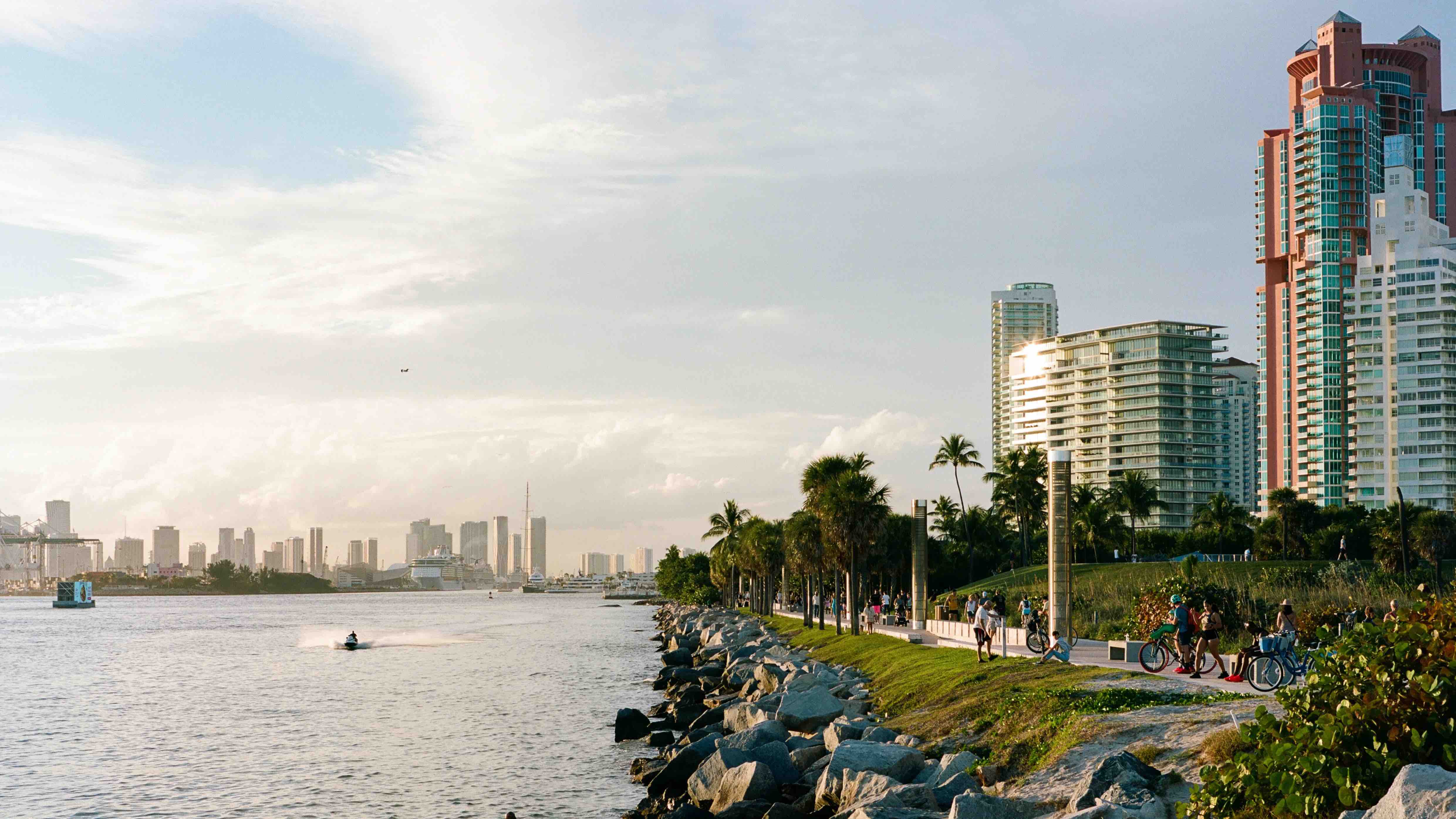
Joel Stein on the ascendance of Miami…
The last time Miami was relevant, it wasn’t important. In the 1980s, Miami provided nothing more than drugs, clubs, pastel blazers, jai alai gambling and, most notably, a hit TV show about all four.
But now Miami is the most important city in America. Not because Miami stopped being a frivolous, regulation-free, climate-doomed tax haven dominated by hot microcelebrities. It became the most important city in America because the country became a frivolous, regulation-free, climate-doomed tax haven dominated by hot microcelebrities…
How a refuge for the retired, divorced, bankrupt, and unemployed has evolved into a “paradise of freedom”: “How Miami became the most important city in America,” from @thejoelstein in @FinancialTimes. (A “gifted” article, so should be free of the paywall.)
An apposite look at ascendant cities worldwide, but especially in Africa: “Africa’s rising cities” (also “gifted”).
* Plato
###
As we investigate epicenters, we might recall that it was on this date in 1986 that figure skater Debi Thomas, a Stanford undergraduate, became the first African American to win the Women’s Singles event in the U.S. National Figure Skating Championship competition. She went on to win a gold medal in the World Championships later that year, and then (after battling Achilles tendinitis in both ankles) to earn a Bronze in the 1988 Olympics.
Thomas then attended medical school at Northwestern, and has since practiced as a surgeon.

“There is always something new out of Africa”*…

Afrofuturism is a fun and interesting subgenre of science fiction and philosophy:, but I kind of chuckle every time I see the word, because all futurism is actually Afrofuturism. Africa is literally the future of the entire world. Here is one of the two or three most important charts you will ever see:

Notice that this is the projection for total population. It has Africa just about equal to Asia by the end of the century, but if we were to look at only young population, Africa would have a clear majority here.
“Wait,” you may be about to ask. “Are these 80-year-ahead projections really reliable? What if African fertility falls?”
And the answer is: It’s going to fall! It’s already falling fast. As countries get richer their fertility rates drop; as Lyman Stone shows, Africa’s fertility rates are dropping faster, relative to their income level, than any other region except India…
A recent paper in The Lancet attempts to model how African population will change as women’s education and access to contraception (the two biggest things other than GDP that we know affect fertility) increase. They predict a population for Sub-Saharan Africa of about 3.4 billion by century’s end — only 0.8 billion lower than the UN median projection. That’s still an absolutely enormous fraction of humanity, and an even larger chunk of the young population.
Thus, the future of Africa is the future of humanity, despite the fact that Africa will experience a normal fertility transition and its population will eventually stabilize rather than explode. I don’t think people in the U.S. (or, probably, other regions) have come to grips with the full import of this.
But what happens to Africa is even more important, relative to the rest of the world, than these population numbers suggest! This is because Africa is still a mostly poor region. Economics teaches us that marginal utility — i.e. the amount life gets better when you get a little richer — is much higher for poor people. And with China and (to some degree) India industrializing successfully and seeing population growth slow, soon most of the extremely poor people in the world will probably reside in Africa.
So the future welfare of humanity depends crucially on whether Africa can make big strides against poverty — in other words, whether African countries can achieve substantial economic growth…
The fate of humanity in the 21st century and beyond hinges on whether African countries can figure out the riddle of industrialization.
Can Africa industrialize? Noah Smith (@Noahpinion) believes that it can: “All futurism is Afrofuturism.” The full argument (and more supporting charts and data) in the complete post.
* Pliny the Elder
###
As we look to the future, we might recall that it was on this date in 1775 that an anonymous writer, now widely thought to be Thomas Paine, published “African Slavery in America,” the first article in the American colonies calling for the emancipation of slaves and the abolition of slavery.

“The worst thing that colonialism did was to cloud our view of our past”*…

Mansa Musa, the king of Mali, approached by a Berber on camelback; detail from The Catalan Atlas, attributed to the Majorcan mapmaker Abraham Cresques, 1375
There is a broad strain in Western thought that has long treated Africa as existing outside of history and progress; it ranges from some of our most famous thinkers to the entertainment that generations of children have grown up with. There are Disney cartoons that depict barely clothed African cannibals merrily stewing their victims in giant pots suspended above pit fires. Among intellectuals there is a wealth of appalling examples. Voltaire said of Africans, “A time will come, without a doubt, when these animals will know how to cultivate the earth well, to embellish it with houses and gardens, and to know the routes of the stars. Time is a must, for everything.” Hegel’s views of Africa were even more sweeping: “What we properly understand by Africa, is the Unhistorical, Undeveloped Spirit, still involved in the conditions of mere nature, and which had to be presented here only as on the threshold of the World’s History.” One can hear echoes of such views even today from Western politicians. Donald Trump referred to a number of African nations as “shithole countries” in 2018, and French president Emmanuel Macron said in 2017, “The challenge Africa faces is completely different and much deeper” than those faced by Europe. “It is civilizational.”
It may remain a little-known fact, but Africa has never lacked civilizations, nor has it ever been as cut off from world events as it has been routinely portrayed. Some remarkable new books make this case in scholarly but accessible terms, and they admirably complicate our understanding of Africa’s past and present…
The estimable Howard French provides an introduction to recent scholarship on “Africa’s Lost Kingdoms.”
* Dreams from My Father
###
As we realize that the continent’s “darkness” is our own, we might send respectful birthday greetings to Mangena Mokone; he was born on this date in 1851. A Wesleyan minister who chafed under the implications of the Church’s (and their colonial partners’) color bar, he left to found the Ethiopian Church in 1892, starting the Ethiopian Movement, which was motivated by the desire for a more African and relevant Christianity, for the restoration of tribal life, and for political and cultural autonomy expressed in the slogan “Africa for the Africans” (and also in the word “Ethiopianism”).

“The darkest thing about Africa has always been our ignorance of it”*…

Aristotle held that philosophising begins with wonder. The African philosopher Jonathan Chimakonam suggested that, while wonder might have instigated Western philosophy, it was frustration that spurred African philosophy, with the emergence of radically Afrocentric nationalist philosophers such as Léopold Sédar Senghor, Aimé Césaire and Kwame Nkrumah who saw in philosophy an ideological weapon for attacking those who sought to denigrate and subjugate Africans culturally and politically. What is needed now is a 21st-century African synthesis that can help to resolve this struggle. ‘Consolation philosophy’ – spurred by both wonder and frustration – attempts to do just that.
The idea of ‘consolation’ philosophy does not imply an attempt to comfort philosophers. Rather, it suggests a philosophy of life, a project similar to the human-centred philosophical projects of Western existentialists such as Martin Heidegger, Jean-Paul Sartre, Friedrich Nietzsche, Gabriel Marcel, Søren Kierkegaard, Miguel de Unamuno, Emmanuel Levinas and German idealists such as Arthur Schopenhauer. Here I offer a brief presentation of this African philosophical synthesis, which I hope will help to resolve the dilemma eloquently put forward in 1997 by professor of philosophy at Penn State University Robert Bernasconi: ‘Either African philosophy is so similar to Western philosophy that it makes no distinctive contribution and effectively disappears; or it is so different that its credentials to be genuine philosophy will always be in doubt.’…
“Consolation philosophy” understands the human being as a unity of feeling and reason, in a cosmos rich with primal emotion. The provocative– and timely– essay in full at “A truly African philosophy.”
See also “Philosophy is the new battleground in South Africa’s fight against colonialism.”
[Image above: source]
* Geographer George Kimble
###
As we take our wisdom where we find it, we might recall that it was on this date in 1899 that the Boer regime in (what we now call) South Africa issued an ultimatum to the British government, declaring that a state of war would exist between Britain and the two Boer republics if the British did not remove their troops from along the border.
The British had challenged the Dutch settlers for a variety of reasons, probably main among them for control of the gold deposits in the region. It was the largest gold-mining complex in the world at a time when the world’s monetary systems, preeminently the British, were increasingly dependent upon gold.
The British ignored the ultimatum, and what we now call the Boer War (actually the second Boer War, as there has been an earlier skirmish) broke out. The two colonialists slugged it out until 1902, when the British took control.

Boer and British troops at the battle of Belmont, Nov. 23, 1899
“It is not our differences that divide us. It is our inability to recognize, accept, and celebrate those differences.”*…

This map of Canada shows the country’s familiar vastness. A single line drawn across its deep south adds a surprising layer of information.
The line runs well below the 49th parallel that constitutes that long straight stretch of U.S.-Canada border from Point Roberts, WA to Lake of the Woods, MN… Split in two by the U.S. state of Maine poking north, the line traverses four eastern provinces, cutting off the southern extremities of Ontario, Québec and New Brunswick. Nova Scotia is the only province that falls mostly below the line.
Amazingly, what the line does, is divide Canada in two perfect halves – demographically speaking: 50% of Canada’s 35 million inhabitants live south of the line, 50% north of it. Below the line is where you find Montreal, Ottawa, Toronto, Halifax and other major cities. The vast expanses north of the line are mainly empty…
Other compelling cartographic “curious dividers” at “One Half of Canada Is Smaller than the Other — Plus More Fascinating Inequalities.”
###
As we conquer the divides, we might send adventurous birthday greetings to Hugh Clapperton; he was born on this date in 1788. A British naval officer, Clapperton saw action in the Napoleonic Wars and in Canada before volunteering for an expedition to explore Africa. He made several such journeys, helping to chart West and Central Africa, and was the first European to to make known from personal observation the Hausa states (in what we now call Nigeria). Clapperton ended his career sailing in an action aimed at suppressing the slave trade.

You must be logged in to post a comment.