Posts Tagged ‘diabetes’
“The worst part about having a mental illness is people expect you to behave as if you don’t”*…

Trends across all causes and risks of disease/disability show that there have been substantial declines in infectious diseases, malnutrition, cardiovascular diseases, and several cancers. But even as we make strides in addressing physical health, mental health challenges are on the rise. In sharp contrast, mental health disorders and alcohol-related disability adjusted life years (DALYS) have increased sharply over the last few decades, especially among people aged 25 to 74.
The WHO found that the two most common mental disorders, anxiety and depression, cost global GDP
$1 trillion in 2010. Lost output for the same time period attributed to mental, neurological, and substance
abuse disorders – which often intersect – was estimated between $2.5-$8.5 trillion. This is expected to double by 2030.
A report from the Aspen Institute and Dalberg explores the global rise of mental illness through economics, lived experiences, and expert insights…
According to the World Health Organization (WHO), 450 million people suffer from some form of mental illness over the course of their lives. So, it’s no surprise that many of us have experienced, or know some-one who has experienced, severe struggles with mental health. This is a full-blown crisis exacerbated by a lack of infrastructure, lack of funding, and a lack of health equity. This is despite the fact that mental health issues are the leading cause of disability globally. Also, according to the WHO, mental health conditions are the primary cause of suicide. And suicide is the second leading cause of death for people age 15to 29. This is a crisis of our time.
In this report, we offer a snapshot into both the magnitude and the scope of the mental health crisis facing humanity. In addition to briefly framing the issues, we share summaries of dozens of interviews we held with both “expert practitioners” working both in the public and private sectors and individuals with a “lived experience” touched by mental health struggles.
In the course of our work, we looked for recurring themes that could promote a dialogue about seeking sustainable, scalable solutions to the crisis. Among those themes are the challenges of building an infrastructure for access to quality mental healthcare, the continued lack of parity between the provision of services for mental health versus physical health, and the pervasiveness of stigma associated with diseases of the mind.
Further, although most of us do not think of mental health as related to investing, and if we do, we might find the notion distasteful, there are indeed a growing number of developing technologies and treatment modalities that hold promise for expanding access to mental health services and offering innovative practices. We highlight a handful of examples. The individuals who generously shared their personal struggles also shared the resources and practices that they found most helpful.
We acknowledge the global nature of the crisis and the role that both the pandemic and other contextual factors have played in substantial increases in anxiety disorders and other mental health issues. Further, we are seeing increases in specific demographics, such as poorer mental health among women, with one in five women experience a more common mental disorder (such as anxiety or depression), compared with one in eight men. No demographic is immune.
Given the crisis at hand, it is our hope that offering greater transparency to the world of mental health will stimulate a search for solutions…
Bracing– but important– reading: “A Crisis of Our Time.”
(Image above from a series of photos illustrating mental illness, from Christian Sampson.)
* from the notebook of Arthur Fleck (AKA, The Joker), via Todd Phillips 2019 film Joker
###
As we care about care, we might recall that it was on this date in 2019 that the first presentation print of Todd Phillip’s film Joker was shipped to Italy, where it premiered at the Venice International Film Festival and won the Golden Lion, the fest’s top prize. The film went on to box office success and set records for an October release. It grossed over $1 billion; the first R-rated to do so. It received numerous accolades, including two Academy Award wins at the 92nd Academy Awards for Best Actor (Joaquin Phoenix) & Best Original Score (Hildur Guðnadóttir) out of 11 nominations including Best Picture, first DC film to score.

“We may say most aptly that the Analytical Engine weaves algebraical patterns just as the Jacquard loom weaves flowers and leaves”*…

Lee Wilkins on the interconnected development of digital and textile technology…
I’ve always been fascinated with the co-evolution of computation and textiles. Some of the first industrialized machines produced elaborate textiles on a mass scale, the most famous example of which is the jacquard loom. It used punch cards to create complex designs programmatically, similar to the computer punch cards that were used until the 1970s. But craft work and computation have many parallel processes. The process of pulling wires is similar to the way yarn is made, and silkscreening is common in both fabric and printed circuit board production. Another of my favorite examples is rubylith, a light-blocking film used to prepare silkscreens for fabric printing and to imprint designs on integrated circuits.
Of course, textiles and computation have diverged on their evolutionary paths, but I love finding the places where they do converge – or inventing them myself. Recently, I’ve had the opportunity to work with a gigantic Tajima digital embroidery machine [see above]. This room-sized machine, affectionately referred to as The Spider Queen by the technician, loudly sews hundreds of stitches per minute – something that would take me months to make by hand. I’m using it to make large soft speaker coils by laying conductive fibers on a thick woven substrate. I’m trying to recreate functional coils – for use as radios, speakers, inductive power, and motors – in textile form. Given the shared history, I can imagine a parallel universe where embroidery is considered high-tech and computers a crafty hobby…
Notes, in @the_prepared.
* Ada Lovelace, programmer of the Analytical Engine, which was designed and built by her partner Charles Babbage
###
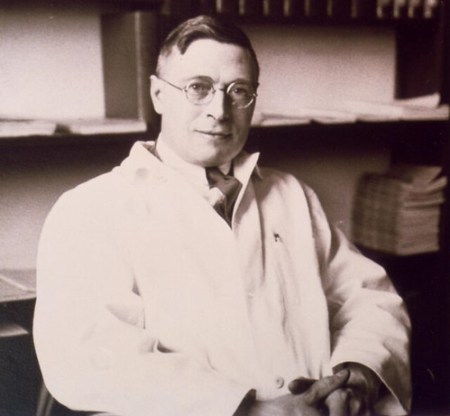
As we investigate intertwining, we might recall that it was on this date in 1922 that Frederick Banting and Charles Best announced their discovery of insulin the prior year (with James Collip). The co-inventors sold the insulin patent to the University of Toronto for a mere $1. They wanted everyone who needed their medication to be able to afford it.
Today, Banting and his colleagues would be spinning in their graves: their drug, one on which many of the 30 million Americans with diabetes rely, has become the poster child for pharmaceutical price gouging.
The cost of the four most popular types of insulin has tripled over the past decade, and the out-of-pocket prescription costs patients now face have doubled. By 2016, the average price per month rose to $450 — and costs continue to rise, so much so that as many as one in four people with diabetes are now skimping on or skipping lifesaving doses…

Best (left) and Bantling with with one of the diabetic dogs used in their experiments with insulin
“Gain not base gains; base gains are the same as losses”*…

When inventor Frederick Banting discovered insulin in 1921, he refused to put his name on the patent. He felt it was unethical for a doctor to profit from a discovery that would save lives. Banting’s co-inventors, James Collip and Charles Best, sold the insulin patent to the University of Toronto for a mere $1. They wanted everyone who needed their medication to be able to afford it. [see here]
Today, Banting and his colleagues would be spinning in their graves: Their drug, which many of the 30 million Americans with diabetes rely on, has become the poster child for pharmaceutical price gouging.
The cost of the four most popular types of insulin has tripled over the past decade, and the out-of-pocket prescription costs patients now face have doubled. By 2016, the average price per month rose to $450 — and costs continue to rise, so much so that as many as one in four people with diabetes are now skimping on or skipping lifesaving doses…
Why Americans ration a drug discovered– and given free to the world– in the 1920s: “The absurdly high cost of insulin, explained.”
* Hesiod (See also Proverbs 28:20: “he that maketh haste to be rich shall not be innocent”)
###
As we ponder pleonexia, we might send healing birthday greetings to Edward Lawrie Tatum; he was born on this date in 1909. A geneticist, he shared half of the Nobel Prize in Physiology or Medicine in 1958 with George Beadle for showing that genes control individual steps in metabolism. During World War II, his work was of use in maximizing penicillin production, and it has also made possible the introduction of new methods for assaying vitamins and amino acids in foods and tissues. Tatum and Joshua Lederberg (the winner of the other half of the 1958 Nobel award), discovered genetic recombination in bacteria.
His discoveries were made freely available to the scientific community.

“It was all so very businesslike that one watched it fascinated. It was pork-making by machinery, pork-making by applied mathematics.”*…

In the mid-to-late 1800s, the meat industry — from the cowboys and cattle drives to the Chicago slaughterhouses to the refrigerated railcars delivering steaks to New York’s finest restaurants — was the largest industry in America. At the heart of this industry were entrepreneurs like Philip Danforth Armour and Gustavus Franklin Swift, who pioneered business practices later adopted by the automobile industry and whose company names survive to this day:
“[In the meat industry in the mid-1800s], automation was the secret ingredient. Overhead wheels were introduced to carry the hog or the steer from one fixed workstation to the next. Before long, this approach evolved into an overhead trolley system driven by steam engines and industrial belts. Specific repetitive tasks were assigned to each worker along what became, in effect, the first assembly line, although the actual work was disassembly. It was from studying this process in the Chicago slaughterhouses that Henry Ford came up with his own method for assembling automobiles — a development that would revolutionize mass manufacturing…
More at “The American Meat Colossus,” an excerpt from Cattle Kingdom: The Hidden History of the Cowboy West, by Christopher Knowlton.
* “It was all so very businesslike that one watched it fascinated. It was pork-making by machinery, pork-making by applied mathematics. And yet somehow the most matter-of-fact person could not help thinking of the hogs; they were so innocent, they came so very trustingly; and they were so very human in their protests – and so perfectly within their rights! They had done nothing to deserve it; and it was adding insult to injury, as the thing was done here, swinging them up in this cold-blooded, impersonal way, without pretence at apology, without the homage of a tear.” – Upton Sinclair (author of The Jungle)
###
As we ponder protein, we might recall that it was on this date in 1921 that Canadians Sir Frederick Banting and his assistant Charles Best isolated insulin (from canine subjects). Later that year, working with a University of Toronto colleague, J.J.R. MacLeod, Banting developed a diabetes treatment for humans– for which he and MacLeod shared the Nobel Prize in Medicine. Banting and Best (with whom he shared his Nobel Prize money) later improved both the sourcing process for insulin (discovering how to extract it from an intact pancreas) and the diabetes detection process.
Best (left) and Bantling with with one of the diabetic dogs used in their experiments with insulin
When hunger won’t wait…

“For when you need a snack before tonight’s suicide attempt…”
From LiarTownUSA, via the always-riveting Richard Kadrey’s Damn Tumblr.
###
As we contemplate culinary curiosity, we might send prickly birthday greetings to James Bertram Collip; he was born on this date in 1892. A pioneering endocrinologist, Collip was a leader of the Toronto team that isolated insulin (in 1921) and developed it for clinical use. Later in his career he isolated the parathyroid hormone and established a bioassay for measuring serum calcium.
You must be logged in to post a comment.