Posts Tagged ‘Erasmus’
“‘When I use a word,’ Humpty Dumpty said in rather a scornful tone, ‘it means just what I choose it to mean — neither more nor less.'”*…
Like today’s large language models, some 16th-century humanists (like Erasmus) had techniques to automate writing. But as Hannah Katznelson explains, others (like Rabelais) called foul…
The Renaissance scholar and educator Erasmus of Rotterdam opens his polemical treatise The Ciceronian (1528) by describing the utterly dysfunctional writing process of a character named Nosoponus. The Ciceronianis structured as a dialogue, withtwo mature writers, Bulephorus and Hypologus, trying to talk Nosoponus out of his paralysing obsession with stylistic perfection. Nosoponus explains that it would take him weeks of fruitless writing and rewriting to produce a casual letter in which he asks a friend to return some borrowed books. He says that writing requires such intense concentration that he can do it only at night, when no one else is awake to distract him, and even then his perfectionism is so intense that a single sentence becomes a full night’s work. Nosoponus goes over what he’s written again and again, but remains so dissatisfied with the quality of his language that eventually he just gives up.
Nosoponus’s problem might resonate. Who has not spent too long going over the wording of a simple email, at some point or another? Today there is an easy fix: we have large language models (LLMs) to write our letters for us, helpfully proffering suggestions as to what we might say, and how we might phrase it. When I input Nosoponus’s intended request into GPT-4, it generated the following almost instantly:
Hey [Friend’s Name],
Hope you’re doing well! I just realised I never got those books back that I lent you a while ago. No rush, but whenever you get a chance, I’d love to get them back. Let me know what works for you! Thanks!
Nosoponus
But there was a solution in the 16th century, too. A humanist education on the Erasmian model could train its students to produce letters of any length, on any topic – quickly, easily and eloquently. The French humanist François Rabelais, a contemporary of Erasmus, appears to have understood these compositional techniques as automating the creating of text in a way that, retrospectively, looks a lot like how LLMs function. If we want to understand LLMs, and what they are and aren’t capable of, we can look at earlier versions of the same technology – like Erasmian humanism. We can also read authors like Rabelais, who is already thinking about automatic text-generation along these lines, as someone who appreciates the effectiveness of Erasmian generative technology, but at the same time sees it as vitiating the social force of language and, ultimately, ruining language as a tool for moral and political life…
[Katznelson recounts Erasmus’s efforts, Rabelais’s response, and unpacks the important differences between our own authentic speech language created to speak for us and their practical and moral implications…]
What lessons from the 16th century can tell us about AI and LLMs: “Methodical banality,” from @aeon.co.
* Lewis Carroll, Through the Looking Glass
###
As we honor authenticity, we might recall that it was on this date in 1886 that three U.S. patents were issued to Alexander Graham Bell’s Volta Labs for “recording and reproducing speech and other sounds.” The Graphophone, was an improved (and the first practical) version of the Edison phonograph (from 1877), and became the foundation on which the speech recording (e.g., dictaphone) and recorded music (and spoken word) industries began to grow.

“The great men turn out to be all alike. They never stop working. They never lose a minute. It is very depressing.”*…
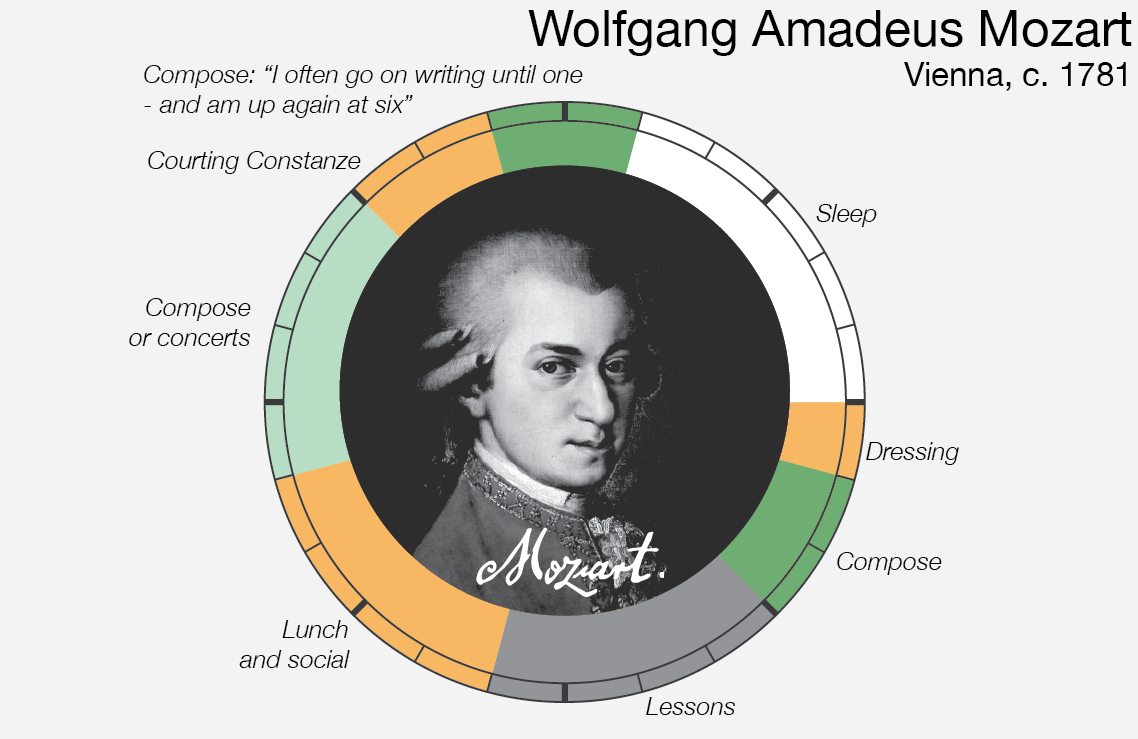
Data storyteller RJ Andrews demonstrates…
How do creatives – composers, painters, writers, scientists, philosophers – find the time to produce their opus?
Each routine day is represented as a continuous 24 hour cycle. Midnight is placed at 12 o’clock position and noon at 6 o’clock. Colors mark major categories of activity including work, sleep, and exercise…

The daily rituals of great creators: “Creative Routines,” from @infowetrust.
* Mason Curry, Daily Rituals: How Artists Work (the source of much of the data that informed the gaphics above)
###
As we contemplate cultivating customs, we might send learned birthday greetings to Desiderius Erasmus Roterodamus, better known simply as Erasmus; he was born on this date in 1466. A Catholic priest, social critic, teacher, translator, and theologian, probably best remembered for his book In Praise of Folly, he was the greatest scholar of the northern Renaissance, the first editor of the New Testament (“Do unto others…”), and an important figure in patristics and classical literature.
Erasmus had contrasting experiences of routine: on being orphaned, Erasmus was sent to a series of monastic or semi-monastic schools, which he despised both for their discipline and for their disdain of inquiry. Graduating with few prospects, he joined an Augustinian monastery where he considered his superiors “barbarians” discouraging his classical studies. On ordination, he escaped– and began a career that began in struggle (as he balanced the demands of study with those of serving as a Clerk, and Priest, a tutor… all while trying to distinguish himself as a poet.
His luck changed in 1499, when he connected with a reformist English circle (notably John Colet and Thomas More), then with radical French Franciscan Jean Vitrier, and later with the Aldine New Academy in Venice… which led, in the Reformation, to his emergence as a prime influencer of European thought. Among fellow scholars and philosophers of that era he was– and is still– known as the “Prince of the Humanists.”
Erasmus’ views were contentious on his time and elicited a good bit of criticism. While we don’t know too much about his daily routine, we do know that for the last half of his life it included enough time on a regular basis to read these attacks and to prepare and publish apologetic works in his own defense, in many cases leading to a long series of back-and-forth polemical books… kind of like Twitter feud, but at the speed of Gutenberg.

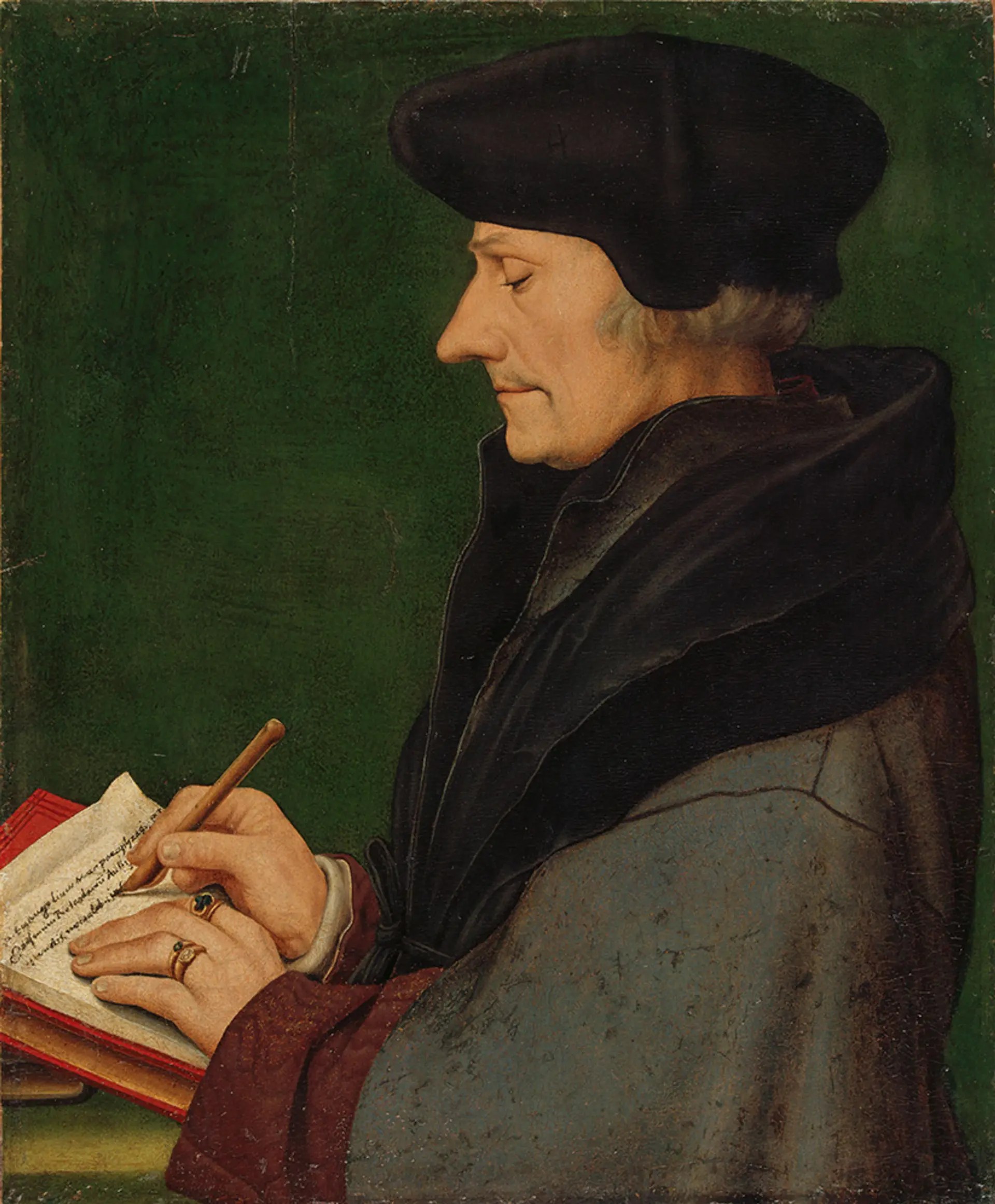
Portrait of Erasmus of Rotterdam (1523) by Hans Holbein the Younger
“People are more violently opposed to fur than leather because it’s safer to harass rich women than motorcycle gangs”*…

Marlon Brando, The Wild One
Throughout the 1930s, the sleepy town of Hollister [California], not far from Monterey Bay, had made a pastime of hosting motorcycle rallies. Paused during World War II, an Independence Day rally returned in 1947 with a pent-up energy like never before.
By the end of the holiday weekend, roughly 50 bikers had been arrested for public drunkenness and other forms of debauchery. Then they left, and life in Hollister went back to normal. But the lore of what became dubbed the Hollister Riot grew. Breathless news accounts told of “havoc” and “pandemonium” on the streets of small-town America.
A couple weeks later LIFE magazine published a S.F. Chronicle photo from Hollister, pictured above, showing a drunken fellow teetering atop a Harley, a beer bottle in each fist and a pile of spent bottles at his feet. The headline: “Cyclists’ Holiday: He and friends terrorize a town.”

Historians have questioned whether this photo from the so-called Hollister Riot was staged. Barney Peterson/S.F. Chronicle
LIFE was read by roughly 10% of the country at a time before widespread adoption of the television. The image of wild men on motorcycles, Hunter S. Thompson observed, was like nothing America had ever seen.
In “Hell’s Angels: A Strange and Terrible Saga,” Thompson wrote: “There was absolutely no precedent, in the years after World War II, for large gangs of hoodlums on motorcycles, reveling in violence, worshiping mobility and thinking nothing of riding five hundreds miles on a weekend … to whoop it up with other gangs of cyclists in some country hamlet entirely unprepared to handle even a dozen peaceful tourists.”
A few years after Hollister, Harper’s Magazine published a fictionalized version of the rally that was in turn crafted into a Hollywood depiction. “The Wild One” premiered in 1953 starring heartthrob Marlon Brando as the iconic biker outlaw Johnny Strabler.
At one point in the movie, a little girl asks Strabler what he’s rebelling against.
“Whaddya got?” he replies.
Over the years, mainstream motorcycle groups sought to dispel their reputation as hell-raising ruffians. But other clubs wore it proudly. They called themselves one-percenters, a response to the claim that 99% of motorcyclists are model citizens. The most notorious, the Hell’s Angels, was founded in Fontana not long after Hollister. Their motto: “When we do right, nobody remembers. When we do wrong, nobody forgets.”…
How the image of the outlaw biker was born. Via the ever-illuminating California Sun.
* Alexi Sayle
###
As we hit the road, we might spare a thought for Desiderius Erasmus Roterodamus, better known simply as Erasmus; he died on this date in 1536. A Catholic priest, social critic, teacher, translator, and theologian, probably best remembered for his book In Praise of Folly, he was the greatest scholar of the northern Renaissance, the first editor of the New Testament (“Do unto others…”), and an important figure in patristics and classical literature. Among fellow scholars and philosophers he was– and is– known as the “Prince of the Humanists.”
Portrait of Erasmus of Rotterdam (1523) by Hans Holbein the Younger
source
“When I got my library card, that’s when my life began”*…

I grew up in libraries, or at least it feels that way. My family lived in the suburbs of Cleveland, about a mile from the brick-faced Bertram Woods Branch of the Shaker Heights Public Library system. Throughout my childhood, starting when I was very young, my mother drove me there a couple of times a week. We walked in together, but, as soon as we passed through the door, we split up, each heading to our favorite section. The library might have been the first place that I was ever given independence. Even when I was maybe four or five years old, I was allowed to go off on my own. Then, after a while, my mother and I reunited at the checkout counter with our finds. Together, we waited as the librarian pulled out each date card and, with a loud chunk-chunk, stamped a crooked due date on it, below a score of previous crooked due dates that belonged to other people, other times.
Our visits were never long enough for me—the library was so bountiful. I loved wandering around the shelves, scanning the spines of the books until something happened to catch my eye. Those trips were dreamy, frictionless interludes that promised I would leave richer than I arrived. It wasn’t like going to a store with my mom, which guaranteed a tug-of-war between what I desired and what she was willing to buy me; in the library, I could have anything I wanted. On the way home, I loved having the books stacked on my lap, pressing me under their solid, warm weight, their Mylar covers sticking to my thighs. It was such a thrill leaving a place with things you hadn’t paid for; such a thrill anticipating the new books we would read. We talked about the order in which we were going to read them, a solemn conversation in which we planned how we would pace ourselves through this charmed, evanescent period of grace until the books were due. We both thought that all the librarians at the Bertram Woods branch were beautiful. For a few minutes, we discussed their beauty. My mother then always mentioned that, if she could have chosen any profession, she would have chosen to be a librarian, and the car would grow silent for a moment as we both considered what an amazing thing that would have been…
In an excerpt from her newest, The Library Book, the superb Susan Orlean on the crucial treasures of the public library: “Growing up in the library.”
* Rita Mae Brown
###
As we check it out, we might send learned birthday greetings to Desiderius Erasmus Roterodamus, better known simply as Erasmus; he was born on this date in 1466 (though some sources place his birth two days later). A Catholic priest, social critic, teacher, translator, and theologian, probably best remembered for his book In Praise of Folly, he was the greatest scholar of the northern Renaissance, the first editor of the New Testament (“Do unto others…”), and an important figure in patristics and classical literature. Among fellow scholars and philosophers he was– and is– known as the “Prince of the Humanists.”
“No Man is wise at all Times, or is without his blind Side”*…

Lucas Cranach the Elder: Martin Luther, circa 1532; Hans Holbein the Younger: Portrait of Erasmus, 1523
Desiderius Erasmus of Rotterdam, the leading figure of the Northern Renaissance, is widely considered the greatest of early humanists. Five hundred years ago, he faced a populist uprising led by a powerful provocateur, Martin Luther, that resulted in divisions no less explosive than those we see in America and Europe today.
Between 1500 and 1515, Erasmus produced a small library of tracts, textbooks, essays, and dialogues that together offered a blueprint for a new Europe. The old Europe had been dominated by the Roman Church. It emphasized hierarchy, authority, tradition, and the performance of rituals like confession and taking communion. But a new order was emerging, marked by spreading literacy, expanding trade, growing cities, the birth of printing, and the rise of a new middle class intent on becoming not only prosperous but learned, too.
Erasmus became the most articulate spokesman for this class…
Around the same time that the Erasmians were celebrating the dawn of a new enlightened era, a very different movement was gathering in support of Martin Luther. An Augustinian friar then in his early thirties, Luther had developed his own, unique gospel, founded on the principle of faith. Man, he thought, can win divine grace not through doing good works, as the Latin Church taught, but through belief in Christ. No matter how sincerely one confessed, no matter how many alms one gave, without faith in the Savior, he reasoned, no one can be saved. When Luther made this “discovery,” in around 1515, he felt that he had become “altogether born again and had entered paradise itself through open gates.”…
Initially, Luther admired Erasmus and his efforts to reform the Church, but over time Luther’s inflammatory language and his stress on faith instead of good works led to a painful separation. The flashpoint was the debate over whether man has free will. In dueling tracts, Erasmus suggested that he does, while Luther vehemently objected; after that, the two men considered each other mortal enemies.
Beyond that immediate matter of dispute, however, their conflict represented the clash of two contrasting world views—those of the Renaissance and the Reformation. Erasmus was an internationalist who sought to establish a borderless Christian union; Luther was a nationalist who appealed to the patriotism of the German people. Where Erasmus wrote exclusively in Latin, Luther often used the vernacular, the better to reach the common man. Erasmus wanted to educate a learned caste; Luther, to evangelize the masses. For years, they waged a battle of ideas, with each seeking to win over Europe to his side, but Erasmus’s reformist and universalist creed could not match Luther’s more emotional and nationalistic one; even some of Erasmus’s closest disciples eventually defected to Luther’s camp. Erasmus became an increasingly marginal figure, scorned by both Catholics, for being too critical of the Church, and Lutherans, for being too timid. In a turbulent and polarized age, he was the archetypal reasonable liberal…
As Mark Twain is reputed to have observed, “history doesn’t repeat itself but it often rhymes”– the Renaissance vs. the Reformation: “Luther vs. Erasmus: When Populism First Eclipsed the Liberal Elite.”
* Desiderius Erasmus, The Alchymyst, in Colloquies of Erasmus, Volume I
###
As we celebrate critical thinking, we might recall that it was on this date in 380 that the three Emperors of the Roman Empire issued the Edict of Thessalonica, ordering all subjects of the Empire to profess the faith of the bishops of Rome and of Alexandria, making Nicene Christianity the state religion of the Roman Empire and effectively creating “Christendom.” It ended a period of religious tolerance that had been formalized in 313 when the emperor Constantine I, together with his eastern counterpart Licinius, had issued the Edict of Milan, which granted religious toleration and freedom for persecuted Christians.

You must be logged in to post a comment.