Posts Tagged ‘Richard Ovenden’
“Frederick Douglass taught that literacy is the path from slavery to freedom. There are many kinds of slavery and many kinds of freedom, but reading is still the path”*…
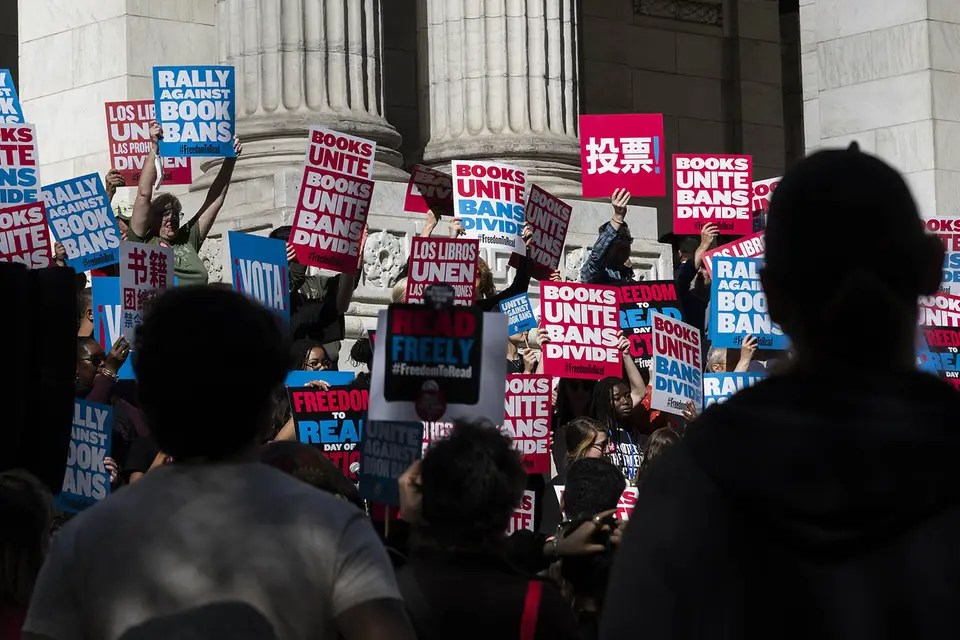
The attack on libraries, in the U.S. and beyond, has been a recurring theme here– precisely because it is so threatening. The estimable Richard Ovenden considers the titles banned, the data deleted, the nation’s librarians sacked without explanation, and explains that Donald Trump’s war on books is a threat to democracy across the world…
I am a librarian. I am fortunate enough to run one of the world’s largest and best known libraries – the Bodleian in Oxford – but my experience of libraries began as a reader. My mother took me as a child to the Deal public library in Kent, and it was there, in its modest book-filled rooms, that I discovered new worlds. My life was transformed by a public library (and its librarians) that allowed me to read freely from its well-stocked shelves. Throughout my career, I have seen at first-hand how libraries underpin the education and self-improvement of all of our citizens, rich and poor, young and old, of all creeds and colours, through providing access to a multitude of ideas and knowledge.
They celebrate the history and identity of our communities; they are stout defenders of facts and truth in an age of misinformation; and they are places where people can learn about their rights and how to protect them. This year we celebrate the 175th anniversary of the Public Libraries Act of 1850, which created our system of free public libraries – a kind of “NHS for the mind”. But what has been happening to American libraries rings a loud alarm bell for our own cherished library system.
Libraries large and small in the US are now on the frontline of the battles over knowledge that have intensified since the second presidency of Donald Trump began. The attack on libraries and librarians there is shocking and happening at a disorienting pace. Thousands of books have been banned from public and school libraries, librarians have received death threats and many have been fired. The heads of both the National Archives and the Library of Congress have been sacked on spurious grounds. Data has been deleted and funding for critical initiatives ceased.
Why is the US, the land of the free, where the realm of ideas and knowledge has been enabled by the first amendment, now turning on institutions that have been among the most trusted in society?
The first dispatches from the war on libraries began to reach me in 2022. I had recently published Burning the Books, which highlighted the role of libraries in society through a long history of attacks on the written word. Librarians began to send me messages and tagged me on social media, sharing news of assaults on public and school libraries in Florida and Texas. As one librarian put it, my book was fast beginning to look as if it would need updating. A pattern was forming: an epidemic of book banning, driven by groups from the far right of the political spectrum, empowered through social media, and funded, it seemed, by larger and darker organisations.
Throughout Joe Biden’s presidency, a coalition of extremist groups, with interests ranging from Christian nationalism to white supremacy, and anti-gay protesters were able to mobilise around common themes such as opposing sex education, LGBTQ+ issues and race equality. They began a concerted campaign to control what young people could read. Two tactics were deployed. The first was to seize control of the boards that oversee small public and school libraries. The boards then censored the books available to library users, especially young people. The second was the mobilisation of supporters using social media, manufacturing outrage through spreading lies, and encouraging challenges to libraries and attacks on librarians.
These tactics have been highly successful. The American Library Association (ALA) collects data on book bans in US libraries. Between 2001 and 2020 an average of 273 unique titles were challenged each year. In 2023, 9,021 individual titles were challenged across hundreds of libraries…
[Richard elaborates on those attacks…]
… Trump’s second presidency has heralded a more ferocious phase in the book-banning wars, moving these acts of local censorship to state and federal level. In April, I received an email letting me know that the Rutherford County’s board of education in Tennessee ordered 145 books to be removed from circulation, citing their “sexually explicit” content; they included Beloved by Toni Morrison and Forever by Judy Blume. In May, a judge ruled that users of Llano County library in Texas have no first amendment right to receive information in the form of books held by public libraries, and that the choice of books a library holds is a form of allowable “government speech” immune from constitutional scrutiny. At a stroke, in Trump’s US, public libraries are the mouthpiece of central government…
… The great civic public libraries, such as those in New York, Brooklyn, San Diego, Boston and Los Angeles, have not sat idly by as the smaller libraries drew the fire. They have digitised banned books to make them available freely online and they have helped develop toolkits to support libraries facing book banning. Despite these efforts, Friedman’s assessment of the future of the free circulation of ideas in the US is sobering: “Between Llano County and Mahmoud v Taylor, we are now seeing a radical upheaval in the legal frameworks for freedom to read,” he explained. It is hard to believe, but in Tennessee, the works of Bill Watterson, the cartoonist author of Calvin and Hobbes, are now considered a danger to young people and are banned in school libraries in many counties…
[Richard unpacks the assault on the Library of Congrees and teh national Archive, and explores the ways on which this particularly heinous form of censorship is being “exported” to other countries…]
… On 10 May 1933, in the heart of Berlin, a mass book-burning was held, where texts considered to be “un-German” – including, of course, Jewish texts, but also books from a library of human sexuality on LGBTQ+ themes – were burned on a pyre on the Unter den Linden boulevard. It is tempting to draw the analogy between this event and the mass burning of books across the US right now.
But if we do we should also remember that new libraries were founded, such as the German Freedom Library in Paris, to counteract Nazi censorship. “You may burn my books and the books of the best minds in Europe,” Helen Keller wrote in 1933, “but the ideas those books contain have passed through millions of channels and will go on.”
We should, in this anniversary year, not only defend the bold and ambitious idea of the Victorian age – that society would benefit from its citizens having access to a free library – but ensure that all people can read freely. To do so, we must empower, support and celebrate the role of libraries and librarians as defenders of an open, pluralist society – the hidden but essential infrastructure of democracy itself…
Eminently worth reading in full: “There is no political power without power over the archive,” from @richove.bsky.social in @theobserveruk.bsky.social.
We might note that, while the primary energy behind this threat is political, it is being supported by the same folks who are hollowing out journalism in the U.S. and capitalizing on the rush to incarcerate immigrants— private equity, which is supporting book banners and local defunding of libraries, then angling to take over the public libraries that they denude.
Your correspondent supports libraries and archives like Richard’s (Oxford’s Bodleian Library), the Harvard Libraries, The New York Public Library, my own local San Francisco Public Library, and the remarkable Internet Archive. You might consider contributing to your local library and to the other libraries and archives of your choice.
* Carl Sagan
###
As we opt for open, we might recall that on this date in 1951 J. D. Salinger’s The Catcher in the Rye was published by Little, Brown and Co. Almost immediately, it was the subject of bans. From 1961 to 1982 it was the most challenged book in the U.S. There was a resurgence of challenges in 2005 and 2009… and it is again the subject of broad removal efforts. In spite of (or more probably, because of) this, it keeps finding its way into adolescent hands, often as assigned reading by high school English teachers.

“Good librarians are natural intelligence operatives”*…

The estimable Richard Ovenden (see here, here, here, and here) on Elyse Graham’s new Book and Dagger…
At dinner parties, it has always been a struggle to get random people to be interested in my work as a librarian. Indeed, throughout my career, I have battled with stereotypes of my profession. We are often pigeonholed as being nerdy, rules obsessed, tweed wearing, bespectacled, and, above all, “dusty.” At least “nerd” has been transformed from negative to positive since the rise of digital technologies over the past few decades. Sometimes, with strangers, I have used the term “archivist” to describe what I do, but that hasn’t helped much.
So my heart rate soared—as would that of any librarian like me—at the idea suggested by the mere title of Book and Dagger that librarians and archivists could be involved in secret and dangerous tasks in a war, risking their lives and taking an active role in fighting against an evil tyrannous oppressor. Perhaps those tweeds are just camouflage.
During World War II, as shown in Elyse Graham’s new book Book and Dagger, librarians, archivists, and scholars played an unexpected and important role in the intelligence services of the United States (and to a lesser extent, of Great Britain). She writes with verve and pace, making this book an easy and enjoyable one to read. Best of all, Graham argues that the humanities—and those librarians and scholars that came from within the discipline—brought special expertise, experience, and attributes that were critical to the direction of strategy, the ultimate victory of the war, and the defense of democracy in the face of tyranny…
[Ovenden unpacks the turf covered…]
… Graham’s study is certainly heartwarming for any librarian, archivist, or humanities scholar seeking confirmation that the skills necessary for their day jobs are directly transferrable to the defense of the realm and of democracy, gaining a utility beyond education, scholarship, and learning to that most visceral of tasks—the waging of war. Also heartwarming is the value which Graham’s account places on the infrastructure of the humanities—the libraries and archives themselves, and the sheer task of acquiring, managing, and preserving knowledge: buying books can keep us free!
Today, the humanities are in a funding crisis, and libraries and archives are being actively defunded by the state. Graham’s book is thus a timely reminder that the skills that are taught and honed in the humanities, in academic departments and in the libraries and archives that support humanistic study, are of vital importance not just to study the past. In fact, they are crucial to defend us in the present, so that we all might enjoy a secure and free future. That’s something I am willing to fight for…
The crucial roles played by unexpected combatants in World War II: “Secrets in the Stacks,” from @richove.bsky.social in @publicbooks.bsky.social.
(Image above: source)
* “Good librarians are natural intelligence operatives. They possess all of the skills and characteristics required for that work: curiosity, wide-ranging knowledge, good memories, organization and analytical aptitude, and discretion.” – Marilyn Johnson, This Book Is Overdue!: How Librarians and Cybrarians Can Save Us All
###
As we check it out, we might recall that it was on this date in 1953 that the first public television station in the U.S.– KUHT, operated in Houston, Texas by the University of Houston– began operation. It was first station to broadcast under an educational non-profit license in the United States, one of the earliest member stations of National Educational Television (which was succeeded by PBS) and offered the university’s first televised college credit classes. Running 13 to 15 hours weekly, these telecasts accounted for 38 percent of the program schedule, mostly airing at night so that students who worked during the day could watch them. By the mid-1960s, with about one-third of the station’s programming devoted to educational programming, more than 100,000 semester hours had been taught on KUHT.

“…When fascism comes to the United States it will be wrapped in the American flag and will claim the name of 100-percent Americanism”*…
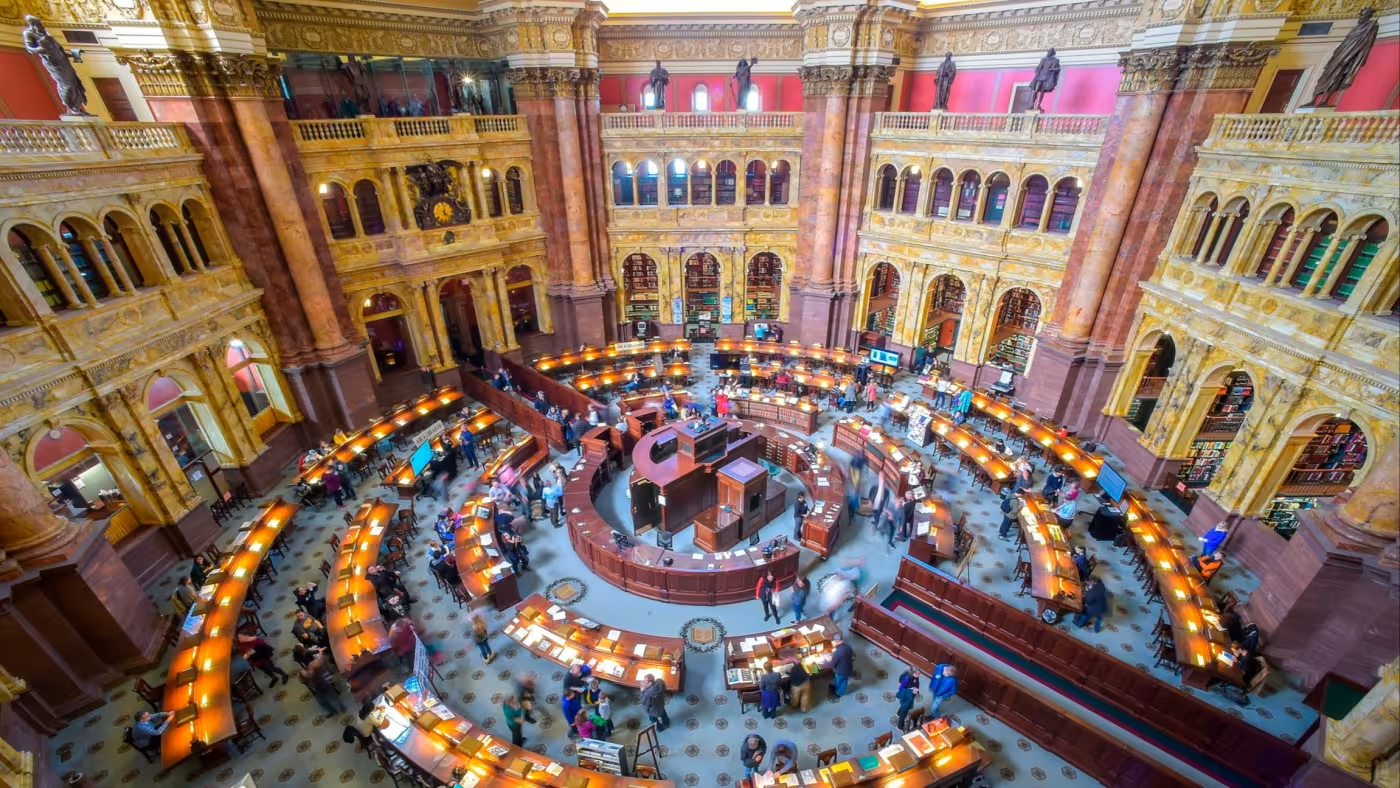
Sinclair Lewis sent up a warning flare in 1935. 90 years later, Richard Ovenden (Oxford’s librarian and author of the important– and terrific— Burning the Books: A History of Knowledge Under Attack) smells smoke…
In the space of three short months, the Archivist of the United States, Colleen Shogan, and the Librarian of Congress, Carla Hayden, have both been fired by the Trump administration. Both of these institutions have suffered setbacks before, and have come back stronger. One of the most severe attacks came at the hands of the British. In 1814 a British expeditionary force besieged Washington and set fire to the Capitol building. Officials had already recognised the threat and commandeered every cart they could find to move the National Archives outside the city.
The Capitol building also housed the Library of Congress, and its 3,000 volumes of highly combustible material could not be moved so quickly. The volumes were ignited by British troops. The whole building, and much of the city, was consumed by flames.
News of the destruction of the library reached Thomas Jefferson, whose presidency had ended five years before. In a letter published in a Washington newspaper, he expressed his outrage at the “barbarism” of the British, and offered to make good the losses from his own private library. Congress purchased 7,000 volumes from the former president; with Jefferson’s books, the Library was reborn.
The Library of Congress serves two functions simultaneously. It is both the national library and the library of the legislature. It is as if the British Library was the same organisation as the libraries of the House of Commons and the House of Lords. The irony of course is that unlike its predecessor in 1814, the 119th US Congress has done nothing to protect its own library.
Trump’s press secretary, Karoline Leavitt, stated in a press briefing that Hayden had been dismissed because the Library had been providing “inappropriate books for children”. It was another senior Trump aide, Kellyanne Conway, who in 2017 introduced the world to the notion that there could be “alternative facts”. This reason for firing Hayden — who has, since 2016, greatly strengthened the institution she inherited — is another “alternative fact”.
The Library of Congress is a reference-only research library and has no lending library for children or adults, its collections being built through legal deposit legislation, passed by Congress in 1909 and updated as recently as 2016.
Shogan was dismissed as Archivist of the United States and replaced by Marco Rubio — who clearly has so much free time alongside his dual role as Secretary of State and national security adviser that he can also run the world’s largest National Archives.
One role that archives play is to preserve documents for legal and evidential reasons. After his last presidency, Trump’s illegal removal of classified documents, stored in a guest bathroom at Mar-a-Lago, resulted in their eventual retrieval by the National Archives under the provisions of the Presidential Records Act.
The removal of Hayden and Shogan demonstrates the exercise of arbitrary power, asserting control over knowledge. Both are the first women to lead their respective institutions, and both committed to reaching all parts of the nation they were appointed to serve. If the ideologically motivated censorship of collections and the recent mass deletion of government websites is anything to go by, the Trump administration is intent on removing swaths of knowledge from public circulation.
In a famous letter of 1813, Thomas Jefferson compared the spread of ideas to the way one candle is lit from another: “He who receives an idea from me”, he wrote, “receives instruction without lessening mine; as he who lights his taper at mine, receives light without darkening me”. Instead of Trump lighting the candles of knowledge in the US today, they are being systematically snuffed out…
An institution that survived British torching in 1814 is now facing a new onslaught: “The US Library of Congress is under attack,” from @richove.bsky.social in @financialtimes.com.
For more on why the attack on the LoC (and the Archive): “Trump Is Trying to Take Control of Congress Through Its Library“- “admin is trying to take over the Library of Congress, ‘a major component of the legislative branch” that confidentially advises lawmakers’.”
And related: “Chaos At The Copyright Office: Trump’s Firing Of Register Shira Perlmutter Came After AI Report’s Release, Leaving Industry Wondering What’s Next“- “speculation about the role that a long-awaited report on [on the use of copyrighted materials to train generative AI models] may have played in his action.”
Apposite, Human Smoke by Nicholson Baker: as Hamilton Nolan explains:
… a history of the years leading up to World War 2. The entire book takes the form of short, stylized, factual items of a few paragraphs or less, presented in chronological order, which taken together tell the story of societies sliding—often unwittingly—into very dark places.
While reading the book, I found over and over again that certain entries would vividly remind me of things happening today. The experience was so vivid that I decided to present a few of them to you here—first, Baker’s entry in his book, and then the modern thing that it made me think of. I make no sweeping claims that one thing is just like the other, or that this time is equivalent to that time. I’m only a curious reader, not a professional historian. I make no sweeping claims at all. It’s just interesting. “History doesn’t repeat itself,” Mark Twain said, “but it often rhymes.”…
And per William Faulkner (“”The past is never dead. It’s not even past”)…

* Sinclair Lewis
###
As we listen carfully for echoes, we might celebrate International Museum Day.

“Everything faded into mist. The past was erased, the erasure was forgotten, the lie became truth.”*…

A bonfire burned on Berlin’s most important thoroughfare, Unter den Linden, just opposite the Friedrich Wilhelm University on May 10, 1933. Watched by a cheering crowd of almost 40,000, a group of students marched toward the flames, carrying the bust of the Jewish intellectual Magnus Hirschfeld, and threw it atop thousands of seized books by other “un-German” writers. Rows of young men in Nazi uniforms gave the Heil Hitler salute, while similar scenes took place in 90 other locations across Germany. The bonfires were a warning sign of the attack on knowledge about to be unleashed by the Nazi regime; more than 100 million books may have been destroyed during the Holocaust.
“There is no political power without power over the archive,” the French philosopher Jacques Derrida wrote in his classic work Archive Fever. Authoritarian rulers have long understood the truth of this statement. But what does it mean in the Digital Age?
To many, libraries seem less important than ever—everything’s online, isn’t it? Yet control of knowledge remains a key battleground in the fight for democracy. At the outset of the Trump presidency in January 2017, his adviser Kellyanne Conway was claiming “alternate facts.” By the end of his presidency, after years of dishonesty, Trump sought to reverse his electoral loss with a “firehose of falsehood” strategy, persisting with the obfuscation even after a mob of supporters stormed the Capitol.
Protecting democracies against “alternate facts” means capturing the truth as well as statements that deny it, so that open societies have reference points to trust and rely on. For over three millennia, librarians and archivists have developed systems, methodologies, techniques and an ethos for preservation to ensure that knowledge persists. Their focus on facts underpins integrity in public decision-making; enables a sense of place in our communities; and ensures diversity of ideas, opinions and memory.
By contrast, recent cases of “book-burning” remind us of how ominous the destruction of information is. During the Bosnian War, the mass murder of humans went alongside the destruction of libraries and archives. Serb forces targeted the National Library of Bosnia and Herzegovina with incendiary shells in August 1992, while forces raided provincial archives across the country to destroy records of land ownership as a means of eradicating the official memory of where Muslims had lived. Millions of books and documents in libraries and archives all over Bosnia and Kosovo were destroyed in the ethnic conflicts of the former Yugoslavia—attacks that became part of the charge sheets at the International Criminal Tribunal in the former Yugoslavia.
Officials in South Africa’s apartheid regime destroyed documents on a massive scale too. The South African Truth and Reconciliation Commission was hampered by this; in its final report, it devoted an entire section to the destruction of records. “The story of apartheid is, amongst other things, the story of the systematic elimination of thousands of voices that should have been part of the nation’s memory,” it said. “The tragedy is that the former government deliberately and systematically destroyed a huge body of state records and documentation in an attempt to remove incriminating evidence and thereby sanitize the history of oppressive rule.”
In Iraq, after the American-led coalition invaded in 2003, U.S. forces moved many of the key state records to the United States, where some, such as the archives of the Ba’ath Party, remained until recently. Just as the eradication of records can presage violence, the recent return of these documents can, I hope, form part of a process of national “truth and reconciliation” in Iraq.
Librarians today are not the stereotype of tweed-wearing introverts obsessed with enforcing silence. They are skilled professionals, often with subject-domain specialisms, adept at navigating physical and digital forms of knowledge–trained in project management and budgetary controls, and well-versed in deploying new technologies to support the public in identifying bogus online information, while using digitization to preserve fragile documents.
Digital technology lends itself to extraordinary archival projects, as in the work of the organization Mnemonic, whose Syrian Archive contains millions of online records about the civil war, alongside a Yemeni Archive and a Sudanese Archive, providing historians, journalists and international criminal lawyers the information to understand these conflicts. Other archival projects online include the Xinjiang Victims Database, which aims to document the Chinese campaign against the Uyghurs and other indigenous groups in northwest China.
As for institutional libraries and archives, they are highly trusted by the public—yet are experiencing declining levels of funding. This is happening when knowledge is increasingly held in digital form, controlled not by public institutions but by tech companies. How can we protect society from the “power over the archive” exercised by private corporations? Greater regulation should sit alongside a new role for libraries as citizens’ data sanctuaries, accountable to the public, and funded by a tax on tech-industry profits.
Looking back at the Nazi book-burnings in 1933, this low moment for human truth had lesser-known responses that should not be forgotten. Exactly a year later, on May 10, 1934, the Deutsche Freiheitsbibliothek (German Freedom Library, also known as the German Library of Burnt Books) opened in Paris, founded by German-Jewish writer Alfred Kantorowicz, with support from writers and intellectuals such as André Gide, Bertrand Russell and Heinrich Mann. Rapidly, it collected more than 20,000 volumes—not just the books that had been targeted for burning in Germany but also copies of key Nazi texts, in order to help understand the emerging regime.
The Brooklyn Jewish Center in New York established an American Library of Nazi-Banned Books in December 1934, with noted intellectuals on its advisory board, including Albert Einstein and Upton Sinclair. The library proclaimed itself a means of preserving and promoting Jewish culture at a time of renewed oppression.
If we are to heed George Orwell’s warning in Nineteen Eighty-Four—“The past was erased, the erasure was forgotten, the lie became truth”—then we must ensure that libraries and archives have the resources and public support to serve as our guardians of knowledge.
Bodley’s Librarian Richard Ovenden (@richove), author of the essential (and gripping) Burning the Books- A History of the Deliberate Destruction of Knowledge, explains why rampant dishonesty reminds us that we must preserve documents. Even– indeed, especially– in the Digital Age, archivists are crucial: “Facts in Flames.“
Your correspondent supports institutional archives like Richard’s (Oxford’s Bodleian Library), the Harvard Libraries, and The New York Public Library; and the digital archive that’s the mother of them all, the remarkable Internet Archive. You might consider contributing to them or to the archives of your choice.
And, of course, we should all support our public libraries, which democratize access to information and knowledge and build community in ways that are critical to a healthy society and to constructive civil discourse.
* George Orwell, 1984
###
As we prioritize preservation, we might recall that it was on this date in 1919 that fiery hot molasses poured into the streets of Boston, killing 21 people and injuring scores of others– the Great Boston Molasses Flood:
The United States Industrial Alcohol building was located on Commercial Street near North End Park in Boston. It was close to lunch time on January 15 and Boston was experiencing some unseasonably warm weather as workers were loading freight-train cars within the large building. Next to the workers was a 58-foot-high tank filled with 2.5 million gallons of crude molasses.
Suddenly, the bolts holding the bottom of the tank exploded, shooting out like bullets, and the hot molasses rushed out. An eight-foot-high wave of molasses swept away the freight cars and caved in the building’s doors and windows. The few workers in the building’s cellar had no chance as the liquid poured down and overwhelmed them.
The huge quantity of molasses then flowed into the street outside. It literally knocked over the local firehouse and then pushed over the support beams for the elevated train line. The hot and sticky substance then drowned and burned five workers at the Public Works Department. In all, 21 people and dozens of horses were killed in the flood. It took weeks to clean the molasses from the streets of Boston.
This disaster also produced an epic court battle, as more than 100 lawsuits were filed against the United States Industrial Alcohol Company. After a six-year-investigation that involved 3,000 witnesses and 45,000 pages of testimony, a special auditor finally determined that the company was at fault because the tank used had not been strong enough to hold the molasses. Nearly $1 million [over $15.5 million in today’s dollars] was paid in settlement of the claims…

You must be logged in to post a comment.