Posts Tagged ‘Medieval’
“Why do I feel so exercised about what we think of the people of the Middle Ages?”*…

There was more to the period than violence, superstition and ignorance: The Economist on a new book, Medieval Horizons, from Ian Mortimer…
“In public your bottom should emit no secret winds past your thighs. It disgraces you if other people notice any of your smelly filth.” This useful bit of advice for young courtiers in the early 13th century appears in “The Book of the Civilised Man”, a poem by Daniel of Beccles. It is the first English guide to manners.
Ian Mortimer, a historian, argues that this and other popular works of advice that began appearing around the same time represent something important: a growing sense of social self-awareness, self-evaluation and self-control. Why then? Probably because of the revival of glass mirrors in the 12th century, which had disappeared from Europe after the fall of Rome. The mirror made it possible for men and women to see themselves as others did. It confirmed their individuality and inspired a greater sense of autonomy and potential. By 1500 mirrors were cheap, and their impact had spread through society.
Mr. Mortimer sets out to show that the medieval period, from 1000 to 1600, is profoundly misunderstood. It was not a backward and unchanging time marked by violence, ignorance and superstition. Instead, huge steps in social and economic progress were made, and the foundations of the modern world were laid.
The misapprehension came about because people’s notion of progress is so bound up with scientific and technological developments that came later, particularly with the industrial and digital revolutions. The author recounts one claim he has heard: that a contemporary schoolchild (armed with her iPhone) knows more about the world than did the greatest scientist of the 16th century.
Never mind that astronomers such as Copernicus and Galileo knew much more about the stars than most children do today. Could a modern architect (without his computer) build a stone spire like Lincoln Cathedral’s, which is 160 metres (525 feet) tall and was completed by 1311? Between 1000 and 1300 the height of the London skyline quintupled, whereas between 1300 and the completion of the 72-storey Shard in 2010, it only doubled. Inventions, including gunpowder, the magnetic compass and the printing press, all found their way from China to transform war, navigation and literacy.
This led to many “expanding horizons” for Europeans. Travel was one. In the 11th century no European had any idea what lay to the east of Jerusalem or south of the Sahara. By 1600 there had been several circumnavigations of the globe.
Law and order was another frontier. Thanks to the arrival of paper from China in the 12th century and the advent of the printing press in the 1430s, document-creation and record-keeping, which are fundamental to administration, surged. Between 1000 and 1600 the number of words written and printed in England went from about 1m a year to around 100bn. In England, a centralised legal and criminal-justice system evolved rapidly from the 12th century. Violent deaths declined from around 23 per 100,000 in the 1300s to seven per 100,000 in the late 16th century.
Another “horizon” was speed and the sense of urgency that went with it. By 1600 a letter bearing important news could be carried 200 miles in a single day, thanks to people starting to use relays of horses at staging posts. Over the course of the 14th century mechanical clocks were developed, allowing time to be standardised and appointments to be kept.
The period was also marked by growing personal freedom, with the banning of slavery within England by the English church in 1102 and the rapid decline of serfdom after the Black Death of 1348-49, when nearly half the labour force died. Political power expanded to include a growing land and property-owning yeoman class. Whoever thinks the Middle Ages were all darkness has a middling understanding of history’s truths…
Shedding light on the Dark Ages: “Is everything you assumed about the Middle Ages wrong?” (gift link) @TheEconomist on @IanJamesFM.
* “Why do I feel so exercised about what we think of the people of the Middle Ages?…I guess it’s because so many of their voices are ringing vibrantly in my ears – Chaucer’s, Boccaccio’s, Henry Knighton’s, Thomas Walsingham’s, Froissart’s, Jean Creton’s… writers and contemporary historians of the period who seem to me just as individual, just as alive as we are today. We need to get to know these folk better in order to know who we are ourselves.” — Terry Jones (@PythonJones) in The Observer
###
As we look back, we might recall that it was on this date (the feast day of St. Mary Magdalene) in in Middle Ages (more specially, in 1342), that Central Europe’s worst flood ever occurred. Following the passage of a Genoa low, the rivers Rhine, Moselle, Main, Danube, Weser, Werra, Unstrut, Elbe, Vltava, and their tributaries inundated large areas. Many towns such as Cologne, Mainz, Frankfurt am Main, Würzburg, Regensburg, Passau, and Vienna were seriously damaged, with water levels exceeding those of the 2002 European floods. Even the river Eider north of Hamburg flooded the surrounding land; indeed, the affected area extended to Carinthia and northern Italy.

“Historians will silently murder you with their eyeballs if you say ‘Dark Ages’ unironically”*…

Henrik Lagerlund explains how medieval thinkers foreshadowed modern physics in investigating the character of machines, devices, and the forces that animate them…
The Middle Ages still suffers from the embarrassment of comparison. Before it glowed the light of the ancient Greeks – the great, early speculators of the natural world and our place in it. After the Middle Ages came the scientific revolution – Copernicus, Galileo, Newton – and the surging onrush of modernity. Even if the idea of the so-called ‘dark ages’ is waning, there remains the widespread impression that the Middle Ages is in some sense a time of stagnancy, especially in its understanding of science and the natural world. Is this an accurate view of medieval science? There is one discipline, often overlooked, that serves to illuminate the Middle Ages, as well as its place in the history of scientific thought: mechanics.
The predominant assumption about the rise of modern science is that it went hand in hand with the conception of nature as a universal mechanism. By viewing nature in this way, it could be studied, analysed and experimented upon with mathematical rigour, and its functioning could be elucidated by physicists harnessing empirical methods. While the motion of inanimate bodies became theorised on the model of projectiles, some mechanical philosophers even claimed that the complex organisation of animate bodies could be understood on the model of levers, springs, pulleys and other mechanical devices. This step – nature as a universal mechanism – is often seen as the important break from the Middle Ages.
But, in fact, mechanics was not unknown in the Middle Ages, and medieval thinkers continuously discussed mechanical problems at the crossroads of natural philosophy and mathematics. Mechanics enjoyed continuous interest and progress throughout the Middle Ages, and modern physicists and mathematicians relied to a large extent on results inherited from the Middle Ages. But mechanics as a scientific discipline did not always go under that name.
Taking this into account, a close look at the Middle Ages reveals that the consideration of mechanics as a core part of physics, together with the mathematical treatment of weights, forces and resistances, all generally assumed to characterise the birth of modern science, was there long before Galileo. That means that medieval thinkers did not simply lay the foundations of the scientific revolution. It means they started it. There should be no more embarrassment of comparison for that great era of scientific thought, especially when we review the fascinating history of mechanics…
Read on for that review: “Machina mundi,” from @HenrikLagerlund in @aeonmag.
###
As we give credit where credit is due, we might note that today is the Summer Solstice– or Midsummer– the day with the longest period of daylight and shortest night of the year, when the Sun is at its highest position in the sky.
Often celebrated during the Middle Ages as the Feast of St. John (six months “opposite” the celebration of Christ, for whom John “paved the way”), it has pagan roots, and was often observed with songs, games, displays, processions, mystery plays, and dancing (often around a Maypole), which served to repel witches and evil spirits.

“When truth and reason cannot be heard, then must presumption rule”*…
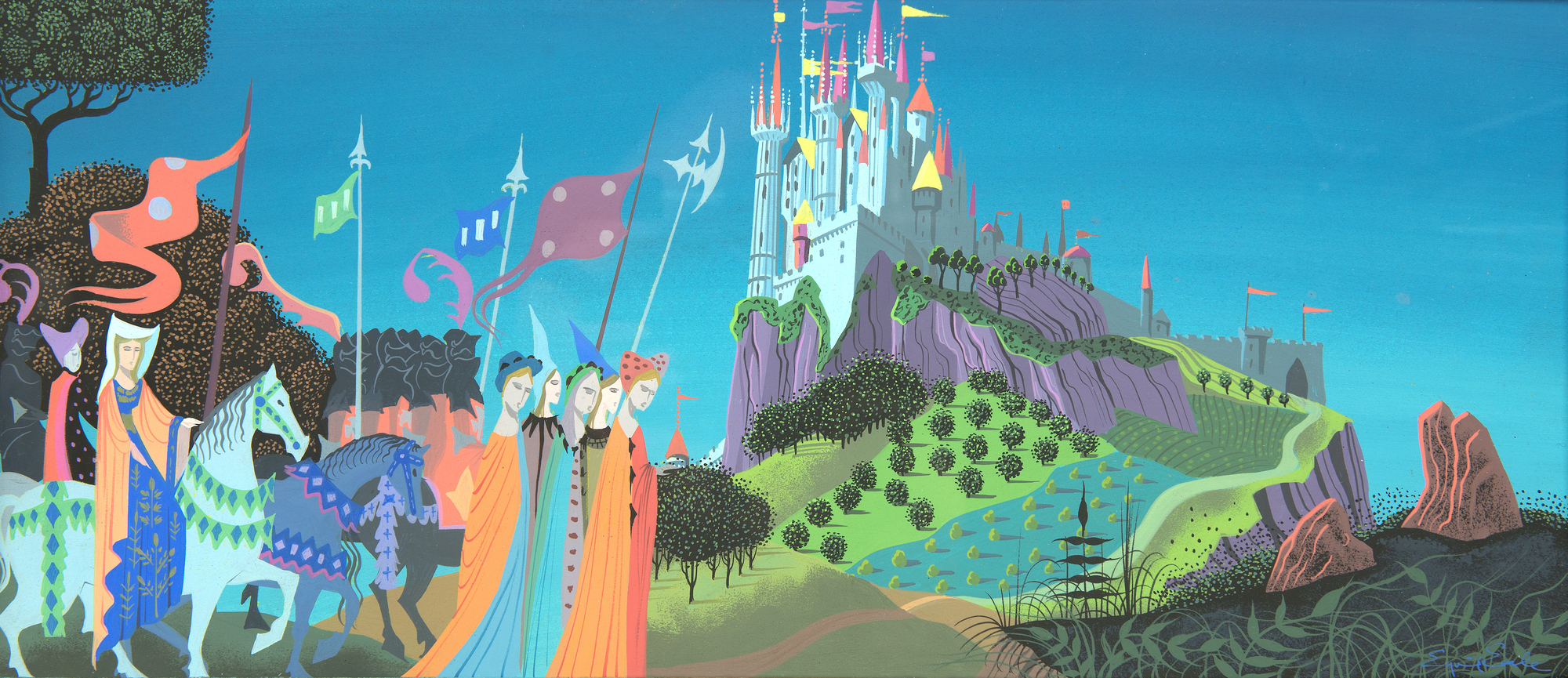
Anne Wallentine considers an exhibition that depicts how people have reimagined the medieval period in the centuries since, and how they have revealed their own interests and ideals with each new interpretation…
To explain why I am standing outside the dinner theater juggernaut Medieval Times in the name of journalism, I would have to go back to the beginning: specifically, to 500 CE, the generally agreed upon start of the Middle Ages, which is a contemporary term for a 1,000-year period (500–1500) in world history. This term is now preferred to the “Dark Ages,” which derived from the assumption that the enlightened learning of Greco-Roman antiquity was extinguished with the collapse of the Roman empire. The retroactive valorizing of past eras — reflected in our names for them — is as constant as our passage into new ones. The Getty Center’s latest exhibition, The Fantasy of the Middle Ages, explores this historical habit by depicting how people have reimagined the medieval period in the centuries since, and how they have revealed their own interests and ideals with each new interpretation…
The fantastical imagery that many of us consider “medieval” today has been invented, at least in part, in the centuries since. While some legends are rooted in the period, like the stories of King Arthur and Camelot, many others were embroidered onto an imagined, “medieval-ish” past through fantasy stories, films, and other forms of popular culture, especially from the 19th century on. Modern medieval tales have become populated with knights, dragons, witches, and fairies — though, as the show explains, only the first two were frequently depicted in the period, and anything magical or mysterious was understood through the lens of religion. The exhibition pairs medieval and later imagery to explore these shifting depictions and the powerful legacy they have left…
Read on: “What Our Fantasies About the European ‘Middle Ages‘ Say About Us,” from @awallintime in @hyperallergic.
* Barbara Tuchman, A Distant Mirror: The Calamitous 14th Century
###
As we ponder the past, we might recall that it was on this date in 1264, in the midst of the War of Saint Sabas (a Crusades-related conflict between Venice/Knights Templar and Genoa/Knights Hospitaller over land in the Kingdom of Jerusalem), that the Genoese tricked the Venetians into sailing east to the Levant, and captured an entire Venetian trade fleet in what’s known as the Battle of Saseno.
Still, the war continued until 1270, when the Peace of Cremona ended the hostilities. In 1288, Genoa finally received their land back.

“For most of history, Anonymous was a woman”*…
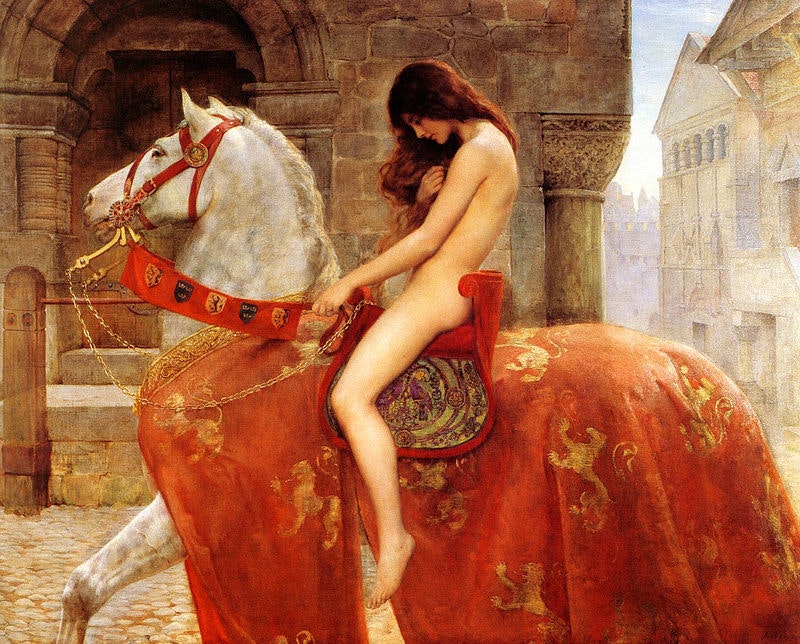
… and in the relatively few instances in which they weren’t anonymous, they were often rarefied into the stuff of legend…
Many of us are familiar with the legend of Lady Godiva, who rode through the streets of Coventry naked, covered only by her long hair, so her husband would reduce taxes. This legendary story actually originates with a real early medieval English woman. Godgifu (who flourished from c.990-1067) was the wife of Earl Leofric of Mercia, and she was a major landholder in England before the Norman Conquest.
…
As powerful members of the nobility, Leofric and Godgifu were generous benefactors. As ‘the earl’s wife’, Godgifu is associated with her husband in the endowment and rebuilding of Stow St Mary, Lincolnshire in the 1050s, which was said to have been in ruins since it was burned down by Vikings. Leofric also endowed Coventry Abbey, an act with which Godgifu was associated in later accounts. Orderic Vitalis says that Godgifu gave ‘her whole store of gold and silver’, and this is said to include a necklace which was worth 100 silver marks. The Evesham Chronicle also names Leofric and Godgifu as founders both of Coventry, but also of the church of Holy Trinity, Evesham, to which they apparently gave a crucifix with figures of the Virgin Mary and St John the Evangelist.
In the centuries after her death tales of her beauty, piety and devotion to the Virgin Mary are known, though it is not until the early thirteenth century that we see the story of Godgifu’s naked horse ride through Coventry appear in sources. Roger of Wendover in his Flores Historiarum, writes that:
The countess Godiva, who was a great lover of God’s mother, longing to free the town of Coventry from the oppression of a heavy toll, often with urgent prayers besought her husband, that from regard to Jesus Christ and his mother, he would free the town from that service, and from all other heavy burdens; when the earl sharply rebuked her for foolishly asking what was so much to his damage, and always forbade her ever more to speak to him on the subject; and while she on the other hand, with a woman’s pertinacity, never ceased to exasperate her husband on that matter, he at last made her this answer, ‘Mount your horse, and ride naked, before all the people, through the market of the town, from one end to the other, and on your return you shall have your request.’ On which Godiva replied, ‘But will you give me permission, if I am willing to do it?’ ‘I will,’ said he. Whereupon the countess, beloved of God, loosed her hair and let down her tresses, which covered the whole of her body like a veil, and then mounting her horse and attended by two knights, she rode through the market-place, without being seen, except her fair legs; and having completed the journey, she returned with gladness to her astonished husband, and obtained of him what she had asked; for earl Leofric freed the town of Coventry and its inhabitants from the aforesaid service, and confirmed what he had done by a charter.
Roger of Wendover is known for his exaggerations. This story is not corroborated by earlier sources and cannot be verified; thus historians must treat it simply as a colourful anecdote. Over the years, elements have been added to the legend, such as the fourteenth century miraculous version where Godiva is invisible, a sixteenth century modest version in ballad form, in which she requests that all the townsfolk stay indoors so as not to see her nakedness, or the late eighteenth century moralistic addition of Peeping Tom, who is struck blind after trying to glimpse her naked body.
It might seem as if the later legend of Godiva has very little to do with the real evidence we have about the eleventh-century noblewoman and landowner Godgifu. However, some links can be made between the two figures. Godiva’s lack of adornment in her nudity would have seemed shocking to a medieval audience, not necessarily because nudity was an indication of sexual promiscuity, but because nobility was indicated by outer wear, like clothing and jewellery. By removing these, Godiva was not only removing her clothes, but also her status. Her nudity in this story does not function as a moral failure, but the converse, as an act of piety, in which she lowers herself in order to help those less fortunate, and her hair covers her ‘like a veil’ to protect her modesty. This piety is also present in the act of the real Godgifu giving away her precious necklace, an important symbol of status for elite women, to Coventry Abbey, as well as great quantities of gold and silver. Within the legend of Godiva and the real life of Godgifu there is a common thread of unadornment as a way of elite and wealthy women expressing religious piety.
“Godgifu: The Bare Truth Behind the Lady Godiva Legend,” just one of the portraits of early medieval English women published every two weeks by Florence H R Scott.
* Virginia Woolf
###
As we get to know the players, we might spare a thought for Æthelthryth (aka Etheldreda and Audrey); she died on this date in 679. An East Anglian princess, a Fenland and Northumbrian queen, and ultimately Abbess of Ely, she is an Anglo-Saxon saint. Indeed, according to Jocelyn Wogan-Browne, “more medieval vernacular lives [about Æthelthryth] were composed in England than any other native female saint”– including an account contained in the Venerable Bede‘s Ecclesiastical History of the English People.

“How does it happen that trade, which after all is nothing more than the exchange of products of various individuals and countries, rules the whole world”*…

Expandable version here
The map above is probably the most detailed map of Medieval Trade Routes in Europe, Asia and Africa in the 11th and 12th centuries you can find online. It includes major and minor locations, major and minor routes, sea routes, canals and roads.
martinjanmansson [see here] explains that:
Even before modern times the Afro-Eurasian world was already well connected. This map depicts the main trading arteries of the high middle ages, just after the decline of the Vikings and before the rise of the Mongols, the Hansa and well before the Portuguese rounded the Cape of Good Hope…
Explore the global markets of the Middle Ages at: “An Incredibly Detailed Map Of Medieval Trade Routes.”
See also Michael Frachetti’s fascinating Long Now Seminar talk, “Open Source Civilization and the Unexpected Origins of the Silk Road.”
* Karl Marx, The German Ideology
###
As we contemplate commerce, we might spare a thought for Francois-Marie Arouet, better known as Voltaire; he died on this date in 1778. The Father of the Age of Reason, he produced works in almost every literary form: plays, poems, novels, essays, and historical and scientific works– more than 2,000 books and pamphlets (and more than 20,000 letters). A social reformer, Voltaire used satire to criticize the intolerance, religious dogma, and oligopolistic privilege of his day, perhaps nowhere more sardonically than in Candide.

You must be logged in to post a comment.