Posts Tagged ‘Faulkner’
“Hollywood is a place where a man can get stabbed in the back while climbing a ladder.”*…

While William Faulkner spent most of his life in the Oxford, Mississippi area that he made famous, he did a considerable– and fascinating– stetch in Hollywood. John Meroney reports…
… It all started in 1932, when, riding on the success of his novel Sanctuary, Faulkner got word that Leland Hayward, a prominent Hollywood talent agent, had secured for him a $500-a-week contract (the equivalent of $8,500 today) to write scripts at Metro-Goldwyn-Mayer. Faulkner was a modernist, and film was still a new, exciting form of storytelling. But that wasn’t the reason Faulkner accepted. It was the money.
At the same time Faulkner received the offer from Metro, he got news that his publisher, Cape & Smith, was bankrupt. Faulkner had been planning on $4,000 ($68,000 in today’s money) from the company for Sanctuary but was informed he wouldn’t see any of it. Suddenly, he was broke. Word apparently got around Oxford. When he tried writing a check for three dollars at a sporting goods store, the owner told him, I’d rather have cash. All at once, Hollywood became attractive. Faulkner didn’t even have the money to send a wire to answer yes. Eventually MGM advanced him some cash and paid for his train ticket, and days later he arrived in Culver City.
He was so naive about the industry that he entertained hopes he would be writing for the famous movie star Mickey Mouse. But the folks at Metro informed him, No, Mickey lives at another studio out in the Valley—we want you for a Wallace Beery picture. “Who’s he?” Faulkner asked…
… Faulkner completed four story treatments in four weeks. That kind of productivity earned him a meeting with up-and-coming director Howard Hawks [see almanac entry here]. He liked Faulkner’s writing and purchased a Saturday Evening Post short story by him that he wanted Faulkner to adapt into a script for Hawks to direct. Over a “couple of quarts of whiskey,” as Hawks recalled in an interview, they clicked and found common cause. “[Faulkner] got up the next morning and started to work, and in five or six days, he had a script,” Hawks said. “It was one of the finest scripts I’ve ever read.” Hawks showed it to Metro’s head of production, Irving Thalberg, who concurred. “Go out and make it!” he ordered Hawks. The result was Today We Live, a drama starring Gary Cooper and Joan Crawford, released in 1933. William Faulkner now had a hit movie to his credit. And, more important, the beginning of what would become an ongoing professional connection with Hawks…
…Faulkner sometimes hunted with Hawks, and on one dove hunting trip recounted by the director, Hawks invited along Clark Gable, already a star. Faulkner and Hawks began discussing literature and eventually Gable asked, “Mr. Faulkner, what do you think somebody should read if he wants to read the best modern books? Who would you say are the best living writers?” Faulkner replied, “Thomas Mann, Willa Cather, John Dos Passos, Ernest Hemingway, and myself.” Gable asked, “Oh, do you write, Mr. Faulkner?” Faulkner replied, “Yeah. What do you do, Mr. Gable?”…
And so much (so very much) more: “William Faulkner’s Hollywood Odyssey” from Garden and Gun.
* William Faulkner
###
As we fathom fish out of water, we might recall that it was on this date in 1987 that the United States Postal Service issued a 22-cent postage stamp in Faulkner’s honor. Very early in his career, Faulkner had briefly served as Postmaster at the University of Mississippi, and in his letter of resignation in 1923 wrote:
As long as I live under the capitalistic system, I expect to have my life influenced by the demands of moneyed people. But I will be damned if I propose to be at the beck and call of every itinerant scoundrel who has two cents to invest in a postage stamp. This, sir, is my resignation.

“Those who can make you believe absurdities, can make you commit atrocities”…

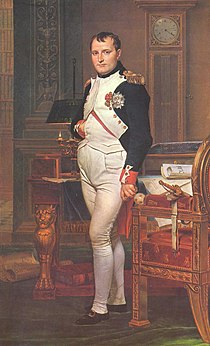
Richard Whately’s 1843 book on whether Napoleon actually existed deserves to be turned into a documentary. It is either (1) an extreme example of skepticism, or (2) satire, or (3) satire of an extreme example of skepticism, or (4) a straightforward debunking of Napoleon’s existence, or—and my preferred interpretation—(5) the first example of French deconstruction…
Faulkner argued that “The past is never dead. It’s not even past.” Ted Gioia (@tedgioia) offers a timely historical example: “Historic Doubts Relative to Napoleon Buonaparte.” Via his wonderful newsletter.
* Voltaire
###
As we contend with conspiracists, we might we might recall that it was on this date in 1804 that Napoleon Bonaparte was in fact proclaimed Emperor of France by the French Senate– at least in part an unintended consequence of Britain’s declaration of war against France (again), exactly one year before, in response to Napoleon’s “activities” in Italy and Switzerland… (Napoleon formally crowned himself “Emperor Napoleon I” on December 2, 1804 at Notre Dame de Paris.)
“I hate the word ‘gothic’ but I would like to try doing something like that”*…

OK, it makes one’s heart beat faster– but is it a gothic novel? The Guardian is here to help:
When Horace Walpole published his ‘gothic story’ The Castle of Otranto, he launched a literary movement which has sired monsters, unleashed lightning and put damsels in distress for 250 years. A horde of sub-genres has followed, from southern gothic to gothic SF, but are some novels more gothic than others? We return to the genre’s roots in the 18th century for this definitive guide…


More (and larger) helpful pictograms at “How to tell if you’re reading a gothic novel.”
* Kelly Osbourne
###
As we struggle with spinal shivers, we might recall that it was on this date in 1910, in an attempt to “conquer time,” that Quentin Compson committed suicide. While Compson was “only” a character created by William Faulkner (Quentin featured in the novels The Sound and the Fury and Absalom, Absalom! and in the short stories “That Evening Sun” and “A Justice”), his death is commemorated by a plaque affixed to the Anderson Memorial Bridge, over the Charles River, near Harvard, where Quentin was enrolled when he took his life.

“QUENTIN COMPSON Drowned in the odour of honeysuckle. 1891-1910”
You must be logged in to post a comment.