Posts Tagged ‘motion pictures’
“A horse! a horse! my kingdom for a horse!”*…

The horse transformed human history—and now, as Christina Larson reports, scientists have a clearer idea of when humans began to transform the horse…
Around 4,200 years ago, one particular lineage of horse quickly became dominant across Eurasia, suggesting that’s when humans started to spread domesticated horses around the world, according to research published [recently] in the journal Nature.
There was something special about this horse: It had a genetic mutation that changed the shape of its back, likely making it easier to ride.
“In the past, you had many different lineages of horses,” said Pablo Librado, an evolutionary biologist at the Spanish National Research Council in Barcelona and co-author of the new study. That genetic diversity was evident in ancient DNA samples the researchers analyzed from archaeological sites across Eurasia dating back to 50,000 years ago.
But their analysis of 475 ancient horse genomes showed a notable change around 4,200 years ago.
That’s when a specific lineage that first arose in what’s known as the Pontic-Caspian Steppe, a plains region that stretches from what is now northeastern Bulgaria across Ukraine and through southern Russia, began to pop up all across Eurasia and quickly replaced other lineages. Within three hundred years, the horses in Spain were similar to those in Russia.
“We saw this genetic type spreading almost everywhere in Eurasia—clearly this horse type that was local became global very fast,” said co-author Ludovic Orlando, a molecular archaeologist at the Centre for Anthropobiology and Genomics of Toulouse in France.
The researchers believe that this change was because a Bronze Age people called the Sintashta had domesticated their local horse and begun to use these animals to help them dramatically expand their territory.
Domesticating wild horses on the plains of Eurasia was a process, not a single event, scientists say.
Archaeologists have previously found evidence of people consuming horse milk in dental remains dating to around 5,500 years ago, and the earliest evidence of horse ridership dates to around 5,000 years ago. But it was the Sintashta who spread the particular horses they had domesticated across Eurasia, the new study suggests…
People had domesticated other animals several thousand years before horses—including dogs, pigs, cattle, goats and sheep. But the new research shows that the shrinking genetic diversity associated with domestication happened much faster in horses.
“Humans changed the horse genome stunningly quickly, perhaps because we already had experience dealing with animals,” said Laurent Frantz, who studies the genetics of ancient creatures at the Ludwig Maximilian University of Munich and was not involved in the study.
“It shows the special place of horses in human societies.”…
“Scientists have traced the origin of the modern horse to a lineage that emerged 4,200 years ago,” from @larsonchristina in @physorg_com.
* Shakespeare, Richard III
###
As we mount up, we might recall that it was on this date in 1878 that Eadweard Muybridge took a series of photographs to prove that all four feet of a horse leave the ground when it runs. He had been retained by former California Governor (and university founder) Leland Stanford to help settle a bet. While Muybridge was best known in his own day for his large photographs of Yosemite Valley, he did seminal early work on motion picture projection, and the approaches he developed for the study of motion are at the heart of both animation and computer analysis today.

“Take this job and shove it”*…

Chauncey Hare hated his job, so he captured the drudgery of office life in order to protest it…
Photography started as a hobby for Chauncey Hare. For 27 years, he worked as a chemical engineer at the Standard Oil Company of California, using his camera to escape the tedium of the office. By 1977, he couldn’t take it anymore. But before he declared himself a “corporate dropout” and committed to art full-time, Hare trained his camera on the world he hoped to leave behind…
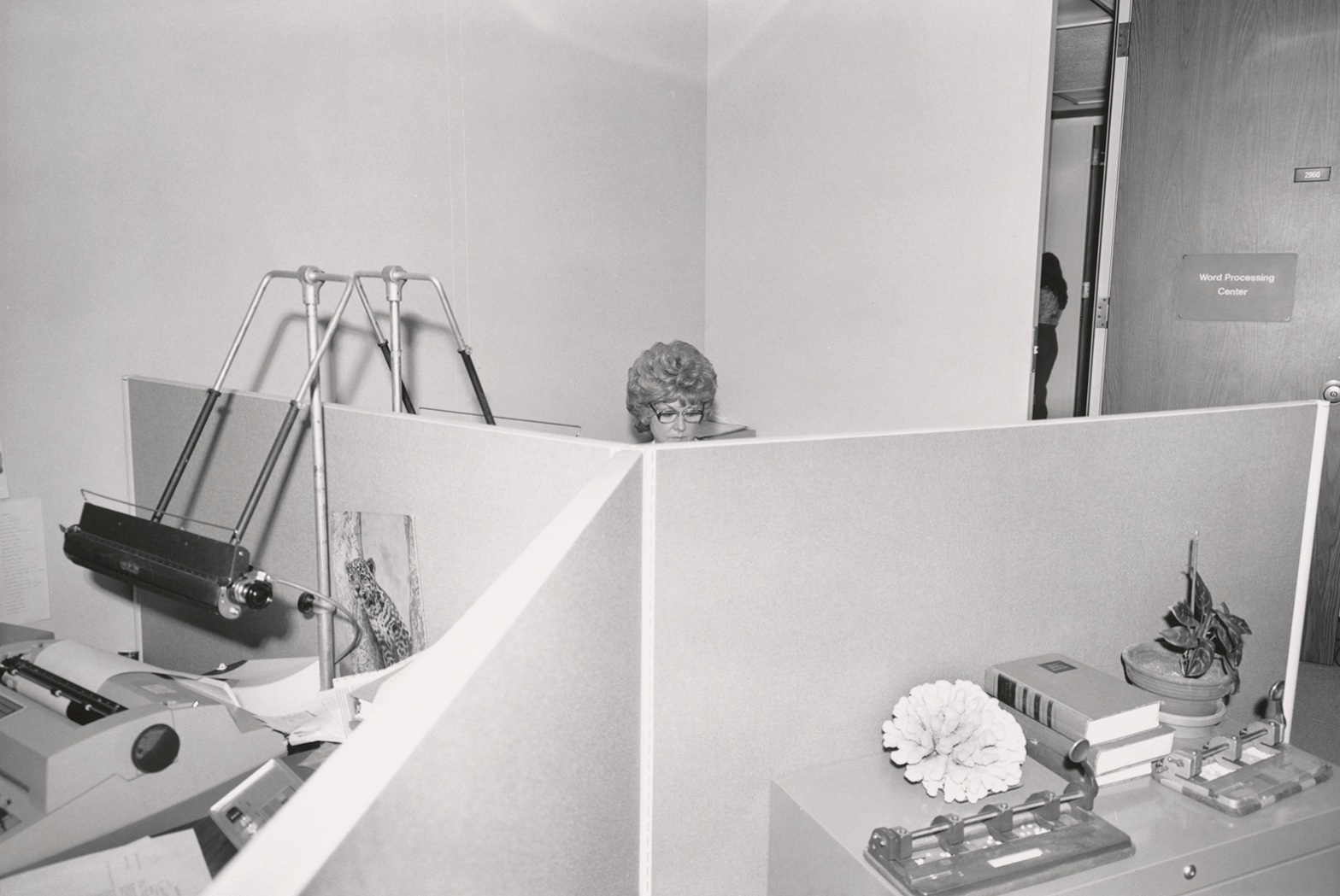
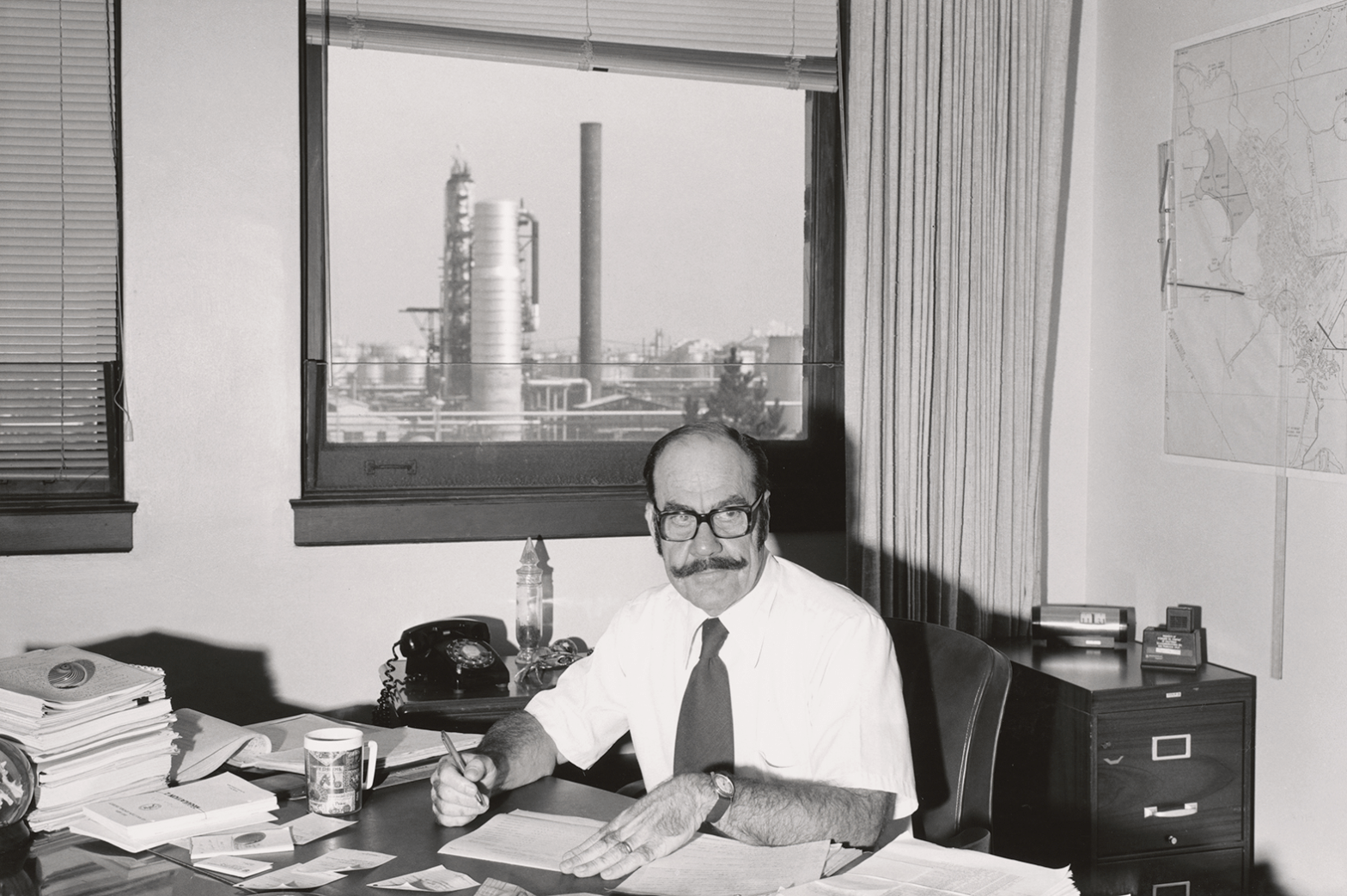
Paradoxically, the same medium that once served as a respite from the banality of Hare’s professional life soon came to feel oppressive in its own right. In Quitting Your Day Job, a forthcoming critical biography of Hare, the scholar Robert Slifkin connects Hare’s sly, arresting portraiture to the artist’s critiques of capitalist power structures, including the cultural institutions that embraced him. (Hare won three Guggenheim fellowships, an honor shared only by Ansel Adams and Walker Evans.) The photographer went on to disavow “official art” and accept a part-time job at the Environmental Protection Agency to support himself. A self-portrait from that time [the photo at the top]shows Hare back in an office environment, where a poster hanging on a cubicle wall poses a question that its surroundings implicitly answer: What’s bugging you? By 1985, Hare had given up photography altogether and become a therapist specializing in “work abuse.”…
More of Hare’s remarkable work, and of his equally-remarkable story, at “Under the Fluorescent Lights,” by Hannah Giorgis. See also “These Photographs Were Made in Protest.”
* songwriter David Allan Coe (made famous in a recording by Johnny Paycheck)
###
As we gag at our gigs, we might recall that it was on this date in 1911 that the first motion picture “stunt man” was hired, when Lt. Henry “Hap” Arnold, a pioneer military pilot, was brought onto director William J. Humphrey‘s production of The Military Air-Scout to do stunt flying for the film; the two-reeler was released the following December.
Lt. Arnold went on to become an Army General (head of the Army Air Corps) and then the commanding general of the U.S. Air Force; he remains the only person every to hold a five-star rank in two different U.S. military services. On retirement, he helped found both Project RAND, which evolved into one of the world’s largest non-profit global policy think tanks, the RAND Corporation, and Pan American World Airways.

“I wonder if computers ever dream of humans”*…

How old are the fields of robotics and artificial intelligence? Many might trace their origins to the mid-twentieth century, and the work of people such as Alan Turing, who wrote about the possibility of machine intelligence in the ‘40s and ‘50s, or the MIT engineer Norbert Wiener, a founder of cybernetics. But these fields have prehistories — traditions of machines that imitate living and intelligent processes — stretching back centuries and, depending how you count, even millennia…
Defecating ducks [see here], talking busts, and mechanized Christs — Jessica Riskin on the wonderful history of automata, machines built to mimic the processes of intelligent life: “Frolicsome Engines: The Long Prehistory of Artificial Intelligence.”
* David Mitchell, Ghostwritten
###
As we take the Turing Test, we might spare a thought for Eadweard Muybridge; he died on this date in 1904. Best remembered now for his pioneering work in photographic studies of motion (created for former California Governor Leland Stanford to help settle a bet), and early work in motion-picture projection, he was famous in his own day for his large photographs of Yosemite Valley. The approaches he developed for the study of motion are at the heart of both animation and computer analysis today.


“New technology is common, new thinking is rare”*…

If one peeks back to the earliest days of television, one discovers that much of the excitement over the nascent new medium was over its promise for education. In fact, that enthusiasm was an echo; years earlier, Thomas Edison had harbored similar dreams for the new medium he helped create: motion pictures…
They say they are spending a million dollars nowadays to make just one big picture. If I had been told in the days of our first movie studio that anybody would spend a million dollars to produce a single film, I don’t know whether I would have swallowed it or not. It would have been some effort.
It may seem curious, but the money end of the movies never hit me the hardest. The feature that did appeal to me about the whole thing was the educational possibilities I thought I could see. I had some glowing dreams about what the camera could be made to do and ought to do in teaching the world things it needed to know—teaching it in a more vivid, direct way.
I figured that after the novelty wore off, the camera would either be taken up by the big educators and pushed as a new agency in the schools—or that it would be developed mostly along straight amusement lines for entertainment and commercial purposes. I guess up to date the entertainment and commercial purposes have won.
A good many people seemed to wonder why I did so—maybe they still wonder. But the answer is simple enough. I was an inventor—an experimenter. I wasn’t a theatrical producer. And I had no ambitions to become one.
If, on the other hand, the educational uses of the camera had come more to the front, as I had hoped, and I had seen an opportunity to develop some new ideas along those lines, my story as a producer might have been very different. I should have been far more interested in going on.
Do you know that one of my first thoughts for the motion-picture camera was to combine it with the phonograph? In fact, that was what primarily interested me in motion pictures— the hope of developing something that would do for the eye what the phonograph did for the ear.
My plan was to synchronize the camera and the phonograph so as to record sounds when the pictures were made, and reproduce the two in harmony. As a matter of fact, we did a lot of work along this line, and my talking pictures were shown in many theaters in the United States and foreign countries. I even worked on the possibility of an entire performance of grand opera, for example, being given in this way.
Another thought I had was that such a dual arrangement might record both the lives and the voices of the great men and women of the world. Can you realize the tremendous impetus this would be to the study of history and economics?
They are producing pictures of this kind now, I understand, by photographing and reproducing the sound waves. We were working, of course, from an entirely different angle—but we had the first of the so-called talking pictures in our laboratory thirty years ago.
We might have developed them into a greater commercial circulation if we had kept on—but I was interested in the educational and not the entertainment field. When the educators failed to respond I lost interest. What I had in mind was a bit ahead of the times, maybe. The world wasn’t ready for the kind of education I had pictured.
Maybe I’m wrong, but I should say that in ten years textbooks as the principal medium of teaching will be as obsolete as the horse and carriage are now. I believe that in the next ten years visual education—the imparting of exact information through the motion-picture camera—will be a matter of course in all of our schools. The printed lesson will be largely supplemental—not paramount.
From The Diary and Sundry Observations of Thomas Alva Edison. Edited by Dagobert D. Runes. New York: Philosophical Library, 1948; via Lapham’s Quaterly.
###
As we dim the lights, we might recall that it was on this date in 1897 that Edison received a U.S. patent (No.589,168) for his kinetoscope camera, a device for producing moving pictures. In fact Edison had developed the camera and a viewer earlier, demonstrating “motion pictures” in 1893. But his earlier attempts to patent the technology were successfully challenged; this was the version that prevailed. Uncharacteristically for Edison (who scored– and energetically protected– 1,093 patents in the U.S. and 2,332 globally), he did not pursue international protection on this invention, which surely hastened its development.

“Fred Ott’s Sneeze”- one of the earlier films shot with the Kinetoscope camera, and the first film to be granted a copyright
Shadows on the wall of a cave…

Detail
2000 films. 20 genres. 100 years… The History of Film.
Created by Larry Gormley, the timeline…
…chronicles the history of feature films from the origins in the 1910s until the present day. More than 2000 of the most important feature-length films are mapped into 20 genres spanning 100 years. Films selected to be included have: won important awards such as the best picture Academy Award; achieved critical acclaim according to recognized film critics; are considered to be key genre films by experts; and/or attained box office success.
It is resolutely seen through the eyes of a U.S. cinema-goer (so misses many European, Latin American, and Asian candidates); but still, much fun!
 click here for zoomable version
Special exuberant extra:
###
As we shake a little extra salt onto our popcorn, we might recall that it was on this date in 1968 that the Motion Picture Association of America’s film-rating system was introduced. On the heels of the release of films like The Pawnbroker, Blow-Up, and Who’s Afraid of Virginia Woolf?, MPAA President Jack Valenti was under pressure from studios and exhibitors alike to find a replacement for The Hayes Code, which had been in effect since the early 30s. The result was the G- PG- R-X rating system that lasted until 1990, when X was replaced by NC-17.
For a peek behind the curtain at how this self-regulatory system does (and doesn’t) work, readers can screen Kirby Dick’s doc, This Film is Not Yet Rated.

You must be logged in to post a comment.