Posts Tagged ‘RNA’
“Judge me by my size, do you?”*…
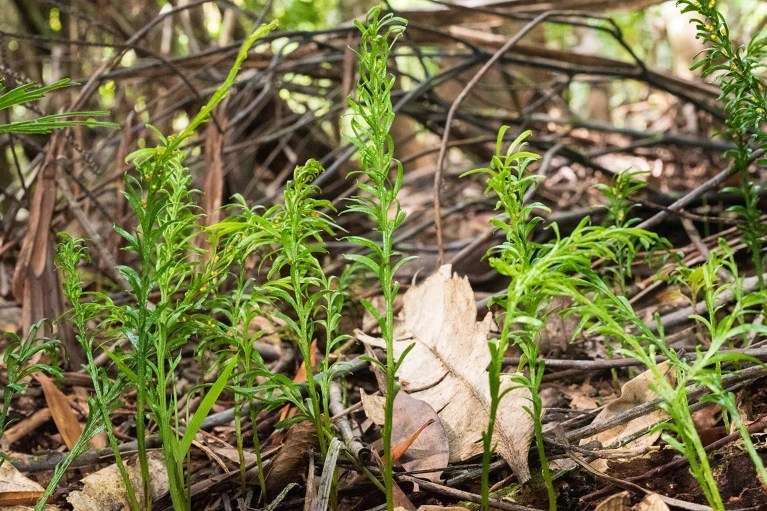
A tiny variety of the fork fern seems altogether unremarkable– but has a genome that dwarfs the human genome in size. Max Kozlov explains what that might teach us…
A small, unassuming fern-like plant has something massive lurking within: the largest genome ever discovered, outstripping the human genome by more than 50 times.
The plant (Tmesipteris oblanceolata) contains a whopping 160 billion base pairs, the units that make up a strand of DNA. That’s 11 billion more than the previous record holder, the flowering plant Paris japonica, and 30 billion more than the marbled lungfish (Protopterus aethiopicus), which has the largest animal genome. The findings were published [on May 31] in iScience…
The world’s genomic champion, which is native to New Caledonia and neighbouring archipelagos in the South Pacific, is a species of plant called a fork fern. Its colossal number of base pairs raises questions as to how the plant manages its genetic material. Only a small proportion of DNA is made of protein-coding genes, leading study co-author Ilia Leitch, an evolutionary biologist at London’s Royal Botanic Gardens, Kew, to wonder how the plant’s cellular machinery accesses those bits of the genome “amongst this huge morass of DNA. It’s like trying to find a few books with the instructions for how to survive in a library of millions of books — it’s just ridiculous.”
There’s also the question of how and why an organism evolved to have so many base pairs. Generally, having more base pairs leads to higher demand for the minerals that comprise DNA and for energy to duplicate the genome with every cell division, Leitch says. But if the organism lives in a relatively stable environment with little competition, a gargantuan genome might not come with a high cost, she adds.
That could help to provide an explanation — although a rather boring one — for the fork fern’s large genome: it might be neither detrimental nor particularly helpful for the plant’s ability to survive and reproduce, so the fork fern has gone on accumulating base pairs over time, says Julie Blommaert, a genomicist at the New Zealand Institute for Plant and Food Research in Nelson.
For now, researchers can only speculate on answers to these questions. The largest genome to be sequenced and assembled belongs to the European mistletoe (Viscum album), with about 90 billion base pairs. Modern techniques might not be sufficient to do the same for the fork fern’s genome: even if it’s sequenced, there’s still the computational challenge of taking the data and “sticking them together in a way that biologically reflects what’s going on”, Leitch says.
Finding ways to analyse enormous genomes could yield crucial insights into how genome size influences where organisms can grow, how they are able to flourish in their environments and their resilience to climate change, independent of their specific DNA sequence, she adds. Pellicer says it’s remarkable that a tiny, non-flowering plant that most people “wouldn’t bother to stop and look at” could offer such important lessons. “The beauty of the plant is inside.”
“Biggest genome ever found belongs to this odd little plant,” from @maxdkozlov in @Nature.
* Yoda, “The Empire Strikes Back”
###
As we rescope scale, we might send insightful birthday greetings to Phillip Allen Sharp; he was born on this date in 1944. A geneticist and molecular biologist, he co-discovered RNA splicing— for which he shared the 1993 Nobel Prize in Physiology or Medicine (with Richard J. Roberts). His work has spurred new research in evolutionary biology, and has contributed to the development of both treatments and vaccines for infectious diseases, cancer and other ailments.

“History repeats itself, in part because the genome repeats itself. And the genome repeats itself, in part because history does.”*…

The original Human Genome Project map of the human genome was largely based on the DNA of one mixed-race man from Buffalo, with inputs from a few dozen other individuals, mostly of European descent. Now, researchers have released draft results from an ongoing effort to capture the entirety of human genetic variation…
More than 20 years after the first draft genome from the landmark Human Genome Project was released, researchers have published a draft human ‘pangenome’ — a snapshot of what is poised to become a new reference for genetic research that captures more of human diversity than has been previously available. Geneticists have welcomed the milestone, while also highlighting key ethical considerations surrounding the effort to make genome research more inclusive…
The draft genome, published in Nature on 10 May, was produced by the Human Pangenome Reference Consortium. Launched in 2019, the international project aims to map the entirety of human genetic variation, to create a comprehensive reference against which geneticists will be able to compare other sequences. Such a reference would aid studies investigating potential links between genes and disease.
The draft pangenome follows the 2022 publication of the first complete sequence of the human genome, which filled gaps that had been left by the original Human Genome Project. But unlike the original draft human genome and its successor, both of which were derived mostly from the DNA of just one person, the draft pangenome represents a collection of sequences from a diverse selection of 47 people from around the globe, including individuals from Africa, the Americas, Asia and Europe…
More at “First human ‘pangenome’ aims to catalogue genetic diversity,” in @Nature.
See the paper on the Pangenome Project here; and for more background, “This new genome map tries to capture all human genetic variation.”
* Siddhartha Mukherjee, The Gene: An Intimate History
###
As we go wide on genetics, we might send microscopic birthday greetings to Christian Anfinsen; he was born on this date in 1916. A biochemist, he won the 1972 Nobel Prize for Chemistry for his research on the shape and primary structure of ribonuclease (the enzyme that hydrolyses RNA), in whihc he found that found that its shape and consequently its enzymatic power could be restored– leading him to conclude that ribonuclease must retain all of the information about its configuration within its amino acids.

“The Times They Are A-Changin’”*…

If the 20th century belonged to physics, the 21st will, many argue, belong to biology… and, as Matthew Herper argues, it’s not clear that we’re ready…
The first time I remember hearing the words “biology’s century,” it was a sales pitch.
I was standing by the Long Island Sound in Sachem’s Head, Conn., in the shadow of an 11-foot-tall granite Stonehenge replica built by Jonathan Rothberg, a biotech entrepreneur, as he talked up his newest gadget, a tabletop DNA sequencer. It was 2010.
Near his monument to the ancient past, Rothberg was conjuring a vision of the future, one based on harnessing the power of biology and technology to transform the world. The phrase he uttered wasn’t new, having been in circulation since the Human Genome Project in the 1990s, and I’d been covering biotech for a decade. But that was the moment the phrase sunk in. I added it to my Twitter bio, where it has remained.
Over the next decade, I’d see even more amazing things. Genetically altered white blood cells that can cure cancer. A gene therapy that gave sight to blind children. Pills that wrench decades of life from a cancer death sentence or ease the breathing of patients with cystic fibrosis. And, of course, not one but several effective Covid-19 vaccines created only a year into a once-in-a-century pandemic.
Here’s what “biology’s century” means to me: In the same way the 20th century belonged to physics, the 21st is biological. But while physics in the 20th century brought airplanes, personal computers, and posters of Albert Einstein, it also meant the atom bomb and a complete transformation of the social order.
Now, we’re approaching a moment when changes in what we understand about biology are every bit as exhilarating and terrifying…
Eminently worth reading in full: “Here’s why we’re not prepared for the next wave of biotech innovation,” from @matthewherper in @statnews.
* Bob Dylan
###
As we get wet, we might send healing birthday greetings to Thomas Cech; he was born on this date in 1947. A chemist, he is best known for his discovery, with Sidney Altman, of the catalytic properties of RNA– for which they were awarded the 1989 Nobel Prize in Chemistry. Cech discovered that RNA could itself cut strands of RNA, suggesting that life might have started as RNA– and paving the way for the development of mRNA vaccines like the ones that have stemmed the tide of COVID.
Cech also studied telomeres; his lab discovered an enzyme, TERT (telomerase reverse transcriptase), which is part of the process of restoring telomeres after they are shortened during cell division. (a process central to aging).
From 2000-2008, Cech served as president of the Howard Hughes Medical Institute, one of the largest private funding organizations for biological and medical research in the United States.

Emergent-cy…

Scripps Research Institute biologist Gerald Joyce (pictured above) and his colleague Tracey Lincoln have built an “immortal molecule.” They have synthesized RNA enzymes – ribonucleic acid enzymes also known as ribozymes – that replicate themselves without the help of any proteins or other cellular components. And since these simple nucleic acids can act as catalysts, the process can continue indefinitely.
As Cosmos reports,
The ultimate goal is to create genetic systems that behave like life, and are for all intents “life” as we know it, but arose without using biological systems.
“The aim is to create systems that have inventive capabilities, that can develop novel solutions to challenges posed by the environment. But that we don’t have yet,” [Joyce] said.
“What we do have is a self-sustained chemical system that undergoes Darwinian evolution. They are synthetic genetic systems, and they are evolving. But they’re not living because they don’t yet show the capacity to invent a whole cloth of functions. The idea is to give them enough information wherewithal [genetic building blocks] so they can start inventing their own solutions rather than just optimizing existing solutions,” he added.
Joyce said it was not practical to synthesize the more complex DNA-based life we know from scratch; it’s too complex and probably beyond today’s science. But it is conceivable to start with a much more basic form of life-like molecules based on RNA, and use evolution to build on them.
Many scientists believe that early life was based on RNA and predated the arrival of life based on deoxyribonucleic acid (DNA) and proteins. RNA, which can both store information like DNA as well as act as an enzyme like proteins, may have supported pre-cellular life.
A leading proponent of this so-called “RNA world” hypothesis, Joyce believes that RNA-based catalysis and information storage may have been the first step in the evolution of cellular life.
Read the whole story here.
As we search our closets for those chemistry sets, we might celebrate the emergence of a technology that took on a life of its own and changed… well, everything: this date in 1455 is the traditionally-given date of the publication of the Gutenberg Bible, the first Western book printed from movable type. The Jikji— the world’s oldest known extant movable metal type printed book– was published in Korea in 1377. Bi Sheng created the first known moveable type– out of wood– in China in 1040.

You must be logged in to post a comment.