Posts Tagged ‘Elvis’
“Las Vegas: a savage journey to the heart of the American dream”*…

Isaac Ariail Reed muses on Las Vegas and what it can tell us about ourselves…
It comes buzzing into my mind like a hazy half dream, the kind that arrives when you’ve had too much espresso and need to close your eyes in the dark of your hotel room for a moment. I’m in two places at once: One is the Neon Museum in Las Vegas, where I am wandering around the sandy two-acre lot amid the retired signs of dynamited casinos, hotels, and other businesses on the Strip, listening to old Elvis live shows on my headphones; the other is the recently opened poker room in the Venetian Casino, where I find myself sitting next to Walter Benjamin, the German Jewish intellectual who once saw, with a clarity that remains difficult to reckon with today, the end of an epoch.
As Benjamin wrote in 1928, in his sprawling and unfinished magnum opus The Arcades Project, “if, sometime in the mid-nineties, we had asked for a prediction, surely it would have been: the decline of a culture.” He meant the 1890s, the European fin-de-siècle and the coming descent into fascism, but I could say the same thing about the 1990s today. Benjamin was writing about the arcades, those iron-and-glass canopied commercial passageways that he took as emblematic of Paris when it was the epicenter of the glory and fragility of nineteenth-century bourgeois culture. What Benjamin saw in the persistence of the remaining arcades in early-twentieth-century Paris (after the urban-renewal efforts of Baron Haussmann leveled many) is what I see in the persistently glitzy architecture and tightly time-constrained nightly shows of Las Vegas today: a culture attempting to grasp its own passing…
…
… What I did not quite realize viscerally before this year, though, is something that the great art critic Dave Hickey was always on about. Las Vegas, despite its similarities to Macau, is in its history, culture, and politics deeply American. Hence, de Tocqueville: “Those who live in the midst of democratic fluctuations have always before their eyes the image of chance; and they end by liking all undertakings in which chance plays a part.” In Hickey’s 1997 classic, Air Guitar, he wrote, “America…is a very poor lens through which to view Las Vegas, while Las Vegas is a wonderful lens through which to view America.” He continued:
What is hidden elsewhere exists here in quotidian visibility. So when you fly out of Las Vegas to, say, Milwaukee, the absences imposed by repression are like holes in your vision. They become breathtakingly perceptible, and, as a consequence, there is no better place than Las Vegas for a traveler to feel at home. The town has a quick, feral glamour that is hard to localize—and it arises, I think, out of the suppression of social differences rather than their exacerbation. The whole city floats on a sleek frisson of anxiety and promise that those of us addicted to such distraction must otherwise induce by motion or medication.
Hickey was luminously perspicacious in his ability to recognize, amid the vast and disturbing inequalities of Las Vegas, the horizontality of its cultural politics, which are not so much lowbrow as they are open to weirdness and conformity in equal measure such that the sheer humanity of the equally but differently weird (or conformist) is suddenly public and undeniable. Hickey also argued that there was something about the American experiment wrapped up in his “home in the neon.” The secret of Vegas is that there are no secrets, he explained, and, furthermore, “there are only two rules: (1) Post the odds, and (2) Treat everybody the same. Just as one might in a democracy (What a concept!)” Hickey thus found in Liberace’s rhinestones the key to a democratic politics of honest fakery as a defense against the subtle tyranny—recently become much less subtle—of a politics of authenticity and its handmaiden, the deep hatred of art, freedom, and changing your mind dressed up as love of family, morality, nation, and the supposed liberty of guns and tariffs. The emphasis, for Hickey, is on the honest and the different human commmunities of desire that are the root of pluralism in aesthetics: Liberace’s rhinestones is not a real diamond, but union wages, sexual freedom, and aesthetic ambition are honestly held commitments. In Hickey’s version of Las Vegas, no one asks who is a “real” American, because the reality of the USA is not something that has to be performed into existence by duplicitous electoral promises and unpaid contractors; it’s right there in the posted gambling odds, the midnight steak and eggs, and the civilizational ambition of the Hoover Dam.
This, then, is the problem we have inherited from Hickey: Can the bare and brutal honest fakery of Las Vegas, and the deeply American, weirdly libertarian, outsider-art-loving union democracy that Hickey found inside that honest fakery sustain itself as part of a free society? Or will the crushing inequality, insane techno-oligarchy, and battling moralisms of toxic masculinity and therapeutic bureaucracy be, in the end, too much for Vegas and thus too much for the United States as well?…
…
… There was in Hickey’s writing a deep suspicion of both the aesthetics and the politics of authenticity, and that suspicion, one might hazard, is the connection between Las Vegas and the kernel of freedom held in common that has, on occasion, here and there, made itself present in American life, and which has sustained American intellectuals as distinct as John Dewey and Joan Didion. What, then, does Las Vegas do for us when it reminds us that libido is a fact of life and building a culture on its suppression is a little like taking a political stand against gravity? Here I found my way to a different kind of theorizing, once I realized that far from any simulacrum, Las Vegas is in fact the place where American modernity articulates the eternal problems of being human.
On the one hand, Las Vegas is the culmination of the historically specific phenomenon of the American modern, bringing together the technological sublime, movable capital, representative democracy, and libertarian culture in the first postindustrial metropolis. Yet on the other hand, Vegas is about the inescapable aspects of human existence from time immemorial: desire as multiple, the importance of creature comforts to a sense of well-being, the philosophy of uncertainty and the problem of fate, embodiment as both wonderful and unbearable, and the irrepressible need to create new art and build new buildings. In this regard, we can say that Vegas is the place where the American project’s complex and conflictual relationship to the more immovable aspects of human life together was thrown into stark relief.
And then there are the binaries. In Vegas, it becomes quite clear that the towering economic power that drives American politics has, in the end, cultural sources and cultural consequences. The USA is about sin and salvation, filth and cleanliness, God and the Devil, believer and atheist, winners and losers. All societies have such binaries. The sociologist Émile Durkheim mapped them all as versions of sacred versus profane, while the anthropologist Claude Lévi-Strauss used them to read stories as clues to the structure of the mind itself. But in the United States, with its Calvinist inheritance and infamously strict racial hierarchy, the binaries have a special importance. They have always resisted middle grounds and gray areas, preferring the intense clash of purified poles to ambiguous endings and existential despair. This is why American movies are melodramatic to the point of absurdity and why the harshness of the American moral climate, when combined with the filth of American politics, created a political culture that can be unbearably self-righteous. Vegas puts on display the harsh feel and gleaming strangeness, bordering on surreality, of the American binaries, but it also breaks them down, which is the deep effect of its honest fakery. Vegas is not there to make you feel your job back home is unavoidable. It is there to make you ask whether the difference between good and evil is really what your pastor says it is.
For a long time, it sure looked as though Hickey was right to find a home in Las Vegas, and to find his version of America there too, because of the way Vegas both displayed the binaries and embraced the gray areas in between. It happens in two steps. First, the town cuts through pretense. One night in Vegas will remind you that in America, the most famous cultural critic in the world, past or present, is about as important as the current special-teams coach of the Pittsburgh Steelers (and probably less). Second, it liberates you from the defensiveness that constantly infects the American intellectual trying to justify his existence. Why? Because Vegas is an intellectual’s paradise in so far as it is the place that knows, better than anywhere else in the United States, that we are all creatures addicted to symbols, entranced by our illusions, and in need of a lucky roll. In Vegas, as Dean Martin and Katy Perry have both attested, the desirous body, the strategic mind, and the neon sign are bound together in a cosmic swirl, and the result is the Frankenstein’s monster of American modernity. What could be more intellectual than that?
Back when American modernity was more than the latest tweet from the Department of Homeland Security, its intellectuals navigated the harsh binaries of American culture via innovation in thinking and generosity of spirit, making some kind of room, some of the time, for the next immigrant culture to arrive and do the two most American things of all: make a buck and do whatever you want with religion and culture. This is the spirit we have lost; we increasingly just want to double down on the same binaries that every other preacher in this godforsaken land does, calling endlessly for the return of the cultural artifacts of an earlier era. But the two great philosophies of culture to emerge in America—pragmatism and jazz—are, among many other things, attempts to solve the problem of the excluded middle between the purest Good and the worst Evil, and to find in the very confrontation of contradiction an improvised way for humans to live together a little better tomorrow than they did yesterday. This is the American promise: that beyond the binaries lies not transcendent meaning or nihilism but a little bit of democracy, a little bit of freedom, and a whole lot of practicality.
But navigating the binaries to subvert and reinvent them takes energy, and it is that energy one still finds in Las Vegas. Even if in enervated form, it is there, and this is the part of the city—the Strip, yes, but also the Arts District and downtown—that some foreign visitors grasp intuitively and immediately and others will never, ever understand: Vegas as the intensity of American hustle. On that winter-vacation visit, I was set straight about it by my bartender. I had just had a quite unpleasant interaction at the craps table with an overstimulated and sleep-deficient fellow in town for the rodeo. His truculent attitude had turned very dark, even threatening, in response to my friendly overtures. I was getting ready to bitch about it to the young man from Los Angeles who had just served my whiskey and had all the signs of being a safe political harbor. He cut me off right away: “Shit, I’m glad they’re here. Otherwise, we’d have no money to make these two weeks in December.”
There, in that moment, I saw the tiniest glimpse of possibility for a new, but nonetheless recognizable, American culture, and I realized everything I was, in my academic bubble, missing. Vegas is much cheaper to live in than LA; for the first time in its history all major casinos on the Strip are unionized; my bartender, like me and the poker pros, was hustling most weeks of the year but was also going to take a real vacation with his girlfriend; I might be able to write and teach, but who cares about my opinions on the cultural politics of the rodeo? And that’s the deal that Las Vegas has offered: Make the wages fair and the housing affordable, post the damn odds, and let people make their own judgments about what kind of clothes, art, sex, and sports they want. That’s the project, if we want our country back in a new and better form. But the artists in Vegas are here to tell you: The odds are very long…
What does it mean to “think Las Vegas”? “Mourning and Melancholia in Las Vegas,” from @hedgehogreview.bsky.social. Eminently worth reading in full.
Pair with “Lost Vegas,” from @lukewinkie.bsky.social in @slate.com: “Everyone inside America’s most flailing destination city has a theory for what’s wrong. Now I have my own.”
* Hunter S. Thompson
###
As we check the odds, we might recall that it was on this date in 1997 that Las Vegas strip fixture The Aladdin hotel and casino closed. The site of Elvis and Priscilla Presley’s wedding in 1967, its final show was a preformance by Mötley Crüe.
The building was demolished the following March (in front of 20,000 spectators, 1,000 of whom paid $250 each to watch the implosion from inside a “ringside” tent). In 2000 a new Aladdin resort, three times larger than the original, opened on the site, but quickly went broke. It was purchased out of bankruptcy to become “The Planet Hollywood Resort and Casino.”

“People haven’t always been there for me but music always has”*…

Well, they’re there now– and of all ages…
Taylor Swift made headlines throughout 2023 thanks to her super successful Eras Tour and her relationship with a certain football player, which launched her already-sky-high popularity into the stratosphere. Now, there’s additional evidence of her global dominance, even among the 2- to 8-year-old set: The Little Golden Book about the pop star sold more than 1 million copies in its first seven months.
This makes the title Taylor Swift: A Little Golden Book Biography the fastest-selling title in Little Golden Book history…
NPD BookScan told The Washington Post that a typical Little Golden Book biography sells 5,000-6,000 copies in its first four weeks, and some become more popular over time. The Taylor Swift book sold 167,872 copies during that same time frame and sales appear to have been boosted by adults, the Wall Street Journal reports…
Laying the foundation for a lasting legacy? “The Taylor Swift Little Golden Book becomes the series’ biggest seller,” from @Simplemostsite.
Apposite? here and here (via the always-illuminating Today in Tabs)
* Taylor Swift
###
As we ponder pop phenomena, we might note that, per the Luminate report issued today, Swift officially surpassed Elvis Presley’s longstanding Billboard 200 album chart record as the solo artist with the most weeks atop the chart. She set a new mark of 68 total weeks, as 1989 (Taylor’s Version) landed atop the chart for a fifth time in the final full tracking week of 2023.
That said, in order to surpass the all-time record, she has a long way to go – that crown is currently held by The Beatles, who maintain a significant lead with an impressive 132 weeks at the top of the chart.

“Television is now so desperately hungry for material that they’re scraping the top of the barrel”*…

The television industry, in its new streaming-led form, is in turmoil. The companies that control it are slashing their available libraries and “reorganizing” their operations, leading to layoffs throughout the industry, and writers are on strike. To some extent, these are consequences of the years of deficit-funded efforts to grab subscribers coming home to roost. But as Max Read argues, there is a deeper problem: the people making our entertainment don’t like it…
… [David] Zaslav is this cycle’s big Hollywood villain, most famous for burying completed but unreleased movies for tax write-offs and removing shows from their streaming platforms to save money. When “Max,” the new streaming service that combined all of WBD’s streaming apps into a single offering, was released in May, its interface credited directors and producers together under the hilariously dismissive heading “Creators,” which was both a blatant violation of bargaining agreements around credits and an on-the-nose suggestion that the WBD people simply couldn’t be bothered to care what a “director” is or what one does.
But he is hardly the only person in Hollywood who seems to have more contempt than love for what the industry does. This excellent Vulture piece about the state of streaming by Lane Brown and Joseph Adalian has been rattling around in my head all week, specifically this quote:
One high-level agent says that studios regard the WGA’s demands — for higher minimum pay and staffing requirements, among other things — as simply incompatible with the way TV is now made: “The Writers Guild, delusionally, is harkening back to a day when there were 25 episodes of Nash Bridges a year and repeats and residuals. Back-end payments existed because Europeans were willing to watch our garbage, and Americans were willing to watch repeats of that garbage on cable at 11 at night. The real issue is that the medium changed. Instead of getting a job as a staff writer on CSI: Miami for 46 weeks a year, now it’s a 25-week job working on Wednesday, which is a better show. That’s just progress.”
This begins as a relatively lucid description of why back-end payments existed and then becomes a bizarre fantasy in which, for some strange reason, writers are now obligated to trade stable and remunerative employment for a vague sense of creative fulfillment and prestige, and this trade is called “progress.”…
I don’t meant to make one agent’s offhand quotes to Vulture emblematic of an entire industry, and I know there are many people in Hollywood who would disagree. But the contempt on display for (1) the product being produced, (2) the people who make that product, and (3) the people who consume that product is, I think, widely shared–look at Zaslav, HBO, and TCM. That contempt is nothing new in the entertainment industry, of course. But as it grows and develops it has increasingly made the people in charge unable to distinguish between good product and bad product.
The agent here is committing the same mistake as a lot of bad critics and even more bad development executives, which is to think of “prestige” as a desirable marker of quality, instead of as a kind of genre, or, more cynically, a set of narrative and aesthetic tropes (antiheroes, serialized narratives, film-like cinematography) designed to appeal to a particular marketing demographic–one that happens to be a target demographic for subscription streaming services. As the Vulture piece goes on to point out, just because something is eight episodes long and “actually about trauma” doesn’t automatically make it good, let alone popular…
The agent describes the old residuals system like this: “Back-end payments existed because Europeans were willing to watch our garbage, and Americans were willing to watch repeats of that garbage on cable at 11 at night.” The idea is that people are no longer willing to watch “garbage,” presumably because so many more options are available to them. But this is only a satisfying answer if you assume that “garbage” is automatically bad. What if the problem is that we’re not really making much good garbage anymore?…
You don’t even have to watch the garbage to appreciate its role in the creative ecosystem. The Shield creator Shawn Ryan, who’s quoted in the story above, was a Nash Bridges writer; so too was Watchmen and The Leftovers creator Damon Lindelof. I’m not the first person to make this point, but the entire first generation of “prestige TV” in the 2000s–which is to say, 90 percent of the actually good prestige TV–was written by people who’d spent a lot of time learning to write quickly to a tight structure for a big audience, a set of skills no longer as widespread among writers, to dire consequences for audiences, who have essentially traded consistent, engaging entertainment for the convenience of on-demand streaming.
Networks used to create several Honda Civic shows a year (and, yes, a lot of lemons); these days, if I can stretch this metaphor past the breaking point, streaming platforms seem to mostly create Tesla Model 3s, which is to say expensive, technologically interesting products that gesture at luxury and quality but tend to fall apart quickly and rely almost entirely on hype and conspicuous consumption (not to mention labor exploitation!) to make themselves profitable–and then only after years of burning cash in pursuit of a business model…
Is the problem really that streamers (or writers) are too focused on “prestige” at the expense of “populist” “garbage”? Netflix, the biggest streamer of all, produces mind-boggling amounts of middlebrow and trash TV; every time I open the app there’s a new reality competition between friendship bracelet makers or whatever.
There are many, many cultural and technological reasons for the various (and often overstated) malaises of the streaming era, and there’s no one weird trick for the industry to fix itself. But it’s hard not to notice that, from a labor perspective, the big difference between the era of West Wing and Ally McBeal and now is not so much that writers and directors and actors are too pretentious for lady-lawyer shows but that back then seasons lasted for 20+ episodes, paid more people, promised more consistency (to audiences and to workers above and below the line), and underwent more development. Streamers seem happy to make middlebrow TV; but they also seem unable or unwilling to consistently make good middlebrow TV–by paying enough people, building enough institutional knowledge, committing enough resources, and marketing the product.
You hear sometimes a call from writers or directors or other creatives for studios and streamers to take more risks and get more creative. But I don’t really think the problem of bad TV in the streaming era is an issue of “creativity” (versus conservatism) or “risk” (versus safety) so much as it is an issue of professionalism (versus saying “yes” to 1,000 shows at once, under-developing them, and then killing them en masse for no clear reason). Maybe the reason writers and directors and other creatives are treating TV “like art” instead of like “a job” is because none of the people who hire them are treating it like a job either!
If you do not like movies and TV you cannot make good movies and TV: “Why do entertainment executives hate entertainment?” from @readmaxread in his ever-illuminating newsletter, Read Max. Eminently worth reading in full.
* Gore Vidal
###
As we change the channel, we might recall that it was on this date in 1977 that Elvis performed his last concert at Indianapolis’ Market Square Arena.

“There is nothing permanent except change”*…

Menudo has been ranked one of the Biggest Boy Bands of All Time by several publications (Billboard, Us Weekly, Seventeen, and Teen Vogue, among others)– the only Latin band on their lists. The Puerto Rican boy band, founded by producer Edgardo Díaz in 1977, has had 39 members– who’ve been routinely replaced as they “age out,” usually at 16. It has launched the careers of a number of popular international stars, including Ricky Martin (in Menudo 1984–89) and Draco Rosa (1984–87), and sold over 20 million albums worldwide.
The band disbanded in 2009, but re-formed on its old template in 2019. And it’s just announced its latest roster, bringing its count of members up to 44…
Nearly a year after Menudo Productions announced they were on the search for new members to form the next generation of Menudo, the band has officially unveiled the five boys that will comprise the group.
On Monday (March 20), Nicolas Calero (10), Gabriel Rossell (13), Andres Emilio (14), Alejandro Querales (15) and Ezra Gilmore (12) were announced as the new faces of the eternally youthful boy band. And, in celebration of the announcement, the group also released their very first single “Mi Amore,” the first song off their upcoming debut album…
What’s old is new again: “New Menudo Boy Band Members Unveiled,” from @billboard.
* Heraclitus
###
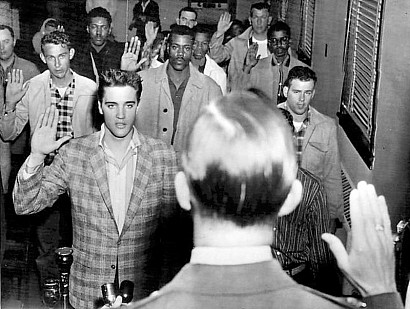
As we board the Ship of Theseus, we might recall that it was on this date in 1958, at 6.35am, that Elvis Presley reported to the Memphis draft board to be inducted in the U.S. Army. From there Elvis and twelve other recruits were taken by bus to Kennedy Veterans Memorial Hospital where the singer was assigned Army serial number 53310761.
“A man is worked upon by what he works on”*…
Further to last week’s “The most perfect political community is one in which the middle class is in control, and outnumbers both of the other classes”*…
The numbers tell one story. Unemployment in the US is the lowest it’s been in 50 years. More Americans have jobs than ever before. Wage growth keeps climbing.
People tell a different story. Long job hunts. Trouble finding work with decent pay. A lack of predictable hours.
These accounts are hard to square with the record-long economic expansion and robust labor market described in headline statistics. Put another way, when you compare the lived reality with the data and it’s clear something big is getting lost in translation. But a team of researchers thinks they may have uncovered the Rosetta Stone of the US labor market.
They recently unveiled the US Private Sector Job Quality Index (or JQI for short), a new monthly indicator that aims to track the quality of jobs instead of just the quantity. The JQI measures the ratio of what the researchers call “high-quality” versus “low-quality” jobs, based on whether the work offer more or less than the average income.
A reading of 100 means that there are equal numbers of the two groups, while anything less implies relatively lower-quality jobs. Here’s what it looks like:
So, what is this newfangled thing telling us? Right now the JQI is just shy of 81, which implies that there are 81 high-quality jobs for every 100 low-quality ones. While that’s a slight improvement from early 2012—the JQI’s 30-year nadir—it’s still way down from 2006, the eve of the housing market crash, when the economy regularly supported about 90 good jobs per 100 lousy ones.
Or, in plainer English, the US labor market is nowhere near fully recovered from the Great Recession. In fact, the long-term trend in the balance of jobs paints a more ominous picture…

Quality vs. quantity: more at “The great American labor paradox: Plentiful jobs, most of them bad.”
Resonantly, see also: “Job loss predictions over rising minimum wages haven’t come true.” The higher minimum wages in question are still below the average that separates high- and low-quality jobs; but they are a step in the direction of narrowing the gap.
* “A man is worked upon by what he works on. He may carve out his circumstances, but his circumstances will carve him out as well.” –
###
As we “Get a Job,” we might recall that it was on this date in 1956 that serendipity yielded one of the coolest collectibles ever: rockabilly legend Carl “Blue Suede Shoes” Perkins was recording at Sam Phillips’ Sun Records in Memphis; Perkin’s buddy Johnny Cash, a Sun artist and a country star by virtue of his recent hits “I Walk The Line” and “Folsom Prison Blues,” was hanging out in the booth; and soon-to-be-famous Jerry Lee Lewis was playing piano (for a $15 dollar session fee– “Whole Lotta Shakin’ Goin’ On” was set for release a few weeks later).
A couple of years earlier, Phillips had launched Elvis Presley with “It’s Alright Mama”; but in 1955, as Elvis’ career exploded, Phillips had sold his contract to RCA, and Elvis moved on. But The King was back in Memphis that fateful day; he stopped by Sun to say hello… and an impromptu jam ensued. Phillips had the presence of mind to order his engineer, Jack Clement, to roll tape– a tape that was promptly shelved, forgotten, and unheard for 20 years. The recordings of what was arguably the first “supergroup” were found in 1976 and finally released in 1981… since when, they’ve been treasured by fans– a new crop of which has emerged with the success of the Broadway musical Million Dollar Quartet.

You must be logged in to post a comment.