Posts Tagged ‘phonograph’
“‘When I use a word,’ Humpty Dumpty said in rather a scornful tone, ‘it means just what I choose it to mean — neither more nor less.'”*…
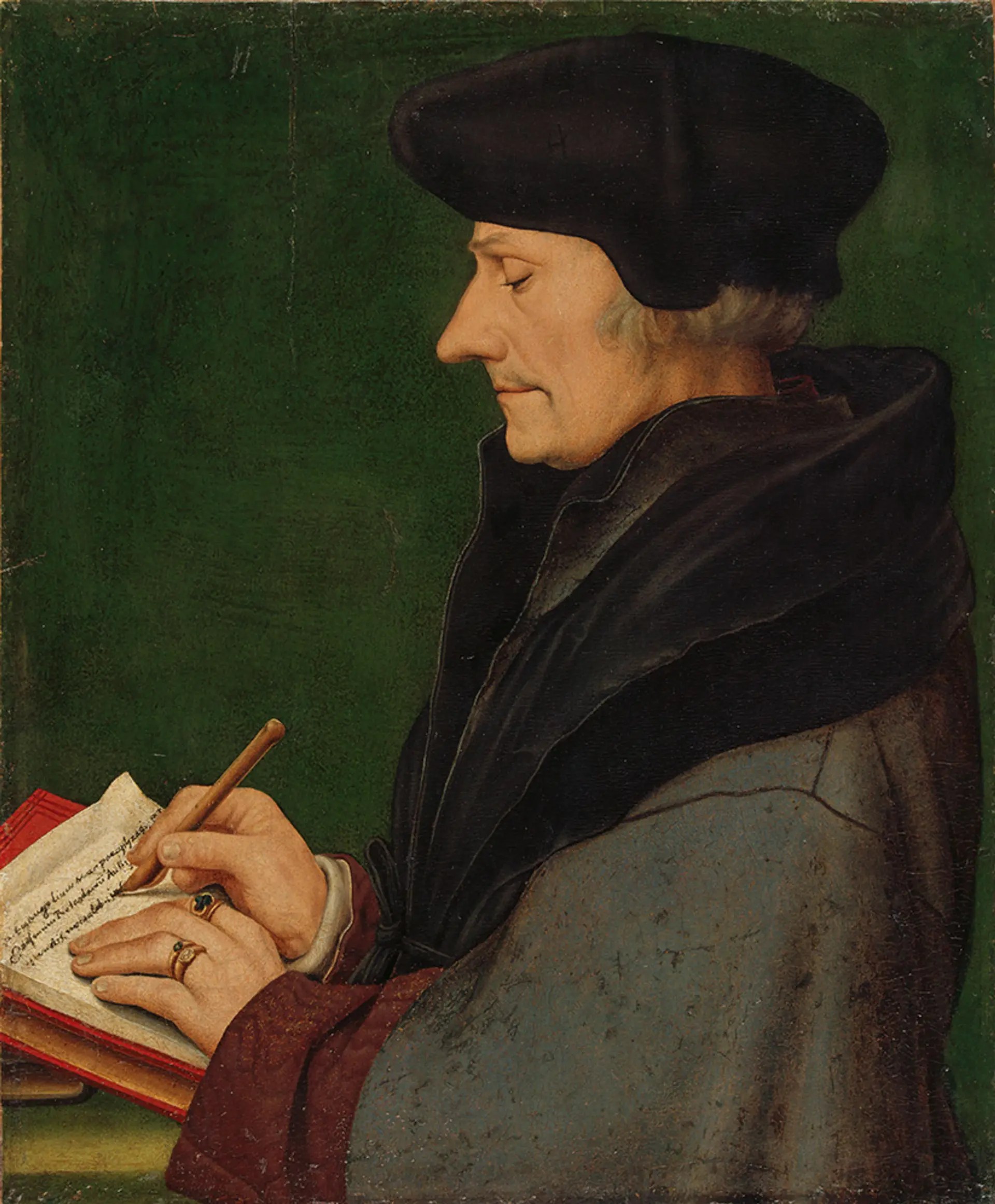
Like today’s large language models, some 16th-century humanists (like Erasmus) had techniques to automate writing. But as Hannah Katznelson explains, others (like Rabelais) called foul…
The Renaissance scholar and educator Erasmus of Rotterdam opens his polemical treatise The Ciceronian (1528) by describing the utterly dysfunctional writing process of a character named Nosoponus. The Ciceronianis structured as a dialogue, withtwo mature writers, Bulephorus and Hypologus, trying to talk Nosoponus out of his paralysing obsession with stylistic perfection. Nosoponus explains that it would take him weeks of fruitless writing and rewriting to produce a casual letter in which he asks a friend to return some borrowed books. He says that writing requires such intense concentration that he can do it only at night, when no one else is awake to distract him, and even then his perfectionism is so intense that a single sentence becomes a full night’s work. Nosoponus goes over what he’s written again and again, but remains so dissatisfied with the quality of his language that eventually he just gives up.
Nosoponus’s problem might resonate. Who has not spent too long going over the wording of a simple email, at some point or another? Today there is an easy fix: we have large language models (LLMs) to write our letters for us, helpfully proffering suggestions as to what we might say, and how we might phrase it. When I input Nosoponus’s intended request into GPT-4, it generated the following almost instantly:
Hey [Friend’s Name],
Hope you’re doing well! I just realised I never got those books back that I lent you a while ago. No rush, but whenever you get a chance, I’d love to get them back. Let me know what works for you! Thanks!
Nosoponus
But there was a solution in the 16th century, too. A humanist education on the Erasmian model could train its students to produce letters of any length, on any topic – quickly, easily and eloquently. The French humanist François Rabelais, a contemporary of Erasmus, appears to have understood these compositional techniques as automating the creating of text in a way that, retrospectively, looks a lot like how LLMs function. If we want to understand LLMs, and what they are and aren’t capable of, we can look at earlier versions of the same technology – like Erasmian humanism. We can also read authors like Rabelais, who is already thinking about automatic text-generation along these lines, as someone who appreciates the effectiveness of Erasmian generative technology, but at the same time sees it as vitiating the social force of language and, ultimately, ruining language as a tool for moral and political life…
[Katznelson recounts Erasmus’s efforts, Rabelais’s response, and unpacks the important differences between our own authentic speech language created to speak for us and their practical and moral implications…]
What lessons from the 16th century can tell us about AI and LLMs: “Methodical banality,” from @aeon.co.
* Lewis Carroll, Through the Looking Glass
###
As we honor authenticity, we might recall that it was on this date in 1886 that three U.S. patents were issued to Alexander Graham Bell’s Volta Labs for “recording and reproducing speech and other sounds.” The Graphophone, was an improved (and the first practical) version of the Edison phonograph (from 1877), and became the foundation on which the speech recording (e.g., dictaphone) and recorded music (and spoken word) industries began to grow.

“You are the music while the music lasts”*…

Composer (and Stanford professor) Jonathan Berger explains how music works its magic on our brains…
One evening, some 40 years ago, I got lost in time. I was at a performance of Schubert’s String Quintet in C major. During the second movement I had the unnerving feeling that time was literally grinding to a halt. The sensation was powerful, visceral, overwhelming. It was a life-changing moment, or, as it felt at the time, a life-changing eon.
It has been my goal ever since to compose music that usurps the perceived flow of time and commandeers the sense of how time passes. Although I’ve learned to manipulate subjective time, I still stand in awe of Schubert’s unparalleled power. Nearly two centuries ago, the composer anticipated the neurological underpinnings of time perception that science has underscored in the past few decades.
The human brain, we have learned, adjusts and recalibrates temporal perception. Our ability to encode and decode sequential information, to integrate and segregate simultaneous signals, is fundamental to human survival. It allows us to find our place in, and navigate, our physical world. But music also demonstrates that time perception is inherently subjective—and an integral part of our lives. “For the time element in music is single,” wrote Thomas Mann in his novel, The Magic Mountain. “Into a section of mortal time music pours itself, thereby inexpressibly enhancing and ennobling what it fills.”
We conceive of time as a continuum, but we perceive it in discretized units—or, rather, as discretized units. It has long been held that, just as objective time is dictated by clocks, subjective time (barring external influences) aligns to physiological metronomes. Music creates discrete temporal units but ones that do not typically align with the discrete temporal units in which we measure time. Rather, music embodies (or, rather, is embodied within) a separate, quasi-independent concept of time, able to distort or negate “clock-time.” This other time creates a parallel temporal world in which we are prone to lose ourselves, or at least to lose all semblance of objective time.
In recent years, numerous studies have shown how music hijacks our relationship with everyday time…
The fascinating story of “How Music Hijacks Our Perception of Time,” in @NautilusMag.
* T. S. Eliot
###
As we tangle with tempo, we might spare a thought for Charles Sumner Tainter; he died on this date in 1940. A scientific instrument maker, engineer, and inventor, he is best known for his collaborations with Alexander Graham Bell, and for his significant improvements to Thomas Edison’s phonograph, resulting in the Graphophone— which, beyond bringing music to living rooms around the world by making Edison’s idea commercially feasible, also spawned the Dictaphone.

“Technology makes everyone feel old”*…
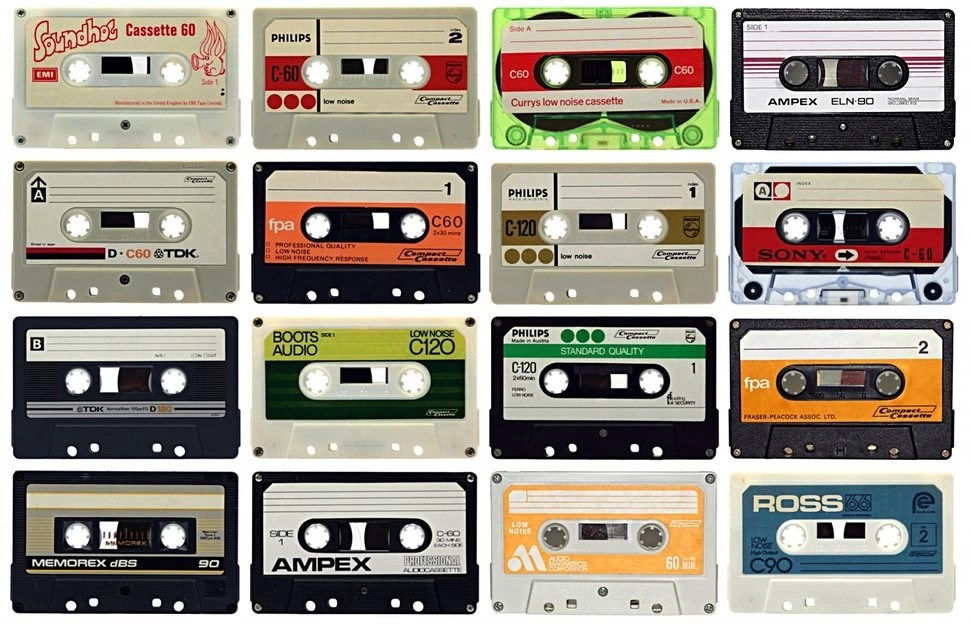
Cassette tapes, the fax machine, overhead projectors… Adrian Willings catalogues some transitional technologies that, he suggests, are headed for the dust bin of history…
… we’re… looking at some of the biggest, best and most memorable gadgets from the last century that have been outdated, outmoded or just forced into irrelevance by better, modern technologies.
You might remember many of these, but there are plenty of the younger generation that don’t…
… and won’t? “39 obsolete technologies that will baffle modern generations,” from @Age_Dub in @Pocketlint.
* Jennifer Egan
###
As we mosey down memory lane, we might send electronic birthday greetings to David Sarnoff; he was born on this date in 1891. An early employee of Marconi Wireless Telegraph, he befriended its owner, and began a a long career in broadcasting.
Unlike many who were involved with early radio communications, who often viewed radio as a point-to-point medium, Sarnoff saw the potential of radio as point-to-mass. One person (the broadcaster) could speak to– inform, entertain, sell to– many. When Owen D. Young of General Electric arranged the purchase of American Marconi and turned it into the Radio Corporation of America, a radio patent monopoly, Sarnoff got his chance.
His colleagues were wary, but in 1921, Sarnoff arranged a broadcast of a heavyweight boxing match between Jack Dempsey and Georges Carpentier. An estimated 300,000 people heard the fight, and demand for home radio equipment bloomed that winter. As head of radio broadcasting for RCA, Sarnoff was instrumental in building and establishing the AM broadcasting radio business that became the preeminent public radio standard for the majority of the 20th century.
In that late 1920s and early 30s Sarnoff (who had become RCA’s President) drove the company’s push to develop television. In April, 1939, regularly scheduled television in America was initiated by RCA under the name of their broadcasting division at the time, The National Broadcasting Company (NBC). The first television broadcast aired was the dedication of the RCA pavilion at the 1939 New York World’s Fairgrounds and was introduced by Sarnoff himself.
Along the way, Sarnoff led the formation of RKO (in which the “R” stood for RCA) and bought Victor Talking Machine Company, the nation’s largest manufacturer of records and phonographs, assuring RCA a piece of the content business.

“Prediction and explanation are exactly symmetrical”*…

From a December, 1969 episode of the BBC series Tomorrow’s World, an eerily-prescient look at the computerized future of banking…
The emergence of the debit card, the impact on back-office jobs, the receding importance of branch banks… they nailed it.
TotH to Benedict Evans (@benedictevans)
* “Prediction and explanation are exactly symmetrical. Explanations are, in effect, predictions about what has happened; predictions are explanations about what’s going to happen.” – John Searle
###
As we find our ways into the future, we might recall that it was on this date in 1878 that the modern music business was effectively born: Thomas Edison was awarded U.S. Patent No. 200,521 for his invention, the phonograph.

“So sa-a-a-ad that you’re leaving”*…

It happened exactly 36 seconds into the song—a glimpse of the shape of pop to come, a feel of the fabric of the future we now inhabit. The phrase “I can’t break through” turned crystalline, like the singer suddenly disappeared behind frosted glass. That sparkly special effect reappeared in the next verse, but this time a robotic warble wobbled, “So sa-a-a-ad that you’re leaving.”
The song, of course, was Cher’s “Believe,” a worldwide smash on its October 1998 release. And what we were really “leaving” was the 20th century.
The pitch-correction technology Auto-Tune had been on the market for about a year before “Believe” hit the charts, but its previous appearances had been discreet, as its makers, Antares Audio Technologies, intended. “Believe” was the first record where the effect drew attention to itself…
And an era was born. We’ve looked at Auto-Tune before (see here for an example of the difference the technology can make, here, and here); now, from our friends at Pitchfork, an in-depth history of the most important pop innovation of the last 20 years: “How Auto-Tune Revolutionized the Sound of Popular Music.”
* Cher, “Believe”
###
As we pine for authentic imperfection, we might recall that it was on this date in 1901 that the Victor Talking Machine Company was incorporated. A phonograph manufacturer and record company, it operated on disc record patents that it soon licensed to the Columbia Record Company as well (reinforcing Victor’s position as the leading phonograph manufacturer). In 1929, Victor was merged into RCA.

You must be logged in to post a comment.