Posts Tagged ‘Hitler’
“The clearest way to show what the rule of law means to us in everyday life is to recall what has happened when there is no rule of law”*…

There’s rule-by-law, and then there’s rule-by-law (AKA, authoritarianism).
Long-time readers will know of your correspondent’s affection and respect for the artist Banksy. He’s “struck” again– and again, he’s hit a nerve…
From the AP…
… Unlike the elusive artist’s other provocative works that are sometimes stolen or carefully removed and displayed in galleries or sold at auction for millions, his latest mural was being erased Wednesday from the record.
The stenciled spray-painting of a protester lying on the ground holding a blood-splattered placard while a judge in a traditional wig and black gown beats him with a gavel was scrubbed from wall of the iconic Royal Courts of Justice…

More of the story: “Banksy mural of a judge beating a protester is scrubbed from London court,” from @apnews.com.
* Dwight D. Eisenhower
###
As we protect what’s precious, we might recall that it was on this date in 1935 that Adolf Hitler addressed the eighth Nuremberg Rally, the “Rally of Freedom.” Following Goebbels (who had declared that history would some day pass the verdict on Hitler that by overthrowing Bolshevism he saved Germany from an immediate catastrophe and thereby brought Western civilization back from the brink of complete destruction)…
In a speech to 120,000 political functionaries on the Zeppelinwiese [here] this afternoon, Herr Hitler expressed his appreciation of their loyalty, which had been inspired by faith in him and his ideals, and which had enabled him to achieve for Germany what he had.
In an address to several thousand “Hitler” girls and women Herr Hitler said that the National-Socialist movement was providing “braver and better husbands.”
He added:- We are training real men for the women, decent, brave, and honourable. When the women see the fine Labour Service boys, dressed only in trousers and with breasts all bare, they must say, “It is nice for the women and what fine fellows are here, and conscription, what marvellous training!”, There is no equality in giving women tasks where they were men’s inferiors. Whenever I picture a woman in Parliament, I feel that she is being degraded. She does not raise the general level. She is drawn down to it herself.
– source

“Power always reveals”*…

Apposite to yesterday’s post, a provocative piece by Ben Ansell, who is reacting to a [terrific] piece by Henry Farrell in which Farrell, as he contemplates Trump’s moves, unpacks the “coordination” problems facing– and, Farrell suggests, often limiting– autocratic rulers…
… But you will notice an assumption I and Henry have been making – that Trump is like any other authoritarian leader. I suspect that in lots of ways Trump does wish to behave like one – certainly the treatment of Kilmar Abrego Garcia and his current refusal to follow court judgments meets that mark.
But Trump is attempting this in an otherwise democratic system and I think there is a risk that we overstate the degree to which that system has already deteriorated by assuming that the language and logic that we use to describe authoritarianism fits his case. Part of the risk is we give up on democracy while it’s still here. But the other danger is that we think Trump behaves like a rational authoritarian leader, a la Svolik, when it’s all just bluntly a lot dumber than that…
… In an earlier post I referred to Donald Trump as a ‘chaotic authoritarian’. I don’t think it’s implausible that a democracy could have such a figure as a leader, though I do think it’s unlikely that it would remain democratic indefinitely under such leadership.
But in the absence of already having subverted elections, stymied courts, shut down the media, banned opponents and the other types of effective institutional backsliding that are the tell-tale signs of a democracy dying, I think we might do better to think about how such a figure operates in, what for now, is a democracy.
The temptation when talking about dictators is to reach for Thomas Hobbes. We depict them as the Leviathan – imposing order on the body politic to prevent chaos but also any rivals. Hobbes’ vision was after all a painstaking justification for monarchical absolutism.
If you are not familiar with Leviathan, well do read it, it’s a banger. But the very basic gist is a theory of government built from the ground up. Hobbes even starts with a slightly rococo account of how we process sensations. But his core mechanism is to imagine a world without government – his famous state of nature – in which every individual was essentially on their own. A self-help system if you will, but not the kind in the woo-woo psychology section of the bookstore – the kind where if you don’t look after number one, you’ll get an axe in the back of the head.
The Hobbesian state of nature is anarchy and life in it is – say it with me – ‘solitary, poor, nasty, brutish and short’. And so anyone living in this state would seek to escape this ceaseless terror and have some entity that could guarantee security. Hobbes is a social contract theorist, and the contract upon which we could all be presumed to agree is a third party that can ruthlessly crush insecurity. An absolute sovereign power that would protect its subjects…
… The Hobbesian vision of the state is draconian of course and in… err… pretty sharp contrast with the social contract theories of John Locke or Jean Jacques Rousseau. But one way it has come down to us is in how we think about authoritanism. As about order and control, crushing dissent mercilessly, but also preventing anarchy, rebellion, and so forth. It is governing with an iron fist. Rational authoritarianism if you will.
Whatever Trump is trying to achieve, it’s not hitting this mark. Instead of authoritarianism containing chaos, it is chaos personified. Instead of quelling the anarchic state of nature, it is spreading anarchy and confusion. Hobbes’ frontispiece Leviathan is a steady ruler, holding sword and staff, made up out of their ordered subjects [In contrast to the disintegrating beast in the illustation above]…
… Hence, it’s not clear to me that the standard tools we use to think about authoritarianism accordingly make that much sense with Trump. Is he really thinking about how to coordinate among the elites to keep his support base? Because he’s not doing a brilliant job here having already lost the support of the Wall Street journal editorial board, a litany of very conservative judges, and increasingly corporate elites…
… what I find most interesting about Trump’s anti-Leviathan is that his rule is creating anarchy everywhere else too. And that means not only are his promises not credible but nor are his threats…
[Ansell reviews Trumps’ attack on universities, his approach to tariffs, and trade policy, his “crackdown” on immigration, and his foreign policy (or lack thereof)…]
… We will spend a lot of time over the next few years trying to figure out if Trump’s America remains a democracy. Already the main indices we use are starting to downgrade the USA. I struggle as to whether that coding is premature or not – we will of course know much more by the midterms about the stability and freedom of elections, though by then it could be too late.
It is very clear that Trump wishes to act as an authoritarian. But it is not yet obvious to me that analysing him using the logic of dictatorship makes sense. Because he lacks the control, the ruthlessness, and the rationality of normal authoritarian leaders. As Henry says in his post, ‘absolute power can be a terrible weakness.’ True. However, for many – perhaps most – dictators, absolute power is a terrible (in the original sense of that word) strength. Think to the horrors of the twentieth century.
That, however, is not Donald Trump. He may be the master of chaos. But he is not the Leviathan…
What if we abandoned the social contract for the state of nature? “Donald Trump’s Anti-Leviathan,” from @benansell.bsky.social (with @himself.bsky.social).
* “Power doesn’t always corrupt. Power always reveals. When you have enough power to do what you always wanted to do, then you see what the guy always wanted to do.” – Robert Caro (riffing on Lord Acton: “Power tends to corrupt and absolute power corrupts absolutely”) Or as David Brin put it: “it is said that power corrupts, but actually it’s more true that power attracts the corruptible.”
###
As we rein in reigns, we might recall that it was on this date in 1945 that Hermann Göring, head of the Luftwaffe and Adolf Hitler’s designated successor as leader of Nazi Germany, wired the Führer asking permission to assume leadership of the crumbling regime. The telegram caused an infuriated Hitler to strip Göring of power and to appoint new successors, Joseph Goebbels and Karl Dönitz, as chancellor and head of state, respectively.

“Even though our lives wander, our memories remain in one place”*…

Your correspondent’s fascination with the “memory palace,” the age-old technique of memorization, has shown up in (R)D many times before (e.g., here, here, here, here, here, and here :) That it works has been long understood– but how it works, not so much. Ingrid Wickelgren reports on research that may offer a clue…
After shuffling the cards in a standard 52-card deck, Alex Mullen, a three-time world memory champion, can memorize their order in under 20 seconds. As he flips though the cards, he takes a mental walk through a house. At each point in his journey — the mailbox, front door, staircase and so on — he attaches a card. To recall the cards, he relives the trip.
This technique, called “method of loci” or “memory palace,” is effective because it mirrors the way the brain naturally constructs narrative memories: Mullen’s memory for the card order is built on the scaffold of a familiar journey. We all do something similar every day, as we use familiar sequences of events, such as the repeated steps that unfold during a meal at a restaurant or a trip through the airport, as a home for specific details — an exceptional appetizer or an object flagged at security. The general narrative makes the noteworthy features easier to recall later.
“You are taking these details and connecting them to this prior knowledge,” said Christopher Baldassano, a cognitive neuroscientist at Columbia University. “We think this is how you create your autobiographical memories.”
Psychologists empirically introduced this theory some 50 years ago, but proof of such scaffolds in the brain was missing. Then, in 2018, Baldassano found it: neural fingerprints of narrative experience, derived from brain scans, that replay sequentially during standard life events. He believes that the brain builds a rich library of scripts for expected scenarios — restaurant or airport, business deal or marriage proposal — over a person’s lifetime.
These standardized scripts, and departures from them, influence how and how well we remember specific instances of these event types, his lab has found. And recently, in a paper published in Current Biology in fall 2024, they showed that individuals can select a dominant script for a complex, real-world event — for example, while watching a marriage proposal in a restaurant, we might opt, subconsciously, for either a proposal or a restaurant script — which determines what details we remember…
The fascinating details of how, by screening films in a brain scanner, neuroscientists discovered a rich library of neural scripts — from a trip through an airport to a marriage proposal — that form scaffolds for memories of our experiences: “How ‘Event Scripts’ Structure Our Personal Memories,” from @iwickelgren in @quantamagazine.bsky.social.
* Marcel Proust
###
As we remember (and lest we forget), we might recall that it was on this date in 1920 that Adolf Hitler, the propaganda head of the German Worker’s Party (DAP) gave a speech (now known as “Hitler’s Hofbräuhaus speech”) to 2,000 followers at a Munich beer hall announcing the change in the party’s name to the Nationalsozialistische Deutsche Arbeiterpartei (“National Socialist German Workers’ Party”, or Nazi Party). It was then that the party officially announced that only persons of “pure Aryan descent” could become members and that their spouses had to be “racially pure” as well.

Oh, and on this date in 1868, an American President (Andrew Johnson) was impeached for the first time.
“My spirit will arise from my grave”*…
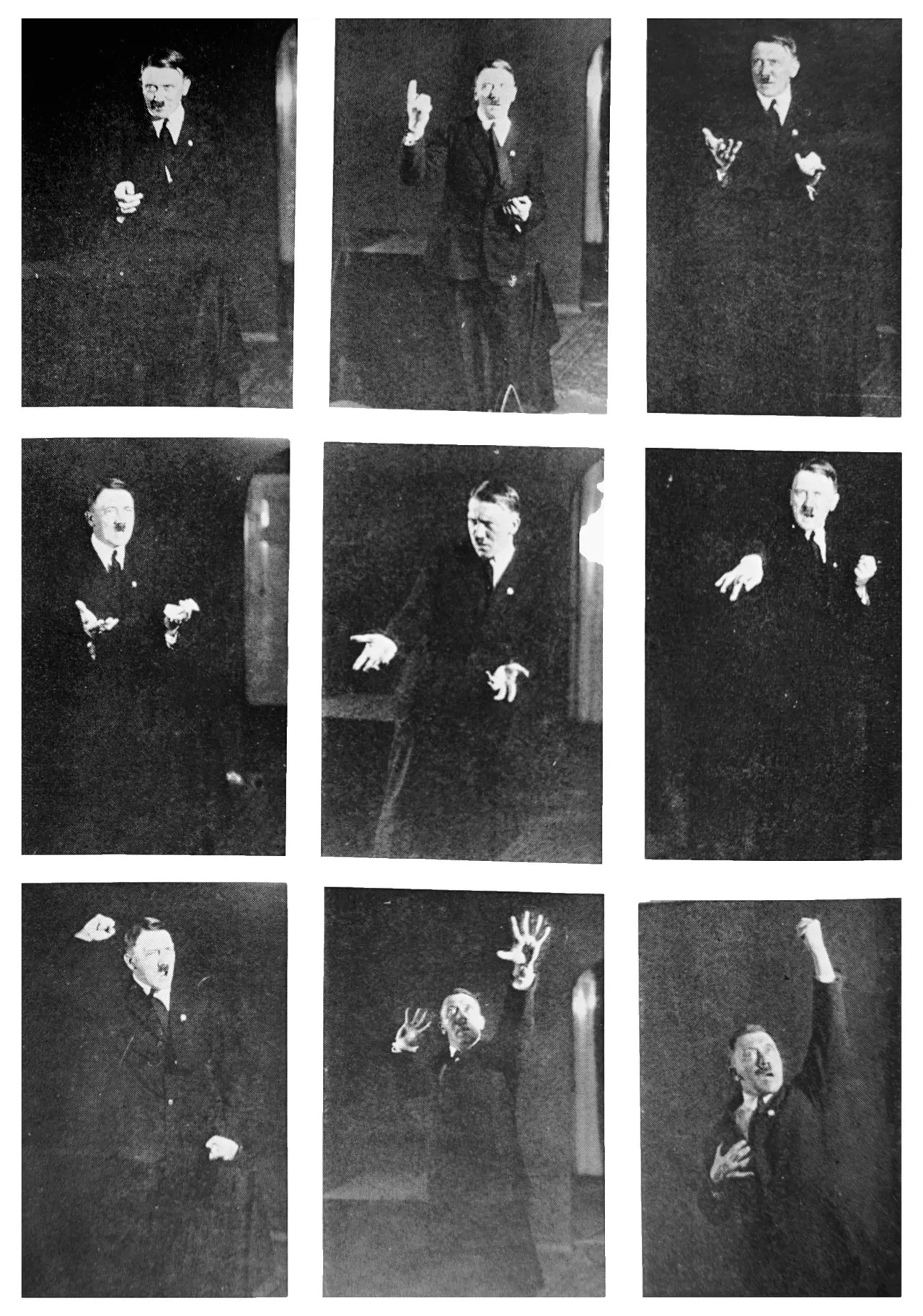
Hitler didn’t seize power; he was given it. As Adam Gopnik reports in a review of Tim Ryback‘s important new book, media lords thought that they could control him; political schemers thought that they could outwit him. The mainstream left had become a gerontocracy. And all of them failed to recognize his immunity to shame…
Hitler is so fully imagined a subject—so obsessively present on our televisions and in our bookstores—that to reimagine him seems pointless. As with the Hollywood fascination with Charles Manson, speculative curiosity gives retrospective glamour to evil. Hitler created a world in which women were transported with their children for days in closed train cars and then had to watch those children die alongside them, naked, gasping for breath in a gas chamber. To ask whether the man responsible for this was motivated by reading Oswald Spengler or merely by meeting him seems to attribute too much complexity of purpose to him, not to mention posthumous dignity. Yet allowing the specifics of his ascent to be clouded by disdain is not much better than allowing his memory to be ennobled by mystery.
So the historian Timothy W. Ryback’s choice to make his new book, “Takeover: Hitler’s Final Rise to Power” (Knopf), an aggressively specific chronicle of a single year, 1932, seems a wise, even an inspired one. Ryback details, week by week, day by day, and sometimes hour by hour, how a country with a functional, if flawed, democratic machinery handed absolute power over to someone who could never claim a majority in an actual election and whom the entire conservative political class regarded as a chaotic clown with a violent following. Ryback shows how major players thought they could find some ulterior advantage in managing him. Each was sure that, after the passing of a brief storm cloud, so obviously overloaded that it had to expend itself, they would emerge in possession of power. The corporate bosses thought that, if you looked past the strutting and the performative antisemitism, you had someone who would protect your money. Communist ideologues thought that, if you peered deeply enough into the strutting and the performative antisemitism, you could spy the pattern of a popular revolution. The decent right thought that he was too obviously deranged to remain in power long, and the decent left, tempered by earlier fights against different enemies, thought that, if they forcibly stuck to the rule of law, then the law would somehow by itself entrap a lawless leader. In a now familiar paradox, the rational forces stuck to magical thinking, while the irrational ones were more logical, parsing the brute equations of power. And so the storm never passed. In a way, it still has not…
Both the review and the book on which it focuses are eminently worth reading in full: “The Forgotten History of Hitler’s Establishment Enablers” (possible paywall; in which case, archived copy here), from @adamgopnik in @NewYorker.
* Hitler, as quoted in a letter from von Ribbentrop (to Churchill and Atlee) sent just before von Ribbentrop was captured at the end of the war
###
As we hear the echo, we might spare a thought for Ludwig van Beethoven; he died on this date in 1827. A crucial figure in the transition between the Classical and Romantic eras in Western music, he remains one of the most famous and influential of all composers. His best-known compositions include 9 symphonies, 5 concertos for piano, 32 piano sonatas, and 16 string quartets. He also composed other chamber music, choral works (including the celebrated Missa Solemnis), a single opera (Fidelio), and numerous songs.
Relevantly to the piece above…
Beethoven admired the ideals of the French Revolution, so he dedicated his third symphony to Napoleon Bonaparte… until Napoleon declared himself emperor. Beethoven then sprung into a rage, ripped the front page from his manuscript and scrubbed out Napoleon’s name. Some modern reproductions of the original title page have scrubbed out Napoleon’s name to create a hole for authenticity’s sake!
Beethoven’s temper and Symphony No. 3 ‘Eroica’
But, of course, it was too late…

“Darkness cannot drive out darkness, only light can do that”*…

Noah Smith‘s sobering reflection on the rise of authoritarianism and illiberalism…
[This week] is the 20-year anniversary of the U.S. invasion of Iraq — a multi-decade debacle that would see hundreds of thousands of innocents killed, trillions of dollars flushed down the drain, America’s image in the Middle East destroyed, and the acceleration of the end of U.S. hegemony.
[This week] is also the [time] of the summit between Xi Jinping and Vladimir Putin, in which the leaders of the two authoritarian great powers reiterate their de facto alliance. With one of those powers actively engaged in a war of conquest against a peaceful neighbor, and the other threatening to do the same, the world is in danger of plunging back into the horrors of the early 20th century.
So this is the perfect [time] to repost a fairly melodramatic post that I wrote two years ago, about the rise of authoritarianism and illiberalism. I don’t apologize for the over-the-top language, since I think it’s difficult to overstate the danger; we humans have a strong tendency to stick our heads in the sand until it’s too late, and we need to wake up.
But we also need to remember a crucial piece of this story: It was American folly that began this baleful trend. Our victories in World War 2 and Cold War 1 gave the U.S. the unique opportunity to build a world where countries don’t invade other countries; when we invaded Iraq without cause or provocation, we threw away that opportunity. We brought back the principle of “the strong do what they can, and the weak suffer what they must”. We opened the gates, and allowed the Darkness back into our world. Now it’s our responsibility to help fix what we broke…
Illiberalism is on the march, all over the world- thoughts on what’s happening, why, and what we can do about it: “The Darkness,” from @Noahpinion. Eminently worth reading in full.
* Martin Luther King Jr.
###
As we face the future, we might recall that it was on this date in 1933 that Germany opened its first concentration camp, Dachau. Initially intended to intern Hitler’s political opponents (communists, social democrats, and other dissidents), it’s “mission” was enlarged to include forced labor, and, eventually, the imprisonment of Jews, Romani, German and Austrian criminals, and, finally, foreign nationals from countries that Germany occupied or invaded. There were 32,000 documented deaths at the camp, and thousands that are undocumented. Approximately 10,000 of the 30,000 prisoners were sick at the time of liberation by U.S. forces in April of 1945.

You must be logged in to post a comment.