Posts Tagged ‘Hitler’
“Every decent man is ashamed of the government he lives under”*…

The majority of countries are democracies, but how many people enjoy what we think of as democratic rights? A nifty interactive map from Our World In Data charts the changes in political regimes across the globe, country by country, over the last 200 years. By way of explaining its categories:
• In closed autocracies, citizens do not have the right to choose either the chief executive of the government or the legislature through multi-party elections.
• In electoral autocracies, citizens have the right to choose the chief executive and the legislature through multi-party elections; but they lack some freedoms, such as the freedoms of association or expression, that make the elections meaningful, free, and fair.
• In electoral democracies, citizens have the right to participate in meaningful, free and fair, and multi-party elections.
• In liberal democracies, citizens have further individual and minority rights, are equal before the law, and the actions of the executive are constrained by the legislative and the courts.
As Visual Capitalist observes…
Do civilians get a representative say in how the government is run where you live?
While it might seem like living with a basic level of democratic rights is the status quo, this is only true for 93 countries or territories today—the majority of the world does not enjoy these rights.
It also might surprise you that much of the progress towards democracy came as late as the mid-20th century…
An interactive look at the state of democracy around the world, and how it has evolved. From @OurWorldInData, via @VisualCap.
* H. L. Mencken
###
As we ruminate on representation, we might recall that it was on this date in 1933, the day after an arsonist ignited the Reichstag building, home of the German parliament in Berlin (and four weeks after Nazi leader Adolf Hitler had been sworn in as Chancellor of German), that Adolf Hitler attributed the fire to a conspiracy of Communist agitators.
Marinus van der Lubbe, a Dutch “council communist”, was the apparent culprit; but Hitler insisted on a wider network of villains. He used it as a pretext to claim that Communists were plotting against the German government, and induced President Paul von Hindenburg to issue the Reichstag Fire Decree suspending civil liberties, and to pursue a “ruthless confrontation” with the Communists. A court later found that van der Lubbe had in fact acted alone. But Hitler’s orchestrated reaction to the Reichstag Fire began the effective rule of the Nazi Party and the establishment of Nazi Germany.

“A Dictator? Why, he makes love to beautiful women, drinks champagne, enjoys life and never works. He makes speeches to the people promising them plenty, gives them nothing and takes everything. *That’s* a Dictator.”*…

Hollywood’s relationship to the Third Reich before Pearl Harbor was a complex one. Film producers – particularly Jewish ones – had ample reason to dislike Nazis, but the US was not yet at war with them, and it wasn’t necessarily good for business to lampoon the government of a large foreign market. So, with some exceptions, Hollywood tended to tread carefully in the late 1930s.
Charles Chaplin famously lampooned the Third Reich leader in The Great Dictator, which was released in October 1940. The Three Stooges got the jump on Chaplin by nine months, however, releasing their own quickie Third Reich parody in January that year, although Chaplin’s film had started production first.
In January 1940, the Stooges released a two-reel short called You Nazty Spy! in which they play dimwitted wallpaper hangers who are installed as dictators of the country of Moronica; the businessmen who elevate them think they are stupid enough to be easily controlled.
Moe plays the Hitler-like leader, while Curly plays Field Marshal Gallstone (a mashup of Goering and Mussolini), and Larry is Propaganda Minister Pebble (a spoof of Goebbels). Various comic hijinks ensue, culminating in the dictatorial trio getting deposed and eaten by lions. In 1941, a sequel came out called I’ll Never Heil Again…
The first Hollywood film to spoof Hitler: a Three Stooges two-reeler called You Nazty Spy!
See You Nazty Spy! here. More on Chaplin’s rather better-known The Great Dictator here.
* “Mr. Ixnay” (Richard Fiske) in You Nazty Spy!
###
As we ridicule the ridiculous, we might recall that it was on this date in 1976 that Sesame Street aired episode #847, featuring Margaret Hamilton reprising her role as the Wicked Witch of the West from the 1939 film The Wizard of Oz. It scared children so badly that the episode has never been re-aired. (This, after she had appeared as herself in three episodes of Mister Rogers’ Neighborhood, between 1975 and 1976– because Fred Rogers wanted his young viewers to recognize the Wicked Witch was just a character and not something to fear.)

“a crime committed by a person of respectability and high social status in the course of his occupation”*
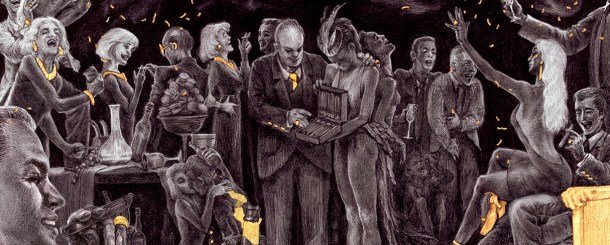
Over the last two years, nearly every institution of American life has taken on the unmistakable stench of moral rot. Corporate behemoths like Boeing and Wells Fargo have traded blue-chip credibility for white-collar callousness. Elite universities are selling admission spots to the highest Hollywood bidder. Silicon Valley unicorns have revealed themselves as long cons (Theranos), venture-capital cremation devices (Uber, WeWork) or straightforward comic book supervillains (Facebook). Every week unearths a cabinet-level political scandal that would have defined any other presidency. From the blackouts in California to the bloated bonuses on Wall Street to the entire biography of Jeffrey Epstein, it is impossible to look around the country and not get the feeling that elites are slowly looting it.
And why wouldn’t they? The criminal justice system has given up all pretense that the crimes of the wealthy are worth taking seriously. In January 2019, white-collar prosecutions fell to their lowest level since researchers started tracking them in 1998. Even within the dwindling number of prosecutions, most are cases against low-level con artists and small-fry financial schemes. Since 2015, criminal penalties levied by the Justice Department have fallen from $3.6 billion to roughly $110 million. Illicit profits seized by the Securities and Exchange Commission have reportedly dropped by more than half. In 2018, a year when nearly 19,000 people were sentenced in federal court for drug crimes alone, prosecutors convicted just 37 corporate criminals who worked at firms with more than 50 employees.
With few exceptions, the only rich people America prosecutes anymore are those who victimize their fellow elites. Pharma frat boy Martin Shkreli, to pick just one example, wasn’t prosecuted for hiking the price of a drug used to treat HIV from $13.50 to $750 per pill. He went to prison for scamming investors in a hedge fund scheme years before. Meanwhile, in 2016, the CEO whose company experienced the deadliest mining disaster since 1970 served less than one year in prison and paid a fine of 1.4 percent of his salary and stock bonuses the previous year. Why? Because overseeing a company that ignores warnings and causes the deaths of workers, even 29 of them, is a misdemeanor…
A bracing look at an alarming phenomenon, and at the forces that drive it: “The Golden Age of White Collar Crime.”
See also this interactive “heat map” of “White Collar Crime Risk Zones,” from @sam_lavigne and his colleagues, and this paper on the cost of white collar crime– more than $300 Billion per year as of 2015; likely more now– and who pays for it (HBS pdf).
 [Paul Noth in The New Yorker, via Jack Shalom]
* Criminologist Edwin Sutherland’s definition of white collar crime, 1939
###
As we equilibrate equity, we might recall that it was on this date in 1933, the day after the German Parliament building (the Reichstag) was damaged by arson, that President Hindenburg issues the Decree for the Protection of People and the Reich…
Though the origins of the fire are still unclear, in a propaganda maneuver, the coalition government (made up of Nazis and the Nationalists) blamed the Communists. They exploited the Reichstag fire to secure President Hindenburg’s approval for an emergency decree, popularly known as the Reichstag Fire Decree, that suspended individual rights and due process of law. The Reichstag Fire Decree permitted the regime to arrest and incarcerate political opponents without specific charge, dissolve political organizations, and to suppress publications. It also gave the central government the authority to overrule state and local laws and overthrow state and local governments. The decree was a key step in the establishment of the Nazi dictatorship. Germany became a police state in which citizens enjoyed no guaranteed basic rights and the SS, the elite guard of the Nazi state, wielded increasing authority through its control over the police. [source]

“Authoritarian populism can be seen as a pushback of elements of human nature—tribalism, authoritarianism, demonization, zero-sum thinking—against the Enlightenment institutions that were designed to circumvent them”*…

We live in the age of charismatic elected would-be despots. His — it is almost always a “he” — are the politics of fear and rage. It takes a certain sort of personality to be a master of such politics. In the right — that is, the wrong — circumstances, such leaders emerge naturally. That is not surprising after a violent revolution. What is far more so is that such leaders have been emerging in well-established democracies.
We now see elected “strongmen” — actual and would-be — everywhere. Leading examples are Vladimir Putin in Russia, Recep Tayyip Erdogan in Turkey, Narendra Modi in India, Nicolás Maduro in Venezuela, Rodrigo Duterte in the Philippines, Jair Bolsonaro in Brazil, Benjamin Netanyahu in Israel, Matteo Salvini in Italy and Donald Trump in the US. These leaders differ in degrees of sophistication. The countries in which they operate also differ. Some are economically developed, while others are not. Some are longstanding democracies; others, again, are not.
Yet these men are all characters in a story powerfully told by the independent US watchdog Freedom House. Freedom in the World 2019, published in February, reported a 13th consecutive year of decline in the global health of democracy. This decline occurred in all regions of the world, notably in the democracies that emerged after the cold war. Above all, it occurred in western democracies, with the US — the most influential upholder of democratic values — leading the way…
People want to believe a powerful and charismatic leader is on their side in an unjust world. The estimable Martin Wolf unpacks the mechanism of “strong man” rule: “The age of the elected despot is here.”
For a different angle on the phenomenon the Wolf unpacks, one that speaks directly to Steven’s Pinker’s quote in the title of this post, see “Dialectics of Enlightenment.”
*”A very different threat to human progress is a political movement that seeks to undermine its Enlightenment foundations.
The second decade of the 21st century has seen the rise of a counter-Enlightenment movement called populism, more accurately, authoritarian populism. Populism calls for the direct sovereignty of a country’s “people” (usually an ethnic group, sometimes a class), embodied in a strong leader who directly channels their authentic virtue and experience.
Authoritarian populism can be seen as a pushback of elements of human nature—tribalism, authoritarianism, demonization, zero-sum thinking—against the Enlightenment institutions that were designed to circumvent them. By focusing on the tribe rather than the individual, it has no place for the protection of minority rights or the promotion of human welfare worldwide. By failing to acknowledge that hard-won knowledge is the key to societal improvement, it denigrates “elites” and “experts” and downplays the marketplace of ideas, including freedom of speech, diversity of opinion, and the fact-checking of self-serving claims. By valorizing a strong leader, populism overlooks the limitations in human nature, and disdains the rule-governed institutions and constitutional checks that constrain the power of flawed human actors.
Populism comes in left-wing and right-wing varieties, which share a folk theory of economics as zero-sum competition: between economic classes in the case of the left, between nations or ethnic groups in the case of the right. Problems are seen not as challenges that are inevitable in an indifferent universe but as the malevolent designs of insidious elites, minorities, or foreigners. As for progress, forget about it: populism looks backward to an age in which the nation was ethnically homogeneous, orthodox cultural and religious values prevailed, and economies were powered by farming and manufacturing, which produced tangible goods for local consumption and for export.”
― Enlightenment Now: The Case for Reason, Science, Humanism, and Progress
Consider also:
“Ur-Fascism is based upon a selective populism, a qualitative populism, one might say. In a democracy, the citizens have individual rights, but the citizens in their entirety have a political impact only from a quantitative point of view—one follows the decisions of the majority. For Ur-Fascism, however, individuals as individuals have no rights, and the People is conceived as a quality, a monolithic entity expressing the Common Will. Since no large quantity of human beings can have a common will, the Leader pretends to be their interpreter. Having lost their power of delegation, citizens do not act; they are only called on to play the role of the People. Thus the People is only a theatrical fiction.”
– Umberto Eco, “Ur-Fascism”, New York Review of Books (June 22, 1995)
###
As we think for ourselves, we might recall that it was on this date in 1945 that Joseph Goebbels died. One of Adolf Hitler’s closest and most devoted associates, Goebbels was a student of the shaping of public opinion; he served as Reich Minister of Propaganda of Nazi Germany from 1933 to 1945. He was a gifted public speaker, who was particularly adept at using the relatively new media of radio and film for propaganda purposes, emphasizing antisemitism, attacks on the Christian churches, and (after the start of World War II) the boosting of public morale.
Hitler committed suicide in his bunker on April 30, 1945. In accordance with his will, Goebbels succeeded him as Chancellor of Germany, serving one day in this post. The following day, Goebbels and his wife committed suicide, after poisoning their six children with cyanide.

“Great necessities call out great virtues”*…

Fatebenefratelli Hospital, Tiber Island, Rome
Behind the closed doors of the Fatebenefratelli hospital in Rome was a ward filled with patients being treated for K Syndrome. This new and unfamiliar disease – whose name evoked Koch Syndrome (tuberculosis) – was a strong deterrent to the occupying Nazi soldiers who carried out routine searches of the hospital for Jews, partisans and anti-fascists. Fearing infection, the Nazis did not dare enter the ward, turning their attention elsewhere.
Patients in this ward had been hospitalised and classified as suffering from K Syndrome in late 1943. On 16 October of that year, the Nazis combed the Jewish ghetto and other areas of Rome, deporting about 1,200 Jews. Only 15 survived the camps. After this, the hospital’s doctors and friars welcomed ever-increasing numbers of patients. These patients were, however, refugees. K Syndrome was an invented illness…
The remarkable story of hundreds hidden from the Nazis: “K Syndrome, the Disease that Saved.”
* Abigail Adams
###
As we admire audacity, we might recall that it was on this date in 1932 that Germany held a Presidential election. With six million unemployed, chaos in Berlin, starvation and ruin, the threat of Marxism, and a very uncertain future, the German people turned to Hitler by the millions.
Incumbent President Paul von Hindenburg was 84 years old and in poor health. Never enthusiastic about the presidency (or public office in general), Hindenburg had planned to stand down after his first term. But the prospect of Adolf Hitler being elected President of Germany persuaded the reluctant incumbent to seek a second term. In the first round of voting, Hindenberg received 49.6% of the vote, just shy of the majority necessary to avoid a run-off. Hitler polled 30%; Thälmann, the Communist candidate, 16%, and other candidates, 7%.
Hitler took to the skies, criss-crossing Germany by airplane in the run-off campaign. He raised his total to 37% of the vote. Although Hitler lost the presidential election of 1932, he achieved his goals when he was appointed chancellor on January 30, 1933. Then on February 27, Hindenburg paved the way to dictatorship and war by issuing the Reichstag Fire Decree which nullified civil liberties. Hitler succeeded Hindenburg as head of state upon Hindenberg’s death in 1934, whereafter he abolished the office entirely, and replaced it with the new position of Führer und Reichskanzler (“Leader and Reich Chancellor”), cementing his rule.

1932 Ballot
You must be logged in to post a comment.