Archive for October 2013
Phreaking out…

Cover of the Spring 2012 issue of 2600
In preparation for “treat-ing” tonight’s parade of freaks, one might pause to pay respects to 2600: The Hacker Quarterly, an American publication that specializes in publishing technical information on a variety of subjects including telephone switching systems, Internet protocols and services, as well as general news concerning the computer underground. The magazine’s moniker comes from the “phreaker” discovery (by John “Cap’n Crunch” Draper and friends in the 1960s) that the transmission of a 2600 hertz tone (which could be produced perfectly with a plastic toy whistle given away free with Cap’n Crunch cereal) over a long-distance trunk connection gained access to “operator mode” and allowed the user to explore aspects of the telephone system that were not otherwise accessible… like free long distance calls. (The seed money for Apple was in part raised by the two Steves’ sale of “phreaking boxes” designed to do just this.)
2600 has become a journal-of-record for “Grey Hat” hackers– tech explorers concerned to push past the limits inherent to the design of a given technological device or application (as opposed to White Hats, who are ideologically motivated to do good, or Black Hats, who pursue selfish– often illegal– gain). So its current editorial focus is largely on the web and its devices, increasingly on mobile implementations and application.
But 2600 honors its roots, among other ways, by maintaining a gallery of photos of payphones around the world; for example…

Peshlawar, Pakistan

Moscow, Russia (The payphones only accept one ruble coins, an obsolete denomination)
###
As we wax nostalgic, we might send illuminating birthday greetings to Narinder Singh Kapany; he was born on this date in 1926. While growing up in Dehradun in northern India, a teacher informed him that light only traveled in a straight line. He took this as a challenge and made the study of light his life work, initially at Imperial College, London. In January 1954, Nature published his report of successfully transmitting images through fiber bundles– and Dr. Kapany became the father of fiber optics (a name he coined). Dr. Kapany ultimately migrated to the U.S., where he continued to invent (he holds over 100 patents), taught, started successful companies, and became a philanthropist. Fortune named him one of seven ‘Unsung Heroes’ in their “Businessmen of the Century” issue (November 22, 1999). It was, of course, the implementation of Dr. Kapany’s work that rendered “phreaking” moot.

Happy Halloween!
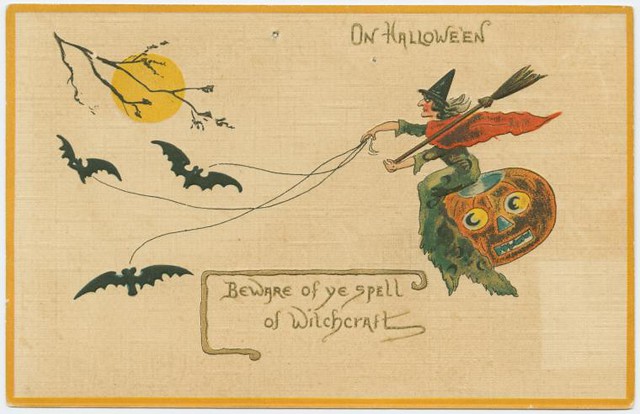 from the NY Public Library’s Flickr set of Halloween cards…
Like a big pizza pie, that’s amore…

As October, National Pizza Month, draws to a close, Flowing Data offers a rigorous examination of pizza chains across the U.S. and the relative proximity of their outlets in different areas. It’s the handiest of guides– and one to use: surely Americans can improve on last year’s statistics; surely we can do better than 251,770,000 pounds of pepperoni consumed…
###
As we ask for extra crushed red pepper, we might recall that it was on this date in 1937 we– the entire population of the earth– narrowly avoided (by twice the distance of the Moon… but that’s only three seconds) obliteration as the 500,000 ton asteroid/planetoid 69230 Hermes failed to collide with our planet. (In 1989, the earth had an even closer approach, but by the smaller 4581 Asclepius.)

69230 Hermes
“I’m mad as hell, and I’m not going to take this anymore…”*

From the good folks at Revolution Messaging, a site for our times: Drink recipes + talking points + an app that dials the office of a random member of Congress = Drunkdial Congress… and a cathartic experience.
* “Howard Beale” (Peter Finch) in Paddy Chayefsky’s Network
###
As we contemplate the wages of federal foolishness, we might recall that this is the anniversary of the date commemorated in Harold Rosenberg’s powerful lithograph, “Dies Irae (Oct 29).” A graduate of Columbia College (1895) and Law School (1898), Rosenberg practiced corporate law for decades. But his passion was art. In 1922, he founded the New Gallery in New York for the exhibition and sale of works by little-known American and foreign artists. “Dies Irae” (Day of Wrath), made on the day of the Wall Street crash in 1929, appeared on the front page of the Sunday Magazine section of The New York Times in 1930. Rosenberg retired from the Bar in the late 1940s, and devoted himself to art, both as a creator and as an influential critic (he coined the term “Action Painting” in 1952 for what came to be known as Abstract Expressionism). He was himself the subject of a painting by Elaine de Kooning, and was the model for Saul Bellow’s “Rosenberg” in the short story “What Kind of Day Did You Have?” His works hangs in museums throughout the U.S.
 source: The Smithsonian Institution/American Art Museum
“Life is really simple, but we insist on making it complicated…”*

Capt. Kirk facing a Horta, a silicon-based life-form (in “Devil in the Dark” from “Star Trek: The Original Series”
Silicon-based (and other alternate) forms of life are a staple of speculative fiction. But are they as far-fetched as they might seem? In Smithsonian‘s Daily Planet blog, astrobiologist Dirk Schulze-Makuch suggests not…
It would be extremely “earth-centric” to presume that the biochemistry on our planet is the only way life can operate. But just how different can it be? One extreme example are the “Horta,” the silicon-based life portrayed in Star Trek. Could we expect organisms like that on a terrestrial, meaning Earth-type, planet? Most likely not, because the biochemistry of life is intrinsically related to its environment. On Earth, silicon and oxygen are the main building blocks of Earth’s crust and mantle. Most rocks, particularly volcanic and igneous rocks, are built from silicate minerals, which are based on a silicon and oxygen framework. Any free silicon would be bound in these rocks, which are inert at moderate temperatures. Only at very high temperatures does the framework become more plastic and reactive, which led Gerald Feinberg and Robert Shapiro to suggest the possible existence of lavobes and magmobes that could live in molten silicate rocks…

Adam and 3-CPO, from “Darths and Droids”
One can read the full story at “Is Silicon-Based Life Possible?”
And one can muse on a resonant issue: if we earth-bound humans tend to be pretty precious about our definition of life, we are even more sensitive– indeed, often down-right chauvinistic– in our understandings of consciousness, sentience and who/what can or can’t enjoy them.
* Confucius
###
As we study up for the Turing Test, we might send animated birthday greetings to Hans Adolf Eduard Driesch; he was born on this date in 1867. The father of experimental embryology and the first person to clone an animal, Driesch was also the creator of the philosophy of entelechy— and thus the last the last great spokesman for vitalism. Following in the footsteps of Epicurus, Galen, and Pasteur, Driesch argued that life cannot be explained as physical or chemical phenomena.

The City That Never Shuts Up…

For those with delicate ears, New York City in the 1930s was a 24-hour nightmare. The city rumbled, squeaked, mewed, and tooted thanks to the aural diarrhea of ice deliverers, cattle-car operators, jazz players, river dredgers, steam whistle-happy boat captains, cats, dogs, chickens, and construction workers shooting rivets into everything in sight.
The cacophony that thundered through New York in the Jazz Age has now received proper cartographic attention from Emily Thompson, a historian at Princeton who studies acoustic innovation and the historical “emergence of excessive noise,” according to her MacArthur “genius grant” bio. Back in 2002, Thompson penned a book about noise and architecture called The Soundscape of Modernity, which triggered a flood of people bugging her to work up a companion piece that you could actually, you know, hear. More than a decade later the result is here for all to savor: The Roaring ‘Twenties, an interactive map of roughly 600 peevish, outraged, and frequently hilarious noise complaints from 1926 to 1932.
Thompson delved into musty records boxes from the city’s municipal archives to create this fantastic minefield of misery and broken sleep. As to her motivation, she explains:
By offering a website dedicated to the sounds of New York City circa 1930, The Roaring ‘Twenties is following the lead of countless other individuals and organizations who have turned the web into a vast sonic archive, delivering a previously unimaginable wealth of historic sound recordings to anyone with a connection and a desire to listen in. With The Roaring ‘Twenties, I hope we not only add to that archive, but also set an example by doing so in an explicitly historically-minded way. The aim here is not just to present sonic content, but to evoke the original contexts of those sounds, to help us better understand that context as well as the sounds themselves. The goal is to recover the meaning of sound, to undertake a historicized mode of listening that tunes our modern ears to the pitch of the past. Simply clicking a “play” button will not do.
Head on over to the site and you’ll be confronted with this pigeon’s-eye view of the city. Each target represents one noise complaint, often accompanied by old news-reel footage offering the sights and sounds of those responsible for the rowdy decibels: grinning jackhammer operators, clacking elevated trains, boys racing homemade scooters, whanging blacksmiths, a particularly loud-mouthed preacher from the Salvation Army:

More of the story– and wonderful sample cases– at “Exploring the Hilarious Noise Complaints of 1930s New York.”

###
As we cover our ears, we might recall that this is a resonant anniversary in the Big Apple’s sonic history: on this date in 1904 New York City Mayor George McClellan took the controls on the inaugural run of the city’s innovative new rapid transit system: the subway. London had the world’s first underground (opened in 1863); Boston, America’s first (1897). But New York’s subway quickly became the largest in the U.S… and a significant contributor to the din that accompanies life in The City That Never Sleeps.

McClellan (center) at the controls
You must be logged in to post a comment.