Posts Tagged ‘Wikipedia’
“How do I know what I think until I see what I say?”*…

A housekeeping note: (R)D will be off tomorrow– Sunday the 12th– returning on Monday…
Wikipedia has over 300 language editions. Each one picks different images to illustrate the same topic.
From Riley Walz, a marvelous way to explore the the images that different concepts conjure in different cultures: “In Every Language.”
(Image above: “Mother” in English, Portuguese, and others on the left; Italian, Esperanto, and others on the right)
* E. M. Forster
###
As we visualize, we might recall that it was on this date in 1966 that Frank Sinatra recorded “Strangers in the Night.” According to Sinatra: The Life (Summers, Swan, 2006), Sinatra despised the song and called it “a piece of sh*t” and, per Frank Sinatra by Jean-Pierre Hombach, “worst f*cking song that I have ever heard.” Nevertheless, it became his first No. 1 hit since 1955’s “Learning the Blues” and remained on the Billboard charts for 15 weeks. His album of the same name became his most successful. The song also won him Grammy Awards for Best Male Pop Vocal Performance, Record of the Year, and Best Arrangement.

“A Wikipedia article is a process, not a product”*…
A quarter of a century ago Jimmy Wales, Wikipedia‘s founder, articulated its vision– one into which it has impressively grown: “Imagine a world in which every single person on the planet is given free access to the sum of all human knowledge. That’s what we’re doing.”
On the ocassion of its birthday this month, Caitlin Dewey takes stock…
Happy birthday to Wikipedia, which is now old enough to rent a car without extra charges … but faces new (and newly urgent) threats from AI and political polarization. As a palate cleanser, should those bum you out (the second, in particular, is very grim/good), may I then suggest this “entirely non-comprehensive list of life principles” learned from 20 years of editing Wikipedia. [Scientific American / Financial Times / The Wikipedian]…
From her wonderful newsletter, Links I Would Gchat You If We Were Friends. All three are eminently worth reading.
* Clay Shirky, who went on to observe that “Wikipedia is forcing people to accept the stone-cold bummer that knowledge is produced and constructed by argument rather than by divine inspiration,” but at the same time that: “We have lived in this world where little things are done for love and big things for money. Now we have Wikipedia. Suddenly big things can be done for love.”
###
As we treasure– and support— treasures, we might recall that it was on this date in 1885 that LaMarcus Adna Thompson received the first patent for a true “switchback railroad”– or , as we know it, a roller coaster. Thompson had designed the ride in 1881, and opened it on Coney Island in 1884. (The “hot dog” had been invented, also at Coney Island, in 1867, so was available to trouble the stomachs of the very first coaster riders.)

“That’s why we have the Museum… to remind us of how we came, and why: to start fresh, and begin a new place from what we had learned and carried from the old”*…

Maya Claire has created a virtual museum– and nearly infinite museum– generated from Wikipedia…
You can find exhibits on millions of topics, from the Architecture of Liverpool to Zoroastrianism. Search for the topic you want to learn about, or just wander from topic to topic as your curiosity dictates!
If you have an OpenXR-compatible headset, you can also visit the MoAT in VR! (Currently, the Oculus Quest is not supported)
The breadth of the museum is made possible by downloading text and images from Wikipedia and Wikimedia Commons. Every exhibit in the museum corresponds to a Wikipedia article. The walls of the exhibit are covered in images and text from the article, and hallways lead out to other exhibits based on the article’s links.
The museum is greatly inspired by educational videos that I watched as a kid, and the liminal spaces produced by early CGI. I want to recapture the promise that the internet can be a place of endless learning and exploration. I hope you enjoy your time exploring the Museum of All Things!…
Download instructions (and more) at “MoAT: The Museum of All Things,” by @may.as (with help from @wikipedia.org).
###
As we browse, we might recall that it was on this date in 1974 that Emerson, Lake, and Palmer’s concert film Pictures at an Exhibition had its US premiere in Los Angeles. Their rock adaptation of the piano suite by Modest Mussorgsky was filmed live in 1970 at the Lyceum Theatre in London.
“We have lived in this world where little things are done for love and big things for money. Now we have Wikipedia. Suddenly big things can be done for love.”*…
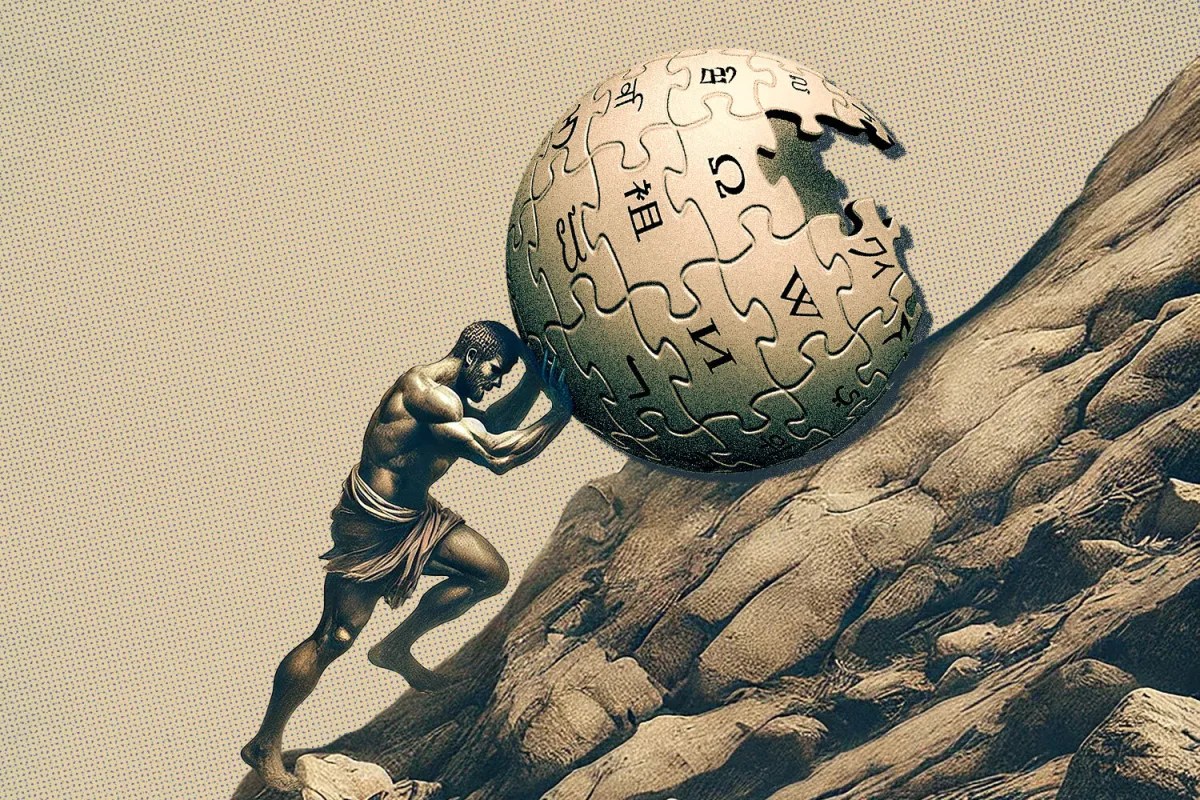
Since it was launched in 2001, Wikipedia has gone from curiosity to “bane of teachers” to cherished resource– the largest and most-read reference work in history, consistently among the top ten websites visited globally. Free and run by a network of volunteers (it’s hosted by the Wikimedia Foundation, an American nonprofit funded mainly by donations from readers), it has always been an anomaly– and has always been under some kind of threat.
Tobias Carroll of Inside Hook interviewed author, tech lawyer, and long-time student of Wikipedia Stephen Harrison on what the future might hold– is a tipping point coming?…
Has there ever been a time when Wikipedia wasn’t controversial? The long-running online encyclopedia has sparked plenty of debates since its founding in 2001, and has at various points been the subject of critiques from all across the political spectrum. It’s also an invaluable resource to millions around the world, host to a wealth of knowledge about everything from military battles to defunct sports teams.
Over the years, Stephen Harrison has written extensively about Wikipedia, including in a series of articles at Slate and his newsletter Source Notes. He’s also the author of a recent thriller, The Editors, about the international intrigue surrounding a Wikipedia-like website in the months leading up to the 2020 pandemic.
Harrison spoke with InsideHook about Wikipedia’s shifting place in internet culture, the many threats to it (including those from Elon Musk) and where he sees the encyclopedia going in the years to come…
… [Carroll] We’re now seeing people like Elon Musk targeting Wikipedia with existential criticism. What do you see as the biggest threats to Wikipedia — do you think it’s AI? Is it powerful people looking to make radical changes to how it works?
[Harrison] To some extent, it’s all of the above. I think it’s always under threat; even at the beginning they wondered if it would last and if people would keep contributing to it. There have been alternatives to it, like Conservapedia and RationalWiki and things like that, but they haven’t gotten the same traction. It’s a question of Joan Didion’s point about whether the center will hold. Hopefully Wikipedia will.
Now we have Elon Musk, who’s taken a pretty negative stance against Wikipedia. Of course, that’s very self-serving on his end because he wants people to go to his platform X, right? And he doesn’t like some of the content on his Wikipedia page, even the content that’s true about him being primarily an investor in a lot of these companies. He just doesn’t want to be couched or described as an investor because he has a certain narrative that he’s trying to put out there.
I think that there was always tension in the site. I think that to some extent people wanted to attack Wikipedia for something else, but it was very convenient to say, “Oh no, it’s all about women and minorities and underrepresented groups.” On the other hand, I want to say it does challenge some notions of what is encyclopedic. Wikipedia has kind of a small-c conservative view on topics that are notable.
The definition of notability has been repeat coverage and mainstream reliable sources, which a lot of people in underrepresented groups didn’t have for a long time. There’ll be people on Wikipedia, old-school editors, who’ll take issue with that. Editors aren’t just young guys in Silicon Valley. There are a lot of people — like the character Ed in The Editors — that have just been with the project for a long time, and they have their own views, too. They’ll say, “We’re an encyclopedia. We’re not here to try to right history’s wrongs.”I’m not saying that it needs to get to 50-50 in terms of male and female articles. But for a long time, it was less than 10% [biographical articles about] women. Now it’s like climbing up to 20%, so it’s getting a little bit closer…
… I think the issue is that I’m increasingly finding myself asking AI applications questions that I might have initially gone to Wikipedia for. That pushes Wikipedia further into the background. Are humans going to keep contributing to Wikipedia if it’s perceived that all the information is going to ChatGPT or Perplexity or Grok?
I’ll be interested to see how Wikipedia editors overcome that. Maybe if there’s a silver lining it’s that Wikipedia editors have never been that egotistical. They’re always a little bit behind the scenes. So maybe they won’t mind their information going out to other sources as it does with Google knowledge panels or Alexa or Siri or something like that.
On the other hand, I don’t think they like the idea of it just doing free labor for tech companies. It gets to be a really tough problem: should Google or OpenAI donate more money to the Wikimedia Foundation? But you don’t want there to be any editorial control or any undue influence by Big Tech. So It’s a little bit of a mess. I think that part of it will involve requiring that these LLMs start citing or stating that this information comes from Wikipedia to give some sort of provenance to Wikipedia….
… I’ve been concerned that Wikipedia isn’t recruiting the younger generation. But then every time I’ve expressed worry about that, I find new contributors joining. I think that there’s a certain personality dimension that’s attracted to editing Wikipedia. And those people, hopefully, always find the site.
I think that there’s this political-industrial complex right now where everything is being politicized, right? And the right wing has an interest in portraying Wikipedia as left-wing and a kind of liberal media. What I would hope is that Wikipedia can withstand some of those criticisms. I don’t want only half of the readership to think about Wikipedia as a resource that can be used. But if I had to guess, I think it’s going to get worse before it gets better in terms of partisan rhetoric about Wikipedia…
“How Long Can Wikipedia Hold On?” @tobiascarroll.bsky.social and @stephenharrison.com.
* Clay Shirky
###
As we look it up, we might recall that it was on this date in 1991 that Tim Berners-Lee showed the world the first web browser (and first WYSIWYG HTML editor), “WorldWideWeb” (the name of which was changed to “Nexus” after the debut of the World Wide Web later that year to avoid confusion between the brower and the network it was browsing).

“Nature doesn’t feel compelled to stick to a mathematically precise algorithm; in fact, nature probably can’t stick to an algorithm.”*…

Just over 30 years ago, my GBN partner Stewart Brand and I were discussing the then-new web affordance Pointcast, an active screensaver that displayed news and other information tailored to a user’s expressed interests and delivered live over the Internet. It was big news at the time; and while it failed, it prefigured the emergence of the algorithms that today feed “preferences” that we don’t even need (nor for that matter have the opportunity) to articlulate.
The problem, we mused, is that a system like that becomes a trap, one that (by simply satisfying expressed desires) impicitly works against discovery of the altogether new, of the thing we didn’t yet know might interest (or benefit) us. A system like that pulls us more deeply into holes instead of helping us explore broader horizons– it is biased against discovery, against learning (in its broadest sense). Our most important discoveries are often the books somewhere on the library shelp near the one we were seeking, the article in the (old print) newpaper next to the one to which we were intially drawn.
The answer, we imagined, wasn’t to skip such systems altogether; they can play a useful role; rather, it was to introduce a complementary “dial-up randomness”– to create ways to feed ourselves a stream of surprises.
Benj Edwards reports on just such an affordance…
[Recently] a New York-based app developer named Isaac Gemal [here] debuted a new site called WikiTok, where users can vertically swipe through an endless stream of Wikipedia article stubs in a manner similar to the interface for video-sharing app TikTok.
It’s a neat way to stumble upon interesting information randomly, learn new things, and spend spare moments of boredom without reaching for an algorithmically addictive social media app. Although to be fair, WikiTok is addictive in its own way, but without an invasive algorithm tracking you and pushing you toward the lowest-common-denominator content. It’s also thrilling because you never know what’s going to pop up next.
WikiTok, which works through mobile and desktop browsers, feeds visitors a random list of Wikipedia articles—culled from the Wikipedia API—into a vertically scrolling interface. Despite the name that hearkens to TikTok, there are currently no videos involved. Each entry is accompanied by an image pulled from the corresponding article. If you see something you like, you can tap “Read More,” and the full Wikipedia page on the topic will open in your browser.
For now, the feed is truly random, and Gemal is currently resisting calls to automatically tailor the stream of articles to the user’s interests based on what they express interest in.
“I have had plenty of people message me and even make issues on my GitHub asking for some insane crazy WikiTok algorithm,” Gemal told Ars. “And I had to put my foot down and say something along the lines that we’re already ruled by ruthless, opaque algorithms in our everyday life; why can’t we just have one little corner in the world without them?”
The breadth of topics you’ll encounter on WikiTok is staggering, owing to the wide range of knowledge that Wikipedia covers…
… Gemal posted the code for WikiTok on GitHub, so anyone can modify or contribute to the project. Right now, the web app supports 14 languages, article previews, and article sharing on both desktop and mobile browsers. New features may arrive as contributors add them. It’s based on a tech stack that includes React 18, TypeScript, Tailwind CSS, and Vite.
And so far, he is sticking to his vision of a free way to enjoy Wikipedia without being tracked and targeted. “I have no grand plans for some sort of insane monetized hyper-calculating TikTok algorithm,” Gemal told us. “It is anti-algorithmic, if anything.”
WikiTok cures boredom in spare moments with wholesome swipe-ups: “Developer creates endless Wikipedia feed to fight algorithm addiction,” @benjedwards.com in @arstechnica.com.
###
As we supersize serendipity, we might recall that it was on this date in 1967 that a remarkably warm and open new neighbor moved into the neighborhood: Misteroger’s Neighborhood premeired nationally on public television stations.
Fred McFeely Rogers was born in Latrobe, Pennsylvania on March 20, 1928. After earning his bachelor’s degree in music from Rollins College in 1951, he began working for NBC for a short time in New York. In 1953, he began working at the new public television station WQED for the show, The Children’s Corner where he learned that wearing sneakers were a lot quieter on the set than his dress shoes.
In 1961, Rogers moved to Toronto, Ontario to work on a new 15-minute show called Misterogers for CBC Television. In 1966, Rogers went back to WQED to create Misteroger’s Neighborhood.
In 1970, the show was renamed Mister Rogers’ Neighborhood. The series ended again in 1976 but was picked up three years later when Rogers felt as if his work speaking to children wasn’t done. The show continued from 1979 through 2001. Mr. Rogers passed away on February 27, 2003.
In 2011, PBS created an animated “spinoff” of the show called Daniel Tiger’s Neighborhood featuring the characters Rogers had created in his “land of make-believe”; and in 2019, Tom Hanks portrayed Rogers in the film, A Beautiful Day in the Neighborhood,” a role that earned him an Oscar nomination.

You must be logged in to post a comment.