Posts Tagged ‘measurement’
“It’s not the size of the nose that matters, it’s what’s inside that counts”*…

Dimensions.com is an ongoing reference database of dimensioned drawings documenting the standard measurements and sizes of the everyday objects and spaces that make up our world. Created as a universal resource to better communicate the basic properties, systems, and logics of our built environment, Dimensions.com is a free platform for increasing public and professional knowledge of life and design…
Dimensions.com is an ongoing public research project founded by architect Bryan Maddock and continues to be developed through the architecture practice Fantastic Offense.
The measure of man’s manufacture: Dimensions.com
(See also “Not too big, not too small… just right” for an earlier look at a similar initiative…)
* Steve Martin
###
As we realize that the ruler rules, we might it was on this date in 1951 that the first long distance direct dial call was made (from Englewood, New Jersey, to Alameda, California) in the U.S.– area codes became a reality. The North American Numbering Plan had been published in 1947, dividing most of North America into eighty-six numbering plan areas (NPAs). Each NPA was assigned a unique three-digit code, typically called NPA code or simply area code. These codes were first used by long-distance operators in establishing long-distance calls between toll offices. By the early 1960s, most areas of the Bell System had been converted and DDD had become commonplace in cities and most towns in the United States and Canada. By 1967, the number of assigned area codes had grown to 129. There are currently 317 geographic area codes in the United States and an additional 18 non-geographic area codes, totaling 335 US area codes.

“Only time (whatever that may be) will tell”*…

Scientists have measured the shortest unit of time ever: the time it takes a light particle to cross a hydrogen molecule.
That time, for the record, is 247 zeptoseconds. A zeptosecond is a trillionth of a billionth of a second, or a decimal point followed by 20 zeroes and a 1.
Previously, researchers had dipped into the realm of zeptoseconds; in 2016, researchers reporting in the journal Nature Physics used lasers to measure time in increments down to 850 zeptoseconds. This accuracy is a huge leap from the 1999 Nobel Prize-winning work that first measured time in femtoseconds, which are millionths of a billionths of seconds…
More at “Scientists Measure The Shortest Length of Time Ever: in Zeptoseconds.”
* Stephen Hawking, A Brief History of Time
###
As we acknowledge alacrity, we might spare a thought for James Clerk Maxwell; he died on this date in 1879. A mathematician and and physicist, he calculated (circa 1862) that the speed of propagation of an electromagnetic field is approximately that of the speed of light– kicking off his work in uniting electricity, magnetism, and light… that’s to say, formulating the classical theory of electromagnetic radiation, which is considered the “second great unification in physics” (after the first, realized by Isaac Newton). Maxwell laid the foundation for modern physics, starting the search for radio waves and paving the way for such fields as special relativity and quantum mechanics. In the Millennium Poll – a survey of the 100 most prominent physicists at the turn of the 21st century – Maxwell was voted the third greatest physicist of all time, behind only Newton and Einstein.

“Imperial is lit, but Metric is liter”…*

The English-speaking world has been famously (and, many argue, problematically) slow to switch to the metric system of measurement. One of the reasons is the way in which traditional “imperial” measures are baked into our understanding of products and services we use every day.
Consider the barleycorn, which is still used as the basis of shoe sizes in English-speaking countries.
In ancient Rome, the inch (which was one twelfth of a foot) measured the width across the (interphalangeal) joint of the thumb. By the 7th century in England, the barleycorn became a standard measurement with three ears of corn, laid end to end, equalling one inch. It took until the thirteenth century before the inch was officially sanctioned. Under pressure, Edward II (r. 1307-27) eventually succumbed to appeals from scholars and tradesmen to issue a decree to standardise measurement (Ledger, 1985).
Henceforth an English inch was the distance measured across three barleycorns. Thirty nine (39) barleycorns laid end to end became a foot, and 117 laid end to end became a yard. Whilst the barleycorn decree of Edward II had nothing to do with shoe sizes per se, many shoemakers began to use shoe sticks. Tradesmen had traditionally used the hand span method of measurement, which preferred the quarter of an inch unit, but after the introduction of the barleycorn measure, many began to adopt the third of an inch unit. With 39 barley corns approximating the length of a normal foot this was graded Size 13 and became the largest shoe size. Other sizes were graded down by 1/3 rd of an inch or one barleycorn… [source]
The barleycorn is but one of the old English measures that. more or less obviously, still shape our encounters with and experience of the world:

Forgotten, but not gone: the barleycorn.
* bad joke
###
As we muse on measurement, we might send inventive birthday greetings to Charles Franklin Kettering; he was born on this date in 1876. An engineer, businessman, and inventor (the holder of 186 patents), he worked at National Cash Register (where he created the first electric cash register with an electric motor that opened the drawer), co-founded DELCO, and was head of research at General Motors from 1920 to 1947. He invented the key-operated self-starting motor and developed several new engine types, quick-drying lacquer finishes, anti-knock fuels, and variable-speed transmissions. In association with the DuPont Chemical Company, he was also responsible for the invention of Freon refrigerant for refrigeration and air conditioning systems. While working with the Dayton-Wright Company he developed the “Bug” aerial torpedo, considered the world’s first aerial missile. In 1927, he founded the Kettering Foundation, a non-partisan research foundation devoted to answering the question: “what does it take for democracy to work as it should?”

“You have to be in the right place at the right time. Or the wrong place at the wrong time, depending on your perspective”*…

Hailstones are balls (or spikes, or flattish pancakes) of frozen precipitation that measure at least 0.2 inches across, according to the National Oceanic and Atmospheric Administration’s Severe Storms Laboratory. Several other types of smaller frozen precipitation are known as “ice pellets,” reports the National Snow & Ice Data Center, and may take the form of graupel (soft balls of water droplets clinging to a snow crystal and looking like Styrofoam) or sleet (essentially icy raindrops). In the sky, either of these can serve as an “embryo,” the little nucleus around which a hailstone can grow. The longer a fledgling hailstone stays lofted in a thunderstorm’s fierce updraft, the bigger it gets. Beyond that minimum 0.2-inch threshold, there are a few finer distinctions between hailstones, thrown around by researchers and sometimes forecasters at the National Weather Service. “Severe” hail has a maximum dimension of one inch or more, “significantly severe” stones are larger than two inches, and “giant” hail is bigger than four inches.
“Giant” sounds pretty big, but this crop of researchers didn’t think it seemed quite big enough. A hailstone of more than four inches is “certainly very large,” says Matthew Kumjian, a meteorologist at Penn State University and lead author of the paper. But, he adds, while stones of that size are rare, “they are not exceptional.” Hailstones bigger than four inches are reported 30 to 40 times a year in the United States alone, he says. Stones larger than six inches, though, are few and far between. Kumjian’s co-author, graduate student Rachel Gutierrez, combed through reports and found about 10 confirmed instances in the last 10 or 15 years, mostly in the U.S. (There were a handful of unconfirmed reports in Australia, Africa, and Asia, but photos or official measurements were missing.)
The researchers suspect that there are probably more of these spectacularly sized hailstones dropping down across the country, but they’re likely going unnoticed. When measuring hail, time is of the essence: Hailstones vanish fairly quickly, especially in hot or humid conditions, or if they shatter on impact; even large ones with cushioned falls might be overlooked. The most severe hailstorms in the United States are in the Great Plains, Kumjian says, where people are spread fairly far apart…
They’re huge; they’re rare; and they’re melting all the time: “The Slippery Problem of Measuring Enormous Hunks of Hail.”
* Matthew Kumjian, a meteorologist at Penn State University, on measuring hailstones
###
As we check the weather, we might recall that it was on this date in 1883 that the volcano on the Indonesian island of Krakatoa began to release huge plumes of steam and ash. Roughly three months later, on August 27, it erupted in earnest– with a sound so loud that it circled the earth four times. (As big as the explosion was, it was not the biggest in history: experts suggest that Santorini’s eruption in 1628 BCE was three times as powerful.)

“The welfare of a nation can scarcely be inferred from a measurement of national income as defined by the GDP”*…

Is the world becoming increasingly prosperous? It would be hard to answer “yes” right now, at least so far as the leading high-income economies are concerned. Yet the longstanding bellwether of economic progress – inflation-adjusted GDP – has been growing across most of the OECD since 2010, suggesting that everything is fine.
Some 80 years after GDP was introduced, nearly everyone (apart from the indicator’s stewards) has concluded that it is no longer a useful measure of economic progress. But there is no consensus yet on a possible replacement. Reaching agreement on an alternative will require a new concept of prosperity and a new way to measure whether living standards are improving…
Over eight decades after its introduction, there is a widespread consensus that GDP is no longer a useful measure of economic progress. Its successor will need to be compelling and tell a persuasive story, consistent with experience, of what is happening in our economies. Diane Coyle offers some leads on possible successors: “What Will Succeed GDP?”
###
As we grope for good gauges, we might recall that it was on this date in 1848 that a political pamphlet by the German philosophers Karl Marx and Friedrich Engels, The Communist Manifesto, was published. Commissioned by the Communist League and written in German, it appeared as the Revolutions of 1848 began to erupt. Subsequently, of course, Marx elaborated on his argument (with Engel’s help, after Marx’s death) in Das Kapital.
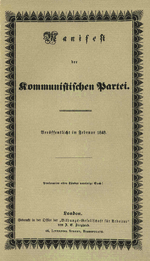
Cover of the first edition
You must be logged in to post a comment.