Posts Tagged ‘Great Depression’
“When I give food to the poor, they call me a saint. When I ask why the poor have no food, they call me a communist.”*…
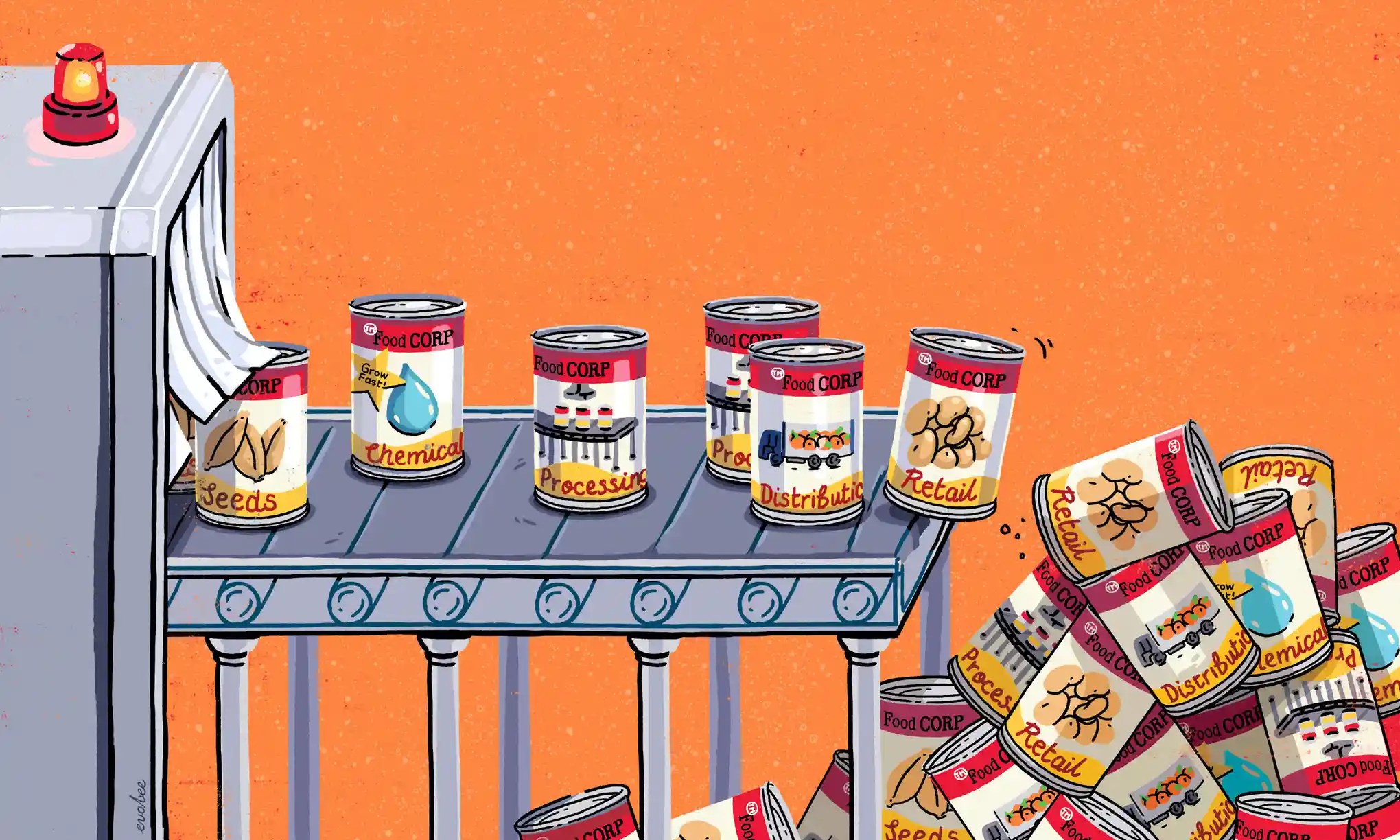
Staying yesterday’s agribusiness theme: George Monbiot on the extraordinary challenges facing the world’s food system…
For the past few years, scientists have been frantically sounding an alarm that governments refuse to hear: the global food system is beginning to look like the global financial system in the run-up to 2008.
While financial collapse would have been devastating to human welfare, food system collapse doesn’t bear thinking about. Yet the evidence that something is going badly wrong has been escalating rapidly. The current surge in food prices looks like the latest sign of systemic instability.
Many people assume that the food crisis was caused by a combination of the pandemic and the invasion of Ukraine. While these are important factors, they aggravate an underlying problem. For years, it looked as if hunger was heading for extinction. The number of undernourished people fell from 811 million in 2005 to 607 million in 2014. But in 2015, the trend began to turn. Hunger has been rising ever since: to 650 million in 2019, and back to 811 million in 2020. This year is likely to be much worse.
Now brace yourself for the really bad news: this has happened at a time of great abundance. Global food production has been rising steadily for more than half a century, comfortably beating population growth. Last year, the global wheat harvest was bigger than ever. Astoundingly, the number of undernourished people began to rise just as world food prices began to fall. In 2014, when fewer people were hungry than at any time since, the global food price index stood at 115 points. In 2015, it fell to 93, and remained below 100 until 2021.
Only in the past two years has it surged. The rise in food prices is now a major driver of inflation, which reached 9% in the UK last month. [Current estimates are that it will be 9% in the U.S. as well.] Food is becoming unaffordable even to many people in rich nations. The impact in poorer countries is much worse.
So what has been going on?…
Spoiler alert: massive food producers hold too much power – and regulators scarcely understand what is happening. Sound familiar? “The banks collapsed in 2008 – and our food system is about to do the same,” from @GeorgeMonbiot in @guardian. Eminently worth reading in full.
Then iris out and consider how agricultural land is used: “Half of the world’s habitable land is used for agriculture.”

… and consider the balance between agriculture aimed at producing food directly and agriculture aimed at producing feed and fuel: “Redefining agricultural yields: from tonnes to people nourished per hectare.”

###
As we secure sustenance, we might send carefully-observed birthday greetings to Dorothea Lange; she was born on this date in 1885. A photographer and photojournalist, she is best known for her Depression-era work for the Farm Security Administration (FSA). Lange’s photographs influenced the development of documentary photography and humanized the consequences of the Great Depression.


“The real alchemy consists in being able to turn gold back again into something else; and that’s the secret that most of your friends have lost.”*…
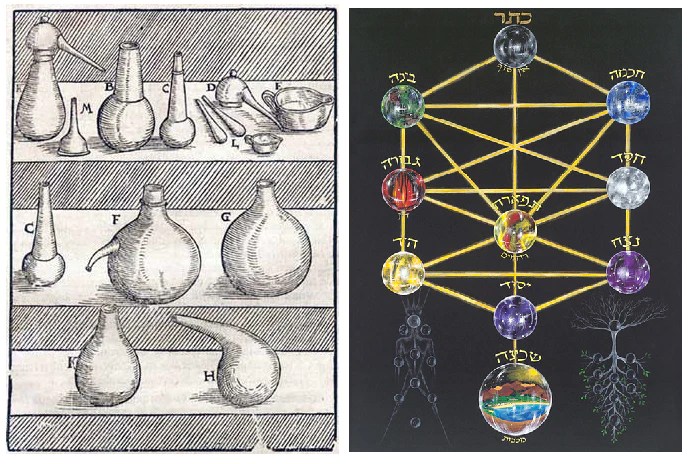
About a decade ago, the formidable Lawrence Weschler was a visiting scholar at the Getty Research Institute in Los Angeles, where he conceived a concept for an exhibit that, sadly, never materialized. Happily, he has shared the design in his wonderful newsletter, Wondercabinet…
Lead into Gold:
Proposal for a little jewel-box exhibit
surveying the Age-Old Quest
To Wrest Something from Nothing,
from the Philosopher’s Stone
through Subprime Loans
The boutique-sized (four-room) show would be called “Lead into Gold” and would track the alchemical passion—from its prehistory in the memory palaces of late antiquity through the Middle Ages

(those elaborate mnemonic techniques whereby monks and clerks stored astonishing amounts of details in their minds by placing them in ever-expanding imaginary structures, forebears, as it were, to the physical wondercabinets of the later medieval period—a sampling of manuscripts depicting the technique would grace a sort of foyer to the exhibition),

into its high classic phase (the show’s first long room) with alchemy as pre-chemistry (with maguses actually trying, that is, to turn physical lead into physical gold, all the beakers and flasks and retorts, etc.) to one side, and astrology as pre-astronomy (the whole deliriously marvelous sixteenth-into-seventeenth centuries) to the other, and Isaac Newton serving as a key leitmotif figure through the entire show (though starting out here), recast no longer in his role as the first of the moderns so much as “the Last of the Sumerians” (as an astonished John Maynard Keynes dubbed him, upon stumbling on a cache of thousands of pages of his Cambridge forebear’s detailed alchemical notes, not just from his early years before the Principia, but from throughout his entire life!).
The show would then branch off in two directions, in a sort of Y configuration. To one side:
1) The Golden Path, which is to say the growing conviction among maguses and their progeny during the later early-modern period that the point was allegorical, an inducement to soul-work, in which one was called upon to try to refine the leaden parts of oneself into ever more perfect golden forms, hence Faustus and Prospero through Jung, with those magi Leibniz and Newton riffing off Kabbalistic meditations on Infinity and stumbling instead onto the infinitesimal as they invent the Calculus, in turn eventually opening out (by way of Blake) onto all those Sixties versions, the dawning of the Age of Aquarius, etc., which set the stage for the Whole Earth Catalog and all those kid-maguses working in their garages (developing both hardware and software: fashioning the Calculus into material reality) and presently the Web itself (latter day version of those original memory palaces from back in the show’s foyer, writ large);
while, branching off to the other side, we would have:
2) The Leaden Path, in which moneychangers and presently bankers decided to cut to the chase, for, after all, who needed lead and who needed gold and for god’s sake who needed a more perfect soul when you could simply turn any old crap into money (!)—thus, for example, the South Sea Bubble, in which Newton lost the equivalent of a million dollars (whereupon he declared that he could understand the transit of stars but not the madness of men), tulipomania, etc., and thence onward to Freud (rather than Jung) and his conception of “filthy lucre” and George Soros (with his book, The Alchemy of Finance), with the Calculus showing up again across ever more elaborate permutations, leading on through Ponzi and Gecko (by way of Ayn Rand and Alan “The Wizard” Greenspan) to the whole derivatives bubble/tumor, as adumbrated in part by my own main man, the money artist JSG Boggs, and then on past that to the purest mechanism ever conceived for generating fast money out of crap: meth labs (which deploy exactly but exactly the same equipment as the original alchemists, beakers and flasks and retorts, to accomplish the literal-leaden version of what they were after, the turning of filth into lucre).
And I appended a xerox of that napkin sketch:

Eminently worth reading– and enjoying–in full. “The age-old human quest to turn nothing into something.”
* Edith Wharton
###
As we appreciate the abiding attraction of alchemy, we might recall that it was on this date in 1933 that President Franklin D. Roosevelt signed the act creating the Tennessee Valley Authority. A feature of the New Deal, the TVA was created to provide navigation, flood control, electricity generation, fertilizer manufacturing, regional planning, and economic development to the Tennessee Valley, a region (all of Tennessee, portions of Alabama, Mississippi, and Kentucky, and small areas of Georgia, North Carolina, and Virginia) which was particularly hard hit by the Great Depression relative to the rest of the nation. While owned by the federal government, TVA receives no taxpayer funding and operates similar to a private for-profit company.
The TVA has been criticized for its use of eminent domain, which resulted in the displacement of over 125,000 Tennessee Valley residents for the agency’s infrastructure projects. But on balance the TVA has been documented as a success in its efforts to modernize the Tennessee Valley and helping to recruit new employment opportunities to the region.

“All photographs are accurate. None of them is the truth.”*…

Of the 270,000 photographs commissioned by the US Farm Security Administration to document the Great Depression more than a third were “killed.” As we wrestle with the stories we’re being told, an update of an earlier post…
From his office at the Farm Security Administration (FSA) in Washington, D.C., Roy Stryker saw, time and again, the reality of the Great Depression, and the poverty and desperation gripping America’s rural communities. As head of the Information Division and manager of the FSA’s photo-documentary project, his job was to hire and brief photographers, and then select images they captured for distribution and publication. His eye helped shape the way we view the Great Depression, even today.
Professionally, Stryker was known for two things: preserving thousands of photographs from being destroyed for political reasons, and for “killing” lots of photos himself. Negatives he liked were selected to be printed. Those he didn’t—ones that didn’t fit the narrative and perspective of the FSA at the time, perhaps—were met with the business end of hole punch, which left gaping black voids in place of hog’s bellys, industrial landscapes, and the faces of farmworkers.
In 1935, the Resettlement Administration (RA) was established as part of the New Deal to provide relief, recovery, and reform to rural areas. The FSA, created in 1937, was its spiritual successor. The FSA’s duties included, but were not limited to, operating camps for victims of the Dust Bowl, setting up homestead communities, and providing education to more than 400,000 migrant families. Communicating about its efforts was also part of its mandate…
Stryker sought out photographers, among them Dorothea Lange, Gordon Parks, and Arthur Rothstein, and made their images readily available to the press. Given the lack of new photography and art being produced during the Great Depression, the photos regularly appeared in magazines such as LIFE and Look. He also had them displayed at the 1936 Democratic National Convention, the 1936 World’s Fair, the Museum of Modern Art, and other prominent venues. The publication of a series of early photographs, including Lange’s Migrant Mother, proved instrumental in pushing the federal government to provide emergency aid to migrant workers in California.
In the effort to represent the FSA and Roosevelt’s signature domestic achievement in a positive light, the chosen photos captured how the idealistic views of farm life were being tainted by poverty, and how the FSA programs were helping farmers reclaim their dignity. Common elements were decrepit housing conditions, the lack of food and clean water, and harsh work environments.
It was government propaganda, and there were certainly some within the government (both supporters and detractors) who saw it that way, and more who considered both the FSA and its photography project as communist and un-American. In a 1972 Interview, Stryker admits to having felt political pressure from the Department of Agriculture to portray the effectiveness of the New Deal. “Go to hell,” was his response. His photographers “were warned repeatedly not to manipulate their subjects in order to get more dramatic images, and their pictures were almost always printed without cropping or retouching.”
But there is a way to manipulate the story being told without altering the images themselves—the process of photo editing, of choosing which images to highlight and which to discard…
The fascinating story of one man’s (materially successful) effort to galvanize social and political opinion: “How a Hole Punch Shaped Public Perception of the Great Depression.”
See also “The Kept and the Killed.”
And for an equally-fascinating consideration of how emerging new visual technologies might similarly be used to sway sentiment, read Fred Turner‘s “The Politics of Virtual Reality.”
* Richard Avedon
###
As we contemplate cuts, we might recall that it was on this date in 1940 that the first Social Security check– for $22.54– was issued to Ida May Fuller.
The Social Security Program had been created in 1935, with qualification for eligibility (covered earnings) beginning in 1937. So Ms. Fuller, a teacher-turned legal-secretary, had been accumulating credit for three years. She lived to 100 years old and collected a total of $22,888.

“Books are a uniquely portable magic”*…

A “Pack Horse Librarian” returning for a new supply of books
The Pack Horse Library initiative, which sent librarians deep into Appalachia, was one of the New Deal’s most unique plans. The project, as implemented by the Works Progress Administration (WPA), distributed reading material to the people who lived in the craggy, 10,000-square-mile portion of eastern Kentucky. The state already trailed its neighbors in electricity and highways. And during the Depression, food, education and economic opportunity were even scarcer for Appalachians.
They also lacked books: In 1930, up to 31 percent of people in eastern Kentucky couldn’t read. Residents wanted to learn, notes historian Donald C. Boyd. Coal and railroads, poised to industrialize eastern Kentucky, loomed large in the minds of many Appalachians who were ready to take part in the hoped prosperity that would bring. “Workers viewed the sudden economic changes as a threat to their survival and literacy as a means of escape from a vicious economic trap,” writes Boyd.
This presented a challenge: In 1935, Kentucky only circulated one book per capita compared to the American Library Association standard of five to ten, writes historian Jeanne Cannella Schmitzer,. It was “a distressing picture of library conditions and needs in Kentucky,” wrote Lena Nofcier, who chaired library services for the Kentucky Congress of Parents and Teachers at the time…
Unlike many New Deal projects, the packhorse plan required help from locals. “Libraries” were housed any in facility that would step up, from churches to post offices. Librarians manned these outposts, giving books to carriers who then climbed aboard their mules or horses, panniers loaded with books, and headed into the hills. They took their job as seriously as mail carriers and crossed streams in wintry conditions, feet frozen in the stirrups.
Carriers rode out at least twice a month, with each route covering 100 to 120 miles a week…
A New Deal program brought books to Kentuckians living in the most remote areas: “Horse-Riding Librarians Were the Great Depression’s Bookmobiles.”
* Stephen King, On Writing
###
As we check it out, we might send shocking birthday greetings to the enfant terrible of French letters, Arthur Rimbaud; he was born on this date in 1854. In his adolescence and early adulthood (he wrote his final work when he was 21), and with his buddy, Symbolist poet Paul Verlaine, Rimbaud was a leader of the Decadent Movement; fueled by absinthe and hashish, he succeeded in shocking a literary establishment that was nonetheless awed by his visionary verse, which influenced modern literature and arts, inspired a number of important musicians, and prefigured Surrealism.
All known literature is written in the language of common sense—except Rimbaud’s – Paul Valéry

“Turn left at Greenland”*…

After a series of setbacks in the courts that repealed many of the First New Deal’s program, President Roosevelt pursued a new set of initiatives including the Resettlement Administration in 1935. It was charged with aiding the poorest third of farmers displaced by the depression and particularly focused on resettlement on viable lands and providing low-interest loans. Directed by Rexford Tugwell, a Columbia University economist, the RA came under immediate scrutiny. Realizing the battle for public opinion had begun, Tugwell hired his former student Roy Stryker to lead the Historic Section within the Information Division of the RA, which in 1937 was moved to the FSA.
In order to build support for and justify government programs, the Historical Section set out to document America, often at her most vulnerable, and the successful administration of relief service. The Farm Security Administration—Office of War Information (FSA-OWI) produced some of the most iconic images of the Great Depression and World War II and included photographers such as Dorothea Lange, Walker Evans, and Arthur Rothstein who shaped the visual culture of the era both in its moment and in American memory. Unit photographers were sent across the country. The negatives were sent to Washington, DC. The growing collection came to be known as “The File.” With the United State’s entry into WWII, the unit moved into the Office of War Information and the collection became known as the FSA-OWI File…
Now, from Yale, a web-based platform for organizing, searching, and visualizing 90,000 of those 170,000 photographs created by the United States Farm Security Administration and Office of War Information (FSA-OWI) from 1935 to 1945: Programmer.
* Ringo Starr, in response to the question “How do you find America?,” asked in a Beatles press conference on the first U.S. tour
###
As we look and see, we might recall that it was on this date in 1931 that Cab Calloway recorded “Minnie the Moocher,” the first jazz record to sell one million copies and the song that cemented the popularity of “scat” singing (which had been first popularized in 1926 by Louis Armstrong’s “Heebie Jeebies.”)
You must be logged in to post a comment.