Posts Tagged ‘Darwin’
Squatch Watch…
 click here (and again) for larger version
Every now and then a dataset comes along that just has to be mapped. This is one of those times.
Bigfoot. Sasquatch. Skookum. Yahoo. Whatever you call it, the towering man-like ape is a folklore staple. From stories of Yeti in the Himalayas to Wildmen in the Pacific Northwest, people have been talking about and trying to find the creature for ages. Occasionally, some form of evidence – like Patterson’s famous 1967 film – emerges and either feeds our fascination or gets dismissed as a hoax. In either case, it’s easy to see why believers search for proof and skeptics remain doubtful.
Through archival work and reports submitted directly to their website, the Bigfoot Field Researchers Organization has amassed a database of thousands of sasquatch sightings. Each report is geocoded and timestamped. Occasionally, even photos and videos of the alleged evidence are included. I’m not quite sure how I stumbled across this, but I’m glad I did.
After crawling the data and converting it to a more convenient format, I mapped and graphed all 3,313 sightings that were reported from 1921 to 2013…
Read Josh Steven‘s fascinating notes on “92 Years of Bigfoot Sightings in the U.S. and Canada” (and do browse the comments…)
###
As we we ask Nessie if she’s seen him, we might recall that it was on this date in 1836 that HMS Beagle called at the Island of St. Michael’s (north of the Azores) for letters, then sailed for England. The ship’s naturalist, Charles Darwin, did not sight Bigfoot.

Firing blanks…

Since the early 70s, academics and NGOs concerned with population growth have understood that the single most effective “lever” a society can pull to achieve population “control” (short of authoritarian birth bans, a la China) is the enhancement of women’s roles in the economy and society– the better educated, the more engaged a country’s women, the lower its fertility rate– and almost always, the more robust its economy, the more stable its polis, the healthier its environment, etc., etc. [c.f., e.g., here].
While experience continues to support this understanding, research is also suggesting that there may be another, complementary force at work; Pacific Standard reports that “French Semen Is Not What It Used To Be.”:
French men are losing sperm, and not in the fun way, according to a new study in Human Reproduction. Researchers examined semen samples given by 27,000 French men at fertility clinics, and found that the average sperm concentration fell more than 32 percent between 1989 and 2005.
Those findings echo a growing heap of research going back to the 1970s suggesting that the semen quality of men in industrialized countries is steadily declining. The most commonly-cited explanation is chemicals in the environment. Bear in mind, though, the supposed sperm-concentration drop is not a settled matter – many of the studies over the years were poorly designed, had overly-small sample sizes or were otherwise flawed. But if the ranks of men’s sperm are being thinned, for whatever reason, it could have serious implications for couples’ chances of conceiving.
###
As we ponder potency, we might send biological birthday greetings to Erasmus Darwin; he was born on this date in 1731. Erasmus was an accomplished doctor (he declined an offer to be personal physician to Charles III), but is better remembered as a key thinker in the “Midlands Enlightenment”– a founder of the Lunar Society of Birmingham and author of (among other works) Zoonomia, or, The Laws of Organic Life, which contained one of the first formal theories of evolution… one that foreshadowed the theories of Erasmus’ reader– and grandson– Charles.

Just Say “Yes!”…

Prohibited prose has been a continuing theme here at (R)D: c.f., e.g., “And the ban played on…,” “Fahrenheit 451…,” “Got you covered…,” “If we do not meet with agreeable things, we shall at least meet with something new…,” et. al.
Well it’s that time again; it’s National Banned Books Week. What better time to dip into a taboo title?
Lord knows, the options are plentiful: Darwin’s Origin of the Species, Thoreau’s On the Duty of Civil Obedience, Stowe’s Uncle Tom’s Cabin, Carroll’s Alice’s Adventures in Wonderland… Indeed, according to the Office for Intellectual Freedom, at least 46 of the Radcliffe Publishing Course Top 100 Novels of the 20th Century have been the target of ban attempts. (See the American Library Association’s list of Challenged Classics here.) For an even longer (and older) list, consult the Index Librorum Prohibitorum (List of Prohibited Books), the list of publications prohibited by the Catholic Church (from 1557 until the practice was halted in 1966).
Many, many of them are available via Project Gutenberg and/or as free downloads through Amazon, Barnes and Noble, et al.
Ladies and Gentlemen, to your easy chairs!
As we turn the page, we might recall that it was on this date in 1892 that Joshua Pusey patented the “flexible match”; he then sold his patent to the Diamond Match Trust (which he joined, as patent attorney)– and his design became the first mass-produced paper matchbook.

So many books! So little time!…
Daniel Rourke– a contributor to the terrific Three Quarks Daily, and proprietor of the equally-nifty MachineMacine— reminds us that the problems of coping with information overload are nothing new…
Agostino Ramelli’s Rotary Reader

In 1588, the Italian Engineer Agostino Ramelli described a novel invention to facilitate the reading of multiple books at once:
A beautiful and ingenious machine, which is very useful and convenient to every person who takes pleasure in study, especially those who are suffering from indisposition or are subject to gout: for with this sort of machine a man can see and read a great quantity of books, without moving his place: besides, it has this fine convenience, which is, of occupying a little space in the place where it is set, as any person of understanding can appreciate from the drawing.
The precursor, no doubt, to internet surfing… Gout beget Carpal Tunnel Syndrome beget Muscle Atrophy beget Internet Addiction Disorder. Will mankind stop at nothing in the pursuit of pure information?!?
As we meditate on multi-tasking, we might wish an admiring and grateful Happy Birthday to one of the most accomplished multi-taskers of all time, the mathematician, biologist, historian of science, literary critic, poet and inventor Jacob Bronowski; he was born on this date in 1908. Bronowski is probably best remembered as the writer (and host) of the epochal 1973 BBC television documentary series (and accompanying book), The Ascent of Man (the title of which was a play on the title of Darwin’s second book on evolution, The Descent of Man)… the thirteen-part series (which is available at libraries, on DVD, or Netflix), a survey of the history of science– from rock tools to relativity– and its place in civilizations, is still an extraordinary treat.

It’s a Bard! it’s a plain (Jane)! It’s…


Literary Action Figures! Shakespeare, Ms. Austen, plus Oscar Wilde, Edgar Allan Poe, and Charles Dickens…
Order now, and as a special bonus receive:
(TotH to Brainpickings)
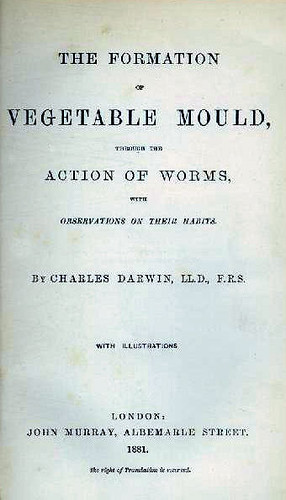
As we save up our allowance, we might recall that it was on this date in 1881 that Charles Darwin published The Formation of Vegetable Mould Through the Action of Worms-– the work he considered a more important accomplishment than The Origin of Species (1859).
You must be logged in to post a comment.