Posts Tagged ‘books’
“The test of a first-rate intelligence is the ability to hold two opposed ideas in the mind at the same time, and still retain the ability to function”*…
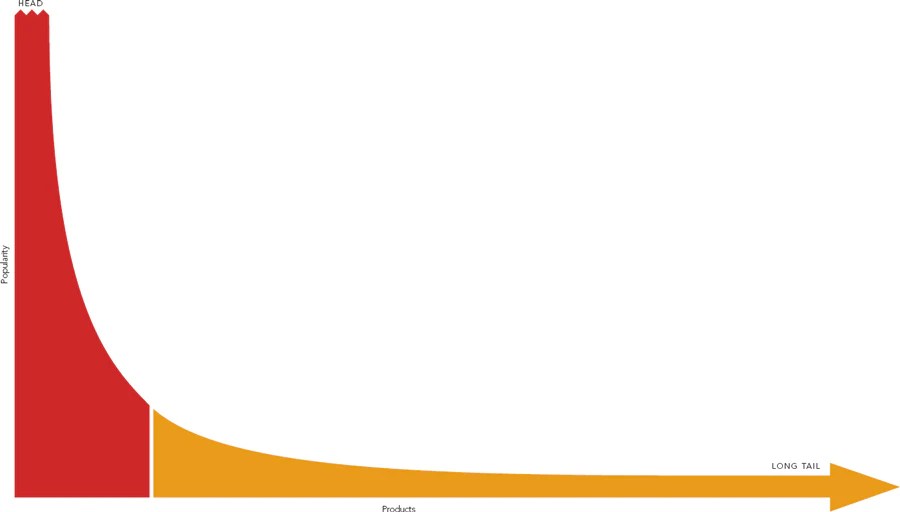
One the one hand: Ted Gioia suggests that, while ‘The Long Tail’ was supposed to boost alternative voices in music, movies, and books, the exact opposite has happened…
When I first heard people predict the rise of the Long Tail, I was amused. Not only did it seem wrong-headed, but it ran counter to everything I saw happening around me.
It pains me to say this—because the Long Tail was sold to us as an economic law that not only predicted a more inclusive era of prosperity, but would especially help creative people. According to its proponents, the Long Tail would revitalize our culture by expanding the scope of the arts and giving a boost to visionaries on the fringes of society.
Alternative voices would be nurtured and flourish. Music would get cooler and more surprising. Books would become more diverse and interesting. Indie films would reach larger audiences. Etc. etc. etc.
Hey, what’s not to like?
But it never happened. More to the point, it was never going to happen because the story was a fairy tale. I knew it back then because I had been hired on a number of occasions to analyze the Long Tail myself. But the flaws in the reasoning are far more obvious today, even to me.
Nonetheless many believed it—and many still do. So it’s worth digging into the story of the Long Tail, and examining exactly why it never delivered its promise.
And maybe we can find some alternative pathway to that lost cultural renaissance by seeing how this one went off the rails.
…
On the other hand: Cal Newport suggest that Kevin Kelly‘s fourteen-year-old prediction that an artist could make a living online with a thousand true fans is (finally) coming true…
In his “1,000 True Fans” essay, Kelly explains that he wasn’t as excited about this new economic model as others seemed to be. “The long tail is famously good news for two classes of people: a few lucky aggregators, such as Amazon and Netflix, and 6 billion consumers,” he writes. “But the long tail is a decidedly mixed blessing for creators.” If your work lives in the long tail, the introduction of Internet-based markets might mean that you go from selling zero units of your creations to selling a handful of units a month, but this makes little difference to your livelihood. “The long tail offers no path out of the quiet doldrums of minuscule sales,” Kelly writes. “Other than aim for a blockbuster hit, what can an artists do to escape the long tail?”
This question might seem fatalistic, but Kelly had a solution. If your creative work exists in the long tail, generating a small but consistent number of sales, then it’s probably sufficiently good to support a small but serious fan base, assuming you’re willing to put in the work required to cultivate this community. In an earlier age, a creative professional might be limited to fans who lived nearby. But by using the tools of the Internet, Kelly argued, it was now possible for creative types to both find and interact with supporters all around the world…
A shining example of the 1,000 True Fans model is the podcasting boom. There are more than eight hundred and fifty thousand active podcasts available right now. Although most of these shows are small and don’t generate much money, the number of people making a full-time living off original audio content is substantial. The key to a financially viable podcast is to cultivate a group of True Fans eager to listen to every episode. The value of each such fan, willing to stream hours and hours of a creator’s content, is surprisingly large; if sufficiently committed, even a modest-sized audience can generate significant income for a creator. According to an advertising agency I consulted, for example, a weekly podcast that generates thirty thousand downloads per episode should be able to reach Kelly’s target of generating a hundred thousand dollars a year in income. Earning a middle-class salary by talking through a digital microphone to a fiercely loyal band of supporters around the world, who are connected by the magic of the Internet, is about as pure a distillation of Kelly’s vision as you’re likely to find…
The real breakthroughs that enabled the revival of the 1,000 True Fans model are better understood as cultural. The rise in both online news paywalls and subscription video-streaming services trained users to be more comfortable paying à la carte for content. When you already shell out regular subscription fees for newyorker.com, Netflix, Peacock, and Disney+, why not also pay for “Breaking Points,” or throw a monthly donation toward Maria Popova? In 2008, when Kelly published the original “1,000 True Fans” essay, it was widely assumed that it would be hard to ever persuade people to pay money for most digital content. (This likely explains why so many of Kelly’s examples focus on selling tangible goods, such as DVDs or custom prints.) This is no longer true. Opening up these marketplaces to purely digital artifacts—text, audio, video, online classes—significantly lowered the barriers to entry for creative professionals looking to make a living online…
But can this last? Is it destined to fall prey to the forces that Gioia catalogues?
The recent history of the Internet, however, warns that we shouldn’t necessarily expect the endearingly homegrown nature of these 1,000 True Fans communities to persist. When viable new economic niches emerge online, venture-backed businesses, looking to extract their cut, are typically not far behind. Services such as Patreon and Kickstarter are jostling for a dominant position in this direct-to-consumer creative marketplace. A prominent recent example of such attempts to centralize the True Fan economy is Substack, which eliminates friction for writers who want to launch paid e-mail newsletters. Substack now has more than a million subscribers who pay for access to newsletters, and is currently valued at around six hundred and fifty million dollars. With this type of money at stake, it’s easy to imagine a future in which a small number of similarly optimized platforms dominate most of the mechanisms by which creative professionals interact with their 1,000 True Fans. In the optimistic scenario, this competition will lead to continued streamlining of the process of serving supporters, increasing the number of people who are able to make a good living off of their creative work: an apotheosis of sorts of Kelly’s original vision. A more pessimistic prediction is that the current True Fan revolution will eventually go the way of the original Web 2.0 revolution, with creators increasingly ground in the gears of monetization. The Substack of today makes it easy for a writer to charge fans for a newsletter. The Substack of tomorrow might move toward a flat-fee subscription model, driving users toward an algorithmically optimized collection of newsletter content, concentrating rewards within a small number of hyper-popular producers, and in turn eliminating the ability for any number of niche writers to make a living…
The future of the creative economy: “Where Did the Long Tail Go?,” from @tedgioia and “The Rise of the Internet’s Creative Middle Class,” from Cal Newport on @kevin2kelly in @NewYorker.
* F. Scott Fitzgerald (“The Crack-Up,” Esquire, February, 1936)
###
As we contemplate culture and commerce, we might recall that it was on this date in 1894 (after 30 states had already enshrined the occasion) that Labor Day became a federal holiday in the United States.

“Living with those who have lived and the companionship of those who are no longer alive… archives are a kind of site in the sense of an archaeological site”*…

Why do the archives of so many great writers end up in Texas? D.T. Max dives into what is, arguably, America’s “hottest” literary archive, and chronicles the acquisition strategy of its director…
The Harry Ransom Humanities Research Center, the literary archive of the University of Texas at Austin, contains thirty-six million manuscript pages, five million photographs, a million books, and ten thousand objects, including a lock of Byron’s curly brown hair. It houses one of the forty-eight complete Gutenberg Bibles; a rare first edition of “Alice’s Adventures in Wonderland,” which Lewis Carroll and his illustrator, John Tenniel, thought poorly printed, and which they suppressed; one of Jack Kerouac’s spiral-bound journals for “On the Road”; and Ezra Pound’s copy of “The Waste Land,” in which Eliot scribbled his famous dedication: “For E. P., miglior fabbro, from T. S. E.” Putting a price on the collection would be impossible: What is the value of a first edition of “Comus,” containing corrections in Milton’s own hand? Or the manuscript for “The Green Dwarf,” a story that Charlotte Brontë wrote in minuscule lettering, to discourage adult eyes, and then made into a book for her siblings? Or the corrected proofs of “Ulysses,” on which James Joyce rewrote parts of the novel? The university insures the center’s archival holdings, as a whole, for a billion dollars.
The current director of the center is Thomas Staley. Seventy-one, and a modernist scholar by training, he is mercurial and hard-driving. Amid the silence of the center’s Reading Room, he often greets visiting scholars with a resonant slap on the back. In college, at a Jesuit school in Colorado, Staley pitched in a summer baseball league, specializing in a slow, sinking curve. His “crafty pitch,” as he calls it, was good enough to attract the attention of professional scouts. The Ransom Center, under Staley’s leadership, easily outmaneuvers rivals such as Yale, Harvard, and the British Library. It operates more like a college sports team, with Staley as the coach—an approach that fits the temperament of Texas. “People take a special pride here in winners,” Staley says. “They like success.” (After the Ransom bought its Gutenberg Bible, the center sent the Bible on a victory lap, displaying it at libraries, museums, and universities around the state.)…
A fascinating look into the (surprisingly competitive) world of literary archives: “Final Destination,” from @dtmax in @NewYorker.
(One archive that is not at the Ransom Center is that of Lou Reed. His widow and executor Laurie Anderson had originally intended to house the papers, tapes, and memorabilia there, but changed her mind when the Texas legislature passed a law allowing the open carry of hand guns on state college campuses. They are now at the New York Public Library– and the subject of an exhibit at The Library of the Performing Arts at Lincoln Center.)
* John Berger
###
As we turn every page, we might send archival birthday greetings to Henry Clay Folger; he was born on this date in 1857. A businessman and philanthropist, he founded (with with his wife, Emily Jordan Folger) the Folger Shakespeare Library in Washington, D.C., an independent research library (and archive) that houses the world’s largest collection of the printed works of William Shakespeare, and is a primary repository for rare materials from the early modern period (1500–1750) in Britain and Europe. The library is privately endowed, and is administered by the trustees of Folger’s alma mater, Amherst College.

“A children’s story that can only be enjoyed by children is not a good children’s story in the slightest”*…

The “children’s book” effectively dates from the mid-18th century (before which children’s reading was generally confined to literature intended for their education and moral edification rather than for their amusement). Since then, there’s been an extraordinary– and illuminating– flowering…
We can learn much about how a historical period viewed the abilities of its children by studying its children’s literature. Occupying a space somewhere between the purely didactic and the nonsensical, most children’s books published in the past few hundred years have attempted to find a line between the two poles, seeking a balance between entertainment and instruction. However, that line seems to move closer to one pole or another depending on the prevailing cultural sentiments of the time. And the very fact that children’s books were hardly published at all before the early 18th century tells us a lot about when and how modern ideas of childhood as a separate category of existence began.
“By the end of the 18th century,” writes Newcastle University professor M.O. Grenby, “children’s literature was a flourishing, separate and secure part of the publishing industry in Britain.” The trend accelerated rapidly and has never ceased—children’s and young adult books now drive sales in publishing (with 80% of YA books bought by grown-ups for themselves)…
More– and a chance to do your own exploration– at “Enter an Archive of 6,000 Historical Children’s Books, All Digitized and Free to Read Online,” from @openculture. Go directly to the 6,000+ titles in the Baldwin Library of Historical Children’s Literature here.
And as a bonus, visit the 1,800+ titles in UCLA Children’s Book Collection at the Internet Archive.
* C. S. Lewis
###
As we turn the page, we might turn back to “adult” literature and recall that today– and every June 16– is Bloomsday, a commemoration and celebration of the life of Irish writer James Joyce, during which the events of his novel Ulysses (a modern classic set on this date in 1904) are relived: Leopold Bloom goes about Dublin, James Joyce’s immortalization of his first outing with Nora Barnacle, the woman who would eventually become his wife.
The first Bloomsday was observed on the 50th anniversary of the events in the novel, in 1954, when John Ryan (artist, critic, publican and founder of Envoy magazine) and the novelist Brian O’Nolan organized what was to be a daylong pilgrimage along the Ulysses route. They were joined by Patrick Kavanagh, Anthony Cronin, Tom Joyce (a dentist who, as Joyce’s cousin, represented the family interest), and AJ Leventhal (a lecturer in French at Trinity College, Dublin).

“Don’t raise your voice, improve your argument”*…

Through reading, champion debater Bo Sen learned that disagreement can be a source of good, not ill, even in our polarized age.
Nowadays, disagreement is out of fashion. It is seen as the root of our personal and political troubles. Debate, in making a sport out of argument, seems at once a trivial pursuit and a serious impediment to the kinds of conversation we want to cultivate. But in my first book, Good Arguments, I propose that the opposite is true. Students may train to win every disagreement, but they soon learn that this is impossible. Even the best lose most of the competitions they attend. What one can do is disagree better—be more convincing and tenacious, and argue in a manner that keeps others willing to come back for another round. In the end, the prize for all that training and effort is a good conversation…
He shares several recommendations, e.g…
Thinking in an Emergency, by Elaine Scarry
Scarry, one of my English professors at Harvard, is the rare scholar who can change how you move through the world. She has made a career of bringing language to the ineffable ends of human experience: pain and beauty. In Thinking in an Emergency, she places deliberation at the core of a democratic response to emergencies including natural disasters and nuclear war. Scarry argues that debate, both real-time and prospective, need not hinder action and can instead secure the resolve and coordination needed for rapid response. She warns against leaders who invoke catastrophes to demand that their populations stop thinking. In this era of calamities, natural and man-made, Scarry’s wisdom is essential: “Whatever happens, keep talking.”
…
The Autobiography of Malcolm X, by Malcolm X and Alex Haley
Malcolm X learned to debate as a 20-something in what was then called Norfolk Prison Colony, a state prison founded on reformist ideals that fielded debate teams against local colleges such as Boston University. In his memoir, X describes the experience of finding one’s voice and communing with an audience as a revelation: “I will tell you that, right there, in the prison, debating, speaking to a crowd, was as exhilarating to me as the discovery of knowledge through reading had been … once my feet got wet, I was gone on debating.” For most people, debate is a pastime of school and university years. This memoir shows that one can make a career and a life from its lessons in fierce, courageous, and resolute disagreement.
…
When Should Law Forgive?, by Martha Minow
One question I struggle with in Good Arguments is when we should stop debating. Minow, a former dean of Harvard Law School, provides here a model of humane consideration on the limits of the adversarial ethic. Hers is an argument for accommodating forgiveness—the “letting go of justified grievances”—in the legal system. She builds the book as one would a spacious house, each area of the law—juvenile justice, debt, amnesties and pardons—a separate chapter in which readers are invited to stay and reflect awhile. Martha Nussbaum is illuminating on related topics in her critique of anger in Anger and Forgiveness, which elicited rebuttal from Myisha Cherry in The Case for Rage, an argument for the emotion’s usefulness in conditions of resistance. The need to balance dispute and conciliation, accountability and grace, cannot be transcended, only better managed.
Seven more recommendations at “The Books That Taught a Debate Champion How to Argue,” from @helloboseo in @TheAtlantic.
* Desmond Tutu
###
As we put the civil back into civil discourse, we might recall that it was on this date in 1966 that the Roman Catholic Church announced, via a notification from the Congregation for the Doctrine of the Faith, the abolition of the Index Librorum Prohibitorum (“index of prohibited books”), which was originally instituted in 1557. The communique stated that, while the Index maintained its moral force, in that it taught Christians to beware, as required by the natural law itself, of those writings that could endanger faith and morality, it no longer had the force of ecclesiastical positive law with the associated penalties. So… read on.

“I rather think that archives exist to keep things safe – but not secret”*…

Brewster Kahle, founder and head of The Internet Archive couldn’t agree more, and for the last 25 years he’s put his energy, his money– his life– to work trying to make that happen…
In 1996, Kahle founded the Internet Archive, which stands alongside Wikipedia as one of the great not-for-profit knowledge-enhancing creations of modern digital technology. You may know it best for the Wayback Machine, its now quarter-century-old tool for deriving some sort of permanent record from the inherently transient medium of the web. (It’s collected 668 billion web pages so far.) But its ambitions extend far beyond that, creating a free-to-all library of 38 million books and documents, 14 million audio recordings, 7 million videos, and more…
That work has not been without controversy, but it’s an enormous public service — not least to journalists, who rely on it for reporting every day. (Not to mention the Wayback Machine is often the only place to find the first two decades of web-based journalism, most of which has been wiped away from its original URLs.)…
Joshua Benton (@jbenton) of @NiemanLab debriefs Brewster on the occasion of the Archive’s silver anniversary: “After 25 years, Brewster Kahle and the Internet Archive are still working to democratize knowledge.”
Amidst wonderfully illuminating reminiscences, Brewster goes right to the heart of the issue…
Corporations continue to control access to materials that are in the library, which is controlling preservation, and it’s killing us….
[The Archive and the movement of which it’s a part are] a radical experiment in radical sharing. I think the winner, the hero of the last 25 years, is the everyman. They’ve been the heroes. The institutions are the ones who haven’t adjusted. Large corporations have found this technology as a mechanism of becoming global monopolies. It’s been a boom time for monopolists.
###
As we love librarians, we might send carefully-curated birthday greetings to Frederick Baldwin Adams Jr.; he was born on this date in 1910. A bibliophile who was more a curator than an archivist, he was the the director of the Pierpont Morgan Library in New York City from 1948–1969. His predecessor, Belle da Costa Greene, was responsible for organizing the results of Morgan’s rapacious collecting; Adams was responsible for broadening– and modernizing– that collection, adding works by Virginia Woolf, E. M. Forster, Willa Cather, Robert Frost, E. A. Robinson, among many others, along with manuscripts and visual arts, and for enhancing the institution’s role as a research facility.
Adams was also an important collector in his own right. He amassed two of the largest holdings of works by Thomas Hardy and Robert Frost, as well as one of the leading collections of writing by Karl Marx and left-wing Americana.

You must be logged in to post a comment.