Posts Tagged ‘art’
“It is what you read when you don’t have to that determines what you will be when you can’t help it”*…
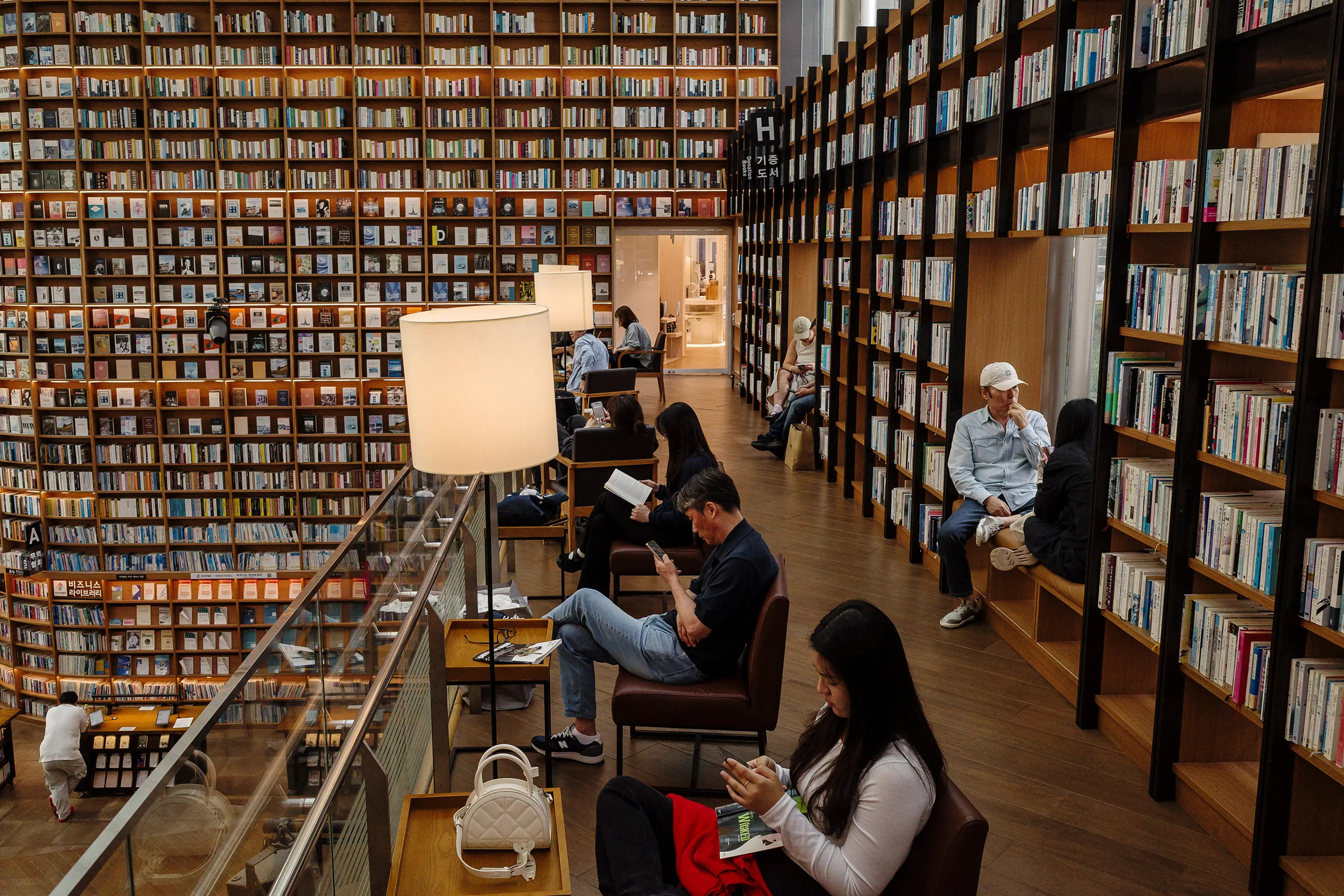
… What we read– and, librarian Carlo Iacono argues, how we read.
Our inabilty to focus isn’t a failing. It’s a design problem, and the answer isn’t getting rid of our screen time…
Everyone is panicking about the death of reading. The statistics look damning: the share of Americans who read for pleasure on an average day has fallen by more than 40 per cent over the past 20 years, according to research published in iScience this year. The OECD calls the 2022 decline in educational outcomes ‘unprecedented’ across developed nations. In the OECD’s latest adult-skills survey, Denmark and Finland were the only participating countries where average literacy proficiency improved over the past decade. Your nephew speaks in TikTok references. Democracy itself apparently hangs by the thread of our collective attention span.
This narrative has a seductive simplicity. Screens are destroying civilisation. Children can no longer think. We are witnessing the twilight of the literate mind. A recent Substack essay by James Marriott proclaimed the arrival of a ‘post-literate society’ and invited us to accept this as a fait accompli. (Marriott does also write for The Times.) The diagnosis is familiar: technology has fundamentally degraded our capacity for sustained thought, and there’s nothing to be done except write elegiac essays from a comfortable distance.
I spend my working life in a university library, watching how people actually engage with information. What I observe doesn’t match this narrative. Not because the problems aren’t real, but because the diagnosis is wrong.
The declinist position rests on a category error: treating ‘screen culture’ as a unified phenomenon with inherent cognitive properties. As if the same device that delivers algorithmically curated rage-bait and also the complete works of Shakespeare is itself the problem rather than how we decide to use it…
[… observing that “people who ‘can’t focus’ on traditional texts can maintain extraordinary concentration when working across modes, he argues that “we haven’t become post-literate. We’ve become post-monomodal. Text hasn’t disappeared; it’s been joined by a symphony of other channels.”…]
… What troubles me most about the declinist position is not its diagnosis but its conclusion. The commentators who lament the post-literate society often identify the same villains I do. They recognise that technology companies are, in Marriott’s words, ‘actively working to destroy human enlightenment’, that tech oligarchs ‘have just as much of a stake in the ignorance of the population as the most reactionary feudal autocrat.’
And then they surrender. As Marriott says: ‘Nothing will ever be the same again. Welcome to the post-literate society.’
This is the move I cannot follow. To name the actors responsible and then treat the outcome as inevitable is to provide them cover. If the crisis is a force of nature, ‘screens’ destroying civilisation like some technological weather system, then there’s nothing to be done but write elegiac essays from a comfortable distance. But if the crisis is the product of specific design choices made by specific companies for specific economic reasons, then those choices can be challenged, regulated, reversed.
The fatalism, however beautifully expressed, serves the very interests it condemns. The technology companies would very much like us to believe that what they’re doing to human attention is simply the inevitable result of technological progress rather than something they’re doing to us, something that could, with sufficient political will, be stopped.
Your inability to focus isn’t a moral failing. It’s a design problem. You’re trying to think in environments built to prevent thinking. You’re trying to sustain attention in spaces engineered to shatter it. You’re fighting algorithms explicitly optimised to keep you scrolling, not learning.
The solution isn’t discipline. It’s architecture. Build different defaults. Create different spaces. Establish different rhythms. Make depth as easy as distraction currently is. Make thinking feel as natural as scrolling currently does.
What if, instead of mourning some imaginary golden age of pure text, we got serious about designing for depth across all modes? Every video could come with a searchable transcript. Every article could offer multiple entry points for different levels of attention. Our devices could recognise when we’re trying to think and protect that thinking. Schools could teach students to translate between modes the way they once taught translation between languages.
Books aren’t going anywhere. They remain unmatched for certain kinds of sustained, complex thinking. But they’re no longer the only game in town for serious ideas. A well-crafted video essay can carry philosophical weight. A podcast can enable the kind of long-form thinking we associate with written essays. An interactive visualisation can reveal patterns that pages of description struggle to achieve.
The future belongs to people who can dance between all modes without losing their balance. Someone who can read deeply when depth is needed, skim efficiently when efficiency matters, listen actively during a commute, and watch critically when images carry the argument. This isn’t about consuming more. It’s about choosing consciously.
We stand at an inflection point. We can drift into a world where sustained thought becomes a luxury good, where only the privileged have access to the conditions that enable deep thinking. Or we can build something unprecedented: a culture that preserves the best of print’s cognitive gifts while embracing the possibilities of a world where ideas travel through light, sound and interaction.
The choice isn’t between books and screens. The choice is between intentional design and profitable chaos. Between habitats that cultivate human potential and platforms that extract human attention.
The civilisations that thrive won’t be the ones that retreat into text or surrender to the feed. They’ll be the ones that understand a simple truth: every idea has a natural form, and wisdom lies in matching the mode to the meaning. Some ideas want to be written. Others need to be seen. Still others must be heard, felt or experienced. The mistake is forcing all ideas through a single channel, whether that channel is a book or a screen.
Your great-grandchildren won’t read less than you do. They’ll read differently, as part of a richer symphony of sense-making. Whether that symphony sounds like music or noise depends entirely on the choices we make right now about the shape of our tools, the structure of our schools, and the design of our days.
The elegant lamenters offer a eulogy. I’m more interested in a fight…
Reunderstanding reading: “Books and screens,” from @carloiacono.bsky.social in @aeon.co.
* Oscar Wilde
###
As we turn the page, we might note that we’ve been here before, and celebrate the emergence of a design, an innovation, a technology that took on a life of its own and changed reading and… well, everything: this day in 1455 is the traditionally-given date of the publication of the Gutenberg Bible, the first Western book printed from movable type.
(Lest we think that there’s actually anything new under the sun, we might recall that The Jikji— the world’s oldest known extant movable metal type printed book– was published in Korea in 1377; and that Bi Sheng created the first known moveable type– out of wood– in China in 1040.)

“A good photograph is knowing where to stand”*…

Today’s post– commemorating the 124th birthday of a man who knew exactly where to stand– reverses (Roughly) Daily‘s usual format, opening with the almanac entry…
We might send thoughtfully-composed birthday greetings to Ansel Adams; he was born on this date in 1902. A photographer who specialized in landscapes, especially in black-and-white photos of the American West, he was hugely influential both in photography and in environmentalism.
Adams helped found Group f/64, an association of photographers advocating “pure” photography which favored sharp focus and the use of the full tonal range of a photograph; was a key advisor in establishing the photography department at the Museum of Modern Art in New York, and a founder of the photography journal Aperture.
His love of photography was born when, at age 12, he visited Yosemite and took his first shots. He became a life-long advocate for environmental conservation, a commitment deeply intertwined with his photographic practice. At one point, he contracted with the United States Department of the Interior to make photographs of national parks. For his work and his persistent advocacy, which helped expand the National Park system, he was awarded the Presidential Medal of Freedom in 1980.
Visit the Ansel Adams Gallery to see more of Adams’ signature lanscape and natural wonder work.

Adams, c. 1950 (source)
###
On the occasion of Adams’ birthday, we might note that, working photographer that he was, he took commercial assignments from time to time– assignments focused on subjects not usually associated with Adams. Two of them are especially interesting…
A collection of photos taken for Fortune Magazine in Los Angeles in the run-up to World War II documented the lives of workers in Los Angeles’ booming aviation industry…


More at “Ansel Adams’ Photos of Pre-War Los Angeles.”
And then, from the early 1960s, photos taken by Adams for Stanford’s PACE Program…
“Once it was a rich, sleepy school with rich, sleepy students; now it aims to be the ‘Harvard of the West’.” That was how Time magazine described Stanford University in the fall of 1962. The publication had been reporting on Stanford’s PACE program, a massive fundraising effort that the school launched to strive toward the kind of prominence that its founders Leland and Jane Stanford had originally envisioned. The core drive behind PACE, an acronym for Plan of Action for a Challenging Era, was for Stanford to transcend its “sleepy” backwater reputation (the “rich” part would remain) and emerge as a potential Western rival to the Ivy League universities on the East Coast.
When it came to PACE’s promotional materials for wooing donors, Stanford’s planning department hired Ansel Adams to produce the visuals. Adams was already well known and highly accomplished at the time, having shot the majority of his masterpiece landscapes depicting the natural grandeur of the American West. But in the early 1960s, he was also still a for-hire photographer trying to make a living in the Bay Area. According to archival letters, Adams and his team of photographers were contracted for $3,000 to produce a series of images from around the Stanford campus over a period of two months in early 1961.
The PACE program ultimately proved to be a resounding success, to the tune of $114 million in fundraising (nearly $1.1 billion today), which became foundational to Stanford’s present-day status as an ultra-elite university. In parallel fashion, Adams would eventually be considered the great American photographer of his era, an exceedingly rare household name in the world of photography, and a visual artist still highly celebrated in museums and pricey galleries around the world. However, his series of Stanford photographs was never recorded in his otherwise meticulous photo log and fell into deep obscurity, becoming all but never-before-seen images by the general public and unknown to even his biographers and archivists…
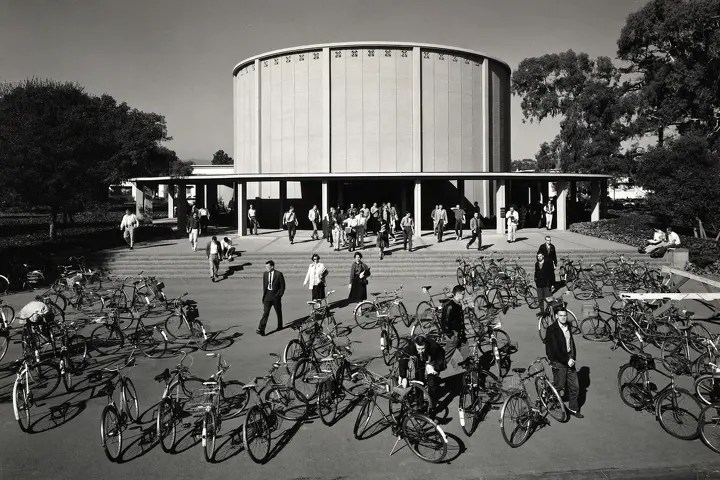

More at “Lost California photos from Ansel Adams.”
* Ansel Adams
“Traduttore, traditore”*…

Translation is key to communication across cultures– and across time. But as the old Italian adage above suggests, transaction is difficult; indeed, translation is sure, from time to time, to fail. (C.f., e.g., here) The estimable Jonathan Bate shares a “tragic” example…
One of the most consequential misunderstandings in the history of literary criticism turns on a single Greek word. In Aristotle’s Poetics, that word is hamartia. It is usually rendered, in classrooms and handbooks, as “tragic flaw,” and on that translation an entire tradition of reading tragedy has been erected. Yet if we return to Aristotle’s Greek and trace the word’s history with some philological care, it becomes clear that this familiar formula rests on a slow but decisive mistranslation—less an error at a single moment than a long cultural drift in which a term meaning “mistake” gradually hardened into a doctrine of moral defect.
In classical Greek, hamartia belongs to the language of action rather than character. Its root sense is concrete and kinetic: to miss one’s mark, as an archer misses the target. By extension, it denotes an error, a misjudgment, a false step—often one made in ignorance of some crucial fact. Aristotle uses the term this way throughout his works, ethical and otherwise. In the Poetics, when he says that the tragic hero falls into misfortune “because of hamartia,” he is careful to exclude two alternatives. The hero does not fall because he is wicked, nor because he is exceptionally virtuous. Tragedy, for Aristotle, does not punish vice or reward goodness; it stages the vulnerability of human action to error within an intelligible but unstable world. The downfall comes about δι’ ἁμαρτίαν—because of an error, not because the hero is “flawed” in a modern psychological or ethical sense…
[Bate locates this reading in the larger corpus of Aristotle’s thinking, then traces the evolution of the reading of hamartia— and of the culture(s) that informed those understandings. He concludes…]
… the history of hamartia traces a remarkable arc: from error in action, to moral fault, to sin, to vice, to psychological flaw. Each step made sense within its own intellectual climate, yet the cumulative effect was to impose on Aristotle a conception of tragedy he would scarcely have recognized. What began as a missed mark became a stain on the soul. And with that shift, tragedy itself was subtly transformed—from a meditation on human fallibility into a lesson on personal failure…
The history of a misreading: “Aristotle and the so-called Tragic Flaw,” from @profbate.bsky.social.
* Old Italian adage: “translator, traitor” (or, “to translate is to betray”) See here and here.
###
As we tangle with tragedy, we might recall that it was on this date in 1904 that Giacomo Puccini‘s Madama Butterfly premiered at La Scala in Milan. The tragic opera (with a libretto by Luigi Illica and Giuseppe Giacosa) was based on the 1898 short story “Madame Butterfly” by John Luther Long, which in turn was based on stories told to Long by his sister Jennie Correll, and on the semi-autobiographical 1887 French novel Madame Chrysanthème by Pierre Loti. Long’s version was dramatized by David Belasco as the one-act play Madame Butterfly: A Tragedy of Japan, which, after premiering in New York in 1900, moved to London, where Puccini saw it in the summer of that year.
The premiere in Milan was a fiasco, beset by several bad staging decisions, from the lack of an intermission during the second act to the device of giving audience plants nightingale whistles to deepen the sense of sunrise in the final scene– which the audience took as a cue to make their own animal noises. Today Madama Butterfly is considered a masterpiece and is the sixth most performed opera in the world.

“Where’s the beef?”*…

There’s been some consternation over the FDA’s new food pyramid, with nutritionists arguing that, while the emphasis on “whole foods” (as opposed to processed) is a plus, the guidance overstresses satured-fat-rich foods and under-recommends gut-healthy fermented foods, and beans and grains (see also here).
There could be material economic costs as well. The Federal goverment already spends over $72 Billion subsidizing livestock— not counting the reduced cost grazing permits offered ranchers on Federal land. And as ranch and farm land ownership has become more and more concentrated in fewer and fwer hands, the benifits are flowing to fewer, wealthier “ranchers” (like Bill Gates, Warren Buffett, Jeff Bezos, a clutch of large corporations, and foreign investors).
Then there are the environmental implications. Oliver Milman ponders the potential scale of that impact if the new pyramid is followed…
The Trump administration’s new dietary guidelines urging Americans to eat far more meat and dairy products will, if followed, come at a major cost to the planet via huge swathes of habitat razed for farmland and millions of tons of extra planet-heating emissions.
A new inverted food pyramid recently released by Donald Trump’s health department emphasizes pictures of steak, poultry, ground beef and whole milk, alongside fruits and vegetables, as the most important foods to eat.
The new guidelines are designed to nearly double the amount of protein currently consumed by Americans. “Protein and healthy fats are essential and were wrongly discouraged in prior dietary guidelines,” said Robert F Kennedy Jr, the US health secretary. “We are ending the war on saturated fats.”
But a surge in meat-eating by Americans would involve flattening vast tracts of ecosystems such as forests to make way for the hefty environmental hoofprint of raised livestock, emitting large quantities of greenhouse gases in the process, experts have warned.
Even a 25% increase in the amount of protein consumed in this way in the US would require about 100m acres of additional agricultural land each year, an area about the size of California, and add hundreds of millions of tons of extra pollution to an already overheating planet, according to an estimate by the World Resources Institute (WRI), a non-profit research body.
“We are seeing millions of acres of forest cut down and agricultural expansion is the lead driver of that – adding 100m acres to that to feed the US means additional pressure on the world’s remaining ecosystems,” said Richard Waite, the director of agriculture initiatives at WRI.
“It’s already hard to feed the global population while reducing emissions and stopping deforestation, and a shift in this direction would make the challenge even harder. We need to reduce the impact of our food systems urgently and the US is an important piece of the puzzle in doing that.”
While many Americans will simply ignore the guidelines, the new framework will probably influence institutions such as schools and federal workplaces. The average American already eats about 144kg (317lb) of meat and seafood a year, second globally only to Portugal, and ingests more protein than previous federal government guidelines recommended.
Any further increase will be felt in places such as the Amazon rainforest, which is already being felled at a rapid rate for cattle ranches and to grow livestock feed.
Red meat, in particular, has an outsized impact upon the planet – beef requires 20 times more land and emits 20 times more greenhouse gas emissions per gram of protein than common plant proteins, such as beans. The raising of cows, pigs, lamb and other animals for slaughter is also associated with significant localized air and water pollution.
“To the extent that people follow these guidelines and eat more animal protein foods, particularly beef and dairy, they will negatively impact our environment, since the production of these foods emits way more greenhouse gases than vegetable protein foods, or even other animal foods,” said Diego Rose, a director of nutrition at Tulane University.
Choosing beef over beans and lentils is “a big choice we make that has real consequences”, said Waite. “If people want more protein there are ways to do that via eating plant-based foods without the environmental impacts. We can have our protein and our forests, too.”
Animal agriculture is responsible for about a fifth of global emissions, with little progress made in recent years to reduce its impact as more of the world starts to demand meat products. Worldwide consumption of pork, beef, poultry and meat is projected to reach over 500m tonnes by 2050 –double what it was in 2000.
In the US, much of this meat-eating is concentrated in a relatively small group of avid carnivores – just 12% of Americans consume nearly half of the country’s beef, a 2024 study found. But plant-based options, including “fake meat” burgers, have suffered a slump in sales in recent years amid a resurgent trend in meat-eating, fueled by online “meatfluencers” and a broader desire to consume more protein.
The environmental problems associated with the meat industry were previously highlighted by Kennedy himself, when he was a campaigner on green issues. At one point, Kennedy even said the pork industry was an even bigger threat to the US than Osama bin Laden, the terrorist mastermind.
“The factory meat industry has polluted thousands of miles of America’s rivers, killed billions of fish, pushed tens of thousands of family farmers off their land, sickened and killed thousands of US citizens, and treated millions of farm animals with unspeakable and unnecessary cruelty,” Kennedy wrote in 2004.
However, since becoming Trump’s health secretary, Kennedy has sought to elevate meat-eating, dismissing an independent scientific committee’s advice to emphasize plant-based proteins to instead favor meat.
“The Trump administration will no longer weaponize federal food policy to destroy the livelihoods of hard-working American ranchers and protein producers under the radical dogma of the Green New Scam,” a spokesperson for the Department of Health and Human Services said in response to questions about the knock-on environmental impacts of the new guidelines.
“Americans already eat a lot of meat, so this promotion of more meat and things like beef tallow is puzzling to me,” said Benjamin Goldstein, a researcher at the University of Michigan who has studied the huge emissions associated with meat-eating by city-dwellers in the US.
“We needed to be addressing climate change two decades ago and we are still not doing enough now. If we are adding more greenhouse gases to impose unnecessary ideas of protein intake, that’s going to destabilize the climate further. It’s going to have a big impact.”…
Even 25% increase in meat and dairy consumption would require 100m more acres of agricultural land: “Huge amounts of extra land needed for RFK Jr’s meat-heavy diet guidelines,” from @olliemilman.bsky.social in @theguardian.com.
* Wendy’s advertising tagline (from 1984)
###
As we deconstruct diet, we might send bibulous birthday greetings to William Claude Dukenfield; he was born on this date in 1880. Better known by his stage name, W.C. Fields, an actor, comedian, juggler, and writer, became a vaudeville headliner, “the world’s greatest juggler” [which he may have been], then transitioned to Broadway (e.g., the Ziegfeld Follies revue and Poppy, wherein he perfected his persona as a colorful small-time con man) and began appearing in silent films. In the 1930s, Fields wrote and starred in a series of successful short films for (his golf buddy) Mack Sennett, then appeared in 13 feature films for Paramount. An illness sidelined him in the late 30s, but he roared back in the early 40s with Universal classics like My Little Chickadee, The Bank Dick, and Never Give a Sucker an Even Break.
Now widely regarded one of the comic geniuses of the 20th century, the Surrealists loved Fields’ absurdism and anarchistic pranks. Max Ernst painted a Project for a Monument to W. C. Fields (1957), and René Magritte made an Homage to Mack Sennett (1934).
The Firesign Theatre titled the second track of their 1968 album Waiting for the Electrician or Someone Like Him “W. C. Fields Forever,” a riff on the Beatles song “Strawberry Fields Forever.”
“I personally stay away from natural foods. At my age I need all the preservatives I can get.”
– W. C. Fields

“Early modern society created – and we have inherited – that paradoxical thing: a tradition of radical innovation”*…

A University of Chicago economist with a specialty in the economics of creativity, David Galenson, with an argument that the Impressionists contributed more than their works to the story of art…
Since the 1960s the art world has become accustomed to the arrival of startling new works by contemporary artists, from Yves Klein’s anthropometries created by nude models covered with blue paint, Piero Manzoni’s canned feces, and Andy Warhol’s silkscreened portraits, through Andres Serrano’s crucifix in urine, Damien Hirst’s sectioned animals in formaldehyde, and Tracey Emin’s soiled bed, to Maurizio Cattelan’s duct-taped banana. Yet few art experts understand that these radical works are only the most recent consequences of a fundamental change in the structure of art markets that occurred more than a century ago. And the artists who initiated this change are today so venerated that few people realize how radical they were in their own time…
Art historians have long recognized that a radical change occurred in the appearance of fine art during the late 19th and early twentieth centuries, but they have failed to explain why this happened when it did. The answer lies in a change in the structure of the market for art, initiated by Claude Monet and a small group of his friends. The Impressionist group exhibitions of 1874–86 effectively ended the official Salon’s monopoly of the ability to certify artists as qualified professionals, and began a new regime in which small independent group exhibitions competed for attention. The result was a new era of artistic freedom, as painters no longer had to satisfy the conservative Salon jury, and new styles challenged for leadership of the art world. The heightened demand for originality favored conceptual artists, who could innovate conspicuously and decisively. So ironically, Monet and his fellow experimental Impressionists came under attack from the supporters of Seurat, van Gogh, Gauguin, and other young conceptual artists. The growing independence of private galleries, which further contributed to fostering competition, would allow Matisse, Picasso, and their peers to consolidate this revolution early in the next century. And the products of this perpetual revolution have included such later works as Warhol’s silkscreened portraits, Hirst’s sectioned animals, and Cattelan’s duct-taped banana. Art historians have described the transformation of modern art in great detail, but have failed to recognize the causal role of economic forces, as the shift from monopsony to a competitive market gave artists a new freedom to innovate, and made the modern era a time of continuing radical innovation…
Fascinating: “Marketing modern art: how the impressionists started a perpetual revolution,” from @jcultecon.bsky.social.
Bay Area readers can peek at the process in motion at The MFA’s Legion of Honor in the “Manet & Morisot” exhibition, up through March 1.
###
As we divvy up the difference, we might send avant-garde birthday greetings to a beneficiary of this emergent cultural mechanism, Francis Picabia; he was born on this date in 1879. A French avant-garde painter, poet, and typographist, Picabia experimented with Impressionism and Pointillism before becoming a Cubist. He then became one of the early major figures of the Dada movement in the United States and in France, and was later briefly associated with Surrealism.
See his work at the record of a major retrospective hung at the Museum of Modern Art in New York in 2017 on their web site.

You must be logged in to post a comment.