Posts Tagged ‘Animation’
“The horror! The horror!”

Tis the season, thus time for seasonal specials. Indeed, since 1990, those fabulous folks behind The Simpsons have given us annual installments of what’s become a beloved Halloween tradition: The Treehouse of Horror, a collection of wonderful riffs on horror and sci-fi films/shows/tropes that never fails to delight.
Enthusiasts have created beaucoup “best of” lists (see here and here, for a couple of examples). Now, just in time (this year’s installment airs tonight), Bo McCready has created a terrific resource: a comprehensive run-down of the source/inspiration of each Treehouse of Horror segment– in infographic form. A small excerpt:

See it all at “Treehouse of Horror: 100+ Simpsons Halloween Stories!” from @boknowsdata.
Apposite: “Run for your life, Charlie Brown.”
* Joseph Conrad, Heart of Darkness
###
As we trick and treat, we might recall that it was on this date in 1938 that the Mercury Theater broadcast the Halloween episode of its weekly series on the WABC Radio Network, Orson Welle’s adaptation of H.G. Wells’ War of the Worlds. The first two-thirds of the show (which was uninterrupted by ads) was composed of simulated news bulletins… which suggested to many listeners that a real Martian invasion was underway. (While headlines like the one below suggest that there was widespread panic, research reveals that the fright was more subdued. Still there was an out-cry against the “phoney-news” format… and Welles was launched into the notoriety that would characterize his career ever after.)

“These fragments I have shored against my ruins”*…

On its publication in 1922, T. S. Eliot’s “The Waste Land” was not so well received: “so much waste paper,” opined The Guardian. But of course since then it has ascended into the canon. Four writers and scholars– Beci Carver, Jahan Ramazani, Robert Crawford, and David Barnes— explain why now “the poem is such a key landmark that all modern poets know it, whether they swerve around it, crash into it, or attempt to assimilate it.”
Though I do understand why people often see—and hear—“The Love Song of J. Alfred Prufrock” as inventing modern poetry in English, I think The Waste Land does so more comprehensively. It’s as if this poem can give anything—a cry, a list of place-names, a snatch of conversation, a Sanskrit word, a nursery rhyme, an echo—an almost infinite and carrying resonance that brings with it unforgettable intensity. Ezra Pound who, prior to editing The Waste Land, had just been editing an English translation of an avant-garde collage-style French poem by Jean Cocteau, helped give the poem its intensity; but the words were Eliot’s.
… Pound’s editing was highly ethical in that he did not add or substitute words of his own; he just honed what Eliot had written. Eliot had learned from Pound’s bricolage style, but where Pound went on to go on and on and on, Eliot (with Pound’s editorial help) learned as a young poet just when to stop. That’s a great gift. So the poem exemplifies at once the way in which poetry can incorporate all kinds of diverse materials; yet it also constitutes a supreme example of poetic intensity. It’s quite a combination—and one from which innumerable poets (from Auden to Xu Zhimo and from MacDiarmid to Okigbo and beyond) have learned…
Robert Crawford
The appreciation in full at “The Most Important Poem of the 20th Century: On T.S. Eliot’s ‘The Waste Land’ at 100,” in @lithub.
* T. S. Eliot, “The Waste Land”
###
As we muse on modernism, we might recall that it was on this date in 1966 that It’s the Great Pumpkin, Charlie Brown” premiered on CBS. The special, based on Charles Schulz’s Peanuts comic strip and produced/animated by Bill Melendez, pre-empted My Three Sons and tied Bonanza as the top-rated program of the week. It has aired every year since, on network television until 2020, when Apple TV won the exclusive rights to the show.

“I have not yet lost a feeling of wonder, and of delight, that the delicate motion should reside in all the things around us”*…
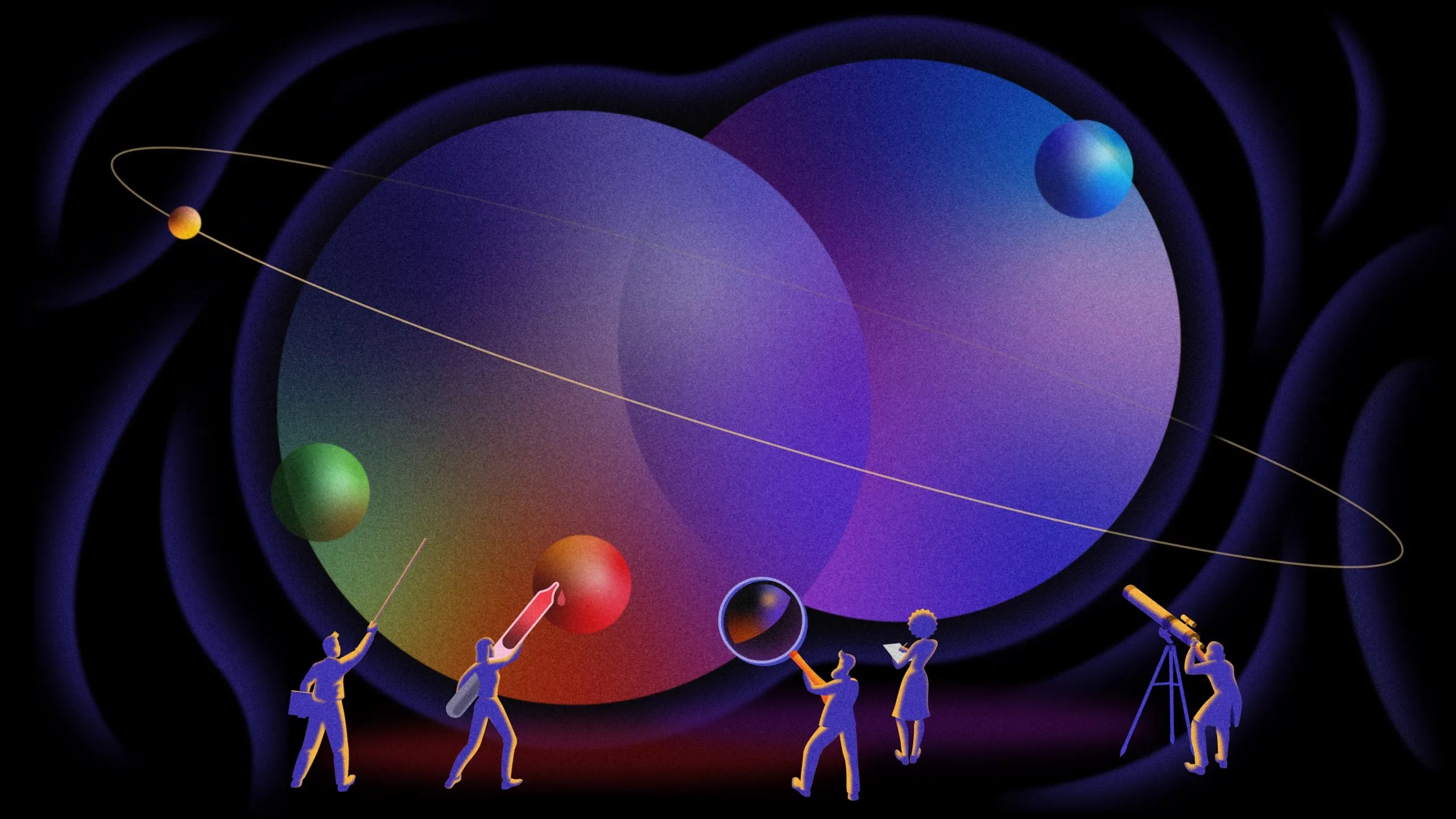
The proton, the positively charged particle at the heart of the atom, is an object of unspeakable complexity, one that changes its appearance depending on how it is probed…
“This is the most complicated thing that you could possibly imagine,” said Mike Williams, a physicist at the Massachusetts Institute of Technology. “In fact, you can’t even imagine how complicated it is.”
The proton is a quantum mechanical object that exists as a haze of probabilities until an experiment forces it to take a concrete form. And its forms differ drastically depending on how researchers set up their experiment. Connecting the particle’s many faces has been the work of generations. “We’re kind of just starting to understand this system in a complete way,” said Richard Milner, a nuclear physicist at MIT.
As the pursuit continues, the proton’s secrets keep tumbling out. Most recently, a monumental data analysis published in August found that the proton contains traces of particles called charm quarks that are heavier than the proton itself.
The proton “has been humbling to humans,” Williams said. “Every time you think you kind of have a handle on it, it throws you some curveballs.”
Recently, Milner, together with Rolf Ent at Jefferson Lab, MIT filmmakers Chris Boebel and Joe McMaster, and animator James LaPlante, set out to transform a set of arcane plots that compile the results of hundreds of experiments into a series of animations of the shape-shifting proton…
Charlie Wood (and Merrill Sherman) have incorporated that work into an attempt to unveil the particle’s secrets: “Inside the Proton, the ‘Most Complicated Thing You Could Possibly Imagine’,” from @walkingthedot in @QuantaMagazine.
* Edmund Burke
###
As we ponder presumptive paradoxes, we might send insightful birthday greetings to David Schramm; he was born on this date in 1945. A theoretical astrophysicist, he established the field of particle astrophysics, a branch of particle physics that studies elementary particles of astronomical origin and their relation to astrophysics and cosmology. He was particularly well known for the study of Big Bang nucleosynthesis and its use as a probe of dark matter and of neutrinos. And he made important contributions to the study of cosmic rays, supernova explosions, heavy-element nucleosynthesis, and nuclear astrophysics generally.

“Do I rue a life wasted doing crosswords? Yes, but I do know the three-letter word for ‘regret'”*…

Efforts to diversify the crossword puzzle industry might be having the opposite effect. As Matt Hartmann explains, although puzzles are an increasingly important part of The New York Times’ and others’ business strategies, only a handful of people actually make a living from crosswords…
The conspiracy theory writes itself. Start looking, and you’ll notice how many New York Times crossword puzzles are co-constructed (the preferred term for what most people would refer to as co-written) by a professional crossword constructor and someone with a day job—it’s hard not to see all the artists, web developers, professors, and other titles that imply a degree of wealth and elite connections. As the pandemic handed the work-from-home class extra time for their hobbies, the number of first-timers published in the Times has skyrocketed. Obviously, rich people are paying others to get the glory of their name in ink.
But the theory is almost diametrically wrong. It turns out the crossword industry really does consist of earnest wordplay lovers donating their time to unpaid mentorships, generally as part of an industry-wide effort to bring new and underrepresented people into crosswords.
Unfortunately, the end result might be even more exclusive than a pay-to-play scheme. And a game that brings the Times at least one million monthly subscribers—at $1.25 a week or $40 for a year—provides a sustainable living wage for shockingly few people…
Learn why at “Inside the Elite, Underpaid, and Weird World of Crossword Writers,” from @themhartman in @newrepublic.
###
As we fill in the blanks, we might recall that it was on this date in 1977 that South Park premiered on Comedy Central– where it runs to this day. The animated saga of Stan, Kyle, Eric, and Kenny and their exploits in their (titular) Colorado hometown has won five Emmys and a Peabody Award. A theatrical film, South Park: Bigger, Longer & Uncut, was released in June, 1999 to commercial and critical success, and scored an Academy Award nomination.

“O brave new world, that has such people in ‘t!”*…

The estimable Steven Johnson suggests that the creation of Disney’s masterpiece, Snow White, gives us a preview of what may be coming with AI algorithms sophisticated enough to pass for sentient beings…
… You can make the argument that the single most dramatic acceleration point in the history of illusion occurred between the years of 1928 and 1937, the years between the release of Steamboat Willie [here], Disney’s breakthrough sound cartoon introducing Mickey Mouse, and the completion of his masterpiece, Snow White, the first long-form animated film in history [here— actually the first full-length animated feature produced in the U.S; the first produced anywhere in color]. It is hard to think of another stretch where the formal possibilities of an artistic medium expanded in such a dramatic fashion, in such a short amount of time.
[There follows an fascinating history of the Disney Studios technical innovations that made Snow White possible, and an account of the film;’s remarkable premiere…]
In just nine years, Disney and his team had transformed a quaint illusion—the dancing mouse is whistling!—into an expressive form so vivid and realistic that it could bring people to tears. Disney and his team had created the ultimate illusion: fictional characters created by hand, etched onto celluloid, and projected at twenty-four frames per second, that were somehow so believably human that it was almost impossible not to feel empathy for them.
Those weeping spectators at the Snow White premiere signaled a fundamental change in the relationship between human beings and the illusions concocted to amuse them. Complexity theorists have a term for this kind of change in physical systems: phase transitions. Alter one property of a system—lowering the temperature of a cloud of steam, for instance—and for a while the changes are linear: the steam gets steadily cooler. But then, at a certain threshold point, a fundamental shift happens: below 212 degrees Fahrenheit, the gas becomes liquid water. That moment marks the phase transition: not just cooler steam, but something altogether different.
…
It is possible—maybe even likely—that a further twist awaits us. When Charles Babbage encountered an automaton of a ballerina as a child in the early 1800s, the “irresistible eyes” of the mechanism convinced him that there was something lifelike in the machine. Those robotic facial expressions would seem laughable to a modern viewer, but animatronics has made a great deal of progress since then. There may well be a comparable threshold in simulated emotion—via robotics or digital animation, or even the text chat of an AI like LaMDA—that makes it near impossible for humans not to form emotional bonds with a simulated being. We knew the dwarfs in Snow White were not real, but we couldn’t keep ourselves from weeping for their lost princess in sympathy with them. Imagine a world populated by machines or digital simulations that fill our lives with comparable illusion, only this time the virtual beings are not following a storyboard sketched out in Disney’s studios, but instead responding to the twists and turns and unmet emotional needs of our own lives. (The brilliant Spike Jonze film Her imagined this scenario using only a voice.) There is likely to be the equivalent of a Turing Test for artificial emotional intelligence: a machine real enough to elicit an emotional attachment. It may well be that the first simulated intelligence to trigger that connection will be some kind of voice-only assistant, a descendant of software like Alexa or Siri—only these assistants will have such fluid conversational skills and growing knowledge of our own individual needs and habits that we will find ourselves compelled to think of them as more than machines, just as we were compelled to think of those first movie stars as more than just flickering lights on a fabric screen. Once we pass that threshold, a bizarre new world may open up, a world where our lives are accompanied by simulated friends…
Are we in for a phase-shift in our understanding of companionship? “Natural Magic,” from @stevenbjohnson, adapted from his book Wonderland: How Play Made The Modern World.
And for a different, but aposite perspective, from the ever-illuminating L. M. Sacasas (@LMSacasas), see “LaMDA, Lemoine, and the Allures of Digital Re-enchantment.”
* Shakespeare, The Tempest
###
As we rethink relationships, we might recall that it was on this date in 2007 that the original iPhone was introduced. Generally downplayed by traditional technology pundits after its announcement six months earlier, the iPhone was greeted by long lines of buyers around the country on that first day. Quickly becoming a phenomenon, one million iPhones were sold in only 74 days. Since those early days, the ensuing iPhone models have continued to set sales records and have radically changed not only the smartphone and technology industries, but the world in which they operate as well.

You must be logged in to post a comment.