Posts Tagged ‘animals’
“He was a killer, a thing that preyed, living on the things that lived, unaided, alone, by virtue of his own strength and prowess, surviving triumphantly in a hostile environment where only the strong survive”*…
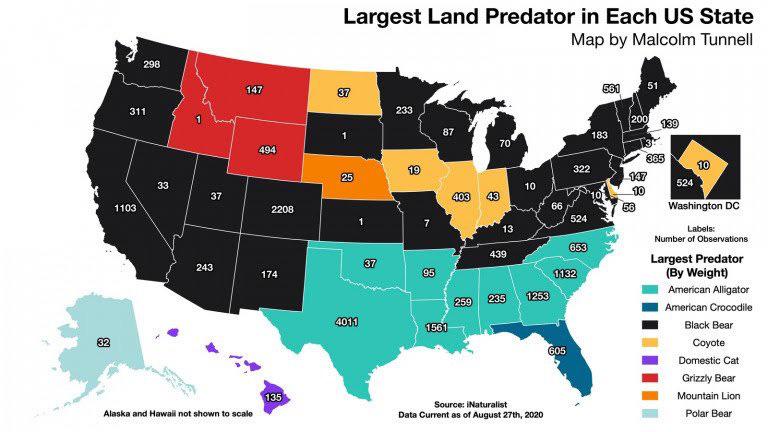
One notes that there are only three states with unique predators: two with apex predators– Alaska (the polar bear); Florida (the crocodile)– and Hawaii (the domestic cat). A ‘o ia!
The largest land predators in each state. (TotH to @simongerman600)
* Jack London, The Call of the Wild
###
As we watch our backs, we might spare a thought for Alexander Emmanuel Rodolphe Agassiz; he died on this date in 1910. Following in his father‘s footsteps, he made important contributions to systematic zoology, serving as curator of Harvard’s Museum of Comparative Zoology (1873-85), which was founded by his father.

“If you talk to the animals they will talk with you and you will know each other”*…

The prevailing belief in a separation between humans and everything else is an essential function of a contemporary global economy which has permitted unprecedented levels of unsustainable resource extraction. The increasingly complex challenges human beings face in relation to the non-human world call for a paradigm shift: it is becoming ever more urgent to embrace new stories about ourselves and our relation to each other. This is the aim of ‘Stories on Earth’, Failed Architecture’s project for the parallel program of the Dutch Pavilion for the Venice Biennale 2021. Stories on Earth is an experiment which brings together spatial designers and writers to devise new spatial narratives that accommodate the inherent interrelationship between humans and the non-human. We selected three designers whose works challenge humans’ relationship with nature, and three writers with personal and professional connections with Caribbean storytelling…
Six designers and writers participating in FA’s project for Venice Biennale 2021 speak with one composite voice about nature, humanity, and storytelling at: “Stories on Earth: A Collective Voice for the Human and Non-Human.”
On this same topic, check in with musician and humanitarian Peter Gabriel, ecologist Carl Safina, technologist and novelist Jonathan Ledgard, prominent author and speaker on animal behaviour, Temple Grandin, and others…
We are pleased to announce the Interspecies Conversations Public Event 2020 in collaboration with the Coller Foundation, Google and MIT’s Center for Bits and Atoms. We would be delighted if you could join us and contribute to the conversation!
Interspecies I/O’s mission is to encourage, explore and facilitate interfaces for interspecies communication and approaches for deciphering the communication of non-human animals. With the aim to positively impact species conservation, welfare, empathy, compassion, enrichment, sustainability and understanding. It brings together a multidisciplinary group drawn from the sciences, arts and humanities in a rich collaborative forum, to advance the understanding and appreciation of the mental lives and intelligence of the diverse species with which we share our planet…
… at “Interspecies Conversations Public Conference 2020.”
And to complete the hat-trick, Matt Webb’s “On speaking with dolphins.”
* “If you talk to the animals they will talk with you and you will know each other. If you do not talk to them you will not know them, and what you do not know you will fear. What one fears one destroys.” – Chief Dan George
###
As we “Talk to the Animals,” we might recall that it was on this date in 1983 that the first “test-tube baboon” was born; as The New York Times reported…
A female black baboon, believed to be the first nonhuman primate conceived in a laboratory dish, has been born at the Southwest Foundation for Research and Education in San Antonio. The baby, named E. T., for embryo transfer, was born July 25, six months after its ”test-tube” fertilization and, coincidentally, on the fifth birthday of Louise Brown, the first human conceived ”in vitro.”…

“The animals of the world exist for their own reasons. They were not made for humans any more than black people were made for white, or women created for men”*…

In 2015, more than 1.5 million people were killed by animals. That’s a startling figure. To put it in perspective, that’s about the same number of people who died from HIV/AIDS or diabetes last year.
Some of the culprits are the usual suspects of the animal kingdom. Lions, for instance, with their incredible ability to stalk prey, are responsible for the deaths of about 100 people. Hippos, very territorial, are more dangerous, claiming about 500 lives. Crocodiles are even more deadly, killing 1,000 people.
But take a look at this interactive chart [a portion of which is excerpted above] and you might be surprised to learn that the heavyweights of the animal kingdom do the least damage. Pound for pound, a shark isn’t that scary compared with many smaller creatures on the list…
The relative numbers of people killed by different animals: Bill Gates explains “Why I’d Rather Cuddle with a Shark than a Kissing Bug.”
* Alice Walker
###
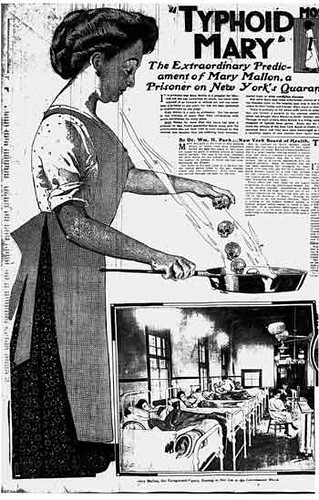
As we slather on the DEET, we might recall that it was on this date in 1938 that Mary Mallon– “Typhoid Mary”– died of a stroke on North Brother Island, where she he had been quarantined since 1915. She was the first person in the United States identified as an asymptomatic carrier of the pathogen associated with typhoid fever… before which, she inadvertently spread typhus for years while working as a cook in the New York area.
“If you talk to the animals they will talk with you”*…

The Macaulay Library is the world’s largest and oldest scientific archive of biodiversity audio and video recordings. Our mission is to collect and preserve recordings of each species’ behavior and natural history, to facilitate the ability of others to collect and preserve such recordings, and to actively promote the use of these recordings for diverse purposes spanning scientific research, education, conservation, and the arts.
Scientists worldwide use our audio and video recordings to better understand and preserve our planet. Teachers use our sounds and videos to illustrate the natural world and create exciting interactive learning opportunities. We help others depict nature accurately and bring the wonders of animal behavior to the widest possible audience. It is an invaluable resource at your fingertips.
This archive grows through the efforts of dedicated recordists who share their recordings with the community. We encourage recordists around the world to contribute their recordings and data to what has become an irreplaceable resource…
Browse the collection and learn more about its work at Cornell’s Macaulay Library.
And explore more “sounds that never die” at “The Eternal Auditorium.”
* Chief Dan George
###
As we peel our ears, we might spare a thought for John W. “Jack” Ryan; he died on this date in 1991. A Yale-trained engineer, Ryan left Raytheon (where he worked on the Navy’s Sparrow III and Hawk guided missiles) to join Mattel. He oversaw the conversion of the Mattel-licensed “Bild Lili” doll into Barbie (contributing, among other things, the joints that allowed “her” to bend at the waist and the knee) and created the Hot Wheels line. But he is perhaps best remembered as the inventor of the pull-string, talking voice box that gave Chatty Cathy her voice.

Ryan with his wife, Zsa Zsa Gabor. She was his first only spouse; he, her sixth.
“Fancy thinking the Beast was something you could hunt and kill!”*…


Also from the Aberdeen Bestiary, “in Asia an animal is found which men call Bonnacon. It has the head of a bull, and thereafter its whole body is of the size of a bull’s with the maned neck of a horse. Its horns are convoluted, curling back on themselves in such a way that if anyone comes up against it, he is not harmed. But the protection which its forehead denies this monster is furnished by its bowels. For when it turns to flee, it discharges fumes from the excrement of its belly over a distance of three acres, the heat of which sets fire to anything it touches. In this way, it drives off its pursuers with its harmful excrement.”

From a 13th century Bestiary by Hugh of Fouilloy: “There is a beast in the sea which is called a Sawfish, and has immense wings. When this beast has seen a ship making sail on the ocean, it raises its wings above the water and competes with the ship in sailing. (But when it has competed in sailing or racing against the ship) for 30 or 40 furlongs, being unable to sustain the exertion, it gives up, and lowering its wings draws them in. And the waves of the sea carry it back again, tired out, to its own place in the deep.”
These and other curious critters that may or may not have ever existed– but were featured in medieval Bestiaries— at “Ten Strange Medieval Animals You Might Not Have Heard Of.”
* William Golding, Lord of the Flies
###
As we contemplate cryptozoology, we might recall that it was on this date in 1953, on the death of her father, George VI, that Elizabeth Alexandra Mary, became Elizabeth II, Queen of the United Kingdom (and of 16 of the 53 member states in the Commonwealth of Nations), and Supreme Governor of the Church of England.

You must be logged in to post a comment.