Posts Tagged ‘David Bowie’
“All is change”*…

The Wikipedia article on the Ship of Theseus has changed entirely since its inception.
A paradoxical thought experiment made meta: “The Same Boat,” from Greg Ross in his wonderful blog, Futility Closet.
* Euripedes, Heracles (and others, e.g., Marcus Aurelius, echoing Heraclitus)
###
As we contemplate conundra, we might recall that it was on this date in 1971 that the mix was completed on David Bowie’s “Changes,” which had been recorded nine days earlier at Trident Studios in London. Co-produced by Bowie and Ken Scott, it featured Rick Wakeman on piano and the musicians who would later become known as the Spiders from Mars—Mick Ronson, Trevor Bolder and Mick Woodmansey.
“Changes” is widely considered to be one of Bowie’s best songs and has appeared on many best-of lists. His biographers have suggested that the track is a manifesto of his entire career, predicting a constant change of musical styles: the first verse focuses on the compulsive nature of artistic reinvention and distancing oneself from the rock mainstream; the second verse concerns clashes between children and their parents, urging them to allow their children to be themselves as teenagers. Bowie frequently included the song in his live performances; it was the final song he performed on stage before his death in 2016.
See Bowie perform it here.

“I Want My MTV!”*…

You’ve probably seen a variation of this news on social media over the past few days: MTV officially shut down on New Year’s Eve, ending their final broadcast the same way the network started: With the clip “Video Killed the Radio Star” by The Buggles.
But those posts are misinformed. It’s New Year’s Day 2026, and MTV is still around. Granted, today the channel is playing a marathon of “The Big Bang Theory” sitcom repeats, so your interpretation of “MTV is still around” may vary…
– Variety, January 1, 2026
Indeed, the reality shows and network re-runs are still flowing. But the new owners of MTV’s parent, Paramount Global, did end its dedicated, 24/7 music channels (like MTV Music, MTV 80s, MTV 90s) at the close of 2025 across most international markets, effectively ceding the video music turf to YouTube.
So it’s a propitious moment to pause and reflect on the legacy, the impact of MTV…
… MTV, the Music Television that launched a thousand careers and redefined a generation, is finally shutting down [as a music channel]. It’s bittersweet to see it go, but it’s also a perfect moment to reflect on just how profoundly this channel, born in a blaze of sound and vision, altered the landscape of music, media, and even society itself.
It’s hard to imagine now, but before August 1, 1981, music was primarily an auditory experience. You listened to it on the radio, on records, or at concerts. The idea of a 24-hour channel dedicated solely to music videos was revolutionary, a gamble by Warner-Amex Satellite Entertainment. They saw the burgeoning popularity of music videos, then mostly promotional tools for artists, and envisioned a dedicated platform. The very first video ever played, fittingly, was “Video Killed the Radio Star” by The Buggles – a prophetic title if there ever was one.
MTV’s early days were a chaotic, vibrant mix of rock, pop, and new wave, with VJs (video jockeys) becoming household names. It was raw, experimental, and deeply intertwined with the youth culture of the 80s. But what started as a niche cable channel quickly exploded into a global phenomenon, forever altering how we consumed and understood music. So, as we bid adieu, let’s explore ten ways MTV truly changed everything…
Remember them at: “MTV: A Farewell to the Channel That Changed Our World,” from Eric Alper (@thatericalper.com)
* The tag line of MTV’s initial ad campaign (aimed at getting cable viewers to press their cable suppliers to carry MTV)
###
As we recollect rock, we might recall that it was on this date in 1972 that David Bowie released “Changes,” from his 1971 album Hunky Dory. Co-produced by Bowie and Ken Scott, it featured Rick Wakeman on piano and the musicians who would later become known as the Spiders from Mars—Mick Ronson, Trevor Bolder and Mick Woodmansey.

“Whatever happens to musicians happens to everybody”*…

Further, In a fashion, to yesterday’s post (and for that matter, to “Nature doesn’t feel compelled to stick to a mathematically precise algorithm; in fact, nature probably can’t stick to an algorithm.”), a provocative proposal from Justin Patrick Moore…
We don’t have enough Dada in this world of too much data. Something is needed to break-through the over-curated simulacrum that is the online world in order to let in a bit of non-artificial light. One way to make a break is through the deliberate cultivation of the glitch.
The exact etymology of the word glitch is not known, though it may derive from the Yiddish “glitsh” which means a “slippery place.” In the mid-twentieth century the word first started showing up in technical texts and related to sudden surges of voltage within an electrical circuit causing it to overload. Today a glitch is any kind of malfunction in hardware or error in software.
In the 1990’s glitch music became a kind of sub-genre of electronic music found at the meeting points of the avant-garde, noise, and more popular forms. This type of music, and the methods surrounding it, including circuit-bending, can provide a window, cracked as it is, for looking out at adjacent electronic worlds, including the internet…
[Moore explains circuit-bending and it’s history…]
… Digital natives need chance like a body needs water. Algorithms have taken the fun out of what was once unplanned and unstructured; internet surfing has been made accident proof, as if it were run by insurance agents and safety specialists. Spots of possible slippage are mopped up in favor of putting forth pre-chewed opinions and junk food clickbait. A similar environment prevails for electronic musicians. The hardware and software being made more often than not makes it difficult to fail. Sound libraries, instrument and effect presets, samplers pre-loaded with perfect pulsing patterns, make it hard to even play in the wrong pitch. These fully loaded tools make it a possible to become a producer of music in a matter of minutes.
Preconfigured musical gear may make it easier to get grooving right off the bat, but the gift of instant gratification steals the sense of accomplishment and intimacy that comes from knowing every inch and crevice of an instrument. And while on first meeting, a run in with a run of the mill modular set up might cause sparks to fly, the slow burn of excitable electrons grows even further from long association. The nuance and subtlety available to those who explore in depth comes across in the very sounds. Circuit-bending is one way to go into those depths, down to the wire.
Prefab music is low risk music. Something might be made from it that could be used as a backdrop to a car commercial or fit into a DJ set at a dance club, as filler, but without investigating the underlying assumptions of a piece of gear, or software, the things that come out of it will tend to not have the rewards associated with riskier behavior. Disfigured musical gear gives the gift of decomposition and recomposition to electronic composers. With their materials mangled and mutilated, the gear becomes a mutt, with all the natural advantages over thoroughbred, store bought, off-the-shelf kit. The system may be less predictable, but that is the point…
[Moore unpacks examples, and explains how, as the solution was itself absorbed into the problem…]
Kim Cascone pointed this out in his inspired essay The Aesthetics of Failure [here] that glitch is just the latest way of investigating the creative misuse of technology. Yet as the internet grew, the process by which those techniques spread happened much faster than in previous decades. In sharing technique of glitch, some of the imaginative grain within the music was lost as it became just another commodity. With the widespread availability of digital music software, “the medium is no longer the message in glitch music: the tool has become the message.”
Failure had reached a point of failure.
If our own thinking can be glitched then perhaps it is still possible to create systems that embrace the slippage. If we don’t want the “tool to become the message” than a third element beyond the digital must be added into the mix.
The technopoly runs on data. Is there a way to make it more Dada? The artists of the Dada movement rejected many things, but logic and reason were chief among them. Where was the logic in the atrocities of World War I? The founders of the movement had lived through the war and in reaction against it, sought to elevate nonsense and the irrational above cruel, cold logic.
In our own time reason and logic have failed to deliver the utopia of technology as promised and promoted by Big Techs advertisers and PR specialists. It can seem that humanities dystopian nightmares are what are actually manifesting. Perhaps part of technologies failure is due to the fact that the digital world is built on binaries.
Logic circuits or gates are the brick and mortar of digital systems. They are electronic circuits that have one or more than one input, but only one output. Logic gates are the switches that turn ON or OFF depending on what the user does. A logic gates turn ON when a certain condition is true, and OFF when the condition is false. A logic gate is able to check whether or not the information they get follows a certain rule, and the output is thus determined.
There are several types of logic gates, but the three most common are the NOT gate, the AND gate, and the OR gate. The NOT gate is the simplest. It’s sole function is to take an input that is either ON or OFF and give it back as the opposite, what the original signal is NOT. The AND circuit requires two inputs. It can only turn on when both inputs are ON. If only one input is on it turns OFF, and when both inputs are off, it turns OFF.
The OR circuit also requires two inputs. It needs one input to be on for it be ON, and is also still ON when both inputs are ON, and it is only OFF when both inputs are OFF.
While variations from these basic circuits have been used to build complex systems, they still have at their core, the binary which undergirds the entire techonosphere. It is rather difficult for the unknown to break through when only two outcomes are possible. A third position between ON and OFF is never arrived at. This would require ternary logic, and as far as I know, a ternary computer has yet to be built.
In lieu of a ternary computer, a third element needs to be added to digital systems: that is the human component. This is also where I think modes of artistic creation in the spirit of Dada can help. By moving away from pure logic and reason, by letting a bit of nonsense or irrationality slip through, the human tendency to also think in binaries can be glitched.
So much of the creative process is automated when working with digital tools, but it has little in common with the methods of automatism that came out of the Surrealist milieu. The various methods of automatism developed by the Surrealists put a person in touch with the unknown, whether it be the unconscious or from beyond the fragile borders of this world. Bringing these techniques back into play could give back a sense of humanity to the sounds of dead electric emitted from programmed machines.
Automatism came in part from the method of automatic writing or spirit writing, when mediums and others of their psychic ilk were said to be in touch with disembodied spirits. The writing came through them from the other side. For the Surrealists tapping into these forces became a source of creativity. The results were often startling as they bypassed logic and reason.
To the point of this essay, in artistic creation, logic is rarely the principle that needs to be abided. Automation needs to be bypassed in favor of automatism. In electronic music strategies and interventions need to be used to work around and supplant the built-in binary biases of the tools, otherwise the music being made on them ends up just sounding like a commercial for the tool…
[Moore offers examples from Ben Chasney and Max Ernst…]
Whatever the source may be, if we are to glitch the circuit, we need to open ourselves up to the slippage that comes in from the unknown. Otherwise people might as well just let AIs design the music for them. And while generative music systems can be built that produce startling beauty, such as Wotja and Brian Eno’s Bloom, they leave too little for unintended influences from outside the confines of the system. For that a human really does have to put themselves into line with the flow of the circuit path.
To create something new, we need to become conduits, connect and plug into to an outside source…
Putting the Dada into data: “Glitching the Circuit,” from @igloomag.bsky.social.
* Bruce Sterling (@bruces.mastodon.social.ap.brid.gy)
###
As we explore, we might recall that it was on this date in 1977 that Iggy Pop, former frontman of The Stooges, released his debut solo album, The Idiot. It was produced by Pop’s friend David Bowie, who also wrote much of the album’s music (to which Pop added most of the lyrics). Described by Pop as “a cross between James Brown and Kraftwerk”, The Idiot marked a departure from the proto-punk of the Stooges to a more subdued, mechanical sound with electronic overtones.

“The only truth is music”*…
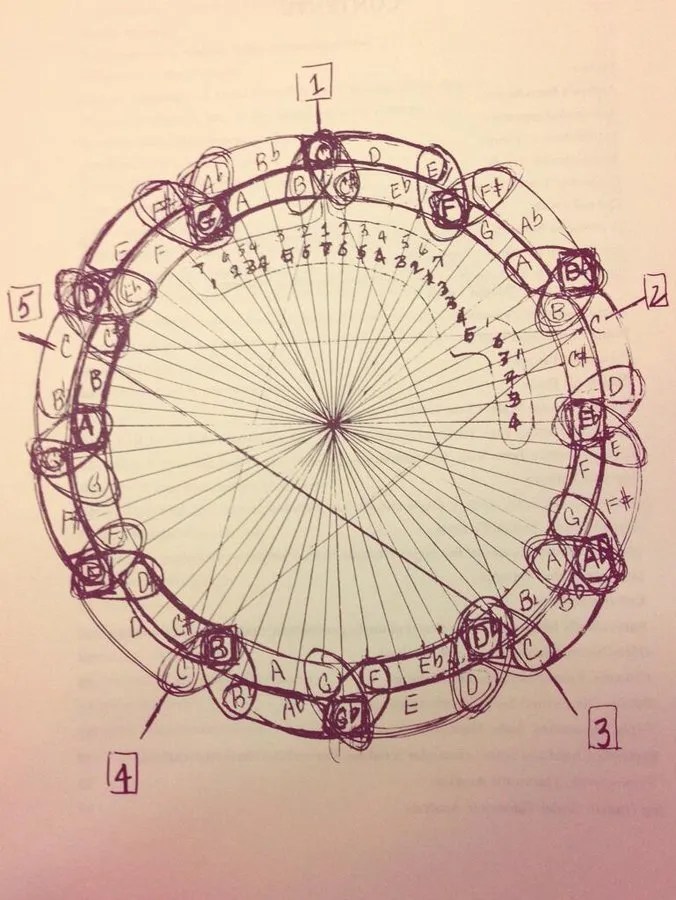
The pseudonymous Kerwin Fjøl on music theory and its origins…
A while back, I posted the above picture onto Elon Musk’s X, and it got fairly popular, which was nice. It’s a sketch that John Coltrane made, and I had no idea what it was meant to demonstrate. Apparently, he gave it to fellow jazz musician Yusef Lateef in 1967, the same year he died (although I heard elsewhere he actually drew it in 1961), and he would pretty regularly produce these sorts of sketches to help himself reason through his music. A small handful of people started wondering about its mystical or occult implications, while others connected it to the “my coworker be losing his mind” meme. But what surprised me about it was the amount of people who got annoyed and immediately started yammering about how it isn’t really mystical; it’s just a boring circle of fifths, as though the fact that anyone might find this picture interesting for spiritual reasons was offensive on its face. One guy in particular, an account with 10k followers and a furry avatar, used it as the basis of a thread in which he saw a dichotomy between the real music theorists, the serious guys who are simply working out their ideas visually, and the woo-woo mystics who have no idea what they’re talking about but desperately want to see magic things everywhere. I’d link the post, but X doesn’t allow me to go through view most of the quote-tweets for some reason. In any case, you can imagine the kind of person who made it: the classic fedora-wearing, Reddit-using atheist that has become a cliché by this point.
There are a few problems with this interpretation, though, that are worth discussing. First, the picture isn’t just a typical circle of fifths. A circle of fifths is usually drawn by laying out the notes of a major scale in one circle and its relative minor notes in another, whereas this picture demonstrates a chromatic scale distributed along two concentric circles, with each circle arranged by whole tones. The likely reason Coltrane drew the picture, as I think this YouTube video lecture convincingly argues, was to think through what you can do with tritones during improvisation. And although it’s unclear what the pentangle might be doing besides linking the C octaves, it’s not at all unreasonable to guess that Coltrane was interested in its esoteric significance and wanted to incorporate it into his music somehow. After all, people have discussed this exact sort of influence when interpreting how he devised his Coltrane changes, which use major third interval chord substitutions that form an equilateral triangle on the circle of fifths. And he was clearly into pan-religious mysticism, which should be obvious by the content of his late albums.
But the more important problem with this distinction between the “Real Music Theorists” and the “woo-woo mystics” is that music has always been grounded in woo-woo mysticism. Bizarre philosophical ideas and supernatural notions have always accompanied the formal development of music theory, and composers themselves have often embedded religious and theological ideas into their compositional approach. I’d like to spend a bit of time here discussing exactly that topic…
There follows a fascinating history and analysis of the Pythagorean origins of Western music theory: “Yes, Music Is Mystical (and woo-woo),” from @zermatist.
See also Ted Gioia‘s broader survey of much the same turf: “Music to Raise the Dead: The Secret Origins of Musicology” @tedgioia
* Jack Kerouac
###
As we contemplate the key to keys, we might recall that it was on this date in 1969 that David Bowie’s “Space Oddity” was released as a single in the U.K. The tale of a fictional astronaut, it was hurried out to precede the Apollo moon landing– and became Bowie’s first commercial hit, reaching the UK top five.

“Superstition is the poetry of life”*…

Charles Dickens
Slept Facing NorthCharles Dickens (1812–1870) carried a navigational compass with him at all times and always faced north while he slept—a practice he believed improved his creativity and writing.
Nine other personal peculiarities at “Ten Superstitions of Writers and Artists.”
* Johann Wolfgang Goethe
###
As we knock on wood, we might spare a thought for Michael “Mick” Ronson; he died on this date in 1993. A guitarist, songwriter, multi-instrumentalist, arranger, and producer, he is best remembered as the foil to David Bowie in his breakout years, the leader of the Spiders from Mars. But Ronson also served as arranger and occasional producer on Bowie’s work. He went on to a successful career as a session musician recording with the like of Ian Hunter, John Mellencamp, Elton John, and Morrissey, and as a sideman in touring bands with Van Morrison and Bob Dylan (Ronson was the anchor of the Rolling Thunder Revue band). He wrote and recored successful solo albums, and produced albums for acts including Ellen Foley, Roger McGuinn, Morrissey, and many others.

Ziggy and the Spider
You must be logged in to post a comment.