Posts Tagged ‘Robert Fludd’
“In all chaos there is a cosmos, in all disorder a secret order”*…
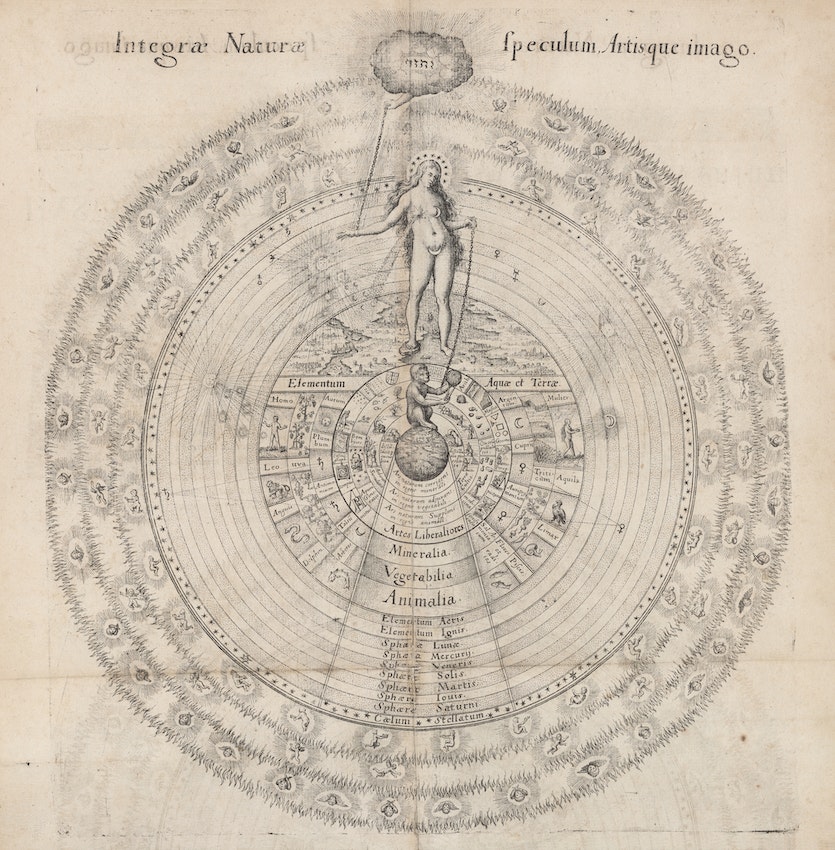
Between 1617 and 1621 the English physician and polymath Robert Fludd published his masterpiece Utriusque Cosmi . . . Historia, a two-volume work packed with over sixty intricate engravings. Urszula Szulakowska looks at the philosophical and theological ideas behind the extraordinary images found in the first volume, an exploration of the macrocosm of the universe and spiritual realm…
Robert Fludd was a respected English physician (of Welsh origins) employed at the court of King James I of England. He was a prolific writer of vast, multi-volume encyclopaedias in which he discussed a universal range of topics from magical practices — such as alchemy, astrology, kabbalism, and fortune-telling — to radical theological thinking concerning the interrelation of God with the natural and human worlds. However, he also proudly displayed his grasp of practical knowledge, such as mechanics, architecture, military fortifications, armaments, military manoeuvres, hydrology, musical theory and musical instruments, mathematics, geometry, optics, and the art of drawing, as well as chemistry and medicine. Fludd used the common metaphor for the arts as being the “ape of Nature”, a microcosmic form of how the universe itself functioned.
Fludd’s most famous work is the History of the Two Worlds (Utriusque Cosmi . . . Historia, 1617-21) published in two volumes by Theodore de Bry in Oppenheim. The two worlds under discussion are those of the Microcosm of human life on earth and the Macrocosm of the universe (which included the spiritual realm of the Divine).
Fludd himself was a staunch member of the Anglican Church. He was educated in the medical profession at St. John’s College in Oxford. At the turn of the seventeenth century, he set out for an extended period of travel on the continent. He spent a winter with some Jesuits, a Roman Catholic order deeply opposed to Protestantism who, nevertheless, tutored Fludd on magical practices. Fludd, however, always claimed to have worked out the theological and magical systems in his first volume of the Utriusque Cosmi . . . Historia (1617) during his undergraduate days at Oxford. In this work Fludd devised a lavishly illustrated cosmology based on the chemical theory of Paracelsus, in which the materials of the universe were separated out of chaos by God who acted in the manner of a laboratory alchemist…
All of Fludd’s treatises were lavishly illustrated with extraordinary engravings, unique in their form and subject matter, which have the visionary quality of a genuine spiritual seer and which exerted an influence on his contemporary occultists such as Michael Maier, Jacob Boehme, and Johannes Mylius. Fludd himself designed these images and they were engraved by the artisans employed at his publishers. (Some of his own original drawings still exist for the first volume of the Utriusque Cosmi . . . Historia, 1617)…

Read on for more explanation and many more mesmerizing images. A 17th century “theory of everything”: “Robert Fludd and His Images of The Divine,” in @PublicDomainRev.
* Carl Jung
###
As we think holistically, we might recall that it was on this date in 1859 that our perspective was shifted in a different kind of way: Charles Darwin published The Origin of the Species. Actually, on that day he published On the Origin of Species by Means of Natural Selection, or the Preservation of Favoured Races in the Struggle for Life; the title was shortened to the one we know with the sixth edition in 1872.

You must be logged in to post a comment.