Posts Tagged ‘archiving’
“Archive as if the future depends on it”*…

UbuWeb, an open online collection of avant garde materials created by poet Kenneth Goldsmith, went live almost 30 years ago…
Founded in 1996, UbuWeb is a pirate shadow library consisting of hundreds of thousands of freely downloadable avant-garde artifacts. By the letter of the law, the site is questionable; we openly violate copyright norms and almost never ask for permission. Most everything on the site is pilfered, ripped, and swiped from other places, then reposted. We’ve never been sued—never even come close. UbuWeb functions on no money—we don’t take it, we don’t pay it, we don’t touch it; you’ll never find an advertisement, a logo, or a donation box. We’ve never applied for a grant or accepted a sponsorship; we remain happily unaffiliated, keeping us free and clean, allowing us to do what we want to do, the way we want to do it. Most important, UbuWeb has always been and will always be free and open to all: there are no memberships or passwords required. All labor is volunteered; our server space and bandwidth are donated by a likeminded group of intellectual custodians who believe in free access to knowledge. A gift economy of plentitude with a strong emphasis on global education, UbuWeb is visited daily by tens of thousands of people from every continent. We’re on numerous syllabuses, ranging from those for kindergarteners studying pattern poetry to those for postgraduates listening to hours of Jacques Lacan’s Séminaires. When the site goes down from time to time, as most sites do, we’re inundated by emails from panicked faculty wondering how they are going to teach their courses that week.
The site is filled with the detritus and ephemera of great artists better known for other things—the music of Jean Dubuffet, the poetry of Dan Graham, the hip-hop of Jean-Michel Basquiat, the punk rock of Martin Kippenberger, the films of John Lennon, the radio plays of Ulrike Meinhof, the symphonies of Hanne Darboven, the country music of Julian Schnabel—most of which were originally put out in tiny editions, were critically ignored, and quickly vanished. However, the web provides the perfect place to restage these works. With video, sound, and text remaining more faithful to the original experience than, say, painting or sculpture, Ubu proposes a different sort of revisionist art history based on the peripheries of artistic production rather than on the perceived, hyped, or market-based center…
… These days there’s a lot of support for the way we go about things. Many think of UbuWeb as an institution. Artists both well established and lesser known try to contact us asking to be on the site. But it wasn’t always this way; for a long time many people despised UbuWeb, fearing that it was contributing to the erosion of long-standing hierarchies in the avant-garde world, fearing that it was leading to the decimation of certain art forms, fearing that it would tank entire art-based economies. Of course, none of that happened. We just happened to be there at the beginning of the web and had to ride the choppy currents of change as each successive wave washed over. Whereas we once used to receive daily cease-and-desist letters, today we rarely get any. It’s not that we’re doing anything different; it’s just that people’s attitudes toward copyright and distribution have evolved as the web has evolved.
By the time you read this, UbuWeb may be gone. Never meant to be a permanent archive, Ubu could vanish for any number of reasons: our internet service provider (ISP) pulls the plug, we get sued, or we simply grow tired of it. Beggars can’t be choosers, and we gladly take whatever is offered to us. We don’t run on the most stable of servers or on the swiftest of machines; crashes eat into the archive on a periodic basis; sometimes the site as a whole goes down for days; more often than not, the already small group of volunteers dwindles to a team of one. But that’s the beauty of it: UbuWeb is vociferously anti-institutional, eminently fluid, refusing to bow to demands other than what we happen to be moved by at a specific moment, allowing us flexibility and the ability to continually surprise even ourselves…
And indeed, in January of last year, UbuWeb announced it was no longer active, posting: “As of 2024, UbuWeb is no longer active. The archive is preserved for perpetuity, in its entirety.”
But last month, the site reappeared…
A year ago, we decided to shutter UbuWeb. Not really shutter it, per se, but instead to consider it complete. After nearly 30 years, it felt right. But now, with the political changes in America and elsewhere around the world, we have decided to restart our archiving and regrow Ubu. In a moment when our collective memory is being systematically eradicated, archiving reemerges as a strong form of resistance, a way of preserving crucial, subversive, and marginalized forms of expression. We encourage you to do the same. All rivers lead to the same ocean: find your form of resistance, no matter how small, and go hard. It’s now or never. Together we can prevent the annihilation of the memory of the world.
(Image above: source)
###
As we celebrate collective memory, we might (make ourselves) remember that it was on this date in 1933 that Nazi Germany opened its first and longest-operaating concentration camp, Dachau. Initially intended to intern (then still Chancellor) Hitler’s political opponents (communists, social democrats, and other dissidents), it seeded what became a network of more than a thousand concentration camps, including subcamps, on Germany’s own territory and in parts of German-occupied Europe. About 1.65 million people were registered prisoners in the camps, of whom about a million died during their imprisonment.

“A people without the knowledge of their past history, origin and culture is like a tree without roots”*…

From Chris Freeland the Internet Archive, an important new report…
In today’s digital landscape, corporate interests, shifting distribution models, and malicious cyber attacks are threatening public access to our shared cultural history.
• The rise of streaming platforms and temporary licensing agreements means that sound recordings, books, films, and other cultural artifacts that used to be owned in physical form, are now at risk—in digital form—of disappearing from public view without ever being archived.
• Cyber attacks, like those against the Internet Archive, British Library, Seattle Public Library, Toronto Public Library and Calgary Public Library, are a new threat to digital culture, disrupting the infrastructure that secures our digital heritage and impeding access to information at community scale.
When digital materials are vulnerable to sudden removal—whether by design or by attack—our collective memory is compromised, and the public’s ability to access its own history is at risk.
Vanishing Culture: A Report on Our Fragile Cultural Record (download) aims to raise awareness of these growing issues. The report details recent instances of cultural loss, highlights the underlying causes, and emphasizes the critical role that public-serving libraries and archives must play in preserving these materials for future generations. By empowering libraries and archives legally, culturally, and financially, we can safeguard the public’s ability to maintain access to our cultural history and our digital future…
“Vanishing Culture: A Report on Our Fragile Cultural Record,” from @chrisfreeland and @internetarchive. Do read the full report.
* Marcus Garvey
###
As we husband our heritage, we might recall that it was on this date in 1665 that the oldest continuously-published newspaper in English, the Oxford Gazette, was first published. The following year, its name was changed to (it’s current title) the London Gazette, currently shortened to just “the Gazette.”
No longer a conventional newspaper (covering general news), the Gazette is one of the official journals of record or government gazettes of the Government of the United Kingdom, and the most important among such official journals in the United Kingdom, in which certain statutory notices are required to be published. It has become a crucial British archive.
His Majesty’s Stationery Office took over the publication of the Gazette in 1889. Publication of the Gazette was transferred to the private sector in 2006, under government supervision, when HMSO was sold and renamed The Stationery Office. You can read the Gazette here.

“All that mankind has done, thought or been: it is lying as in magic preservation in the pages of books”*…

… But books (and their predecessors) are fragile, and need special archival care if they are to survive. That’s even truer, as Adrienne Bernhard explains in The Long Now Foundation‘s newsletter, of digital data and documents…
The Dead Sea scrolls, made of parchment and papyrus, are still readable nearly two millennia after their creation — yet the expected shelf life of a DVD is about 100 years. Several of Andy Warhol’s doodles, created and stored on a Commodore Amiga computer in the 01980s, were forever stranded there in an obsolete format. During a data-migration in 02019, millions of songs, videos and photos were lost when MySpace — once the Internet’s leading social network — fell prey to an irreversible data loss.
A false sense of security persists surrounding digitized documents: because an infinite number of identical copies can be made of any original, most of us believe that our electronic files have an indefinite shelf life and unlimited retrieval opportunities. In fact, preserving the world’s online content is an increasing concern, particularly as file formats (and the hardware and software used to run them) become scarce, inaccessible, or antiquated, technologies evolve, and data decays. Without constant maintenance and management, most digital information will be lost in just a few decades. Our modern records are far from permanent.
Obstacles to data preservation are generally divided into three broad categories: hardware longevity (e.g., a hard drive that degrades and eventually fails); format accessibility (a 5 ¼ inch floppy disk formatted with a filesystem that can’t be read by a new laptop); and comprehensibility (a document with a long-abandoned file type that can’t be interpreted by any modern machine). The problem is compounded by encryption (data designed to be inaccessible) and abundance (deciding what among the vast human archive of stored data is actually worth preserving).
The looming threat of the so-called “Digital Dark Age”, accelerated by the extraordinary growth of an invisible commodity — data — suggests we have fallen from a golden age of preservation in which everything of value was saved. In fact, countless records of previous historical eras have all but disappeared. The first Dark Ages, shorthand for the period beginning with the fall of the Roman Empire and stretching into the Middle Ages (00500-01000 CE), weren’t actually characterized by intellectual and cultural emptiness but rather by a dearth of historical documentation produced during that era.
Even institutions built for the express purpose of information preservation have succumbed to the ravages of time, natural disaster or human conquest. The famous library of Alexandria, one of the most important repositories of knowledge in the ancient world, eventually faded into obscurity. Built in the fourth century B.C., the library flourished for some six centuries, an unparalleled center of intellectual pursuit. Alexandria’s archive was said to contain half a million papyrus scrolls — the largest collection of manuscripts in the ancient world — including works by Plato, Aristotle, Homer and Herodotus. By the fifth century A.D., however, the majority of its collections had been stolen or destroyed, and the library fell into disrepair.
Digital archives are no different. The durability of the web is far from guaranteed. Link rot, in which outdated links lead readers to dead content (or a cheeky dinosaur icon), sets in like a pestilence. Corporate data sets are often abandoned when a company folds, left to sit in proprietary formats that no one without the right combination of hardware, software, and encryption keys can access. Scientific data is a particularly thorny problem: unless it’s saved to a public repository accessible to other researchers, technical information essentially becomes unusable or lost. Beyond switching to analog alternatives, which have their own drawbacks, how might we secure our digital information so that it survives for generations? How can individuals, private corporations and public entities coordinate efforts to ensure that their data is saved in more resilient formats?…
Without maintenance, most digital information will be lost in just a few decades. How might we secure our data so that it survives for generations? “Shining a Light on the Digital Dark Age,” from @AdrienneEve and @longnow. Eminently worth reading in full.
C.F. also: “Very Long-Term Backup” by Kevin Kelly (@kevin2kelly).
* Thomas Carlyle
###
As we ponder preservation, we might recall that the #1 song in the U.S. and the U.K. (among other territories) was the Beatles’ “Help!” (their fourth of six #1 singles in a row on the American charts).


“Doing research on the Web is like using a library assembled piecemeal by pack rats and vandalized nightly”*…
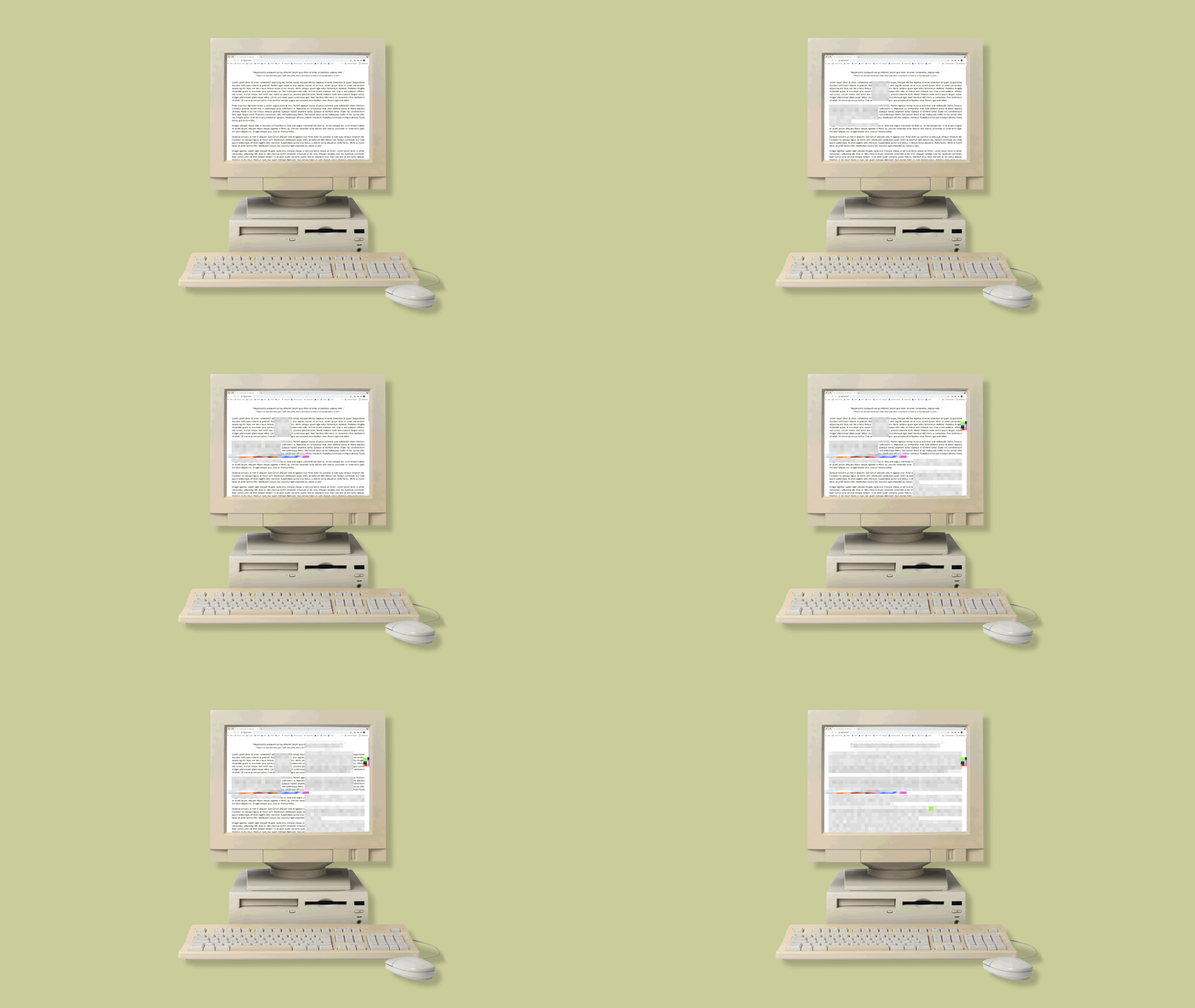
But surely, argues Jonathan Zittrain, it shouldn’t be that way…
Sixty years ago the futurist Arthur C. Clarke observed that any sufficiently advanced technology is indistinguishable from magic. The internet—how we both communicate with one another and together preserve the intellectual products of human civilization—fits Clarke’s observation well. In Steve Jobs’s words, “it just works,” as readily as clicking, tapping, or speaking. And every bit as much aligned with the vicissitudes of magic, when the internet doesn’t work, the reasons are typically so arcane that explanations for it are about as useful as trying to pick apart a failed spell.
Underpinning our vast and simple-seeming digital networks are technologies that, if they hadn’t already been invented, probably wouldn’t unfold the same way again. They are artifacts of a very particular circumstance, and it’s unlikely that in an alternate timeline they would have been designed the same way.
The internet’s distinct architecture arose from a distinct constraint and a distinct freedom: First, its academically minded designers didn’t have or expect to raise massive amounts of capital to build the network; and second, they didn’t want or expect to make money from their invention.
The internet’s framers thus had no money to simply roll out a uniform centralized network the way that, for example, FedEx metabolized a capital outlay of tens of millions of dollars to deploy liveried planes, trucks, people, and drop-off boxes, creating a single point-to-point delivery system. Instead, they settled on the equivalent of rules for how to bolt existing networks together.
Rather than a single centralized network modeled after the legacy telephone system, operated by a government or a few massive utilities, the internet was designed to allow any device anywhere to interoperate with any other device, allowing any provider able to bring whatever networking capacity it had to the growing party. And because the network’s creators did not mean to monetize, much less monopolize, any of it, the key was for desirable content to be provided naturally by the network’s users, some of whom would act as content producers or hosts, setting up watering holes for others to frequent.
Unlike the briefly ascendant proprietary networks such as CompuServe, AOL, and Prodigy, content and network would be separated. Indeed, the internet had and has no main menu, no CEO, no public stock offering, no formal organization at all. There are only engineers who meet every so often to refine its suggested communications protocols that hardware and software makers, and network builders, are then free to take up as they please.
So the internet was a recipe for mortar, with an invitation for anyone, and everyone, to bring their own bricks. Tim Berners-Lee took up the invite and invented the protocols for the World Wide Web, an application to run on the internet. If your computer spoke “web” by running a browser, then it could speak with servers that also spoke web, naturally enough known as websites. Pages on sites could contain links to all sorts of things that would, by definition, be but a click away, and might in practice be found at servers anywhere else in the world, hosted by people or organizations not only not affiliated with the linking webpage, but entirely unaware of its existence. And webpages themselves might be assembled from multiple sources before they displayed as a single unit, facilitating the rise of ad networks that could be called on by websites to insert surveillance beacons and ads on the fly, as pages were pulled together at the moment someone sought to view them.
And like the internet’s own designers, Berners-Lee gave away his protocols to the world for free—enabling a design that omitted any form of centralized management or control, since there was no usage to track by a World Wide Web, Inc., for the purposes of billing. The web, like the internet, is a collective hallucination, a set of independent efforts united by common technological protocols to appear as a seamless, magical whole.
This absence of central control, or even easy central monitoring, has long been celebrated as an instrument of grassroots democracy and freedom. It’s not trivial to censor a network as organic and decentralized as the internet. But more recently, these features have been understood to facilitate vectors for individual harassment and societal destabilization, with no easy gating points through which to remove or label malicious work not under the umbrellas of the major social-media platforms, or to quickly identify their sources. While both assessments have power to them, they each gloss over a key feature of the distributed web and internet: Their designs naturally create gaps of responsibility for maintaining valuable content that others rely on. Links work seamlessly until they don’t. And as tangible counterparts to online work fade, these gaps represent actual holes in humanity’s knowledge…
The glue that holds humanity’s knowledge together is coming undone: “The Internet Is Rotting.” @zittrain explains what we can do to heal it.
(Your correspondent seconds his call to support the critically-important work of The Internet Archive and the Harvard Library Innovation Lab, along with the other initiatives he outlines.)
* Roger Ebert
###
As we protect our past for the future, we might recall that it was on this date in 1937 that Hormel introduced Spam. It was the company’s attempt to increase sales of pork shoulder, not at the time a very popular cut. While there are numerous speculations as to the “meaning of the name” (from a contraction of “spiced ham” to “Scientifically Processed Animal Matter”), its true genesis is known to only a small circle of former Hormel Foods executives.
As a result of the difficulty of delivering fresh meat to the front during World War II, Spam became a ubiquitous part of the U.S. soldier’s diet. It became variously referred to as “ham that didn’t pass its physical,” “meatloaf without basic training,” and “Special Army Meat.” Over 150 million pounds of Spam were purchased by the military before the war’s end. During the war and the occupations that followed, Spam was introduced into Guam, Hawaii, Okinawa, the Philippines, and other islands in the Pacific. Immediately absorbed into native diets, it has become a unique part of the history and effects of U.S. influence in the Pacific islands.

You must be logged in to post a comment.