Posts Tagged ‘criticism’
“A doctor can bury his mistakes, but an architect can only advise his clients to plant vines.”*…

Actually, sometimes architecture is buried– or at least demolished. And occasionally, as in the “refurbishing” of the Sainsbury Wing of London’s National Gallery, that unearths a surprise. Martin Bailey reports…
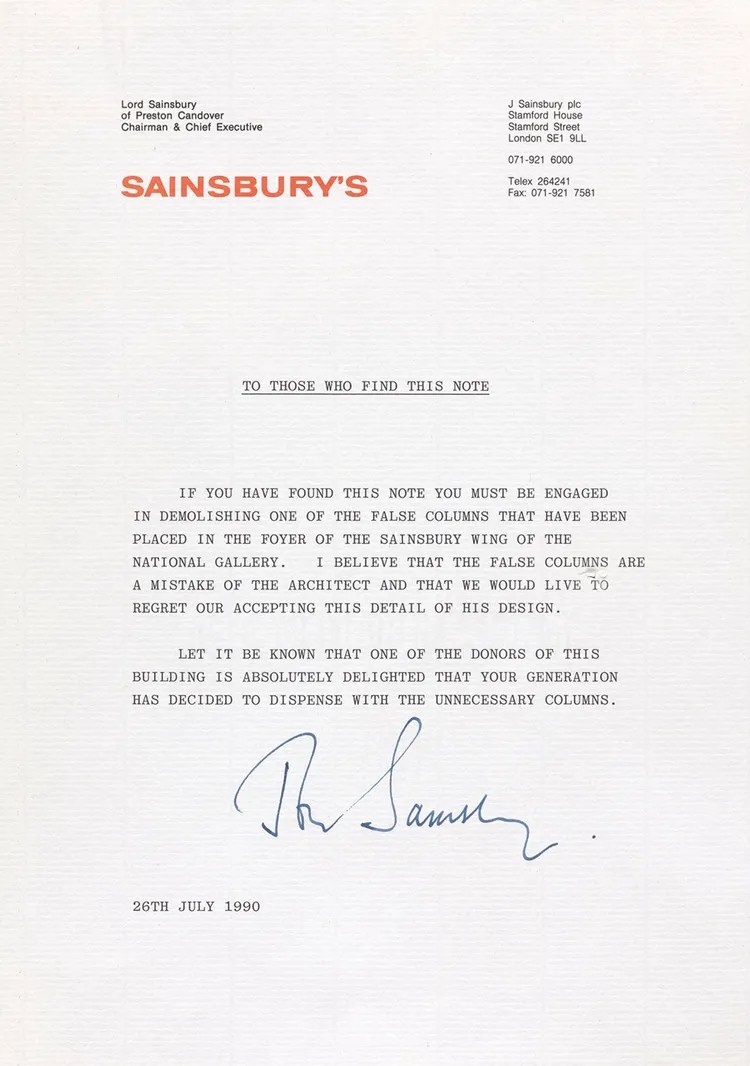
A “time capsule” has been discovered at London’s National Gallery, buried deep in a column in the foyer of the Sainsbury Wing. It is a letter recording that one of the wing’s funders, John Sainsbury (Lord Sainsbury of Preston Candover), believed the architects had committed a serious “mistake”. The 1990 letter, typed on Sainsbury’s supermarket notepaper, has recently been deposited in the gallery’s archive as an historic document.
John Sainsbury is critical in the letter of the American post-Modernist architect Robert Venturi and his professional partner and wife Denise Scott Brown for inserting two large false columns in the gallery’s foyer that served no structural purpose. Other than the false columns, John Sainsbury was happy with the Venturi and Scott Brown design.
While building work was under way, Sainsbury gained access to the site and dropped his letter into a concrete column that was under construction. The letter, protected in a plastic folder, was discovered last year, when the foyer was being reconfigured.
The Sainsbury letter of 26 July 1990 was addressed “To those who find this note”—who turned out to be the 2023 demolition workers.
John and his wife Anya presumably never imagined that the demolition of the Sainsbury Wing foyer might take place during their lifetimes. John, one of the most generous UK donors to the arts, died in 2022, aged 94. His widow Anya, a former ballerina, was present when her husband’s note was removed. “I was so happy for John’s letter to be rediscovered after all these years,” she says, “and I feel he would be relieved and delighted for the gallery’s new plans and the extra space they are creating.”…
From the annals of architecture– a dissenting voice from the past: “Sainsbury Wing contractors find 1990 letter from donor anticipating their demolition of false columns,” from @TheArtNewspaper.
But lest we forget that when one critic is assuaged, others are appalled: “Eight Prestigious Architects Blast Annabelle Selldorf’s Proposed $40 Million Redesign of London’s National Gallery, Likening It to an ‘Airport Lounge’,” from @artnet.
(Image above: source)
* Frank Lloyd Wright
###
As we deconstruct design, we might send peaceful birthday greetings to Stephen Geary; he was born on this date in 1797. An architect who designed everything from gin palaces to the (short-lived) monument to King George IV that gave King’s Cross its name, he is best remembered for Highgate Cemetery, opened in 1839, and later to be his resting place, where he designed the Egyptian Avenue and the Terrace Catacombs. He also designed Gravesend, Nunhead, and Brompton Cemeteries, and founded the London Cemetery Company, established by Act of Parliament in 1836, which owned Highgate Cemetery and Nunhead Cemetery.

“Criticism may not be agreeable, but it is necessary. It fulfills the same function as pain in the human body. It calls attention to an unhealthy state of things.”*…

The estimable Henry Farrell on why, on average, we’re better at criticizing others than thinking originally ourselves…
… our individual reasoning processes are biased in ways that are really hard for us (individually) to correct. We have a strong tendency to believe our own bullshit. The upside is that if we are far better at detecting bullshit in others than in ourselves, and if we have some minimal good faith commitment to making good criticisms, and entertaining good criticisms when we get them, we can harness our individual cognitive biases through appropriate group processes to produce socially beneficial ends. Our ability to see the motes in others’ eyes while ignoring the beams in our own can be put to good work, when we criticize others and force them to improve their arguments. There are strong benefits to collective institutions that underpin a cognitive division of labor.
This superficially looks to resemble the ‘overcoming bias’/’not wrong’ approaches to self-improvement that are popular on the Internet. But it ends up going in a very different direction: collective processes of improvement rather than individual efforts to remedy the irremediable. The ideal of the individual seeking to eliminate all sources of bias so that he (it is, usually, a he) can calmly consider everything from a neutral and dispassionate perspective is replaced by a Humean recognition that reason cannot readily be separated from the desires of the reasoner. We need negative criticisms from others, since they lead us to understand weaknesses in our arguments that we are incapable of coming at ourselves, unless they are pointed out to us…
…
… It’s not about a radical individual virtuosity, but a radical individual humility. Your most truthful contributions to collective reasoning are unlikely to be your own individual arguments, but your useful criticisms of others’ rationales. Even more pungently, you are on average best able to contribute to collective understanding through your criticisms of those whose perspectives are most different to your own, and hence very likely those you most strongly disagree with. The very best thing that you may do in your life is create a speck of intense irritation for someone whose views you vigorously dispute, around which a pearl of new intelligence may then accrete…
…
… One of my favourite passages from anywhere is the closing of Middlemarch, where Eliot says of Dorothea:
“Her full nature, like that river of which Cyrus broke the strength, spent itself in channels which had no great name on the earth. But the effect of her being on those around her was incalculably diffusive: for the growing good of the world is partly dependent on unhistoric acts; and that things are not so ill with you and me as they might have been, is half owing to the number who lived faithfully a hidden life, and rest in unvisited tombs.”
Striving to be a Dorothea is a noble vocation, and likely the best we can hope for in any event; sooner or later, we will all be forgotten. In the long course of time, all of our arguments and ideas will be broken down and decomposed. At best we may hope, if we are very lucky, that they will contribute in some minute way to a rich humus, from which plants that we will never see or understand might spring.
Eminently worth reading in full: “In praise of negativity,” from @henryfarrell.
* Winston Churchill
###
As we contemplate the constructive, we might recall that it was on this date in 1871 that a discipline wholly dependent on incorporating corrective critique into its methods was founded: Cleveland Abbe became the founding chief scientist– effectively the head– of the newly formed U.S. Weather Service (later named the Weather Bureau; later still, the National Weather Service).
Abbe had started the first private weather reporting and warning service (in Cincinnati) and had been issuing weather reports or bulletins since 1869 and was the only person in the country at the time who was experienced in drawing weather maps from telegraphic reports and forecasting from them. The first U.S. meteorologist, he is known as the “father of the U.S. Weather Bureau,” where he systemized observation, trained personnel, and established scientific methods. He went on to become one of the 33 founders of the National Geographic Society.

“After nourishment, shelter and companionship, stories are the thing we need most in the world”*…

The estimable Terry Eagleton on the equally estimable Peter Brooks‘ Seduced By Story: The Use and Abuse of Narrative…
Forty years ago, Peter Brooks produced a pathbreaking study, Reading for the Plot, which was part of the so-called narrative turn in literary criticism. Narratology, as it became known, spread swiftly to other disciplines: law, psychology, philosophy, religion, anthropology and so on. But a problem arose when it began to seep into the general culture – or, as Brooks puts it, into ‘the orbit of political cant and corporate branding’ [and importantly, your correspondent would observe, into journalism]. Not since the work of Freud, whose concepts of neurosis, the Oedipal and the unconscious quickly became common currency, has a piece of high theory so readily entered everyday language. The narratologists had given birth to a monster: George W. Bush announced that ‘each person has got their own story that is so unique’; ‘We are all virtuoso novelists,’ the philosopher Daniel Dennett wrote. What Brooks glumly calls ‘the narrative takeover of reality’ was complete…
Everyone these days is on a journey, which can lend some provisional shape to lives without much sense of direction. Humanity was also on a journey in medieval times, but it was a collective expedition with an origin, well signposted stages and a distinct destination. The Enlightenment notion of progress was more open-ended: to imagine an end to human self-perfecting was to deny our infinite potential. This creed was inherited by some 19th-century thinkers – ironically, since the dominant model of development at the time was evolution, which is random, littered with blind alleys and lengthy digressions and heads nowhere in particular.
If you can carve your own path to the grave these days, it is because grand narratives of this kind have crumbled and can no longer constrain you. Journeys are no longer communal but self-tailored, more like hitchhiking than a coach tour. They are no longer mass products but for the most part embarked on alone. The world has ceased to be story-shaped, which means that you can make your life up as you go along. You can own it, just as you can own a boutique. As the current cliché has it, everybody is different, a proposition which if true would spell the end of ethics, sociology, demography, medical science and a good deal besides.
…
One of the great clichés of modernism is that art imposes order on an anarchic reality. In Brooks’s view, narrative invests our lives with a shapeliness they would otherwise lack. But the world comes to us not as raw material to be sculpted but as already organised, in however rough-and-ready a way. There may be no grand narrative immanent in history, but that isn’t to say situations don’t have a certain structure which is independent of the ways we articulate them. That there was once a revolution in France isn’t just a tidy way of arranging the world. One of the traditional functions of fiction was to give voice to stories that were somehow inherent in reality. This conception was thrown into crisis by modernism, rather as a faith in the inevitability of human progress was challenged around the same time by the First World War. Among other things, modernism is a crisis of narrativity. Telling a story is becoming harder and harder. But there is no point in making things even more difficult for yourself by adopting the Nietzschean position that reality lacks all form until we ourselves breathe one into it.
…
For a slim volume, Seduced by Story covers an impressive array of topics: oral narrative, the function of character, the role of narration in law, storytelling’s affinity with child’s play, what narrators know and don’t know, those raconteurs who calculate the act of narrating into their stories and those who refuse to be authoritative. In the end, however, there is a touch of desperation about demanding so much of fiction and narrative while acknowledging the ease with which they are abused. It isn’t that Brooks thinks fiction can save us, as I.A. Richards believed poetry could; it’s rather that he can think of nowhere else to turn. Story and poetry are important, to be sure, but not that important. Literary types, unsurprisingly, have often overrated their power, loading them with a pressure to which they are unequal. The hope that value and insight are to be found mainly in art is a symptom of our condition, not a solution to it….
The use and abuse of narrative: “What’s Your Story?” from @EagletonTerry in @LRB. Both the book and the article are eminently worth reading in full.
And see (also from Eagleton): “Conspiracies are the price of freedom“: Conspiracy theories are the insecure person’s defense against a confusing world with too many competing narratives. Conspiracy theories allow believers to claim a position of relative strength: They alone know what is going on. This hidden truth is always sinister, not because conspiracy theorists need more to fear, but because they need an explanation for the fear in which they already live. (via @TheBrowser)
* Philip Pullman
###
As we ponder plots, we might note that today is National Rationalization Day.

“There’s no accounting for taste”*…

As Matthew Baldwin demonstrates, the praise of professional critics hardly matters to the book-reviewing readers at Amazon.com…
The following are excerpts from actual one-star Amazon.com reviews of books from Time’s list of the 100 best novels from 1923 to the present. Some entries have been edited.
Beloved by Toni Morrison (1987)
“Morrison’s obviously a good writer, but truly, her subject matter leaves a LOT to be desired in this book. It’s raunchy beyond belief. People do things with farm animals that they shouldn’t. I couldn’t get through the first two chapters without vomiting. Some things you just shouldn’t put in your head.”…
The Catcher in the Rye by J.D. Salinger (1951)
“So many other good books…don’t waste your time on this one. J.D. Salinger went into hiding because he was embarrassed.”…
The Grapes of Wrath by John Steinbeck (1939)
“While the story did have a great moral to go along with it, it was about dirt! Dirt and migrating. Dirt and migrating and more dirt.”…
The Sound and the Fury by William Faulkner (1929)
“This book is like an ungrateful girlfriend. You do your best to understand her and get nothing back in return.”…
More at “Lone Star Statements,” a compilation of the best of the worst… about the best. From @TheMorningNews.
Apposite: “The Strangely Beautiful Experience of Google Reviews“
* An English adaptation of the medieval (Scholastic) Latin saying “De gustibus non est disputandum” (regarding taste, there is no dispute)
###
As we contemplate connoisseurship, we might recall that it was on this date in 1927 that Louis B. Mayer presided over the founding of the Academy of Motion Picture Arts and Sciences.
Anxious to create to create an organization that would mediate labor disputes without unions and improve the film industry’s image, he envisaged an elite club open only to people involved in one of the five branches of the industry: actors, directors, writers, technicians, and producers. He gathered a group of thirty-six industry leaders at a formal banquet at the Ambassador Hotel in Los Angeles, and presented them what he called the International Academy of Motion Picture Arts and Sciences. Everyone in the room that evening became a founder of the Academy. Between that evening (this date in 1927) and the filing of the official Articles of Incorporation for the organization (on May 4, 1927), the “International” was dropped from the name. Labor negotiations were also briskly dropped, leaving the organization to focus on promoting the industry.
In 1929, Academy members, in a joint venture with the University of Southern California, created America’s first film school to further the art and science of moving pictures. The school’s founding faculty included Douglas Fairbanks (President of the Academy), D. W. Griffith, William C. deMille, Ernst Lubitsch, Irving Thalberg, and Darryl F. Zanuck.
But their most recognizable venture into image enhancement was also born in 1929: the Academy held it’s first annual awards ceremony, bestowing the first “award of merit for distinctive achievement,”-what has become the Academy Awards– the Oscars.

“A picture is a poem without words”*…

A collection of pithy illustrations…


Many more artistic aphorisms at Visualize Value.
* Horace
###
As we picture it, we might send aesthetic birthday greetings to Rene Ricard; he was born on this date in 1946. A painter, poet, actor, and art critic, he was a seminal figure in the New York art scene of later 20th century. After dropping out of school in Boston, he moved to New York City, where he became a protégé of Andy Warhol (and appeared in the Warhol films Kitchen, Chelsea Girls, and The Andy Warhol Story). He was a founder of Theater of the Ridiculous (with John Vaccaro and Charles Ludlam). He was a regularly-published poet. And from the early 90s, he was a widely-exhibited artist. But he was perhaps ultimately most influential in his art criticism (and his contributions to gallery and exhibition catalogues)– especially a series of essays he wrote for Artforum magazine in which (among other impacts) he launched the career of painter Julian Schnabel and helped bring Jean-Michel Basquiat to fame. Andy Warhol called Ricard “the George Sanders of the Lower East Side, the Rex Reed of the art world.”

You must be logged in to post a comment.