Posts Tagged ‘isolation’
“Badger hates Society, and invitations, and dinner, and all that sort of thing”*…

Americans are now spending more time alone– mostly at home– than ever. It’s changing our personalities, our politics, and even our relationship to reality. While the pandemic certainly enforced some of that isolation; the post-COVID world remains extraordinarily atomized.
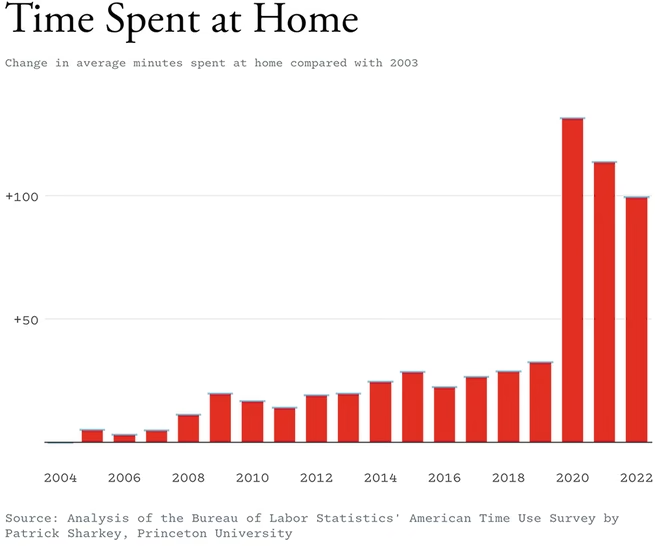

In a bracing essay, Derek Thompson, explores the emergence of this wide-spread isolation, unpacking its drivers, enumerating its considerable (personal and civic) costs, musing on the possible impact of AI, and pondering what might lead to a return to sociability…
… “I have a view that is uncommon among social scientists, which is that moral revolutions are real and they change our culture,” Robert Putnam [author of Bowling Alone] told me. In the early 20th century, a group of liberal Christians, including the pastor Walter Rauschenbusch, urged other Christians to expand their faith from a narrow concern for personal salvation to a public concern for justice. Their movement, which became known as the Social Gospel, was instrumental in passing major political reforms, such as the abolition of child labor. It also encouraged a more communitarian approach to American life, which manifested in an array of entirely secular congregations that met in union halls and community centers and dining rooms. All of this came out of a particular alchemy of writing and thinking and organizing. No one can say precisely how to change a nation’s moral-emotional atmosphere, but what’s certain is that atmospheres do change. Our smallest actions create norms. Our norms create values. Our values drive behavior. And our behaviors cascade.
The anti-social century is the result of one such cascade, of chosen solitude, accelerated by digital-world progress and physical-world regress. But if one cascade brought us into an anti-social century, another can bring about a social century. New norms are possible; they’re being created all the time. Independent bookstores are booming—the American Booksellers Association has reported more than 50 percent growth since 2009—and in cities such as New York City and Washington, D.C., many of them have become miniature theaters, with regular standing-room-only crowds gathered for author readings. More districts and states are banning smartphones in schools, a national experiment that could, optimistically, improve children’s focus and their physical-world relationships. In the past few years, board-game cafés have flowered across the country, and their business is expected to nearly double by 2030. These cafés buck an 80-year trend. Instead of turning a previously social form of entertainment into a private one, they turn a living-room pastime into a destination activity. As sweeping as the social revolution I’ve described might seem, it’s built from the ground up by institutions and decisions that are profoundly within our control: as humble as a café, as small as a new phone locker at school…
On how we spend our time and what that yields: “The Anti-Social Century,” from @dkthomp.bsky.social in @theatlantic.com (gift article).
See also: “You’re Being Alienated From Your Own Attention,” from @chrislhayes.bsky.social (also in @theatlantic.com, also a gift article)
* Kenneth Grahame, The Wind in the Willows
###
As we call a friend, we might recall that it was on this date in 1915 that Alexander Graham Bell placed the first transcontinental phone call, from New York to San Francisco, where the Panama–Pacific International Exposition celebrations were underway and his assistant, his assistant Thomas Augustus Watson stood by. Bell repeated his famous first telephonic words, “Mr. Watson, come here. I want you,” to which Watson this time replied “It will take me five days to get there now!” Bell’s call officially initiated AT&T’s transcontinental service.

And, on ths date 45 years later, in 1959, The first non-stop transcontinental commercial jet trip was made by an American Airlines Boeing 707, from Los Angeles to New York. The sleek silver plane made the flight in airline official time of 4 hours and 3 minutes, half the usual scheduled time for the prop-driven DC- 7Cs then in regular use on that route.

“That’s the place to get to—nowhere”*…

In a triumph of data collection and analysis, a team of researchers based at Oxford University has built the tools necessary to calculate how far any dot on a map is from a city — or anything else.
The research, published in Nature last month, allows us to pin down a question that has long evaded serious answers: Where is the middle of nowhere?
To know, you’d have to catalogue and calculate the navigation challenges presented by the planet’s complex, varied terrain and the dirt tracks, roads, railroads and waterways that crisscross it. You’d then need to string those calculations together, testing every possible path from every point to every other point.
That is pretty much what the folks did at the Malaria Atlas Project, a group at Oxford’s Big Data Institute that studies the intersection of disease, geography and demographics. The huge team — 22 authors are credited — spent years building a globe-spanning map outlining just how long it takes to cross any spot on the planet based on its transportation types, vegetation, slope, elevation and more. Those spots, or pixels, represent about a square kilometer.
Armed with this data, and hours and hours of computer time, The Washington Post processed every pixel and every populated place in the contiguous United States to find the one that best represents the “middle of nowhere.”
Congratulations, Glasgow, Mont.!
Of all towns with more than 1,000 residents, Glasgow, home to 3,363 people in the rolling prairie of northeastern Montana, is farthest — about 4.5 hours in any direction — from any metropolitan area of more than 75,000 people…
Remoteness, ranked– see the runners-up and the contenders in other categories at “Using the best data possible, we set out to find the middle of nowhere.”
* D.H. Lawrence, Women in Love
###
As we idolize isolation, we might recall that it was on this date in 1815 that Napoleon, who had been banished to France’s “middle of nowhere,” escaped from Elba. With 700 men, he sailed back to France.
The 5th Regiment was sent to intercept him and made contact just south of Grenoble on 7 March 1815. Napoleon approached the regiment alone, dismounted his horse and, when he was within gunshot range, shouted to the soldiers, “Here I am. Kill your Emperor, if you wish”. The soldiers quickly responded with, “Vive L’Empereur!” Ney, who had boasted to the restored Bourbon king, Louis XVIII, that he would bring Napoleon to Paris in an iron cage, affectionately kissed his former emperor and forgot his oath of allegiance to the Bourbon monarch. The two then marched together towards Paris with a growing army. The unpopular Louis XVIII fled to Belgium after realizing he had little political support. On 13 March, the powers at the Congress of Vienna declared Napoleon an outlaw. Four days later, Great Britain, Russia, Austria, and Prussia each pledged to put 150,000 men into the field to end his rule… [source]
So began the Hundred Days of Napoleon’s second reign, at the end of which (on the 22nd of June) he abdicated.

Napoleon returned from Elba, by Karl Stenben, 19th century
You must be logged in to post a comment.